Gati Vidhi – June 2026
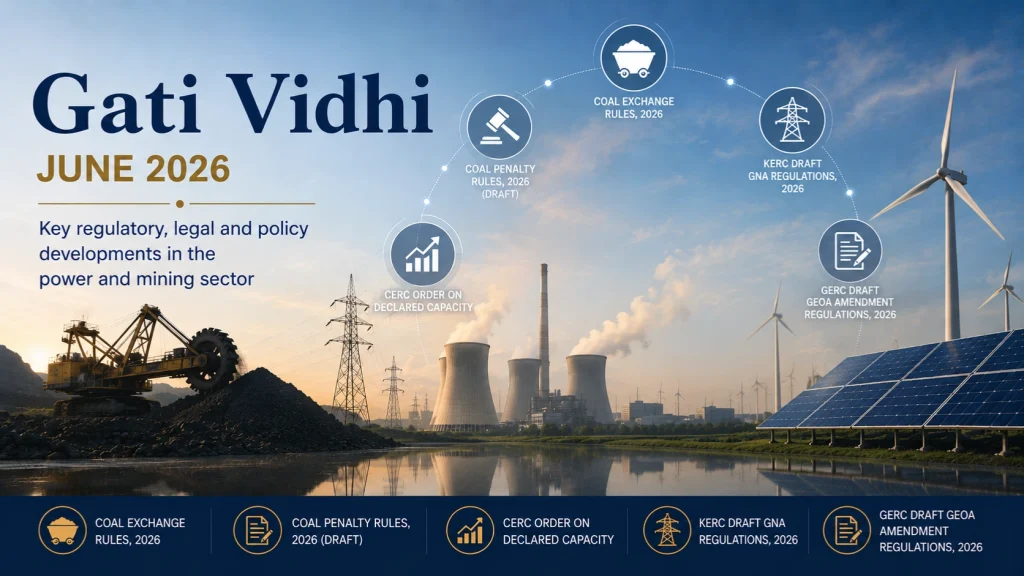
MoC notifies Coal Exchange Rules, 2026
The Ministry of Coal (“MoC”) has, vide notification dated 04.06.2026, notified the Coal Exchange Rules, 2026 (“the Rules”) in exercise of the powers conferred by Section 18B of the Mines and Minerals (Development and Regulation) Act, 1957. The Rules have been notified with the objective to establish and operate coal supply contracts, facilitate their transactions, ensure fair, transparent, neutral, efficient and robust price discovery and dissemination, and secure timely coal supply as per the contract. The Rules provide for payment and settlement of contracts, eligibility criteria to be met for an entity to establish coal exchange, its governance structure etc.
The Rules provide the criteria for registration as a Coal Exchange. The applicant should:
- be a company limited by shares under the Companies Act, 2013;
- be demutualised (ownership and management have to be segregated from the trading rights in the exchange)
- have a net worth of at least Rs. 50 crores (as per an audited special balance sheet dated within 30 days before filing the registration application);
- have directors eligible for appointment to the Board of Directors; and
- meet the ownership and governance requirements.
If the net worth of the Coal Exchange falls below Rs. 50 crores, the Authority may, for recorded reasons, allow time to restore it.
The Rules also lay down important components of coal contracts including bidding, price discovery, scheduling, delivery and provide that the final price of the traded coal be adjusted in accordance with the quality of coal being traded, which shall be assessed by any coal sampling agency recognised by the Coal Controller Organisation.
A copy of the Rules can be accessed here.
MoC invites comments on the draft Coal Mines (Special Provisions) Adjudication of Penalty Rules, 2026
The MoC has, vide notification dated 05.06.2026, has notified the draft Coal Mines (Special Provisions) Adjudication of Penalty Rules, 2026 (“draft Rules”) in exercise of powers conferred by Section 31 (2) (xa) read with Section 24A of the Coal Mines (Special Provisions) Act, 2015 (“the Act”). The comments can be submitted within 2 weeks.
Some of the salient provisions of the draft Rules are as follows:
- Adjudication authority is empowered to initiate inquiry proceedings either suo moto or based on complaints, reports or other information about a contravention of the provisions of the Act.
- Adjudication authority may call for records, documents, explanations, inspection reports and technical reports while recording reasons for initiating inquiry proceedings.
- An officer, not below the rank of Under Secretary and having knowledge of the facts and circumstances, shall be designated as the Inquiry Officer to in the inquiry proceedings.
- Where the adjudication authority is satisfied that there exists a prima facie case for inquiry, a notice shall be issued to the person alleged to have committed the contravention, which shall contain the nature of the contravention alleged, relevant provisions, material relied upon and time for filing a reply (between 15 to 30 days).
- Notices, communication or order may be served by registered post with acknowledgment due, speed post, electronic means, delivery by hand against receipt or any other mode as the adjudication authority may deem fit.
- Hearings may be held physically or through electronic means. Adjudicating authority may proceed ex-parte after recording the reasons if the noticee does not participate despite proper service.
- Factors to be considered while determining the penalty include the nature, gravity and duration of the contravention, repetitive nature of the default, amount of gain or unfair advantage, loss or damage caused to public interest or Government revenue etc.
- Adjudicating authority shall pass a reasoned order containing brief facts, issues for determination, findings, penalty imposed and time period to pay the same.
- Penalties are generally payable within 30 days of receipt of the order with provision for extension in appropriate cases.
A copy of the draft Rules can be accessed here.
CERC holds that declared capacity is directly linked to actual capability and mere declaration without the ability to schedule power does not confer entitlement to recover capacity charges for the full contracted capacity
The Central Electricity Regulatory Commission (“CERC”) has, vide order dated 17.06.2026 passed in TRN Energy Private Limited v. PTC India Limited & Ors., Petition No. 140/MP/2019, held that declared capacity is directly linked to the generating station’s actual capability and mere declaration without the ability to schedule power does not confer entitlement to recover capacity charges for the full contracted capacity.
In this case, the Petitioner was supplying 390 MW Round-the-Clock power under a back-to-back contractual structure – (a) Long-Term Access (LTA) for transmission between the Petitioner and Power Grid Corporation of India Ltd. (“PGCIL”), (b) PPA between the Petitioner and PTC India Ltd. (“PTC”) and (c) Procurers’ PPA between PTC India Ltd. and the Discoms. The dispute arose because PGCIL regulated power supply due to the Petitioner’s non-payment of transmission charges and inadequate Letter of Credit (“LC”) security. The Petitioner claimed additional capacity charges, refund of penalty and late payment surcharge on the said amounts.
The CERC has held as follows:
- Declaration of capacity must be meaningful and effective, i.e., capable of being scheduled in accordance with the Grid Code and contractual provisions.
- Mere declaration of availability, without the ability to schedule power, does not confer entitlement to recover capacity charges for the full contracted capacity.
- Declared capacity is directly linked to the actual capability of the generating station to deliver ex-bus electricity. It cannot exceed what the plant can genuinely deliver.
- There is a sequential contractual framework – (i) first, the Petitioner must discharge its obligation to pay transmission charges and furnish the LC, (b) second, PTC becomes obligated to reimburse the charges, and (c) third, liability of the procurers arises.
- If actual capability is compromised due to constraints, the entitlement to capacity charges must reflect such limitation.
The order dated 17.06.2026 can be accessed here.
KERC invites comments, suggestions and objections to the draft KERC (Connectivity and General Network Access to the Intra-State Transmission and State Distribution System) Regulations, 2026
The Karnataka Electricity Regulatory Commission (“KERC”) has issued the draft KERC (Connectivity and General Network Access to the Intra-State Transmission and State Distribution System) Regulations, 2026 (“draft Regulations”), which were published on 11.06.2026. The draft Regulations propose a comprehensive framework governing connectivity and General Network Access (“GNA”) to the intra-State transmission and distribution systems in Karnataka. The new framework is proposed to become effective from 01.10.2026.
The draft Regulations seeks to align the regulatory framework in Karnataka with the evolving national GNA regime, facilitate greater renewable energy integration, optimise utilisation of network infrastructure, and provide a streamlined framework for connectivity and network access across the State. It seeks to repeal the KERC (Terms and Conditions for Open Access) Regulations, 2025, replacing the Long-Term, Medium-Term and Short-Term Open Access framework with a GNA regime.
The draft prescribes eligibility criteria for connectivity based on capacity and nature of the applicant. Generating stations, renewable energy generating stations, captive generating plants, standalone energy storage systems, and renewable power park developers with capacities of 5 MW and above may seek connectivity at the transmission level, while projects below 5 MW may seek connectivity at the distribution level. Consumers having contract demand or sanctioned load of 100 kW or more shall be eligible for GNA up to the said demand / load, while existing eligible users may be deemed to have been granted GNA.
A detailed procedure for grant of connectivity has also been provided, including application requirements, interconnection studies, in-principle and final connectivity approvals, associated transmission system augmentation, connectivity agreements, and bank guarantee requirements.
The comments, suggestions, and objections can be submitted within 30 days from the date of publication.
The draft Regulations can be accessed here. The public notice dated 15.06.2026 can be accessed here.
GERC invites comments / objections on the draft GERC (Terms and Conditions for Green Energy Open Access) (Sixth Amendment) Regulations, 2026
Gujarat Electricity Regulatory Commission (“GERC”) has issued the draft GERC (Terms and Conditions for Green Energy Open Access) (Sixth Amendment) Regulations, 2026 (“draft Regulations”) amending the GERC (Terms and Conditions for Green Energy Open Access) Regulations, 2024 (“Principal Regulations”).
The proposed amendments are as follows:
- Amendment in Regulation 1.4 of the Principal Regulations – Banking charge at Re. 1/unit shall be effective from 01.09.2026 up to 31.03.2027, after which the same shall be determined as per the amended Regulation 17.6.
- Amendment in Regulation 17.6 of the Principal Regulations – Banking charges are to be determined based on the methodology / computation provided in Annexure – 1 and data provided by the Distribution Licensees (“DL”) till 31.03.2027. Subsequent thereto, banking charge for each financial year starting from 01.04.2027 shall be determined in accordance with the provisions of the Regulations, based on the analysis of the data / information, for the immediately preceding calendar year.
- All DLs shall mandatorily maintain and provide complete, accurate and sufficient data / information for computation.
- The Commission may consider determining a common banking charges applicable for all State Government owned DLs and / or small DLs, who are procuring power solely from State Government owned DLs.
- The Commission may consider determining a common banking charge applicable to multiple private Licensees having common power procurement.
- In the case of existing DLs supplying electricity in SEZs, SIRs, Ports and any new DLs, the Commission may consider applying banking charges as applicable to the State Government owned DLs.
- The Commission may consider limiting the variation in banking charges computed, within a floor rate of Rs. 0.50/unit and ceiling rate of Rs. 1.50/unit to provide certainty to the Green Energy Open Access consumers and DLs.
- If the DL has not provided complete, accurate and sufficient data / information, the banking charges shall be considered as ‘Nil’ for such DL, till such data / information is provided. In such case, the deemed revenue is to be considered equivalent to 1 paisa/unit per annum of the total energy handled during the year and adjusted while determining the Aggregate Revenue Requirement.
The suggestions / comments / objections can be submitted on or before 20.07.2026.
The draft Regulations can be accessed here. The public notice can be accessed here.

 You wish to know more about Neeti Niyaman (the “Firm”) for your own information and use.