Gati Vidhi – June 2026
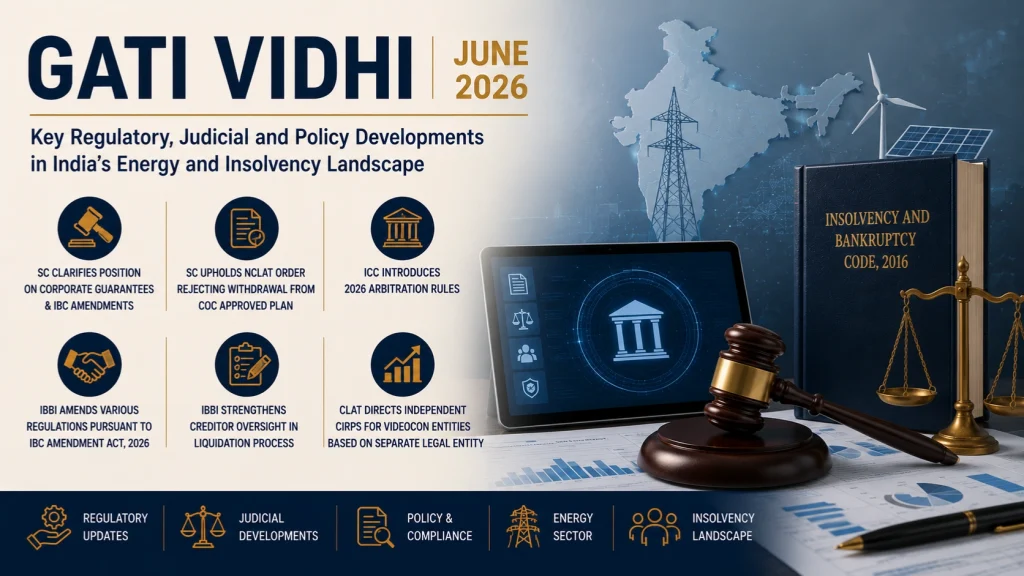
SC clarifies the legal position on recognition of claims arising from corporate guarantees under the IBC
In State Bank of India & Ors. v. Doha Bank Q.P.S.C. & Anr., Civil Appeal No. 8527/2022, vide judgment dated 28.04.2026, the Supreme Court (“SC”) has clarified the legal position on recognition of claims arising from corporate guarantees under the Insolvency and Bankruptcy Code, 2016 (“IBC”).
In the Corporate Insolvency Resolution Process (CIRP) of Reliance Infratel Limited, the SBI-led consortium claimed financial creditor status on the basis of corporate guarantees executed by the corporate debtor in favour of the lenders. Doha Bank challenged the recognition of these claims on several grounds, including alleged non-disclosure of the guarantees in financial statements, improper verification by the Resolution Professional (“RP”), suspicious timing of execution, and alleged insufficiency of stamping.
The issue which arose before the Supreme Court was whether such grounds can legitimately defeat the recognition of a financial debt and status of a financial creditor under the IBC. While setting aside the decision of the National Company Law Tribunal and the National Company Law Appellate Tribunal, the Supreme Court has held as follows:
- Liabilities arising from corporate guarantees given for money borrowed against payment of interest fall squarely within the definition of “financial debt” under Section 5(8) of the IBC. Once such financial debt is owed to a creditor, the creditor is entitled to be treated as a financial creditor under Section 5(7) of the Code.
- The liability of a guarantor is co-extensive with that of the principal borrower and is enforceable in law. Accordingly, the SBI-led consortium could not be excluded from the Committee of Creditors merely because the claim was founded on corporate guarantees.
- The non-disclosure of the corporate guarantees in the financial statements of the corporate debtor would at best amount to a default by the corporate debtor, but it would not deprive the lenders of their right to lodge claims based on validly executed guarantees.
- The guarantees had been verified by the RP by way of inspection at the office of the security trustee and thus, it could not be said that there was improper verification.
Insufficiently stamped document does not become void or unenforceable merely on that ground and such a defect is curable. Stamp laws are fiscal measures intended to secure revenue and cannot be used as a weapon by one litigant to defeat another’s substantive rights.
SC upholds NCLAT Order Rejecting Withdrawal from CoC Approved Resolution Plan
The SC vide judgement dated 27.05.2026 in Sanjay Dave v. Andhra Bank Ltd., reiterated that a Successful Resolution Applicant (“SRA”) cannot evade its obligations under a resolution plan approved by the Committee of Creditors (“CoC”) by subsequently challenging the terms of the Letter of Intent (“LoI”) or attempting to renegotiate the commercial terms of the plan.
The case arose from the Corporate Insolvency Resolution Process (“CIRP”) of Oracle Home Textiles Limited. The appellant, a promoter and director of the corporate debtor, had submitted a resolution plan which was approved by the CoC with an overwhelming majority of 99.90%. Following such approval, the Resolution Professional issued a LoI requiring the appellant to accept the same and furnish a performance guarantee. However, the appellant refused to accept the LoI, contending that it was “conditional” as it made the approved resolution plan subject to the outcome of certain pending applications before the NCLT and imposed liability for potential claims by employees and workers.
Rejecting these contentions, the Supreme Court held that the impugned stipulations did not render the LoI conditional. The Court observed that the appellant had participated in several CoC meetings and was fully aware of the pending proceedings involving prospective resolution applicants. Further, the minutes of the CoC meetings clearly demonstrated that the appellant had expressly agreed to bear the risks associated with employee-related claims and other contingent liabilities. Having acquiesced to such terms during the resolution process, the appellant could not subsequently seek to avoid them after securing approval of his resolution plan.
The Court emphasised that once a resolution plan is approved by the CoC, the negotiations between the CoC and the successful resolution applicant come to an end. Relying on its earlier decision in Ebix Singapore Pvt. Ltd. v. Committee of Creditors of Educomp Solutions Ltd., the Court reiterated that a CoC-approved resolution plan is binding and irrevocable as between the CoC and the SRA, and the Insolvency and Bankruptcy Code, 2016 does not permit modification, withdrawal or renegotiation of such plans at the instance of the successful resolution applicant.
The Supreme Court also upheld the forfeiture of the appellant’s Earnest Money Deposit (“EMD”). The Request for Resolution Plan expressly provided for forfeiture in the event of failure to furnish the performance guarantee or non-compliance with the resolution process. Since the appellant failed to accept the LoI and perform his obligations despite repeated opportunities, the forfeiture was found to be lawful and justified. On the issue of liquidation, the Court upheld the CoC’s decision to liquidate the corporate debtor after the CIRP period expired without implementation of any valid resolution plan. Reaffirming the primacy of the CoC’s commercial wisdom, the Court held that Section 33 of the IBC expressly permits the CoC to resolve to liquidate the corporate debtor at any stage before approval of a resolution plan by the adjudicating authority. The Court found no infirmity in the decision of the CoC, which was approved by an overwhelming majority and was necessitated by the appellant’s own failure to honour the approved plan.
ICC introduces 2026 Arbitration Rules with greater emphasis on efficiency, digital procedure and transparency
The International Chamber of Commerce (“ICC”) has introduced the ICC Arbitration Rules, 2026, which apply to arbitrations commenced on or after 1 June 2026, unless the parties have agreed to apply an earlier version of the Rules. The 2026 Rules clarify at the outset that where parties agree to ICC arbitration, the arbitration will be conducted under the ICC Rules and administered exclusively by the ICC International Court of Arbitration.
A key procedural change is the stronger shift towards digital communications. Under the 2026 Rules, written communications with the Secretariat are to be made by email or other electronic means creating a record of transmission, while hard copies of the Request, Answer and Request for Joinder are required only in limited cases, such as where transmission by registered post/courier is requested or electronic transmission is not practicable.
The 2026 Rules also streamline early case management. The earlier framework around Terms of Reference under the 2021 Rules has been replaced with a more direct requirement for an initial Case Management Conference (CMC). The arbitral tribunal must hold the initial CMC within 30 days of receiving the file from the Secretariat, and must thereafter establish the procedural timetable for efficient conduct of the arbitration. New claims after the initial CMC require authorisation from the arbitral tribunal.
The Rules further strengthen disclosure obligations. Arbitrators are required to remain independent and impartial, and any doubts regarding disclosure are to be resolved in favour of disclosure. Parties must also provide information assisting arbitrators in identifying potential conflicts, including lists of relevant persons and entities. The Rules continue the obligation to disclose third-party funding arrangements where the funder has an economic interest in the outcome of the arbitration.
On multi-party and multi-contract disputes, the 2026 Rules retain and refine the framework for joinder, claims between multiple parties, multiple contracts and consolidation. Notably, a request for joinder after constitution of the tribunal may be accepted only where the additional party accepts the tribunal’s constitution and the tribunal decides to accept the joinder after considering factors such as prima facie jurisdiction, timing, conflicts of interest and impact on the arbitral procedure.
The Rules also modernise award-making. The arbitral tribunal may sign awards electronically, sign awards in counterparts, and request notification of the award in paper or electronic format, subject to applicable law. The ICC Court, while scrutinising draft awards, is also required to consider, to the extent practicable, the validity and enforceability of the award and mandatory law requirements at the place of arbitration.
Another important update is the increased scope of the Expedited Procedure Provisions. For arbitration agreements concluded on or after 1 June 2026, the expedited procedure threshold has been increased to USD 4 million, unless the parties opt out or the Court finds the expedited procedure inappropriate in the circumstances. This will bring more mid-value disputes within a faster and more cost-efficient ICC process.
The 2026 Rules also expressly recognise tribunal secretaries, requiring them to satisfy independence, impartiality and confidentiality standards similar to arbitrators. Further, the Rules provide that parties may request reasons for specified ICC Court decisions, subject to exceptional circumstances.
Copy of the ICC Arbitration Rules can be accessed here.
IBBI amends various Regulations pursuant to IBC Amendment Act, 2026
The Insolvency and Bankruptcy Board of India (IBBI), by press release dated 04.06.2026, has notified amendments to various regulations to give effect to the Insolvency and Bankruptcy Code (Amendment) Act, 2026. The amendments primarily seek to operationalise the recent changes introduced in the Code relating to Information Utilities, pre-packaged insolvency, voluntary liquidation, personal guarantors, bankruptcy process, grievance handling, and disciplinary framework for service providers.
A key amendment concerns the IBBI (Information Utilities) Regulations, 2017. Pursuant to the Amendment Act, where a Record of Default (RoD) with an Information Utility is submitted by a financial institution, the same would be sufficient for the Adjudicating Authority to establish existence of default. The terminology in the regulations has therefore been aligned with the Code by replacing narrower references to scheduled-bank financial creditors with the wider expression “financial institution” under Section 3(14) of the IBC. The amendments also provide that where a debtor fails to respond within the prescribed timeline despite reminders, such non-response will result in deemed authentication of default. Separately, a new informational output called “Information of Dispute” has been introduced for cases where the debtor disputes the information of default.
The amendments also revise the disclosure framework under the Pre-Packaged Insolvency Resolution Process Regulations,2021, in line with the amendment to Section 54C(3) of the Code, by updating the list of information and documents to be furnished by a corporate applicant at the stage of filing an application for initiation of PPIRP. In the Voluntary Liquidation Process Regulations, provisions have been added for submission and updation of claims, recording reasons for rejection of claims, communication of such rejection to stakeholders within seven days, and termination of voluntary liquidation, thereby giving effect to the amended framework under Section 59 of the Code.
For personal guarantors to corporate debtors, the amendments require applications under Sections 94 and 95 of the IBC to be accompanied by a comprehensive statement of assets across specified categories, including digital assets, beneficial interests, and assets held through nominees, trusts or similar structures. The resolution professional or bankruptcy trustee, as applicable, must also coordinate with the resolution professional of the corporate debtor in respect of asset transfers under Section 28A of the Code, with appropriate approvals and disclosures. In bankruptcy proceedings, the trustee is further required to report action taken in respect of transactions defrauding creditors under the newly introduced Section 164A.
The amendments also align the definition of “service provider” in the grievance and complaint handling framework and inspection/investigation regulations with the amended Code, thereby extending regulatory coverage to all service providers regulated by IBBI. Further, the constitution of the Disciplinary Committee has been aligned with the amended Code, allowing it to consist of one or more persons.
Copy of the press release dated 04.06.2026 can be accessed here.
IBBI strengthens creditor oversight in liquidation process
The IBBI has notified the IBBI (Liquidation Process) (Fourth Amendment) Regulations, 2026, pursuant to the Insolvency and Bankruptcy Code (Amendment) Act, 2026. The amendments seek to make liquidation under the IBC more creditor-driven, time-bound and value-maximising by placing the Committee of Creditors (CoC) at the centre of the liquidation process.
A major change is that the CoC constituted during CIRP will continue into liquidation. Key decisions such as approval of liquidation process cost, sale-related matters, treatment of not-readily realisable assets, and recommendation/replacement of the liquidator will now require CoC involvement through the prescribed majority. This ensures continuity between the resolution and liquidation stages and gives creditors a stronger supervisory role over asset realisation.
The amendments also streamline claims verification. Claims already verified during CIRP will be carried forward into liquidation as on the insolvency commencement date and will not be re-verified. Fresh claims will be invited only from stakeholders who did not submit claims during CIRP.
The amended framework also compresses timelines, simplifies reporting, and strengthens sale safeguards. The liquidator is now required to file only progress reports and a final report before the Adjudicating Authority, with other documents folded into the progress report and placed before the CoC. Further, sales to related parties and professionals associated with the process, even through auction, will require permission of the Adjudicating Authority. Conditions for private sale have also been tightened, and reduction of reserve price has been limited.
The amendments also introduce safeguards for early dissolution, asset transfers involving guarantors, and compromise or arrangement. The CoC may opt for early dissolution by the prescribed majority, and a liquidator of a corporate guarantor must coordinate with the resolution professional of the principal corporate debtor in relation to asset transfers under Section 28A of the Code. Any scheme of compromise or arrangement must be approved by creditors with the requisite majority and must offer creditors more than liquidation value as on the insolvency commencement date.
Copy of IBBI (Liquidation Process) (Fourth Amendment) Regulations, 2026 can be accessed here.
IBBI amends CIRP Regulations to improve disclosures and streamline insolvency process
The IBBI has notified the IBBI (Insolvency Resolution Process for Corporate Persons) (Third Amendment) Regulations, 2026, pursuant to the Insolvency and Bankruptcy Code (Amendment) Act, 2026. The amendments seek to make the Corporate Insolvency Resolution Process (CIRP) more information-driven, transparent and time-bound, while reducing avoidable disputes during claim verification and resolution plan consideration.
A key change is the requirement of fuller disclosure at the stage of initiation. Operational creditors and corporate applicants are now required to submit more complete information with their applications. For operational creditors, this includes GST records, e-way bills where applicable, details of part-payments, assignments, guarantees and pending proceedings. For corporate applicants, key financial and asset-related particulars from their books of account are required. This is intended to give the resolution professional and the CoC a clearer picture of the corporate debtor at the beginning of the process.
The amendments also strengthen the powers of the resolution professional by expressly enabling the RP to call for information from creditors, financial institutions and statutory authorities. Creditors are also required to share records in their possession relating to the assets and liabilities of the corporate debtor at the first CoC meeting. Further, the RP must communicate admission or rejection of claims, in whole or in part, along with reasons, to the concerned creditor within seven days, which should reduce claim-related disputes and litigation.
The amendment also operationalises the new framework under Section 28A of the Code concerning treatment of guarantors’ assets. A structured mechanism has been introduced for placing proposals before the CoC regarding transfer of guarantor assets, along with coordination between professionals handling the corporate debtor and a corporate guarantor undergoing insolvency. The CoC is required to factor in the value of such assets while considering resolution plans.
Further, the amendments introduce greater discipline in withdrawal of CIRP under Section 12A by requiring the withdrawal application to be filed within a defined window and backed by a bank guarantee or demand draft towards process costs. A dedicated framework has also been introduced for direct dissolution of the corporate debtor during CIRP, where approved by the CoC within prescribed timelines.
Copy of the IBBI (Insolvency Resolution Process for Corporate Persons) (Third Amendment) Regulations, 2026 can be accessed here.
CLAT directs Independent CIRPs for Videocon Industries and Videocon Oil Ventures based on Separate Legal Entity
The National Company Law Appellate Tribunal (“NCLAT”) vide Order dated 14.05.2026 in Appeals Nos. No. 299/2020, 467/20, 639/2020, 640/2020, State Bank of India v. Venugopal Dhoot set aside NCLT Mumbai Order dated 12.02.2020 (“Impugned Order”) in MA No.2385 of 2019. NCLT vide the Impugned Order which had directed the Resolution Professional to treat the foreign oil and gas assets of certain overseas Videocon group entities as assets of Videocon Industries Limited (“VIL”) for the purposes of its Corporate Insolvency Resolution Process (“CIRP”).
Dispute arose from applications filed by Mr. Venugopal Dhoot seeking inclusion of the foreign oil and gas assets held through entities such as Videocon Oil Venture Limited Videocon Hydrocarbon Holdings Limited (“VOVL”), Videocon Energy Brasil Limited and Videocon Indonesia Nunukan Inc. in the Information Memorandum of Videocon Industries Limited. Pursuant to such applications, the NCLT had, by an interim order dated 22.08.2019, directed maintenance of status quo with respect to the foreign assets and subsequently, by the Impugned Order directed the Resolution Professional to consider all assets, liabilities, claims, rights and benefits of the aforesaid entities as assets and properties of Videocon Industries Limited for purposes of the CIRP.
Before the Appellate Tribunal, the principal issue was whether foreign oil and gas assets, held through subsidiaries such as VOVL could be considered assets of VIL and included in its CIRP and Information Memorandum. NCLAT observed that the foreign oil and gas assets owned by VOVL’s subsidiaries could not be included in VIL’s CIRP because those subsidiaries were separate legal entities and their assets did not belong to VIL. NCLAT emphasized on the fact that the assets of subsidiaries, whether Indian or foreign, cannot be included in the CIRP of the parent company unless there is clear ownership or legal basis for such inclusion. The Appellate Tribunal further observed that one single entity would not have the expertise to revive varied businesses and therefore two separate CIRPs are required for VIL and VOVL and rejected arguments based on VIL’s status as a corporate guarantor or the idea of a “single economic entity,” emphasizing that a guarantor’s liability does not transfer ownership of the borrower’s assets. Accordingly, NCLAT set aside the NCLT’s order and upheld the principle of separate legal personality by directing CIRPs of VIL and VOVL to continue independently.



 You wish to know more about Neeti Niyaman (the “Firm”) for your own information and use.