Gati Vidhi – May 2026
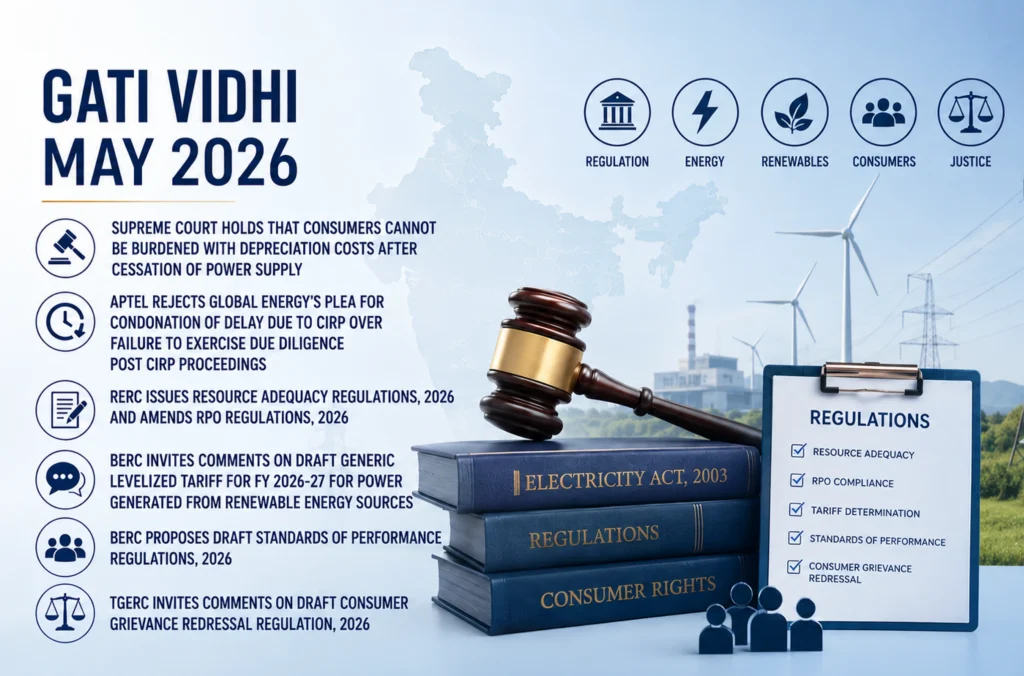
Supreme Court holds that Consumers cannot be burdened with Depreciation Costs after cessation of Power Supply
The Supreme Court, vide its judgment dated 07.05.2026, passed in Civil Appeal No. 6388 of 2025 Delhi Electricity Regulatory Commission v. Tata Power Delhi Distribution Limited, has held that electricity consumers cannot be burdened with depreciation costs for a generating asset for the period during which no electricity was supplied to them. Setting aside the order passed by the Appellate Tribunal for Electricity, the Court restored the order of the Delhi Electricity Regulatory Commission (“DERC”), which had restricted recovery of depreciation only to the six-year period during which the 108 MW gas-based power plant actually supplied electricity to consumers in Delhi.
The Supreme Court observed that although the technical useful life of the plant was 15 years, the generating company did not acquire an absolute right to recover depreciation for the entire technical life of the asset. The Court noted that under the Power Purchase Agreement, electricity supply was envisaged only for six years, after which the generator was free to sell power elsewhere as a merchant generator. Accordingly, the Court held that consumers cannot be made to bear tariff charges, including depreciation costs, beyond the period during which they received supply. The Court further clarified that Regulation 6.32 of the DERC Tariff Regulations, 2011 does not confer an unconditional right upon a generator to recover depreciation from consumers even after cessation of supply.
APTEL rejects Global Energy’s plea for Condonation of Delay due to CIRP over failure to exercise due diligence post CIRP proceedings
The Appellate Tribunal for Electricity (“Tribunal”), vide judgment dated 05.05.2026 in Appeal No. 88 of 2017 and IA Nos. 1759 and 1760 of 2025 (Global Energy Private Limited v. Maharashtra Electricity Regulatory Commission & Anr.), dismissed the application seeking condonation of delay in filing restoration proceedings.
Global Energy Private Limited (“Global Energy”) preferred the Appeal against Order dated 16.11.2016 passed by Maharashtra Electricity Regulatory Commission (“MERC”) in Case No. 186 of 2014. During the pendency of the Appeal, Global Energy underwent Corporate Insolvency Resolution Process and accordingly sought time from the Tribunal to present their case. However, owing to repeated non-appearance, the Tribunal dismissed the appeal for non-prosecution on 12.02.2024. Subsequently, Global Energy filed applications seeking restoration of their Appeal along with condonation of delay of 421 days. The Applicant contended that the continued delay in its CIRP proceedings constituted “sufficient cause” for condonation of delay. The Applicant further argued that the pending claims in the Appeal were valuable assets necessary for revival of the corporate debtor.
While adjudicating the matter, the Tribunal emphasized that the central issue was not the conduct of the CIRP or duties of the RP under the IBC, but whether the Applicant demonstrated “sufficient cause” under Section 5 of the Limitation Act for condoning the inordinate delay. The Tribunal held that despite considering the delay for the period during which CIRP proceedings were underway, the delay after approval of the resolution plan remained substantial and inadequately explained. The Tribunal held that the Applicant did not exercise due diligence post CIRP proceedings and accordingly dismissed the IA as well the Appeal for failing to establish sufficient cause for condonation of delay.
Rajasthan Electricity Regulatory Commission issues Rajasthan Electricity Regulatory Commission (Framework for Resource Adequacy) Regulations, 2026
Rajasthan Electricity Regulatory Commission (“RERC”) in exercise of its powers conferred under Section 181 of the Electricity Act, 2003 issues RERC (“Framework for Resource Adequacy”) Regulations, 2026 (“Resource Adequacy Regulations”). The objective of these Regulations is to enable the implementation of Framework for Resource Adequacy by outlining a mechanism for planning of generation and transmission resources for reliably meeting the projected demand in compliance with specified reliability standards for serving the load with an optimum generation mix. The Framework for Resource Adequacy shall cover a mechanism for demand assessment and forecasting, generation resource planning, procurement planning, and monitoring and compliance.
The Resource Adequacy Regulations shall apply to the generating companies, distribution licensees, State Load Despatch Centre, State Transmission Utility, and other grid connected entities and power procuring entity on behalf of Discoms and stakeholders within the State of Rajasthan. As per Regulation 5 of the Resource Adequacy Regulations resource adequacy framework shall comprise planning of generating resources for reliably meeting the projected demand in compliance with specified reliability standards for serving the load with an optimum generation mix. Resource adequacy framework shall cover demand assessment and forecasting, generation resource planning, procurement planning, monitoring and compliance.
As per Regulation 6 of the Resource Adequacy Regulations the distribution licensee shall develop and prepare demand assessment and forecasting considering the guidelines for Long-Term and Medium-term power demand forecast issued by Central Electricity Authority (“CEA”) from time to time. As per Regulation 8 the distribution licensee shall plan and assess the required generation resources considering the existing resources, upcoming resources (not yet commissioned), capacity credit and incremental capacity requirement to meet forecasted demand including planning reserve margin (“PRM”).
As per Regulation 12, procurement planning shall consist of optimal power procurement resource mix, modalities of procurement type and sharing of capacity. As per Regulation 19, distribution licensee shall maintain and share all data related to demand assessment and forecasting with SLDC such as consumer data, historical demand data, weather data, demographic and economic variables, distribution losses and intra/inter-state transmission losses, actual energy requirement, availability including curtailment, peak electricity demand, historical hourly load pattern etc.
RERC (Framework for Resource Adequacy) Regulations, 2026 can be accessed here.
RERC notifies RPO (First Amendment) Regulations, 2026
RERC vide Notification No. RERC/Secy./Reg./163 has notified the RERC (Renewable Purchase Obligation) (First Amendment) Regulations, 2026, bringing significant changes to the renewable energy compliance framework in the State with effect from 1 April 2026.
The amendment to Regulation 2 of the RERC (Renewable Purchase Obligations) Regulations, 2023 (“Principal Regulations”), through insertion of sub-clause (v-a), introduces the concept of “Distributed Renewable Energy” (“DRE”). The Regulations now recognise renewable energy projects of up to 10 MW, including installations under net metering, gross metering/net billing, virtual net metering, group net metering, behind-the-meter systems, and other renewable energy configurations notified by the Central Government.
The amendment to Regulation 3 clarifies that the applicability of RPO obligations for Designated Consumers shall be governed by notifications issued by the Central Government under the Energy Conservation Act, 2001. It further provides that, in case of any inconsistency between the RERC RPO Regulations and Central Government notifications for an obligated entity which is also a Designated Consumer, the Central Government framework shall prevail.
Regulation 4 has been amended to revise RPO targets for FY 2024-25 and FY 2025-26, prescribing revised total RPO targets of 29.91% and 33.01% respectively. RERC has further clarified that compliance with applicable Renewable Consumption Obligation (“RCO”) targets under the Central framework shall be treated as sufficient compliance for these years, and separate RPO enforcement or penalty proceedings shall not be initiated to the extent shortfalls are addressed under the Energy Conservation Act, 2001 mechanism. The amendment further introduces revised renewable energy trajectories from FY 2026-27 onwards, with total renewable energy obligations increasing from 35.95% in FY 2026-27 to 38.81% in FY 2027-28, 41.36% in FY 2028-29 and 43.33% in FY 2029-30. Separate targets have been specified for Wind Renewable Energy, Hydro Renewable Energy, Distributed Renewable Energy and Other Renewable Energy categories. The amendment also clarifies that obligations under Wind, Hydro and Other Renewable Energy categories are fungible among themselves, whereas Distributed Renewable Energy obligations are non-fungible for shortfalls. Further, electricity consumption from nuclear power sources has been excluded from RPO computation.
Regulation 5 of the Principal Regulations has been amended to clarify the compliance framework applicable to Designated Consumers and other obligated entities i.e. for Designated Consumers, compliance from FY 2024-25 onwards shall be governed by the RCO framework under the Energy Conservation Act, 2001, while entities that are not Designated Consumers shall continue to be governed by the RERC RPO framework and the RERC (Renewable Energy Certificate (“REC”) and RPO Compliance Framework) Regulations, 2010. The amendment also continues the applicability of Energy Storage Obligations to distribution licensees and deemed licensees.
RERC(Renewable Purchase Obligation) (First Amendment) Regulations, 2026 can be accessedhere.
BERC invites comments from the stakeholders on the Draft Generic Levellised Tariff for FY 2026-27 for power generated from renewable energy sources.
The Bihar Electricity Regulatory Commission (“BERC”) has notified Draft BERC (Terms and Conditions for Tariff Determination from Renewable Energy Sources) Regulations, 2025 (“RE Tariff Regulations”) on 27.11.2025. Three years control period was fixed under Regulation 5 of the RE Tariff Regulations. Regulation 8 of the RE Tariff Regulations, 2025 empowers BERC to determine generic (levelized) tariff for the biomass power projects with Rankine Cycle technology, non-fossil fuel-based co-generation plants, biomass gasifier power projects and MSW/RDF project based on Rankine cycle (“generating plants”) from the renewable energy sources. BERC in due discharge of the mandate under Regulation 8 of the RE Tariff Regulations, proposes to determine the generic (levelized) tariff of the RE projects for the control period i.e. FY-2026-27.
Norms and mechanism for tariff determination from renewable energy sources were fixed in the RE Tariff Regulations for the entire control period FY 2025-26 to 2027-28. However, provision has also been made that the benchmark capital cost for the projects may be reviewed annually by BERC. The Generic (levelized) tariff for the second year of control period i.e. FY-2026-27 from renewable energy sources shall be applicable for RE projects commissioned up to 31.03.2027. This tariff shall also be applicable for the RE projects commissioned after 31.03.2027 until the subsequent generic levelized tariff order for RE projects is approved by BERC.
BERC has invited comments on the draft generic levelized tariff from the stakeholders and the last date for submission is22.05.2026. The Draft BERC (Terms and Conditions for Tariff Determination from Renewable Energy Sources) Regulations, 2025 can be accessed here.
BERC proposes Draft BERC (Standards of Performance of Distribution Licensees) Regulations, 2026
BERC in exercise of the powers conferred under Sections 57, 58, 59 and 86(1)(i), read with Sections 181(1) and 181(2)(za) and (zb) of the Electricity Act, 2003 (“Act”), has released a Consultative Paper along with the Draft BERC (Standards of Performance of Distribution Licensees) Regulations, 2026, proposing a comprehensive overhaul of the existing 2006 Standards of Performance framework. The proposed regulations seek to modernise the service obligations of distribution licensees in Bihar in light of technological advancements, changing consumer expectations, and recent statutory developments under the Act.
The proposed regulations are aligned with the Electricity (Rights of Consumers) Rules, 2020, particularly with respect to the provision for automatic compensation to consumers in cases where distribution licensees fail to comply with prescribed standards capable of remote monitoring. The draft regulations also seek to harmonise the Standards of Performance framework with the proposed Bihar Electricity Supply Code, 2026, while introducing revised benchmarks for ensuring reliability, continuity, and quality of electricity supply across the State.
The draft framework prescribes detailed timelines and standards for services including release of new connections, restoration of supply, metering services, billing, complaint redressal, and consumer support systems. It further introduces reliability indices such as Customer Average Interruption Duration Index (CAIDI) and Customer Average Interruption Frequency Index (CAIFI) for performance monitoring and seeks to strengthen accountability of distribution licensees through measurable operational standards and compensation mechanisms for non-compliance.
The Commission has invited comments, objections, and suggestions from stakeholders and consumers by 27 May 2026 and has scheduled a public hearing on 9 June 2026 at its office in Patna.
Draft BERC (Standards of Performance of Distribution Licensees) Regulations, 2026 can be accessed here.
TGERC has invited comments, suggestions, and objections to the Draft TGERC (Establishment of Mechanism for Redressal of Grievances of the Consumers) Regulation, 2026
The Telangana Electricity Regulatory Commission (TGERC) vide public notice dated 05.05.2026, notified the Draft TGERC (Establishment of Mechanism for Redressal of Grievances of the Consumers) Regulation, 2026 with the objective to streamline and strengthen the functioning of the Consumer Grievance Redressal Forums (“CGRFs”) and the Vidyut Ombudsman in the State of Telangana and to meet the expectations of electricity consumers. The TGERC has invited comments, suggestions, and objections to the same on or before 26.05.2026.
The proposed Regulation seeks to repeal the existing Regulation No. 3 of 2015. The proposed Regulation seeks to make consumer grievance redressal in Telangana more accessible, time-bound, accountable, and enforcement-oriented.
The salient features of the Draft Regulation are as follows:
- Every distribution licensee is required to establish two or more CGRFs within its area of supply within 6 months from the date of coming into force of the Regulation or the date of grant of license or from date of commencement of functioning as a licensee.
- Complaints can be filed in person, by post, e-mail, or other electronic modes. Licensees are also required to create a web portal and/or mobile application for online filing and tracking of grievances.
- Complaints related to non-supply, reconnection or disconnection of supply are required to be decided within 15 days, while other complaints are to be decided within 45 days.
- CGRFs are empowered to grant reliefs such as removal of the cause of grievance, refund of undue charges with 9% simple interest, compensation for loss or injury caused due to negligence of the licensee, costs in exceptional cases, and directions for departmental proceedings against erring employees.
- In case of non-compliance of its order, CGRF may award compensation up to Rs. 25,000/- for each non-compliance, with an additional compensation up to Rs. 1,000/- per day for continuing failure.
- A complainant aggrieved by the CGRF’s order, or by non-redressal within the prescribed time, may approach the Vidyut Ombudsman within 45 days, extendable by a further 15 days on sufficient cause.
- The Ombudsman is required to dispose of representations within 60 days and may also issue interim orders where disconnection or other coercive action is threatened in violation of applicable law or regulatory orders.
- In case of non-compliance of its order, Vidyut Ombudsman may award compensation up to Rs. 50,000/- for each non-compliance, with an additional compensation up to Rs. 2,000/- per day for continuing failure.
The public notice can be accessed here. The Draft Regulations can be accessed here.
 You wish to know more about Neeti Niyaman (the “Firm”) for your own information and use.