Gati Vidhi – April 2026
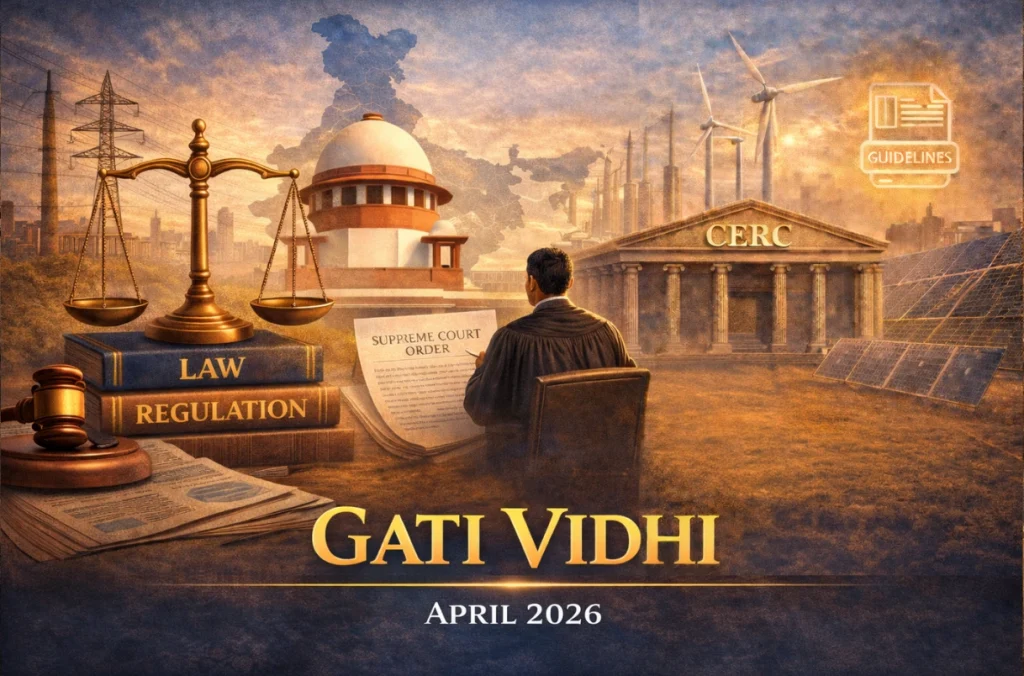
Supreme Court holds that Regulatory Commissions must consider Policy Incentives without defeating their purpose
The Supreme Court of India vide its order in Civil Appeal No. 4495 of 2025 Southern Power Distribution Company of AP & Anr vs Green Infra Wind Solutions Ltd & Ors. held that while tariff determination lies exclusively within the domain of State Electricity Regulatory Commissions, such power must be exercised in a manner that meaningfully considers government policy incentives. The Court clarified that Commissions have complete authority over tariff fixation, including the power to take into account grants or subsidies. However, this does not permit a mechanical adjustment of tariff by simply deducting such incentives, especially where doing so defeats the very objective for which the incentive was introduced.
The case arose from a dispute involving the Andhra Pradesh Electricity Regulatory Commission, which had deducted the GBI, intended to benefit wind power generators, from the tariff payable by distribution companies, effectively passing the benefit to DISCOMs. The Court held that while the Commission was correct in considering the incentive, its approach of automatically deducting it was flawed. Emphasizing a purposive interpretation, the Court observed that incentives aimed at promoting renewable energy must benefit generators as intended under policy schemes. Accordingly, the appeal was dismissed, reaffirming that regulatory powers must align with broader policy objectives and cannot be exercised in a manner that undermines them.
The MoC has issued guidelines for preparation and approval of Mining Plan for Coal and Lignite Blocks/Mines for Underground Gasification 2026
The Ministry of Coal (“MoC”) vide its Office Memorandum dated 06.04.2026 has issued the duly approved Guidelines for preparation and approval of Mining Plan for Coal and Lignite Blocks/Mines for Underground Gasification 2026 (“Guidelines”). These Guidelines shall be applicable only for the purpose of Underground Coal Gasification (“UCG”) and shall be an annexure to the “Guidelines for Preparation of Mining Plan and Mine Closure Plan for Coal and Lignite Blocks 2025” as amended from time to time for undertaking opencast mining/underground mining in the same block/time.
The objectives of the Guidelines are optimisation of coal or lignite extraction by converting coal or lignite into syngas using sustainable in-situ gasification technology with minimal waste and surface impact, mitigating risks like subsidence, fire and water contamination through continuous monitoring and control, minimising environmental impact, and ensuring compliance with regulations. In addition, these Guidelines integrate progressive mine closure with gasification operations, ensuring final closure tasks such as site restoration, well sealing, cavity stabilisation, and ongoing post-closure monitoring for sustainability and safety.
These Guidelines provide that all coal or lignite blocks/ mines proposed for underground coal gasification shall have a Mining Plan approved by the competent authority before the start of gasification activities which shall be valid for the life of the mine. It further provides that the competent authority may approve any revision(s) or modification(s) of the Mining Plan, and upon such approval, the revised or modified Mining Plan, as the case may be. The entire process of submission of mining plan and its approval or rejection shall be done through Single Window Clearance System of the MoC.
The Guidelines further provide that the mining plan shall be prepared on the basis of Geological Report, Hydrogeological Study Report and Pilot Study in that block/mine. The Guidelines further provide the requirements pertaining to safety, infrastructure facilities etc. which are required to be included in the mining plan. The Guidelines further provide for mine closure plan which aims to ensure scientific mine closure and rehabilitation of mining sites, minimising environmental degradation, safeguarding public health, and promoting sustainable development by restoring the land to a condition suitable for future use or returning it to its near-original state or better, while also holding project proponents accountable for their closure obligations. The mine closure plan shall be in the form of a progressive plan which needs to be updated every five years and the final closure plan.
Restoration & repurposing, cavity management and cleanup, long term monitoring, mine closure cost, mine closure certificate etc. are the components dealt with under the mine closure plan. Further, the Guidelines mandate every project proponent to ensure that the Mining Plan has been prepared by the Qualified Person/ Accredited Mining Plan Preparing Agency recognised under section 22B of the Mineral Concessions Rules, 1960, as amended from time to time. The Guidelines further provide the details pertaining to the constitution of a technical committee who shall assist the Coal Controller in scrutinization and examination of mining plan submitted by the project proponent.
The MoC Guidelines can be accessed here.
CERC notifies Trajectory for ‘X’ Factor under DSM Regulations, 2024 for Wind and Solar Generators
CERC vide its suo motu order dated 31.03.2026 in Petition No. 9/SM/2025 issued directions determining the trajectory of the ‘X’ factor under the Deviation Settlement Mechanism (DSM) Regulations, 2024 for wind and solar generators, applicable from 01.04.2026 onwards. The Commission has clarified that the existing framework for deviation computation will continue for FY 2026-27 with the ‘X’ factor retained at 100%, after which a gradual reduction will be implemented in a phased manner. For solar and hybrid projects, the ‘X’ factor will progressively reduce to 0% by 2031, while a slightly different trajectory has been prescribed for wind projects.
Further, the Commission has tightened the permissible deviation (tolerance) bands with effect from April 1, 2026, reducing them to +/- 5% for solar and hybrid projects and +/- 10% for wind projects. The order notes that forecasting and scheduling obligations have already been in place for renewable generators since 2015, supported by Renewable Energy Management Centres (REMCs). The Commission has also clarified that the implementation of the order will remain subject to the outcome of pending writ petitions before the Delhi High Court, which has directed that no coercive action be taken against the petitioners until further hearings.
APTEL rejects claim for generation loss in review proceeding and confirms payment of carrying cost on amount wrongfully retained by NTPC
The Appellate Tribunal for Electricity (“Tribunal”) vide judgement dated 06.04.2026 in R.P. No. 5 of 2025 in Appeal No. 126 of 2022 (M/s Solaire Surya Urja Pvt Ltd v. Central Electricity Regulatory Commission & Ors) allowed the review petition filed by M/s Solaire Surya Urja Pvt Ltd to the limited extent of upholding the grant of carrying cost on amount wrongfully appropriated by NTPC.
The Petitioner, Solairedirect Energy India Private Limited (“Petitioner”), a Special Purpose Vehicle was awarded two solar power projects of 70 MW by NTPC. The scheduled commercial operation date (“SCOD”) of the power projects was agreed as 01 June 2017. However, the completion of the power projects was delayed due to which the projects achieved commissioned at a belated stage. Relying on the delay NTPC sought to levy liquidated damages in accordance with the provisions contained in the PPAs. Consequently, NTPC encashed the bank guarantees submitted by the Petitioner, as a result of which, the Petitioner approached CERC seeking, inter alia, directions that delay was not attributable to it, extension of SCOD and refund of liquidated damages along with recovery of carrying cost. CERC rejected the Petitioner’s claims and held that NTPC was entitled to recover damages for delay in commissioning.
Aggrieved by the decision of the CERC, the Petitioner approached the Tribunal. The Tribunal vide judgement dated 10.02.2025, allowed the Appeal and set aside the decision of CERC. The Tribunal held that the delay in commencement of supply of power was not attributable to the Petitioner but was on account of external factors i.e., non-availability of evacuation transmission system on account of the Rajasthan State Transmission Utility (RRVPNL), which is beyond the control of the Petitioner. Accordingly, the Tribunal allowed extension of SCOD and held that the Petitioner was not liable to pay any liquidated damages.
The Tribunal rejected the claim for generation loss, holding that the same was neither urged nor argued during the appeal and cannot be raised in review proceedings. However, on the issue of carrying cost, the Tribunal held that non-consideration of the Petitioner’s claim constituted an error apparent on the face of the record. Accordingly, it allowed the review petition to this limited extent and directed that the Petitioner shall be entitled to carrying cost on the refunded amount from the date of encashment of bank guarantees till the date of payment.
APTEL upholds CERC decision holding transmission charges payable on 100% contracted capacity despite actual supply of actual 95%
The Appellate Tribunal for Electricity (“Tribunal”) vide judgement dated 06.04.2026 in Appeal No. 242 of 2019 (PTC India Limited v. Secretary, Central Electricity Regulatory Commission & Ors) upheld the CERC decision directing payment of transmission charges for supply of the entire 100% contracted capacity as against the actual 95% of share supplied.
PTC entered into a Power Purchase Agreement (“PPA”) with Korba Power Limited (“KPL”) for 300 MW power and a back-to-back Power Supply Agreement (“PSA”) with Haryana Power Purchase Centre (“HPPC”). Accordingly, PTC obtained Long Term Open Access and executed Bulk Power Transmission Agreement (“BPTA”) with the CTU for transmission of the entire contracted capacity. However, disputes arose, as a result of which, KPL terminated the PPA, and the agreements became subject to arbitral proceedings as well as judicial scrutiny before the Supreme Court and the Delhi High Court. KPL in accordance with the directions of the Supreme Court through an interim order, ended up supplying 95% of power generated to HPPC through PTC and balance 5% directly to Chhattisgarh State Power Distribution company Limited (“CSPDCL”).
In this backdrop, issue before the Central Electricity Regulatory Commission (“CERC”) pertained to levy of transmission charges by CTU. KPL approached CERC seeking relief against CTU for levying transmission charges for the entire 100% power supply as against the actual quantum of 95% share supplied as per the Interim Order of the Supreme Court. CERC vide Order dated 30.05.2019 held PTC liable to pay 100% transmission charges to CTU and also directed PTC to refund 5% LTA charges collected by KPL.
The Tribunal found that the liability for transmission charges arose from the BPTA and TSA, under which PTC had contracted for 300 MW LTA and was obliged to pay charges for the entire capacity unless it formally relinquished any portion.
The Tribunal on the issue of the maintainability of the Petition before CERC held that contractual framework such as PPA, PSA etc was not superseded by the interim arrangement of the Supreme Court. The Tribunal also observed that termination of the PPA was in abeyance until the pendency of proceedings before the Supreme Court.
The Tribunal also upheld that PTC’s failure to timely relinquish 5% LTA capacity meant it remained liable for charges on full 100% capacity, and its attempt to pass this burden to KPL was unjustified. Consequently, the Tribunal affirmed decision of CERC holding PTC liable for 100% transmission charges and directing refund of 5% charges to KPL.
KERC issues Draft KERC (Procedure, Terms and Conditions for grant of Transmission License and other related matters in respect of intra-State Transmission Projects selected through Tariff-Based Competitive Bidding) Regulations, 2026
The Karnataka Electricity Regulatory Commission (“KERC”) has issued the Draft KERC (Procedure, Terms and Conditions for grant of Transmission License and other related matters in respect of intra-State Transmission Projects selected through Tariff-Based Competitive Bidding) Regulations, 2026 (“Draft Regulations”) dated 23.03.2026, proposing a dedicated framework for licensing of intra-state transmission projects selected through Tariff-Based Competitive Bidding, under Section 63 of the Electricity Act, 2003 (“Act”). The Draft Regulations are intended to supplement the existing KERC (Licensing) Regulations, 2004, by specifically addressing projects developed through the competitive bidding route and aligning the state framework with the tariff adoption mechanism envisaged under the Act.
Under the proposed framework, only entities selected through competitive bidding under Section 63 of the Act will be eligible for grant of transmission licences, and the Commission will adopt tariffs discovered through such process. The Draft Regulations prescribe a structured licensing procedure, including submission of applications in specified formats, issuance of public notice, and a stakeholder consultation process prior to the grant of licence, while also envisaging the involvement of key institutional stakeholders such as the State Transmission Utility (STU). The licence is proposed to be granted for a period of 25 years, with provision for renewal upon an application made at least two years prior to its expiry.
The Draft Regulations further clarify that the grant of licence shall be non-exclusive and subject to continued regulatory oversight, including the power of the Commission to amend, revoke, or renew licences based on performance and compliance.
Draft KERC (Procedure, Terms and Conditions for grant of Transmission License and other related matters in respect of intra-State Transmission Projects selected through Tariff-Based Competitive Bidding) Regulations, 2026 can be accessed here.
TGERC observes Rule 8A Electricity (Rights of Consumers) Amendment Rules, 2023 does not mandate Night-Time Rebate
The Telangana Electricity Regulatory Commission (TGERC), by its Order dated 02.04.2026 in I.A. Nos. 24 & 25 of 2025 (in O.P. Nos. 21 & 22 of 2025), has held that Rule 8A of the Electricity (Rights of Consumers) Amendment Rules, 2023 does not mandate continuation of night-time rebate for HT consumers. The matter arose pursuant to a limited remand by APTEL, directing the Commission to examine the applicability of Rule 8A while earlier ToD tariff revisions, including withdrawal of the ₹1.50/unit night rebate, remained undisturbed. Upon consideration, the Commission held that:
- Rule 8A is confined to tariff differentiation during peak hours and solar hours, including the requirement that solar-hour tariff be at least 20% lower than normal tariff;
- It does not extend to or regulate night-time rebate, which remains a matter of tariff design within the Commission’s regulatory discretion; and
- The earlier withdrawal of night-time rebate had attained finality, as it was neither set aside nor interfered with by APTEL.
The Commission further held that implementation of solar-hour tariff or any modification to the ToD framework would amount to a substantive tariff change, requiring a fresh tariff determination exercise under Sections 61, 62, and 64 of the Electricity Act, 2003, including public notice and stakeholder consultation. Such changes cannot be introduced in limited remand proceedings. Accordingly, the Commission declined to grant relief and held that no interference with the earlier ToD tariff orders was warranted.
Order dated 02.04.2026 issued by TGERC can be accessed here.
 You wish to know more about Neeti Niyaman (the “Firm”) for your own information and use.