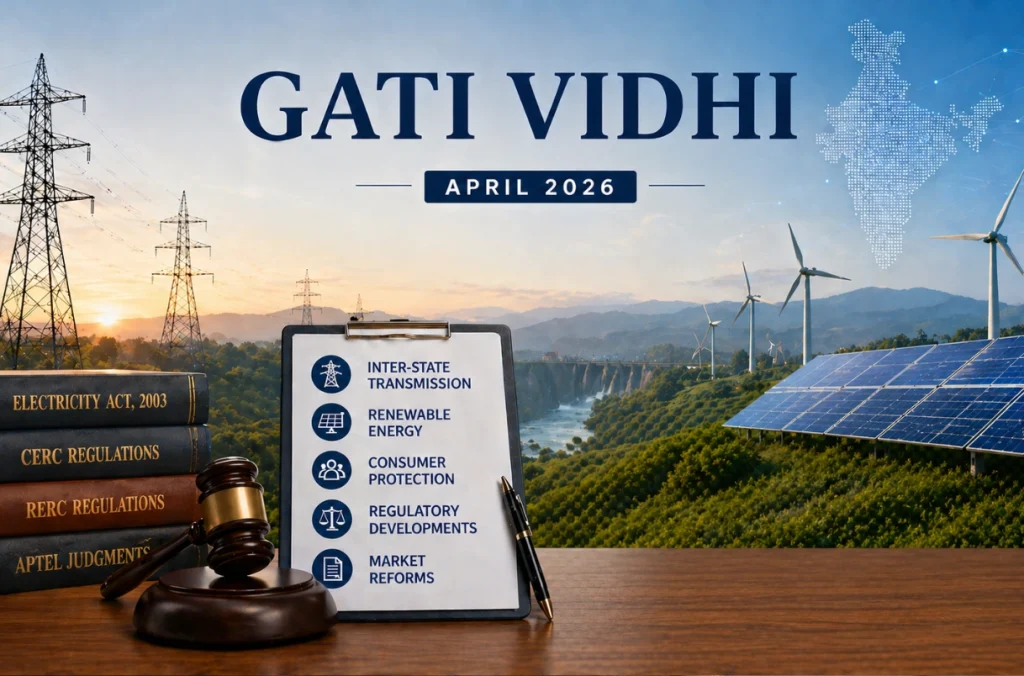
Gati Vidhi – April 2026
APTEL upholds Captive Status and CSS Exemption for Inter-State Holding–Subsidiary Power Arrangement
The Appellate Tribunal for Electricity (“Tribunal”), vide judgment dated 20.04.2026 in Appeal No. 20 of 2021 (Chhattisgarh State Power Distribution Co. Limited. v. Chhattisgarh State Electricity Regulatory Commission & Anr.), upheld the Order passed by Chhattisgarh State Electricity Regulatory Commission (“CSERC”) in Petition No.42/2018. (“Impugned Order”).
CSERC vide the Impugned Order held Sarda Energy & Minerals Limited (“Sarda Energy”) along with its subsidiary M/s Sharda Minerals and Alloys Limited (“Subsidiary Company”) to qualify as a captive user and allowed non-discriminatory open access to Sarda Energy, without imposition of cross subsidy surcharge (“CSS”).
Sarda Energy was availing power, through inter-state open access, from the captive power plant set up by its Subsidiary Company. CSPDCL had levied CSS on such supply, which was challenged before the Commission. CSPDCL, inter alia, contested the Petition on want of territorial jurisdiction of CSERC to determine captive status of a generating plant situated outside the State and to adjudicate issues involving inter-State aspects.
The Tribunal primarily examined whether supply of power by a wholly owned subsidiary’s captive generating plant in one State to its holding company in another State qualified as “captive consumption” exempt under 42(2) of the Electricity Act, 2003. The Tribunal determined the issue in view of scope of “captive generating plant” and “captive user” under Section 2(8) of the Electricity Act, 2003 read with Rule 3 of the Electricity Rules, 2005.
The Tribunal held that neither Section 2(8) of the Electricity Act, 2003 nor Rule 3 of the Electricity Rules, 2005 prescribes any requirement that the captive generating plant and the captive user must be located in the same State. It observed that the definition of “captive user” is based on end-use of electricity and does not incorporate any territorial limitation.
It further held that, in the case of a wholly owned subsidiary, the ownership and consumption of the holding and its subsidiary can be considered collectively for the purpose of satisfying the twin requirement of 26% ownership and 51% consumption under Rule 3. The Tribunal also clarified that the amendments to Rule 3 are clarificatory in nature and do not alter the pre-existing legal position.
The Tribunal upheld the jurisdiction of the State Commission in determining captive user status as the dispute concerned entities within its territorial jurisdiction, irrespective of the generating plant being situated in another State. Accordingly, the Tribunal upheld the decision of the CSERC and held that supply of electricity from the subsidiary’s captive plant to the Holding Company, through inter-state open access, qualified as captive consumption and was therefore exempt from levy of cross-subsidy surcharge under Section 42(2) of the Electricity Act.
APTEL quashes Governor’s approval for CAG Audit of Delhi DISCOMS on Liquidation of Regulatory Asets
Tribunal vide judgement dated 20.04.2016 in suo motu proceedings in O.P. No. 1 of 2025 (In suo motu action under Section 121 of the EA v. Secretary, Central Electricity Regulatory Commission & Ors.) set aside the approval granted by Lt. Governor to entrust audit of Delhi DISCOMs with the Comptroller and Auditor General (“CAG”).
The Tribunal invoking its suo moto jurisdiction examined the legal permissibility of audit of Delhi DISCOMs by CAG in view of the judgment of Supreme Court dated 06.08.2025 in Writ Petition (C) No. 104 of 2014, whereby the Supreme Court directed liquidation of pending regulatory assets and further mandated strict and intensive audit to examine the circumstances leading to accumulation of assets. In compliance with the direction, DERC approached CAG and obtained approval of the Lt. Governor to entrust the audit to CAG. However, the Delhi DISCOMs objected to the approval. DERC had also sought extension for initiating the liquidation process rendering the issues before the Tribunal.
The Tribunal while deciding the issues, emphasized on how audit by CAG is contingent upon strict compliance of the conditions prescribed under Section 20 of the CAG Act.
- The Tribunal observed that the mandatory preconditions under Section 20(3) of public interest satisfaction and opportunity of hearing were not fulfilled since the approval by the Lt. Governor lacked record of satisfaction on public interest.
- Further, the Tribunal held that the DISCOMs were denied opportunity of hearing to represent against the terms and scope of the audit, and hence sufficient opportunity for representation under Section 20(2) was not complied with.
The Tribunal clarified the nature of the audit to be conducted and held that audit for the circumstances leading to asset accumulation cannot be construed as an enquiry into the financial affairs of the DISCOMS. The Tribunal denied the extension sought by DERC, observing that there was no justification for delay and liquidation of assets is neither related to nor dependant on the audit. Further, the Tribunal upheld its supervisory jurisdiction under Section 121 of the Electricity Act to issue directions against non-compliance by Regulatory Commissions of their statutory obligations.
Accordingly, the Tribunal quashed the approval of CAG audit accorded by the Lt. Governor for being in violation of Section 20 of the CAG Act and directed DERC to appoint a chartered accountant within one week and complete the audit within three months. The Tribunal further rejected DERC’s request for extension, holding that pendency of true-up cannot delay liquidation, and directed commencement of the process within three weeks while permitting issuance of true-up orders by 30.06.2026.
APTEL holds Levy of Entry Tax to Constitute “Change in Law” under PPA
The Tribunal vide judgment dated 13.04.2026 in Appeal No. 322 of 2021 (ACME Dayakara Solar Power Private Limited v. Telangana State Electricity Regulatory Commission & Anr.), set aside the order of the Telangana State Electricity Regulatory Commission (“TSERC”) dated 04.10.2021, holding that the levy of Entry Tax constitutes a “Change in Law” event under the Power Purchase Agreement (“PPA”).
A nine-bench of the Supreme Court vide its judgement dated 11.11.2026 in Jindal Stainless Steel Limited & Anr. v. State of Haryana and Ors. (“Jindal Stainless Steel”) had upheld the validity of the Telangana Tax on Entry of Goods into Local Areas Act, 2001(“TET Act”). On 11.02.2020, the Chief Tax Officer (“CTO”) issued assessment orders imposing Entry Tax under the TET Act on the goods against the Appellant. Appellant approached TSERC seeking reliefs under the PPA with the Telangana DISCOM and declaration for imposition of Entry Tax under TET Act as a change in law. However, TSERC vide the Impugned Order denied the reliefs, primarily on the ground that the PPA contemplated a fixed tariff inclusive of taxes and that the Appellant had agreed to the contractual terms with full knowledge of the risks.
The Tribunal on the issue of Change in Law observed, that there was no enactment on Entry Tax when the Appellant submitted its bid and hence there was no occasion for the Appellant to factor Entry Tax while preparing and submitting its bid. The Tribunal observed that the provisions under the PPA distinguish between “quoted tariff” and “tariff payable”, and Article 2.3 expressly contemplates that tariff payable shall be inclusive of taxes, duties and levies “as applicable from time to time”, thereby permitting passthrough of post-bid statutory levies. The Tribunal also emphasized on the inclusion of Change in Law clause in the PPA further confirms the intention of the parties to foresee circumstances on account of which additional financial burden may be incurred, for which the Producer would be compensated by restitution.
In the absence of an express restitution clause, the Tribunal held that once a Change in Law event is established, restitution follows as a necessary consequence, and any contrary interpretation would render the PPA commercially unworkable and contrary to business efficacy.
Accordingly, the Tribunal upheld the imposition of Entry Tax under the TET Act as Change in Law as per the PPA and remanded the case to TSERC on the limited aspect of deciding the extent of restitutionary relief to which the Appellant is entitled on account of such Change in Law event.
MoP extends the Inter-State Transmission charges waiver on transmission of electricity generated from solar and wind sources of energy for RE projects delayed due to delay in readiness of transmission infrastructure
The Ministry of Power (“MoP”) has, vide Office Memorandum dated 16.04.2026, extended the Inter-State Transmission charges waiver on transmission of electricity generated from solar and wind sources of energy for Renewable Energy (“RE”) projects delayed due to delay in readiness of transmission infrastructure.
MoP has received representations from RE developers seeking clarification regarding the extension of benefit of graded waiver of these charges in respect of projects whose firm start date of connectivity falls within the period of 01.07.2025 to 30.06.2028, but whose commissioning may be delayed beyond the firm start date of connectivity due to non-readiness of transmission system.
MoP has recognised that the delay in commissioning of RE projects due to non-readiness of the transmission system may lead to Power Purchase Agreement (“PPA”) disputes between RE developers and the end procurers.
Accordingly, MoP has decided to extend the benefits of graded waiver of 75% or 50% or 25%, as applicable, to such projects:
- Having firm PPA as on 31.03.2026, and
- Having firm start date of connectivity within the period from 01.07.2025 to 30.06.2028, and
- Having achieved COD before, or within the specified time limit from the COD of the concerned transmission system.
Further, the projects with firm start date of connectivity on or before 30.06.2025 may be considered for grant of 100% waiver in case they satisfy the relevant conditions.
MoP has noted that CERC may make suitable regulatory provisions for providing benefit to RE projects.
The Office Memorandum can be accessed here.
MoP extends the timeline for submission of RCO compliance for FY 2024 – 25
MoP has, vide letter dated 16.04.2026, extended the timeline for submission of final Renewable Consumption Obligation (RCO) compliance for FY 2024 – 25 by two months i.e., up to 31.05.2026.
MoP has granted this extension in view of the representations received from various Designated Consumers (DCs) through the Bureau of Energy Efficiency (BEE) regarding the challenges being faced by them.
The letter dated 16.04.2026 can be accessed here.
CERC issues Draft (Power Market) (Second Amendment) Regulations, 2026 on Market Coupling
The Central Electricity Regulatory Commission(“CERC”), vide notification dated 17.04.2026, has issued the Draft CERC (Power Market) (Second Amendment) Regulations, 2026 proposing a formal framework for implementation of market coupling in India. The draft designates Grid Controller of India Limited (Grid India) as the sole Market Coupling Operator (MCO), introduces a Commission-approved Power Market Coupling Procedure (PMCP), and provides for centralized price discovery in coupled market segments.
The key highlights are:
- The draft regulations designate Grid Controller of India Limited (Grid India) as the exclusive Market Coupling Operator, moving away from the previously considered rotational exchange-led model.
- Grid India is required to develop a detailed PMCP within six months of notification, subject to approval by the Commission.
- Price discovery in coupled market segments shall be undertaken by the MCO from dates to be notified by CERC, replacing the existing exchange-level price discovery mechanism.
- The framework provides for coupling of Day Ahead Market (DAM), Real Time Market (RTM), and other segments, with phased implementation permitted through separate notifications.
- Power exchanges are mandated to collect bids in a standardized format, validate and anonymize such bids, and securely transmit them to the MCO within prescribed timelines.
- The coupling mechanism shall result in a uniform market clearing price across exchanges, with provisions for market splitting based on transmission constraints
- The PMCP shall govern key aspects including bid processing, algorithm design, scheduling, delivery, clearing and settlement, operational constraints, and determination of MCO charges.
- The MCO shall be subject to obligations relating to IT systems, secure data transfer, information dissemination, and market surveillance, in line with regulatory requirements applicable to power exchanges.
- While power exchanges will continue as trading platforms, the critical function of price discovery in coupled segments will shift to the centralized MCO.
Copy of the CERC notification dated 17.04.2026 can be accessed here.
CERC proposes Compensation Framework for Grant of Additional Time under GNA Regulations
CERC vide suo motu order dated 15.04.2026 in Petition No. 5/SM/2026, has proposed a procedure for levying compensation charges for permitting additional time to achieve key milestones under the Connectivity and General Network Access (GNA) Regulations, 2022. The proposal addresses situations where connectivity grantees fail to meet the timelines for submission of land documents, achieving financial closure, or commissioning (CoD), which would otherwise result in automatic revocation of connectivity and encashment of bank guarantees. Invoking its powers to relax and remove difficulties under the GNA Regulations, CERC has sought to introduce a structured mechanism allowing limited extensions on payment of compensation.
The proposed framework prescribes eligibility criteria linked to project progress (such as partial land acquisition, financial closure status, and EPC award) and introduces Milestone Extension Charges (MEC) on a per MW per day basis for delay in achieving each milestone. The draft provides graded and time-bound extensions, up to 3 months for land documents, 6 months for financial closure, and 12 months for CoD, with escalating charges and strict consequences for non-compliance. It also clarifies that in cases where project commissioning is delayed due to non-readiness of ISTS infrastructure, a grace period of two months post GNA effectiveness shall be allowed without MEC. Stakeholder comments have been invited on the proposed procedure.
Copy of CERC suo motu order dated 15.04.2026 can be accessed here.
BERC issues Bihar Electricity Regulatory Commission (Consumer Grievance Redressal Forum, Electricity Ombudsman and Consumer Advocacy ) (4th Amendment) Regulations, 2025
Bihar Electricity Regulatory Commission (“BERC”) vide suo-motu proceedings 40/2025 dated 20.04.2026 and in exercise of the powers conferred by clause (r) and (s) of Section 181(2) read with sub-section (5) to (7) of section 42 of the Electricity Act, 2003 issued Bihar Electricity Regulatory Commission(Consumer Grievance Redressal Forum, Electricity Ombudsman and Consumer Advocacy) (4th Amendment) Regulations, 2025 (“Amended Regulations”). The Regulations shall be applicable to all the distribution licensee in the state of Bihar.
The amended Regulations substitutes Regulation 2.2 of the BERC (Consumer Grievance Redressal Forum, Electricity Ombudsman and Consumer Advocacy) Regulation 2017 (“Principal Regulations”). It mentions that distribution licensee shall establish Consumer Grievance Redressal Forum (“CGRF”) at different levels to cater to the needs of the sub divisions, division, circle, zone, company level. The consumer aggrieved by the decision of sub division or division or circle forum will have the option to approach the company level forum before making an appeal to the Ombudsman. However, HT Consumer may approach the company level forum directly without going to the circle level or below CGRF. The Distribution Licensee shall facilitate/create digital interface and escalation of the complaint to Consumer Grievance Redressal Forum at Company level, if the grievances of the consumer are not redressed within a period of forty-five (45) days from the date of admission of the complaint, at the Circle level or below CGRF.
It further substitutes Regulation 2.4(a)(i) of the Principal Regulations and mentions that the forum other than company level shall be headed by an officer of licensee of appropriate seniority not below the rank of Electrical Executive Engineer (“EEE”) or equivalent and forum at company level shall be headed by an officer of licensee of appropriate seniority not below the rank of Chief Engineer (“CE”).
It further substitutes Regulation 2.15 of the Principal Regulations and mentions that the consolidated monthly remuneration payable by the licensee to the independent member (Third Member) will be Rs. 65,000/- and lastly it substitutes Regulation 3.13 of the Principal Regulations and mentions that the electricity ombudsman shall be paid a consolidated salary and other allowances as determined by BERC.
Copy of the Bihar Electricity Regulatory Commission(Consumer Grievance Redressal Forum, Electricity Ombudsman and Consumer Advocacy) (4th Amendment) Regulations, 2025 can be accessed here.
RERC approves Demand Flexibility & Demand Side Management Regulations, 2026
The Rajasthan Electricity Regulatory Commission (“RERC”) vide order dated 17.04.2026 in Suo-motu petition No. 2397 of 2026 finalised the RERC (Demand Flexibility (DF)/Demand Side Management (DSM)) Regulations, 2026 after considering stakeholder comments on the draft framework. The regulations aim to modernise electricity demand management in Rajasthan through peak load reduction, grid efficiency, renewable integration, and consumer-side flexibility measures.
The Commission designated FY 2026-27 as a preparatory year focused on load research, system readiness, and institutional capacity building. During this period, distribution licensees will not face disincentives for non-achievement of targets. The regulations will apply to all distribution licensees in Rajasthan, including successor entities.
The framework mandates every distribution licensee to establish a dedicated DF/DSM Cell headed by an officer not below the rank of Chief Engineer for planning and implementing demand flexibility programmes, conducting consumer outreach, maintaining digital registries, and coordinating with the SLDC for identification of network-constrained zones and system requirements.
The regulations introduce Demand Flexibility Portfolio Obligations (DFPO), starting at 0.25% of previous year peak demand in FY 2026-27, and increasing to 1% in FY 2027-28, 1.5% in FY 2028-29, and reaches 2% in FY 2029-30. Incentives and disincentives of Rs. 0.20 crore per MW have been prescribed for over-achievement or shortfall of targets.
Licensees may meet obligations through their own programmes or through registered aggregators. Approved measures include EV smart charging, battery storage, agricultural load shifting, efficient appliances, cooling solutions, and demand response programmes. Diesel generators have been expressly excluded as eligible resources.
The Commission has also allowed recovery of justified DF/DSM costs through MYT/ARR filings, subject to prudence checks and cost-effectiveness tests, while programme outcomes will be independently verified through a formal Evaluation, Measurement and Verification framework.
TGERC has sought comments / suggestions / objections to TGERC (Electricity Supply Code) Draft Third Amendment Regulation, 2026
The Telangana Electricity Regulatory Commission (“TGERC”) has notified the TGERC (Electricity Supply Code) Draft Third Amendment Regulation, 2026 and has sought comments / suggestions / objections to it on or before 04.05.2026 vide Public Notice dated 13.04.2026.
The amendment in Clause 4.7.3 has been proposed to ensure uniformity in the rates of interest charged on consumers for non-payment of arrears within the due date and the interest payable by TGDISCOMs on account of erroneous billing.
As per the proposed amendment, where a bill is found to be erroneous by the licensee, it shall issue a revised bill to the consumer indicating a revised due date not earlier than seven days from the date of delivery of the revised bill. Any excess amount paid by the consumer shall be adjusted in subsequent bills, and the licensee shall be liable to pay interest at 18% per annum on such excess amount to the consumer.
The Public Notice can be accessed here. The Draft Regulation can be accessed here.
 You wish to know more about Neeti Niyaman (the “Firm”) for your own information and use.