Gati Vidhi – July 2026
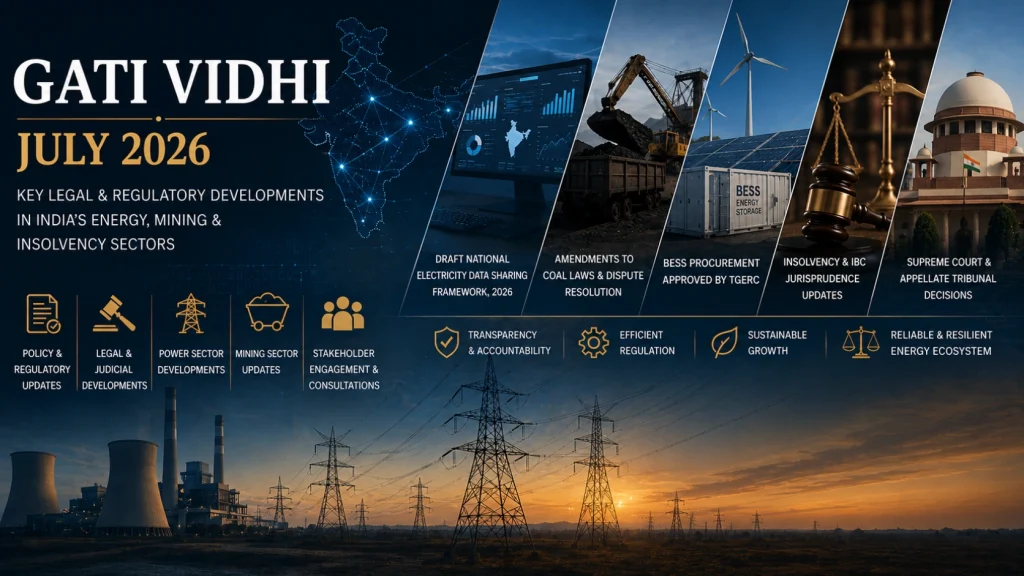
MoP has invited comments on the Draft National Electricity Data Sharing Framework, 2026
The Ministry of Power (“MoP”) has, vide notification dated 22.06.2026, has invited comments on the Draft National Electricity Data Sharing Framework, 2026 (“Draft Framework”). The comments can be submitted within 30 days from the date of issuance of the notification i.e., by 21.07.2026.
The Draft Framework seeks to establish a standardised framework for the collection, sharing and dissemination of electricity sector data to promote transparency, interoperability, data-driven decision-making and innovation. It provides a governance framework for electricity sector data, including the roles and responsibilities of data providers and data users, while prescribing guiding principles relating to data quality, standardisation, accessibility, security and privacy.
The Draft Framework proposes the establishment of a National Electricity Data Centre (NEDC) and the National Electricity Data Portal (NEDP) to create an ecosystem for data sharing across the country.
66 datasets have been identified across various segments of the sector, including generation, transmission, distribution, RE, tariff and regulatory matters, schemes, and planning and policy documents, together with the prescribed granularity and frequency for data publication. The Draft Framework prescribes the frequency for updating and publishing each dataset, ranging from real-time, daily and monthly updates to annual, periodic, and event-based disclosures, depending upon the nature of the dataset.
The notification dated 22.06.2026 can be accessed here.
MoC has appointed the date for enforcement of the amendments to the Coal Mines (Special Provisions) Act, 2015
The Ministry of Coal (“MoC”) has, vide notification dated 23.06.2026, appointed the date of publication of this notification as the date on which the provisions of the Jan Vishwas (Amendment of Provisions) Act, 2026 (“Amendment Act”), in so far as it relates to Serial No. 69 and the entries relating thereto in the Schedule, relating to the Coal Mines (Special Provisions) Act, 2015 (“CMSP Act”), shall come into force. Serial No. 69 provides for amendment of Sections 23 and 24, insertion of Sections 24A and 24B, and consequential amendment to Section 31.
The key amendments are as follows:
- Amendment of Section 23
- Punishment for (a) obstructing or causing any impediment in taking possession or in the man management of Schedule I coal mines, (b) destruction or misuse of mine infrastructure or coal stock, and (c) retention, removal or destruction of mine property – Imprisonment for a term which may extend to 2 years, or with fine of Rs. 1,00,000/-, or with both. In case of a continuing offence, the fine shall be of Rs. 2,00,000/- for each day.
- Punishment for failure to deliver books of account, registers or other documents to the designated custodian – Penalty which may extend to Rs. 1,00,000/-. In case of a continuing offence, the fine shall be up to Rs. 2,00,000/- for each day. For a subsequent contravention, or a contravention continuing beyond 30 days, an additional fine of Rs. 5,00,000/- shall be imposed or there shall be imprisonment for a term which may extend to 2 years, or with both.
- Amendment to Section 24 – If any person fails to comply with any of the directions of the Central Government / nominated authority / designated custodian, without reasonable cause, he shall be liable to penalty which may extend to Rs. 1,00,000/-. In the case of continuing failure, the penalty may extend to Rs. 2,00,000/- for each day.
- Insertion of Section 24A – The Central Government shall appoint the nominated authority as the adjudication authority for adjudicating the penalties under Section 23 (2) and Section 24. The concerned person shall be given a reasonable opportunity of being heard.
- Insertion of Section 24B – The Appellate Authority shall be the Tribunal constituted under the Coal Bearing Areas (Acquisition and Development) Act, 1957. An appeal may be filed against an order under Section 24A within 30 days from the date of receipt of the order, which is extendable at the Tribunal’s discretion on satisfaction of sufficient cause. Any unpaid penalty may be recovered as an arrear of land revenue.
- Insertion of (xa) in Section 31 (2) – The Central Government has the power to prescribe, by rules, the manner of conducting inquiries and imposing penalties under Section 24A (1).
The notification dated 23.06.2026 can be accessed here. The Coal Mines (Special Provisions) Act, 2015 can be accessed here. The Jan Vishwas (Amendment of Provisions) Act, 2026 can be accessed here.
MoC has appointed the date for enforcement of the amendments to the Coal Mines Provident Fund and Miscellaneous Provisions Act, 1948
MoC vide notification dated 23.06.2026, has appointed the date of publication of this notification as the date on which the provisions of the Amendment Act, in so far as it relates to Serial No. 12 and the entries relating thereto in the Schedule, relating to Coal Mines Provident Fund and Miscellaneous Provisions Act, 1948 (“CMPFMP Act”), shall come into force. Serial No. 12 provides for amendment of Section 9 and insertion of Sections 9A, 9B and 11E.
The key amendments are as follows:
- Amendment of Section 9 – A penalty of not less than Rs. 5000/- but extendable to Rs. 50,000/- shall be imposed in case of contravention of any provision of the Act. For continued contravention, an additional penalty of Rs. 10,000/- for each day shall be imposed, subject to a maximum of Rs. 10,00,000/-.
- Insertion of Section 9A – The Central Government may appoint an officer not below the rank of Joint Secretary to the Government of India or Secretary to the State Government as the adjudicating officer for adjudication of penalties under Section 9. Multiple officers may be appointed. The concerned person shall be given a reasonable opportunity of being heard.
- Insertion of Section 9B – An appeal may be filed against an order under Section 9A within 30 days from the date of receipt of the order to an officer at least one rank higher than the adjudicating officer, which is extendable at the officer’s discretion on satisfaction of sufficient cause. Any unpaid penalty may be recovered as an arrear of land revenue.
- Insertion of Section 11E – The Central Government has the power to make rules for carrying out provisions of the Act.
The notification dated 23.06.2026 can be accessed here. The Coal Mines Provident Fund and Miscellaneous Provisions Act, 1948 can be accessed here. The Jan Vishwas (Amendment of Provisions) Act, 2026 can be accessed here.
MoC notifies Government approval on the Scheme for Promotion of Surface Coal / Lignite Gasification Projects
The MoC has, vide office memorandum dated 25.06.2026, has notified that the Scheme for Promotion of Surface Coal / Lignite Gasification Projects has been approved by the Government of India. The aim of the scheme is to accelerate the implementation of such projects through targeted financial incentive, reduction in import dependence, value-added utilisation of domestic coal resources etc. It is applicable to Public Sector Undertakings (PSUs), private sector companies, joint ventures and consortiums (up to three companies), subject to the prescribed eligibility criteria.
The key features of the scheme are as follows:
- A total financial incentive of Rs. 37,500 crores has been proposed.
- Financial incentive up to 20% of the cost of plant and machinery shall be provided to selected applicants, subject to fulfilment of the specified conditions.
- Selection of applicants and allocation of financial incentives shall be undertaken through a transparent and competitive bidding process based on the evaluation framework prescribed under the Guidelines.
- Financial incentives shall be disbursed in four equal instalments, linked to the achievement of specified project milestones.
The guidelines also provide an indicative list of eligible downstream products that qualify under the scheme.
The office memorandum dated 25.06.2026 can be accessed here.
MoC has invited comments on the Draft Colliery Control (Amendment) Rules, 2026
The MoC has, vide notification dated 29.06.2026, invited views / observations / comments / suggestions on the Draft Colliery Control (Amendment) Rules, 2026 (“Draft Rules”) within 15 days from the date of uploading of the Draft Rules on its website.
The Draft Rules seek to amend Rule 9 of the Colliery Control Rules, 2004, which provides for requirement of prior approval to open a coal mine, seam or section of a seam. The proposed amendments are as follows:
- Amendment in sub-section (1) – Prior approval is required from the Board of the company where the owner is a company registered under the Companies Act, 2013, or from the Governing Authority / Board / Committee of statutory corporations established by or under any Central or State Act. Corresponding amendment has also been proposed in the provision to sub-section (1).
- Amendment in sub-section (2) – No owner of a colliery, which is not a company registered under the Companies Act, 2013 nor a statutory corporation, shall open a coal mine or a seam or a section of a seam, without prior approval of the Coal Controller Organisation.
The notification dated 29.06.2026 along with the Draft Rules can be accessed here.
MNRE has amended the Revised Guidelines for Installation of Prototype Wind Turbine Models
The Ministry of New and Renewable Energy (“MNRE”) vide office memorandum dated 25.06.2026 has amended the Revised Guidelines for Installation of Prototype Wind Turbine Models dated 12.06.2025 (“Revised Guidelines”).
The Revised Guidelines were issued to facilitate the installation of limited number of prototype wind turbines to promote testing and certification process of wind turbine in the country. The guidelines are applicable for all the wind turbine manufacturers who wish to install prototype models and synchronize with the Indian grid system.
The key amendments are as follows:
- Amendment in Para 5 – The said para provided that for each prototype model, maximum 3 Nos of wind turbines will be allowed for grid synchronization / commissioning. The said paragraph has been amended to additionally provide that the scheduled power generated from the prototype models may be purchased by DISCOMs / any other entity at a mutually agreed or regulated tariff.
- Amendment in Para 8 – the said para provided that serial production and installation of prototype wind turbines will not be allowed until the wind turbine model is included in RLMM. The same has been revised to provide that installation of prototype wind turbines will not be allowed until the wind turbine model is included in the ALMMM(Wind) list.
The office memorandum dated 25.06.2026 can be accessed here. The Revised Guidelines dated 12.06.2025 can be accessed here.
APTEL holds that an approval of Resolution Plan will not render an Appeal infructuous, when no liability is fastened on Corporate Debtor
The Appellate Tribunal for Electricity (“Tribunal”), vide judgment dated 03.07.2026 in Appeal Nos. 244 and 245 of 2016 Power Company of Karnataka Ltd. v. Maharashtra Electricity Regulatory Commission & Ors., held that approval of a resolution plan under the Insolvency and Bankruptcy Code, 2016 (“IBC”) does not render pending appeals infructuous where the relief sought is against a third party and does not impose any liability upon the corporate debtor.
The appeals challenged orders of the Maharashtra Electricity Regulatory Commission (“MERC”) upholding the levy of temporary tariffs by Maharashtra State Electricity Distribution Company Limited (“MSEDCL”) instead of settlement under the Maharashtra Final Balancing and Settlement Mechanism (“FBSM”) for a power supply arrangement involving Global Energy Private Limited (“GEPL”). During the pendency of the appeals, GEPL underwent Corporate Insolvency Resolution Process, and MSEDCL contended that the approval of GEPL’s resolution plan extinguished all pending claims and rendered the appeals non-maintainable under the “clean slate” principle.
Rejecting the contention, the Tribunal observed that the appeals were directed against the MERC’s orders and MSEDCL’s actions, and not against GEPL. The Tribunal further held that a successful outcome would not fasten any liability upon GEPL but would instead entitle it to recover amounts from MSEDCL. Accordingly, the Tribunal held that the “clean slate” principle applies only to claims against the corporate debtor and does not bar proceedings that seek to protect or enhance the corporate debtor’s rights against third parties. The Tribunal therefore held that the appeals remained maintainable and directed that they proceed to be heard on merits.
RERC issues RERC (Terms and Conditions for Tariff determination from Renewable Energy Sources) (Third Amendment) Regulations, 2026
In exercise of powers conferred under Section 86(1)(e) read with Section 181 of the Electricity Act, 2003, the Rajasthan Electricity Regulatory Commission (“RERC”) has issued the RERC (Terms and Conditions for Tariff determination from Renewable Energy Sources) (Third Amendment) Regulations, 2026 (“RE Regulations”).
It substitutes the main provision of the existing sub-regulation 1.2 of the Rajasthan Electricity Regulatory Commission (Terms and Conditions for Tariff determination from Renewable Energy Sources) Regulations, 2020 (“Principal Regulations”) and provides that the RE Regulations shall be applicable for the determination of tariff from 01.04.2020 up to 31.03.2028. It substitutes the main provision of the existing sub-regulation 5.1 of the Principal Regulations and mentions that the Control Period under the RE Regulations shall be of eight (08) financial years commencing from 01.04.2020 till 31.03.2028.
It further adds a new regulation 21A which provides that calculation of capacity utilization factor and plant load factor shall be reckoned on an annual basis. The number of hours in a year for calculation of the capacity utilization factor and plant load factor, shall be considered as 24 multiplied by the number of days in the financial year under consideration.
It further amends Regulation 23.1 of the Principal Regulations which deal with the Late payment surcharge. It mentions that in case the payment of any bill for charges payable under these Regulations is delayed beyond a period of 45 days from the date of presentation of bills, a late payment surcharge as specified in the Ministry of Power Electricity (Late Payment Surcharge and Related Matters) Rules, 2022 as amended from time to time, shall be levied by the generating company. It further amends the first proviso to Regulation 85 of the Principal Regulations which deals with the storage efficiency and provides that the minimum efficiency for storage based on technology of solid-state batteries shall be 85%. It further amends the existing provisions of sub-regulations 93.1 to 93.7 of the Principal Regulations and provides that the provisions of banking shall be governed by the provisions of the RERC (Terms and Conditions for Green Energy Open Access) Regulations, 2025 and amendments thereto.
A copy of the RE Regulations can be viewed here.
TGERC has approved the procurement of 375 MW / 1500 MWh BESS capacity by TGDISCOMs
The Telangana Electricity Regulatory Commission (“TGERC”) vide its common order dated 24.06.2026 in O.P. No. 10/2026 and O.P. No. 13/2026, approved the procurement of 375 MW / 1500 MWh Battery Energy Storage System (“BESS”) capacity by TGDISCOMs through TGGENCO under the State Component of the Viability Gap Funding (VGF) Scheme supported through Power Systems Development Fund (PSDF). The petitions filed before TGERC pertained to the procurement of BESS capacity for “on demand” usage under the Build Own Operate (BOO) model, with a tenure of 15 years, at two TGTRANSCO substation locations (400 kV Maheshwaram and Choutuppal Substations), with 750 MWh capacity at each location.
TGERC has noted the need for BESS in view of increasing renewable energy (“RE”) penetration, resource adequacy requirements, peak demand management, grid balancing, and the need to absorb surplus power during RE periods.
After concluding that the discovered tariffs had emerged through a transparent competitive bidding process with adequate competition and e-reverse auction, TGERC has adopted the following tariffs:
- Rs. 2,98,000/MW/month for the Maheshwaram BESS project.
- Rs. 3,14,000/MW/month for the Choutuppal BESS project.
TGERC approved TGGENCO’s role as intermediary procurer and limited its trading margin to 0.5% of applicable capacity charges. TGDISCOMs have been permitted to enter into BESS Storage Sale Agreements with TGGENCO, and TGGENCO has been permitted to enter into corresponding Battery Energy Storage Purchase Agreements with the selected developers.
TGERC has directed that future BESS procurements must be supported by detailed technical and economic studies assessing alternative configurations, discharge durations, cycling requirements, sizing and locations. SLDC has been directed to monitor utilisation, availability, efficiency, degradation parameters and cost-benefit outcomes of the approved BESS projects, and to submit operational experience to TGERC for future storage planning in the State.
The order dated 24.06.2026 can be accessed here.



 You wish to know more about Neeti Niyaman (the “Firm”) for your own information and use.