Gati Vidhi – May 2026
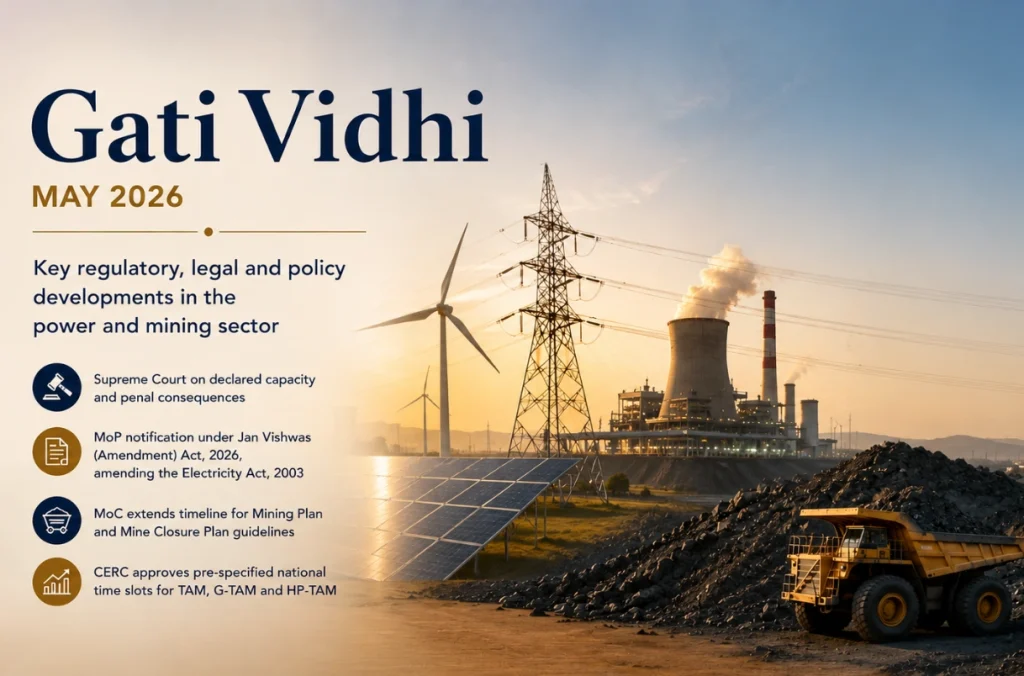
Supreme Court observes that failure to demonstrate declared capacity will automatically attract penal consequences under the regulations.
The Supreme Court of India, vide judgment dated 20.05.2026 in Civil Appeal No. 7432 of 2025, Punjab State Power Corporation Limited v. Talwandi Sabo Power Limited & Ors., held that failure of a generating station to demonstrate its declared generation capacity within the prescribed timeline attracts strict liability under the applicable grid regulations and does not require proof of mens rea, deliberate wrongdoing or “gaming”. The Court restored the order passed by the Punjab State Electricity Regulatory Commission imposing a penalty of approximately Rs. 162 crores on Talwandi Sabo Power Limited for failure to demonstrate its declared capability within the stipulated four time-block period under the Punjab State Grid Code, 2013.
The dispute arose after the generating station allegedly declared higher generation capacity than it could actually supply on multiple occasions in January 2017. The State Load Despatch Centre had issued demonstration notices requiring the company to establish its declared capacity within four time blocks (approximately one hour). However, the generating station failed to achieve the declared capacity within the prescribed timeframe. While the Appellate Tribunal for Electricity had earlier set aside the penalty on the ground that there was no deliberate manipulation or gaming, the Supreme Court reversed the said decision and clarified that failure to demonstrate declared capacity is distinct from “gaming” and automatically attracts penal consequences under the regulations. The Court observed that generating stations receive fixed charges based on declared capability and are therefore required to faithfully declare only such capacity that can be actually generated in real time.
MoP issues notification for implementing the Jan Vishwas (Amendment of Provisions) Act, 2026 for amendment to the Electricity Act, 2003
On 18.05.2026, the Ministry of Power (“MoP”) has issued a notification to implement the Jan Vishwas (Amendment of Provisions) Act, 2026, which was notified on 08.04.2026, to decriminalise certain provisions inter alia under the Electricity Act, 2003, and rationalise the penalty framework. The amended provisions shall come into effect on 01.06.2026.
The key amendments in the Electricity Act, 2003 are as follows:
- For negligently breaking, injuring, throwing down or damaging any material connected with supply of electricity under Section 139 – Penalty shall not be less than Rs. 5,000 but may extend to Rs. 1,00,000.
- For intentionally cutting off the supply of electricity, attempting to or cutting or injuring any electric supply line or works under Section 140 – Penalty shall not be less than Rs. 5,000 but may extend to Rs. 1,00,000.
- For extinguishing public lamps under Section 141 – Omitted.
- For non-compliance of provision of the Act, rules, regulations, order or direction under Section 142 – Penalty shall not be less than Rs. 10,000 but may extend to Rs. 5,00,000 for each violation. In case of a continuing failure, additional penalty shall be levied which shall not be less than Rs. 1000 but may extend to Rs. 10,000 for every day of failure.
- For non-compliance of order or direction given under the Act within the specified time, contravention or attempt or abetment of such contravention under Section 146 – Penalty shall not be less than Rs. 10,000 but may extend to Rs. 10,00,000. In the case of a continuing failure, additional penalty shall be levied which shall not be less than Rs. 1000 but may extend to Rs. 50,000 every day of failure.
- Amendment to Section 152 – Revised sum of money for compounding of offences under Sections 135, 138 and 140.
A copy of the MoP notification can be viewed here.
MoC extends timeline under Guidelines for Preparation of Mining Plan and Mine Closure Plan for Coal and Lignite Blocks, 2025
The Ministry of Coal (“MoC”) has, vide Office Memorandum dated 13.05.2026, extended the timeline under the Guidelines for Preparation of Mining Plan and Mine Closure Plan for Coal and Lignite Blocks, 2025 for (a) revision in escrow agreement for operating mines [Para 3.5.1] and (b) incorporating provision of utilisation of a minimum of 25% of the five-yearly escrow amount deposited for community development and livelihood-related activities in their existing mining plans [Para 3.5.5 (ii)] up to 30.09.2026.
A copy of the Office Memorandum can be viewed here.
CERC approves pre-specified national time slots for TAM, G-TAM and HP-TAM, rejects region-wise and customised delivery contracts
Central Electricity Regulatory Commission (“CERC”), vide its order dated 21.05.2026 in Petition No. 674/RC/2025, Indian Energy Exchange Limited v. Grid Controller of India Limited, Petition No. 754/RC/2025, Power Exchange India Limited v. Grid Controller of India Limited, and Petition No. 753/RC/2025, Hindustan Power Exchange Limited v. Grid Controller of India Limited, has approved a revised framework for pre-specified delivery time slots in the Term Ahead Market (“TAM”), Green Term Ahead Market (“G-TAM”) and High Price Term Ahead Market (“HP-TAM”), while rejecting proposals for region-wise peak-hour contracts and customised delivery slots. The CERC held that permitting region-specific or multiple customised time slots would lead to fragmentation of liquidity, reduced market depth, and impaired price discovery in the power markets. Accepting the recommendations of Grid Controller of India Limited, the Commission approved a uniform national framework based on Solar and Non-Solar hours, in place of peak and off-peak based structures. Accordingly, exchanges will offer contracts under pre-specified categories such as RTC (00-24 hrs), Solar (06-18 hrs), Morning (06-09 hrs), Day (09-18 hrs), non-Solar (18-06 hrs), Evening (18-24 hrs) and Night (00-06 hrs). The Commission observed that pricing pressures in the market are more significant during non-solar hours at a national level, and not on a region-specific basis.
The CERC further directed Grid India to issue a detailed procedure for notifying national solar and non-solar hours, while considering regional variations where feasible. In relation to G-TAM contracts involving renewable technologies other than hydro, the Commission permitted renewable energy generators to create generation profiles within the approved delivery slots. However, Grid India has been directed to examine whether such profile-based flexibility may be susceptible to misuse and to submit a report to the Commission within two months.
CERC issues Draft Fourth Amendment to GNA Regulations proposing key changes for RE and ESS connectivity
CERC, vide draft notification dated 20.05.2026, has issued the Draft Fourth Amendment to the Connectivity and General Network Access (“GNA”) Regulations for the inter-State Transmission System. The draft amendment proposes several changes aimed at improving flexibility for renewable energy developers, Energy Storage System (“ESS”) projects and generating companies, while streamlining procedural and financial requirements relating to connectivity under the ISTS framework. One of the significant proposals under the draft amendment is the introduction of the concept of “LAND BG”, being a specific bank guarantee submitted under Regulation 5.8. The amendment also proposes relief for developers facing substantial delays in connectivity timelines.
Where the gap between the likely start date indicated in the in-principle connectivity grant and the final connectivity grant exceeds two years, developers may withdraw the entire connectivity quantum and seek refund of all submitted bank guarantees, including Conn-BGs and Land BGs, subject to filing such withdrawal request within 30 days from the date of final intimation.
Further, ESS projects, other than Pumped Storage Plants, would be required to maintain a minimum discharge capacity equivalent to at least twice the approved connectivity quantum, along with submission of a bank guarantee of Rs. 5 lakh/MW. The draft amendment further proposes operational flexibility by permitting generating stations and ESS projects to seek connectivity specifically for non-solar hours instead of full-day access. ESS developers would also be allowed to install Renewable Energy Generating Stations (“REGS”) exclusively for charging purposes without requirement of land documents or financial closure proof for such charging-only REGS.
Additionally, the amendment provides clarity for multi-location projects under a single PPA, introduces revised priority principles for PPA-linked connectivity allocation, and permits a second change in power source upon payment of a processing fee. The draft also proposes timelines for submission of financial closure documents and return of subsisting Conn-BG2 and Conn-BG3 for older operational projects, while directing the Nodal Agency to publish a revised Detailed Procedure after stakeholder consultation.
Copy of the Draft Fourth Amendment to the Connectivity and General Network Access Regulations for the inter-State Transmission System can be accessed here.
CERC proposes one-time framework for treatment of Connectivity granted against LoAs where PPAs remain unsigned
CERC vide Draft Order dated 06.05.2026 in Petition No. 11/SM/2026, has proposed a one-time mechanism for treatment of connectivity granted under the GNA Regulations on the basis of Letters of Award (“LoAs”) issued by Renewable Energy Implementing Agencies, where the corresponding PPA has not been signed within 12 months from the date of issuance of the LoA. CERC observed that a significant quantum of connectivity remains tied up in projects where LoAs have not translated into PPAs, primarily due to delays in execution of Power Sale Agreements by buyers.
Under the proposed framework, affected entities may choose between three options i.e. (i) an entity may exit the LoA route without surrendering connectivity by furnishing a Performance Bank Guarantee of Rs. 10 lakh/MW and complying with revised timelines for land acquisition, financial closure and commissioning, (ii) the entity may substitute the original LoA with another executed PPA, including PPAs executed by its parent company, subsidiary, or another subsidiary of the same parent company and (iii) the entity may surrender the connectivity, in which case the Conn-BGs would be returned and the surrendered connectivity would be reallocated or auctioned by Central Transmission Utility of India Limited.
The draft order further proposes that surrendered connectivity may first be offered to existing connectivity grantees within the same cluster through the reallocation mechanism, failing which CTUIL may conduct an auction based on premium bidding above a base price of Rs. 3 lakh/MW. The draft order also prescribes timelines for submission of land documents, financial closure and achievement of COD, along with provisions relating to milestone extension charges and revocation of connectivity for non-compliance.
APERC notifies Second Amendment to the APERC (Green Energy Open Access, Charges, and Banking) Regulation, 2024
The Andhra Pradesh Electricity Regulatory Commission (“APERC”) has notified the Second Amendment to the APERC (Green Energy Open Access, Charges, and Banking) Regulation, 2024 (“Principal Regulation”) dated 08.05.2026, which has come into effect on 21.05.2026. APERC had notified the First Amendment to the Principal Regulation to facilitate enhanced participation in Green Energy Open Access to provide regulatory clarity in matters pertaining to charges, banking and related operational aspects.
APERC issued the Draft Second Amendment to provide regulatory clarity under the Green Energy Open Access framework with respect to the definition, metering arrangements, scheduling, energy accounting, and deviation treatment for Renewable Hybrid Energy Projects, following the proposed removal of the single interconnection point requirement for such projects under the Tariff Regulations covered above.
The key amendments are as follows:
- Insertion of Clause 2(1)(m-a) to define “Renewable Hybrid Energy Project” – A renewable energy project that produces electricity from a combination of RE sources connected at the same or different interconnection point(s), provided that the rated capacity of generation from one RE source must be at least 25% of the rated power capacity of the other resource operating at the same or different point(s) of interconnection, and each 1 MW of contracted Wind Solar Hybrid Project achieves a minimum CUF of 40%.
- Insertion of explanation regarding Non-Colocated RE Hybrid Energy Project in Clause 9(2) [inserted by way of the First Amendment to provide for Energy Settlement] and amendment of Clause 11 which provides for metering [substituted by way of the First Amendment] – Such projects shall be treated as a single generating project. Schedule for each source is to be furnished separately, and the sum shall not exceed the capacity of the project, failing which the excess energy will be treated as inadvertent energy. Energy injected shall be scheduled source wise at the interconnection point for energy settlement, deviation and forecasting deviations. Connectivity for each source can be granted anywhere in the State, subject to normal technical feasibility requirements of TRANSCO/DISCOMs. The interface meter for each source shall be installed at the respective interconnection point(s).
- Amendment of Clause 12 (b) which provides for wheeling charges – Eligible Clean Energy and RE Manufacturing Projects availing Open Access under the Principal Regulation are exempted from distribution/wheeling charges, subject to commissioning or achieving financial closure as provided therein. DISCOMs shall claim such exempted charges along with the subsidy claims under Section 65 of the Electricity Act, 2003. In case of Renewable Hybrid Energy Projects, in case of connection at different voltage levels, wheeling charges and loss allocation shall apply on a component-wise basis based on the respective voltage level of interconnection.
- Substitution of fifth proviso to Clause 13 to revise the period of exemption granted to Green Hydrogen and related projects from cross-subsidy surcharge and additional surcharge (inserted by way of the First Amendment) – The exemption shall be applicable for a period from the date of commissioning of such projects as mentioned in GO.Ms. No. 37 dated 30.10.2024. Before the amendment, the exemption was applicable for a period of 10 years from the commissioning of the project, during the operative period of the policy outlined in the aforesaid GO.Ms.
The Principal Regulations can be accessed here. The First Amendment Regulation can be accessed here. The Second Amendment Regulations can be accessed here.
APERC notifies Second Amendment to the APERC (Terms and Conditions for Tariff Determination from Renewable Energy Sources) Regulation, 2025
The APERC has notified and published the Second Amendment to the APERC (Terms and Conditions for Tariff Determination from Renewable Energy Sources) Regulation, 2025 (“Principal Regulation”) dated 08.05.2026, which has come into effect on 21.05.2026.
APERC had issued the Draft Second Amendment on 19.02.2026. Various representations were received to remove the condition requiring Renewable Hybrid Energy Projects to be connected at a single interconnection point, to provide flexibility in project design and optimal utilization of renewable energy (“RE”) sources.
By way of the amendment, the definitions of “Renewable energy with storage project” [Clause 2(1)(z)] and “Renewable hybrid energy project” [Clause 2(1)(aa)] have been amended to include “same or different interconnection point(s)” instead of only same interconnection point(s).
Corresponding amendments have also been made in Regulation 4 of the Principal Regulation, which provides for the eligibility criteria, whereby the meaning of “Renewable hybrid energy project” and “Renewable energy with storage project” has been amended for the purposes of Clause (d) pertaining to non-fossil fuel-based cogeneration project. The definition has been amended to include “same or different interconnection point(s)” instead of only same interconnection point(s).
Corresponding amendment has also been made in Clause 67 of the Principal Regulation, which provides for Capacity Utilization Factor (“CUF”), to include “interconnection point(s)” in place of “interconnection point”.
The APERC (Terms and Conditions for Tariff Determination from Renewable Energy Sources) Regulation, 2025 can be accessed here. The Second Amendment to the APERC (Terms and Conditions for Tariff Determination from Renewable Energy Sources) Regulation, 2025 can be accessedhere.
RERC issues Draft Regulatory Framework for Grid-Interactive Battery Energy Storage Systems
The Rajasthan Electricity Regulatory Commission (“RERC”) vide Notification No. RERC/Secy/Reg/164, has issued the Draft Rajasthan Electricity Regulatory Commission (Grid Interactive Battery Energy Storage System) Regulations, 2026 (Draft Regulations”), proposing a detailed regulatory framework for deployment, operation, procurement, market participation, and utilisation of Battery Energy Storage Systems (“BESS”) in Rajasthan. The Draft Regulations seek to promote integration of renewable energy, improve grid flexibility and reliability, facilitate ancillary services, and enable participation of BESS in electricity markets. The framework applies to transmission and distribution licensees, generating companies, independent power producers, captive power plants, standalone BESS developers, aggregators, and consumers/prosumers.
The Draft Regulations require utilities and generating companies to incorporate BESS into resource adequacy and network planning exercises. The Commission may also permit BESS to be treated as regulated grid assets for applications such as congestion management, reliability enhancement, and deferral of network augmentation, with approved costs recoverable through tariff mechanisms. The draft prescribes a minimum project size of 1 MW with a minimum two-hour storage duration, subject to exemptions for consumer-level and distribution transformer-level applications. It further permits BESS to provide multiple services, including frequency regulation, spinning reserve, voltage support, black start services, and demand response, while enabling “multi-use” or revenue stacking subject to separate accounting and operational compliance. The framework also formally recognises aggregators, permitting aggregation of distributed BESS resources for provision of services to State Load Despatch Centre (“SLDC”), licensees, and other market participants. Procurement of BESS capacity and services by licensees is proposed to be undertaken primarily through tariff-based competitive bidding in accordance with Ministry of Power and MNRE guidelines. The Draft Regulations permit consumers and prosumers to install standalone or solar-integrated behind-the-meter BESS systems and participate in energy arbitrage, demand response programmes, and Vehicle-to-Grid (“V2G”) arrangements, subject to applicable technical and operational requirements. The Regulations further clarify that renewable energy stored in BESS would retain its renewable character upon discharge, thereby preserving eligibility for RPO / RCO benefits. The draft framework additionally prescribes compliance with technical, safety, cybersecurity, and environmental standards issued by the Central Electricity Authority (“CEA”), Ministry of Power, and other authorities, including compliance with the Battery Waste Management Rules, 2022. The SLDC is proposed to function as the nodal agency for registration, scheduling, monitoring, and ancillary services administration for BESS projects in the State.
Copy of the Draft Rajasthan Electricity Regulatory Commission (Grid Interactive Battery Energy Storage System) Regulations, 2026 can be accessed here.
GERC issues Draft Regulatory Framework for Grid-Interactive Battery Energy Storage Systems
The Gujarat Electricity Regulatory Commission (“GERC”) has on 12.05.2026 issued the Draft Gujarat Electricity Regulatory Commission (Grid Interactive Battery Energy Storage System) Regulations, 2026 (“Draft Regulations”), proposing a comprehensive regulatory framework governing the deployment, ownership, operation, scheduling, and commercial utilisation of Battery Energy Storage Systems (“BESS”) within the State of Gujarat.
The Draft Regulations apply broadly to all entities involved in grid-interactive BESS projects, including generating companies, transmission licensees, distribution licensees, captive generating plants, standalone BESS developers, aggregators, and consumers/prosumers operating under net metering, gross metering, group net metering, virtual net metering, and related arrangements. The Draft Regulations further provide that all BESS projects connected to the intra-state transmission or distribution system are required to be registered with GEDA, except where the BESS forms part of a renewable energy project already registered with the relevant authorities.
The Regulations seek to promote grid flexibility, reliability, renewable energy integration, and participation of storage systems in electricity markets and ancillary services. The framework also supports compliance with Energy Storage Obligations (“ESO”) and formally recognises the role of aggregators and third-party storage developers. The Draft Regulations recognise multiple ownership and deployment models, including co-located BESS with renewable or conventional generators, standalone storage systems, distribution and transmission embedded storage, and storage integrated with EV charging infrastructure. However, captive generating plants and generators are permitted to install only co-located BESS charged through the associated generating plant.
The Draft Regulations also introduce a planning and procurement framework for BESS deployment in Gujarat. All entities are required to consider BESS as an integral component of system planning, resource adequacy, and grid flexibility enhancement. The Regulations prescribe a minimum BESS project size of 1 MW with a minimum storage duration of two hours, subject to exemptions for consumer-level systems, distribution transformer-level installations, and certain captive or net-metering arrangements. Procurement of BESS services is proposed to be undertaken primarily through competitive bidding under Section 63 of the Electricity Act, 2003 (“Act”), in line with the Ministry of Power’s prevailing guidelines. Procurement under Section 62 of the Act is proposed to be permitted only in exceptional cases upon prior approval of the Commission supported by techno-commercial justification. The Draft Regulations separately address generation-linked, transmission-linked, distribution-linked, and standalone BESS projects. Importantly, co-located BESS integrated with renewable energy projects would not require separate connectivity approval so long as total injection remains within the sanctioned connectivity or open access quantum. The State Load Despatch Centre (“SLDC”) is proposed to act as the nodal authority for scheduling and despatch of all grid-connected BESS.
The draft also enables BESS participation in ancillary services such as frequency regulation, reserve management, voltage support, and congestion management. In a significant development, the Regulations permit “multi-use” or “revenue stacking” for standalone BESS projects, allowing storage systems to derive revenues from multiple services simultaneously, subject to separate accounting and avoidance of double recovery. The Draft Regulations further mandates compliance with technical, cybersecurity, and environmental standards issued by the Central Electricity Authority , Ministry of Power, and other authorities, including compliance with the Battery Waste Management Rules, 2022.
Copy of the Draft Gujarat Electricity Regulatory Commission (Grid Interactive Battery Energy Storage System) Regulations, 2026 can be accessed here.
GERC issues draft Gujarat Electricity Grid Code, 2026
Gujarat Electricity Regulatory Commission (“GERC”) has issued draft Gujarat Electricity Grid Code Regulations, 2026 (“draft Grid Code”). The draft Grid Code shall apply to all users of Gujarat Power System including SLDC, State Transmission Utility, Transmission Licensees, Distribution Licensees and Qualified Co-ordinating Agencies. The Grid Code is designed to facilitate the development, operation and maintenance of an efficient, coordinated and economical Gujarat power grid by specifying to STU / transmission licensees and all the users connected to that system for their technical and procedural obligations. It seeks to be non-discriminatory and ensure that interfaces are not areas of weakness in the supply chain.
The objectives of the draft Grid Code is to clearly define the roles, responsibilities and functions of all key institutions involved in grid operation and management in Gujarat, to ensure coordinated planning and operation of the intra-State transmission system among all stakeholders, to establish a framework for integrated resource planning encompassing demand forecasting, generation adequacy, and transmission planning for facilitating secure grid operations, ensure safe, reliable and secure operation of the Gujarat Grid through compliance with prescribed technical and design standards for connectivity, to ensure that new or modified connections neither suffer nor impose unacceptable effects on the grid or any other connected user, to establish a transparent and standardized procedure for connectivity so that prospective users are aware of the requirements in advance, to facilitate seamless integration of renewable energy sources including Wind, Solar, Hybrid and Battery Energy Storage Systems into the grid etc.
As per the Connection Code which applies to the STU, transmission licensees and all users connected to or seeking connection to the Gujarat Grid and embedded in the intra-state systems, a user seeking to establish new or modified arrangement of connection to or for use of Gujarat Grid, shall submit an application in standard format to STU in accordance with Gujarat Electricity Regulatory Commission (Terms and Conditions for Intra-state Open Access) Regulations, 2011, GERC (Terms and Conditions for Green Energy Open Access) Regulations, 2024 and GERC (Forecasting, Scheduling, Deviation Settlement and Related Matters of Solar and Wind Generation Sources) Regulations, 2019 as amended from time to time. SLDC, in coordination with STU, and after due consultation of stakeholders, shall prepare a detailed procedure covering modalities for first time energization and integration of new or modified power system element and submit the same for approval of the Commission. The procedure shall specify requirements for integration with the grid such as protection, telemetry and communication systems, metering, statutory clearances, modelling data requirements for system studies and timeline for submission of data for system study. In the absence of such procedure of SLDC, the NLDC procedure shall apply.
As per the Protection Code there shall be a uniform protection protocol for the users of the grid for proper co-ordination of protection system in order to protect the equipment/system from abnormal operating conditions, isolate the faulty equipment and avoid unintended operation of protection system; to proper co-ordination of protection system in order to protect the equipment/system from abnormal operating conditions, isolate the faulty equipment and avoid unintended operation of protection system; to have a repository of protection system, settings and events at State / Regional level, specifying timelines for submission of data, to ensure healthiness of recording equipment including triggering criteria and time synchronization and to provide for periodic audit of protection system. As per Code 7 which is the commissioning and commercial operation code a unit of a generating station including unit of a captive generating plant that has been granted connectivity to the intra-State System in accordance with Open Access Regulations shall be allowed to inter-change power with the grid during the commissioning period, including testing and full load testing before the COD, after obtaining prior permission of SLDC subject to provisions of applicable Order / Regulations of the Commission / PPA with DISCOMs and procedures approved by the Commission.
Copy of the draft Gujarat Electricity Grid Code Regulations, 2026 can be accessed here.
GERC issues draft Gujarat Electricity Regulatory Commission (Grid Interactive Distributed Renewable Energy Sources) Regulations, 2026
GERC has issued draft Gujarat Electricity Regulatory Commission (Grid Interactive Distributed Renewable Energy Sources) Regulations, 2026. (“Draft Regulations”). The Draft Regulations would apply to Distributed Renewable Energy System (“DRES”) set up by eligible entity under different metering arrangements such as net metering arrangement, net billing arrangement, group net metering arrangement, virtual net metering and gross metering. As per Regulation 8 of the Draft Regulations the eligible consumer shall be the consumer of the concerned Distribution Licensees within whose area of supply the DRES is proposed to be installed or whose service connection is proposed to receive adjustment; the consumer does not have any pending arrears with the Distribution Licensee, the consumer shall be eligible for anyone metering arrangement for the same service connection, namely Net Metering, Net Billing, Gross Metering, Group Net Metering or Virtual Net Metering, as the case may be. Where exemption from Cross Subsidy Surcharge and Additional Surcharge is claimed on the ground of captive consumption, the consumer shall satisfy the requirements of captive generating plant and captive user under the Electricity Rules, 2005 and applicable Regulations.
As per Regulation 9 of the Draft Regulations, energy injected prior to commissioning of DRES shall be deemed as inadvertent or lapsed energy. The DRES owner is not eligible to receive any monetary compensation for such inadvertent power. Regulation 9.2 of the Draft Regulations deals with net billing which mentions that for each billing period, the distribution licensee shall make the additional information available on its bill to the prosumer such as DRES generation recorded in the generation meter, electricity exported or injected by DRES in the grid in the billing period, electricity imported or drawn by prosumer from the grid in the billing period, direct consumption from DRES by prosumer during billing period and DRES generation used by distribution licensee for RPO compliance, if applicable.
Regulation 11 deals with the interconnection with grid standards and safety. It mentions that Consumer intending to install DRES shall apply for connectivity of DRES with the grid in accordance with the Procedure for Grant of Connectivity to Projects based on Renewable Energy Sources to Intra-State Transmission/ Distribution System. The DRES Owner shall be responsible for safe operation, maintenance and rectification of any defect of the DRES up to the delivery point. DRES shall be solely responsible for any accident to human being or animals whatsoever (fatal/non- fatal/departmental/non-departmental) that may occur due to back feeding from the DRES when the grid supply is off, based on the issue decided by the Chief Electrical Inspector. The distribution licensee reserves the right to disconnect the consumer’s installation / DRES at any time in the event of such exigencies to prevent accident or damage to men and materials. Regulation 14 deals with the Renewable Purchase Obligation. The quantum of electricity consumed by the Eligible Consumer from the DRES under the Net Metering, Net Billing , Group Net metering , Virtual Net Metering shall qualify towards compliance of DISCOM’ RPO, if such prosumer / consumer is either not an Obligated Entity or such consumer /prosumer does not wish to use consumption energy from DRES for voluntarily RPO requirement. As per Regulation 19 of the Draft Regulations, 100 % of the gross proceeds on account of Carbon Credit benefits to be retained by the prosumer of DRES.
The draft Gujarat Electricity Regulatory Commission (Grid Interactive Distributed Renewable Energy Sources) Regulations, 2026 can be accessed here.


 You wish to know more about Neeti Niyaman (the “Firm”) for your own information and use.