Gati Vidhi – July 2026
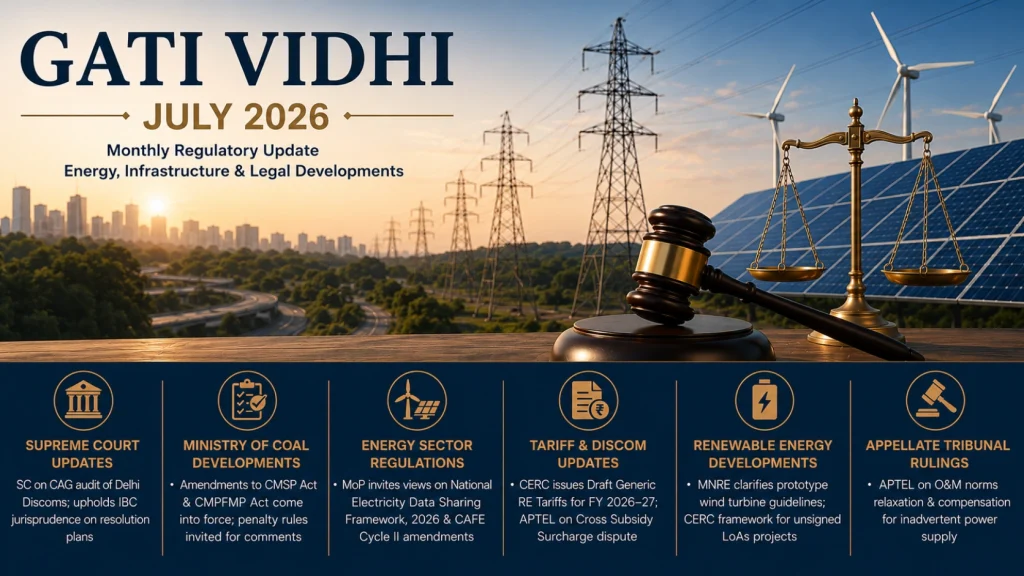
SC holds that legality of CAG Audit of Delhi’s private Discoms requires Judicial examination, Orders Status Quo
The Supreme Court, vide its Order dated 03.07.2026 in Civil Appeal Nos. 8732-8733 of 2026, Delhi Electricity Regulatory Commission v. Forum of Regulators & Ors., has held that the question of whether the Delhi Electricity Regulatory Commission (DERC) is legally empowered to entrust the Comptroller and Auditor General of India (CAG) with the audit of Delhi’s private electricity distribution companies raises an arguable issue requiring judicial examination. Pending adjudication of the appeals, the Court stayed the operation of the Appellate Tribunal for Electricity’s (APTEL) direction requiring DERC to appoint an independent Chartered Accountant to conduct the audit and further directed that the CAG shall not proceed with the audit. The Court also ordered maintenance of status quo on all aspects until the next date of hearing.
The Supreme Court observed that the appeals are confined to examining the legality of DERC’s decision to initiate the audit through the CAG and noted the parties’ competing submissions regarding whether completion of the audit is a prerequisite for the recovery of regulatory assets from consumers. Since the issue involves the interpretation of the Supreme Court’s earlier judgment dated 06.08.2025 concerning the liquidation of regulatory assets, the Court directed that the matter be placed before the Bench which delivered the said judgment, subject to orders of the Hon’ble Chief Justice of India.
MoP invites objections and suggestions on the draft amendments to CAFE Cycle II notification
The Ministry of Power (“MoP”) has issued proposed amendments to the Corporate Average Fuel Efficiency (CAFE) Cycle II notification issued under the Energy Conservation Act, 2001, which seek to operationalise the compliance framework under the existing CAFE regime by introducing a comprehensive mechanism for accounting, banking, trading and settlement of compliance credits and debits.
The salient features of the proposed amendments are as follows:
- Insertion of key definitions, including “Credit”, “Debit”, “Pooling”, “Passbook” and “Reporting Period”, to facilitate implementation of a market-based compliance mechanism.
- Manufacturers whose fleet-average fuel consumption performs better than the prescribed target would earn compliance credits, while those exceeding the prescribed limits would accumulate debits.
- Credits and debits would be calculated based on the difference between the applicable fuel consumption target and the manufacturer’s actual fleet-average performance, expressed in grams of CO₂ per kilometre.
- Introduction of a credit trading and banking mechanism – manufacturers would be permitted to carry forward credits and debits throughout the 5-year compliance block from FY 2022-23 to 2026-27 and voluntarily exchange or trade credits with other manufacturers on mutually agreed terms.
- Any unutilised credits remaining at the end of the compliance block would lapse.
- Manufacturers would be allowed to offset debit balances by purchasing compliance credits from the Bureau of Energy Efficiency (“BEE”) for each reporting period.
- All credit transactions must be completed by 30.09.2027, following which the designated agency will submit the final compliance passbooks to the BEE by 31.10.2027.
- While compliance will continue to be assessed annually, penalties for non-compliance will be determined at the conclusion of the 5-year compliance block.
- Amounts received from penalties and credit buyouts will be credited to the Central Energy Conservation Fund.
Stakeholders can submit objections and suggestions within 14 days from the publication of the draft notification in the Official Gazette.
The proposed amendments can be accessed here.
MoC invites comments and suggestions on the Draft Coal Mines Provident Fund and Miscellaneous Provisions (Adjuqdication of Penalties and Appeal) Rules, 2026
The Ministry of Coal (“MoC”) has, vide office memorandum dated 13.07.2026, issued the Draft Coal Mines Provident Fund and Miscellaneous Provisions (Adjudication of Penalties and Appeal) Rules, 2026 (“Draft Rules”) for the implementation of the provisions of the Jan Vishwas (Amendment of Provisions) Act, 2026.
The Draft Rules seek to establish a framework for adjudication of penalties and appeals under Sections 9, 9A and 9B of the Coal Mines Provident Fund and Miscellaneous Provisions Act, 1948.
The salient features of the proposed amendments are as follows:
- Initiation of inquiries by the Adjudicating Officer, either suo motu or upon receipt of a complaint, in cases of contraventions or non-compliance under the Act, after recording reasons for initiation.
- An Inquiry Officer, not below the rank of Enforcement Officer / such other officer as may be authorised by the Central Government, having knowledge of the facts and circumstances, may be appointed by the Adjudicating Officer for the inquiry proceedings.
- Notice may be issued where the Adjudicating Authority is satisfied that there exists a prima facie case for inquiry.
- At least 15 days and not more than 30 days shall be granted for submission of a reply.
- Appeal against an order of the Adjudicating Authority can be filed within 30 days from the date of receipt of order, which shall, as far as practicable, be disposed of within 60 days from filing.
- Reasonable opportunity of being heard is to be provided to the person concerned at both stages.
The Draft Rules also provide for the manner in which the notices, communications and orders are to be served, powers of the Adjudicating Authority and Appellate Authority, factors for determination of penalty, payment and recovery and procedure for disposal of appeal.
Stakeholders can submit comments and suggestions by 26.07.2026.
The office memorandum dated 13.07.2026 can be accessed here.
MoC invites comments on the draft amendments consequent to the enactment of the Jan Vishwas (Amendment of Provisions) Act, 2026
MoC has, vide notice dated 13.07.2026, invited comments and suggestions on draft amendments consequent to the enactment of the Jan Vishwas (Amendment of Provisions) Act, 2026 (“Amendment Act”). The Amendment Act, which was notified on 08.04.2026, amended the Mines and Minerals (Development and Regulation) Act, 1957 (“MMDR Act”) to decriminalise contraventions of rules or terms and conditions of mineral concessions / operating rights. The said amendments were given effect from 01.08.2026.
The Draft Minerals (Manner of Holding Inquiry and Appeal) Rules, 2026 was notified on 11.06.2026 to effectively implement the amended provisions of the MMDR Act. The said Rules stipulated who can file a complaint for contravention of the MMDR Act, the manner in which the proceedings are to be conducted, the manner in which an appeal can be filed, the timelines, the manner in which a notice or order shall be served, the factors to be considered while determining the quantum of penalty, transfer of complaint, etc.
Consequential changes have been made in the Mineral Concession Rules, 1960, Colliery Control Rules, 2004 and Coal Blocks Allocation Rules, 2017 to insert / substitute the amended penalties, which are as follows:
- Mineral Concession (Second Amendment) Rules, 2026 – Substitution of Rule 76 in Mineral Concession Rules, 1960.
- Colliery Control (Amendment) Rules, 2026 – Substitution of Rule 13 in Colliery Control Rules, 2004.
- Coal Blocks Allocation (Second Amendment) Rules, 2026 – Insertion of Rule 18 in Coal Blocks Allocation Rules, 2017.
Stakeholders can submit comments and suggestions within 21 days from the date of issuance of the notice.
The notice dated 13.07.2026 can be accessed here.
MNRE issues clarification to the amendment to Revised Guidelines for installation of prototype wind turbine models
The Ministry of New and Renewable Energy (“MNRE”) has, vide office memorandum dated 14.07.2026, issued a clarification with respect to the earlier office memorandum dated 25.06.2026 regarding the amendment to the revised guidelines for installation of prototype wind turbine models.
MNRE has clarified that the installation of prototype wind turbine models for commercial deployment shall be undertaken only after inclusion of the wind turbine model in the Approved List of Models and Manufacturers (Wind) (“ALMM (Wind)”) List.
However, they may be continued to be installed and commissioned for testing purposes prior to enlistment in the ALMM (Wind) List in accordance with clause 5 of the Revised Guidelines dated 12.06.2025.
The office memorandum dated 25.06.2026 can be accessed here. The office memorandum dated 14.07.2026 can be accessed here.
APTEL clarifies scope of CERC’s jurisdiction during IBC Moratorium in Cross Subsidy Surcharge Dispute
The Appellate Tribunal for Electricity (“APTEL”) vide Order dated 08.07.2026 passed in Appeal No.13 of 2021, Arcelormittal Nippon Steel India Ltd. v. Dakshin Gujarat Vij Company Ltd and Ors has dismissed the Appeal filed by Arcelormittal Nippon Steel India (“Appellant”) challenging jurisdiction of the Central Electricity Regulatory Commission (“CERC”) to determine liability to pay Cross Subsidy Charges under the Electricity Act, 2003 in view of the moratorium under Section 14 of the Insolvency and Bankruptcy Code, 2016.
The Appellant was granted status of regional entity in Gujarat on certain conditions including payments of CSS applicable under the Electricity Act and the relevant Regulations of GERC. Arcelormittal Nippon Steel India (formerly ESSAR Steel India Limited) was admitted into corporate insolvency under IBC and a moratorium was declared under Section 14 of IBC. After Essar Steel was admitted into CIRP, Dakshin Gujarat Vij Company Ltd (“DGVCL”) filed its CSS claim before the Resolution Professional, and CERC declined to grant enforcement reliefs against Essar Steel due to the moratorium under Section 14 of the IBC. CERC vide the Order dated 06.11.2018 (“Impugned Order”) observed that any determination and recovery of CSS liability would be addressed through the appropriate regulatory forum and the insolvency proceedings. Appellant challenged the observations of the CERC made under certain paragraphs of the Impugned Order regarding its CSS liability, contending that Commission had exceeded its jurisdiction despite being barred from proceeding under the IBC moratorium.
APTEL held that the CERC did not exceed its jurisdiction or create any fresh liability against the Appellant, as the observations in the Impugned Order merely reiterated its earlier findings on the Appellant’s liability to pay applicable Cross Subsidy Surcharge in accordance with the Electricity Act, 2003 and GERC Regulations. The APTEL held that CERC neither undertook the computation or final determination of CSS liability, which remained within GERC’s jurisdiction, nor had it violated the IBC moratorium since it had only declined enforcement action and left DGVCL’s claim to be dealt with through the insolvency process before the Resolution Professional and the appropriate forum. With these observations, the Appeal was dismissed.
APTEL holds that uniform O&M Norms may be relaxed in exceptional regional circumstances
The Appellate Tribunal for Electricity (“APTEL”) by its Order dated 08.07.2026 passed in Appeal No.296 of 2021, North East Transmission Company Limited v. Central Electricity Regulatory Commission set aside the CERC Order dated 27.01.2021 passed in Petition No.191/MP/2019 (“Impugned Order”).
The North East Transmission Company Limited’s (“NETCL”) being aggrieved by the inadequacy of the normative O&M expenses specified under the Tariff Regulations, 2014, approached the CERC under Regulations 54 and 55 of the Tariff Regulations, 2014, seeking relaxation of the O&M norms on the ground that it is a single-project company operating in the difficult terrain of the North-Eastern Region. By the Impugned Order, the CERC did not provisions of power to relax to allow relaxation of normative O&M expenses to the Appellant inter alia stating that the norms were finalised based on the data collected for actual O&M expenses for all the transmission licensees.
The APTEL held that although the CERC Tariff Regulations, 2014 prescribe uniform normative O&M expenses, NETCL’s case warranted relaxation under Regulation 54 because it is a single-project transmission licensee operating exclusively in the North Eastern Region, where difficult terrain, remoteness, and higher maintenance costs make the pan-India norms inequitable. APTEL further found that CERC failed to adequately consider these exceptional circumstances, incorrectly recorded that NETCL had not submitted relevant data, and overlooked evidence showing significantly higher regional O&M costs. Accordingly, the APTEL set aside the Impugned Order and remanded the matter to CERC to exercise its power to relax, undertake a prudence check of the actual O&M expenses, and determine reasonable O&M charges after accounting for NETCL’s unique operational conditions.
APTEL upholds restitutionary claim of Generator for power supplied non-gratuitously
The Appellate Tribunal for Electricity (“APTEL“), vide its Order dated 07.07.2026 passed in Appeal Nos. 11 of 2022 and 468 of 2022, partly allowed the appeal filed by Vibrant Greentech India Private Limited (“VGIPL“) and dismissed the cross-appeal filed by Andhra Pradesh Southern Power Distribution Company Limited (“APSPDCL“), affirming that an unapproved PPA is unenforceable under the Electricity Act, 2003, while allowing compensation under Section 70 of the Indian Contract Act, 1872 for power supplied under the arrangement.
VGIPL established a 4.25 MW wind power project in Andhra Pradesh and executed a PPA with APSPDCL on 30.03.2017 based on the APERC-approved Model PPA. Although the project was commissioned and power was supplied to the grid, the PPA was never placed before the Andhra Pradesh Electricity Regulatory Commission (“APERC“) for approval under Section 86(1)(b) of the Electricity Act, 2003. Subsequently, APSPDCL treated the power as inadvertent supply, disconnected the project, and disputed the enforceability of the PPA. APERC held that the PPA was unenforceable for want of regulatory approval but awarded compensation under Section 70 of the Indian Contract Act, 1872 for the electricity supplied. Both VGIPL and APSPDCL challenged the order before the Tribunal.
The APTEL held that execution of a PPA in the format of the approved Model PPA does not dispense with the mandatory requirement of obtaining the State Commission’s approval under Section 86(1)(b) of the Electricity Act, 2003. Since the PPA executed in 2017 was never placed before APERC, it was unenforceable and incapable of binding APSPDCL. However, the APTEL found that APSPDCL exceeded its authority by disconnecting the project while proceedings regarding the validity of the PPA were still pending before APERC. It further held that despite the PPA being unenforceable, the electricity generated and injected into the grid was lawfully supplied, accepted and utilized by APSPDCL. Accordingly, the Tribunal upheld the grant of compensation under Section 70 of the Indian Contract Act, 1872, observing that the absence of an enforceable contract does not defeat a restitutionary claim where one party has knowingly enjoyed the benefit of a lawful, non-gratuitous act. While affirming the entitlement to compensation, the Tribunal set aside the compensation rate of Rs. 2.93 per unit and remanded the matter to APERC for fresh determination of (i) appropriate compensation for the energy supplied and (ii) compensation for the loss of opportunity during the period of wrongful disconnection.
CERC issues Draft Generic Renewable Energy Tariffs for FY 2026–27
The Central Electricity Regulatory Commission (CERC), vide its Draft Proposal dated 03.07.2026 issued under Regulation 8 of the Central Electricity Regulatory Commission (Terms and Conditions for Tariff Determination from Renewable Energy Sources) Regulations, 2024, has proposed the levelized generic tariffs applicable to eligible renewable energy projects proposed to be commissioned during FY 2026–27 (from 1 August 2026 to 31 March 2027).
The draft continues the regulatory framework for determining generic tariffs for technologies such as small hydro, biomass, biomass gasifier, biogas, non-fossil fuel-based cogeneration, and refuse-derived fuel (RDF)-based municipal solid waste projects, while solar, wind, hybrid renewable energy and energy storage projects will continue to be governed under the project-specific tariff framework. The Commission has invited comments and suggestions from stakeholders on the draft proposal before finalizing the tariffs and the same may be emailed to secy@cercind.gov.in and advisor-re@cercind.gov.in b y 21.07.2026.
The draft proposal retains the existing capital cost norms, 70:30 debt-equity ratio, normative return on equity, project life, and operation and maintenance escalation factor, observing that the prevailing benchmarks continue to reflect market conditions. It also revises the normative biomass and bagasse fuel prices in line with the prescribed escalation methodology and proposes technology-specific levelized tariffs for the eligible renewable energy projects for FY 2026-27. Further, the Commission has clarified that any subsidy, grant or incentive received from the Central or State Government, which has not been factored into the tariff determination, shall be adjusted in future tariff payments, thereby ensuring consistency with the tariff principles under the Renewable Energy Tariff Regulations, 2024.
A copy of the Draft Proposal dated 03.07.2026 can be viewed here.
CERC issues one-time four-option framework for RE Projects with connectivity granted against unsigned LoAs
CERC, vide its Order dated 10.07.2026 in Petition No. 11/SM/2026, has introduced a one-time regulatory framework for renewable energy (RE) developers who have been granted transmission connectivity against Letters of Award (LoAs) but have not executed the corresponding Power Purchase Agreements (PPAs) within the prescribed period. Recognising that a significant quantum of Inter-State Transmission System (ISTS) connectivity remained blocked due to unsigned PPAs, the Commission has sought to optimise the utilisation of transmission infrastructure while providing developers with greater regulatory flexibility. The framework applies to projects granted connectivity under the General Network Access (GNA) Regulations (including projects transitioned from the Connectivity Regulations, 2009) based on LoAs issued by RE Implementing Agencies (SECI, NTPC, NHPC and SJVN) between 1 January 2019 and 31 May 2025, where PPAs remain wholly or partly unsigned.
Under the framework, eligible developers are required to exercise one of four options within 60 days of publication of the eligible project list by the Central Transmission Utility of India Limited (CTUIL):
(i) continue with the connectivity by exiting the LoA route upon furnishing a Performance Bank Guarantee of ₹8 lakh/MW, obtaining a No Objection Certificate (NoC) from the concerned REIA and adhering to a revised Scheduled Commercial Operation Date (SCOD);
(ii) substitute the original LoA with a PPA secured under another LoA, subject to the prescribed conditions and timelines;
(iii) voluntarily surrender full or partial connectivity, which may thereafter be reallocated or auctioned by CTUIL; or
(iv) continue under the existing provisions of the GNA Regulations, which shall also be the default position if no option is exercised within the stipulated period. The Order also introduces a mechanism for the reallocation and auction of surrendered connectivity, with auction proceeds proposed to be utilised for reducing transmission charges payable by Designated Inter-State Customers (DICs), thereby promoting efficient utilisation of the ISTS while balancing the interests of project developers and the transmission network.
A copy of the Order dated 10.07.2026 can be viewed here.
 You wish to know more about Neeti Niyaman (the “Firm”) for your own information and use.