Banked, Not Sold: Unpacking the Legal Regime Governing Energy Banking in India
By – Asmita Narula and Kamatham Rishitha
Table of Contents
Introduction
India’s installed non-fossil power capacity crossed 300 GW as in July 2026, placing the country at approximately 60% of its 2030 target of 500 GW of clean energy. At the same time, an increasing volume of renewable energy in India is being developed for commercial and industrial (“C&I”) consumers through open access and captive arrangements, as an alternative to conventional supply from distribution licensees. Central to the commercial viability of renewable power procurement through open access and captive arrangements is the regulatory mechanism known as ‘energy banking’.
Solar and wind power generation are inherently variable, periodical in nature, and generally non-dispatchable, where there are no storage or other forms of firming available. Renewable power generation cannot be predicted with certainty, even during a period of 24 hours of a day. For instance, wind power generation depends on availability of wind at a particular velocity and solar power generation depends on the solar irradiance. In such cases, energy banking can help address the mismatch between renewable power generation and consumption for C&I consumers with a steady round-the-clock load. However, the banking framework in India remains fragmented and evolving. The framework differs significantly across States and the attempts to standardize the same have been subject to judicial challenge. The distribution licensees have also increasingly questioned the economic aspect of banking arrangements with the expansion of renewable penetration and open access procurement.
What is Energy Banking?
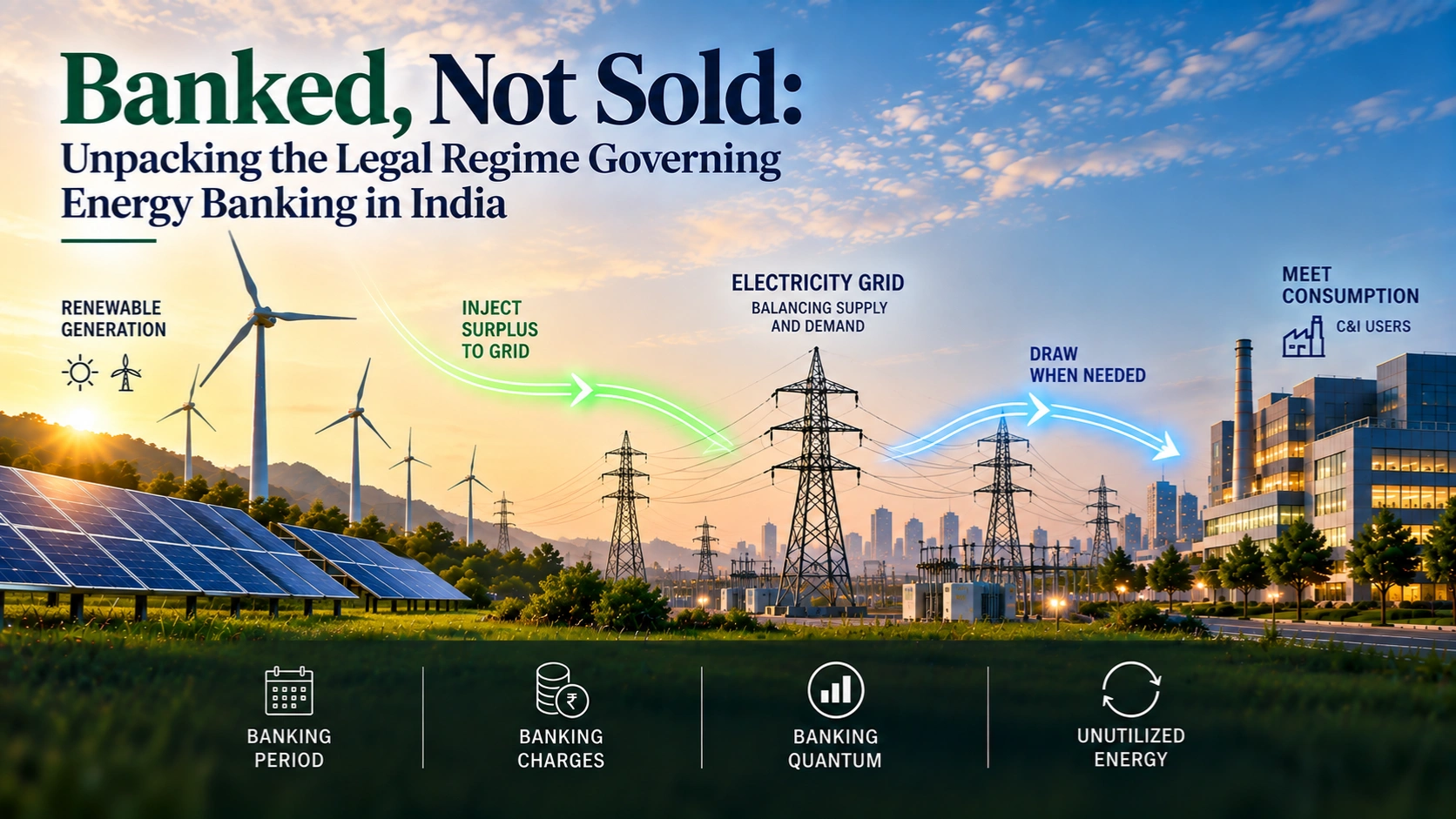
Energy banking is a regulatory and accounting mechanism which allows a renewable energy generator to inject surplus electricity into the grid when generation exceeds consumption, which is credited for subsequent adjustment against electricity drawn from the grid when the position reverses, much like depositing and withdrawing funds from a bank account, only the currency is electricity. The electricity is, however, not actually physically stored in the grid.
Energy banking is subject to applicable banking charges, banking period, quantum restrictions and other settlement conditions.
- Banking charge is the fee payable to the distribution licensee for availing banking facility, as determined under the applicable regulatory framework, which can be paid in cash or in-kind, that it, as a percentage deduction from the banked energy.
- Banking period is the settlement window within which injected and withdrawn energy must be reconciled.
- Banking quantum is the amount of energy that can be banked during the applicable cycle.
- Unutilized energy is energy banked but not drawn back within the period. Such energy may lapse, be carried forward, or be compensated in cash, depending on the applicable regulatory framework.
The Appellate Tribunal for Electricity (“APTEL”) has explained the concept of banking using the analogy of a small savings account in a bank. A person deposits his surplus amount in a savings account from which he can withdraw as per his requirement, while earning interest on the deposited amount. The bank in turn gives loans to other customers at a higher interest rate. Thus, both the account holder and bank are benefiting. Similarly, in a situation where the generator generates electricity when its captive user does not require it, the generator can ‘bank’ it with a distribution licensee, who supplies this energy to its consumers at the applicable tariff. The generator can later withdraw the said energy from the grid as per its requirements, subject to applicable restrictions. The difference is that unlike an actual bank which pays interest to the account holder, the distribution licensee earns interest on the banked energy.
Origin and Historical Development
In India, energy banking traces back to 1986, when the Tamil Nadu Electricity Board introduced the concept to encourage captive and third-party wind power projects. Large volumes of surplus power was produced in the limited windy months and hours, and banking allowed this surplus power to be injected into the grid, which would otherwise be wasted, and drawn back when the wind dropped, thereby materially improving the commercial viability of wind generation in the State. For around two decades thereafter, banking developed primarily as a promotional mechanism for renewable energy projects in India. It was initially introduced by State Electricity Boards and was subsequently continued and regulated by State Commissions. The terms were often accommodative, such as annual or extended banking periods and relatively concessional banking charges. Subsequently, several States adopted similar mechanisms as renewable generation expanded.
With the implementation of the Electricity Act, 2003 (“the Act”), the power sector was liberalized and regulatory framework was consolidated. The Act introduced open access and captive generation and provided for constitution of the Central Electricity Regulatory Commission and State Electricity Regulatory Commissions (“State Commissions”). The Act however does not expressly define ‘banking’. The terms governing banking have been developed largely though regulations notified by the State Commissions and the orders passed by it, subject to the statutory scheme of the Act. This regulatory structure has contributed to the fragmented landscape that persists today, with banking terms largely determined at the State level.
As India’s renewable and clean energy targets expanded from 175 GW renewable energy in 2022 to 450 GW renewable energy by 2030 and now to 500 GW clean energy by 2030, the open-access C&I consumers market also grew. The distribution licensees, however, increasingly argued that banking can impose additional procurement, balancing and settlement costs. The underlying commercial issue was simple, that is, energy injected into the grid at one time may be credited for withdrawal later when the distribution licensee may face different procurement, balancing or system costs. To resolve this, they started seeking different terms for different States in the form of higher banking charges, shorter banking periods, restrictions on withdrawal to the same or a lower tariff time-block as injection, etc.
Parallelly, the Ministry of Power, Government of India, notified the Electricity (Promoting Renewable Energy Through Green Energy Open Access) Rules, 2022 on 06.06.2022 (later amended in 2023) with the objective of promoting generation, purchase and consumption of green energy. As originally notified and amended, these rules provided that consumers having a contracted demand or sanctioned load of 100 kW and above were eligible for Green Energy Open Access, with no such limitation on captive consumers, and a minimum monthly banking facility of 30% of the consumer’s total monthly consumption from the distribution licensee, with banked energy to be adjusted within the same month and no carry-forward of unutilized surplus. However, these rules were declared ultra vires by the Karnataka High Court in Brindavan Hydropower Private Limited v. Union of India and Ors. on the ground that all aspects relating to open access are within the exclusive domain of the State Commissions and the Central Government does not have the power to frame any rules in this regard. The Court also struck down the Karnataka Electricity Regulatory Commission (Terms and Conditions for Green Energy Open Access) Regulations, 2022, which the Commission had notified to implement these rules. This decision of the Karnataka High Court has been covered in detail in our previous article. Notably, appeals are pending as on date against this judgment before the Division Bench of the Karnataka High Court.
The Forum of Regulators, a statutory body constituted under Section 166(2) of the Act, subsequently developed the Model Connectivity and General Network Access to the Intra-State Transmission and State Distribution System Regulations, 2026, which provided for banking of renewable energy generation. While these regulations stipulate that surplus energy from a ‘non-firm’ Renewable Energy Generating Station shall be banked with the distribution licensee after set-off, it also provides that the banking provisions and charges shall be determined by regulations or orders issued by the concerned State Commissions. These regulations further provide that banking charges are to be adjusted in kind at 8% of the energy banked or as specified by the State Commission, and are to be billed, collected and disbursed as per the procedure stipulated by the applicable State Regulations / Orders / Procedures.
Legal Stance – Judicial and Regulatory Precedent
Banking has led to multiple litigations, where the distribution licensees have increasingly argued for discontinuation of banking altogether, increase in banking charges, and shorter banking periods, while generators have argued for continuation of banking on existing and unmodified terms. Over decades, generators and investors have committed substantial capital relying on established and generous banking policies, owing to which the doctrine of ‘legitimate expectation’ became a central and recurring theme in the litigation involving changes to the established banking arrangements.
The legality and computation of energy banking charges for wind energy generators in Tamil Nadu was dealt with by APTEL in Beta Wind Farm Private Limited & Ors. v. Tamil Nadu Electricity Regulatory Commission & Ors.. In Tamil Nadu, banking had been introduced with banking charges fixed at 2%, which were later increased to 5%. The Tamil Nadu Electricity Regulatory Commission substantially increased the banking charges from 5% to Rs. 0.94/unit (difference between the national average bilateral trading price and the wind tariff) without hearing the stakeholders, which was set aside by APTEL with a direction to the Commission to reconsider the computation after hearing the stakeholders. APTEL also directed the Commission to keep in view the decision in Tamil Nadu State Electricity Board, wherein APTEL upheld the decision of the Commission rejecting the increase in the banking charges from 5% to 15%, on the ground that there was no reason to increase the banking charges and such an increase was too radical.
In Tamil Nadu Spinning Mills Association v. Tamil Nadu Electricity Regulatory Commission & Ors., APTEL recognized the need to strike a balance between competing interests and observed that while consumer interest and financial health of the distribution licensee are important, the provisions in regard to third party sale, open access and renewable energy sources are of equal significance. APTEL held that changes in the banking framework cannot be introduced on an ad-hoc basis and the Commission was required to undertake a proper study based on requisite data, properly gathered and analyzed, to assess the financial impact on the various stakeholders.
In Maharashtra, banking facility for those wind energy generators who wanted to supply power to consumers under open access was introduced by the Maharashtra Electricity Regulatory Commission by an order dated 24.11.2003. While upholding the order passed by the Commission continuing the said banking facility in Maharashtra State Electricity Distribution Company Limited v. Maharashtra Electricity Regulatory Commission & Ors., APTEL observed that banking of wind energy is an essential feature enabling the commercial viability of wind energy generators, given the variability of wind generation and the mismatch between generation and the consumer’s load profile. APTEL also recognized that banking could be justified as a measure for promotion of renewable energy under Section 86(1)(e) of the Act.
In Fortune Five Hydel Projects Pvt. Ltd. & Ors. v. Karnataka Electricity Regulatory Commission & Ors., APTEL set aside the order passed by the Karnataka Electricity Regulatory Commission modifying the existing banking arrangement for non-REC renewable energy projects – (a) the banking period was reduced from one year to 6 months, and (b) Time-of-Day (“ToD”) restrictions were introduced on withdrawal i.e., withdrawal during peak ToD hours was restricted to energy banked during the corresponding peak ToD hours. APTEL concluded that the order was passed without adequate data or analysis of the actual financial impact on either side, in violation of the principles of natural justice, and in breach of the doctrines of promissory estoppel and legitimate expectation, given that the Wheeling and Banking Agreements (“WBA”) in this case guaranteed annual banking for a fixed 10-year term. This decision has been challenged before the Supreme Court and is pending as on date.
In Mangalam Cement Ltd. v. Jaipur Vidyut Vitran Nigam Ltd. & Anr., APTEL recognized that the applicability of subsequent regulatory changes to the existing arrangement depends inter alia on the governing contractual and regulatory framework. In this case, APTEL has held that the Rajasthan Electricity Regulatory Commission (Terms and Conditions for Determination of Tariff) Regulations, 2014, which altered the provisions relating to wheeling and banking, were applicable to Power Purchase Agreements / WBA, executed prior to the notification of the said Regulations, in view of the settled law that regulations override existing contractual arrangements and the fact that the WBA expressly provided that banking of energy had to be regulated as per the Commission’s order and amendments made from time to time.
The legal principles can thus be summarized as follows:
- Any material alteration of the banking framework must be supported by State-specific data and analysis. Bare assertions of the financial loss of distribution licensees are insufficient.
- Generators, who have made substantial investments relying on stable and long-standing banking terms, particularly where an existing WBA expressly guarantees a specified banking facility for a fixed term, an abrupt alteration of such arrangement may attract the doctrines of legitimate expectation and promissory estoppel. However, these doctrines are not absolute, and their applicability depends upon the terms of the governing agreement, the applicable regulatory framework and the circumstances of the case.
- The regulatory framework must strike a fair balance between promotion of renewable energy and protection of the economic interests of utilities and consumers.
- Material changes to the banking dispensation must be introduced through a fair, transparent and reasoned regulatory process. Affected stakeholders must be afforded an adequate opportunity to be heard. The absence of proper consideration of stakeholder submissions, requisite data and the financial consequences of the proposed changes may render the decision arbitrary and liable to be set aside.
- While contractual protection and legitimate expectation may operate where the governing agreement guarantees a particular banking dispensation for a fixed period, subsequent regulations or orders may alter the banking framework, including in relation to existing arrangements, where the contractual and statutory framework permits such modification.
Maharashtra: A recent regulatory shift
The debate over the regulatory treatment of banked energy has assumed particular significance in Maharashtra. What began as an increase in banking charges from 2% of the banked energy to 8% of the banked energy in 2023 has since evolved into a more fundamental change in the manner in which banked energy may be adjusted and drawn, through the introduction of ToD based restrictions in 2025. These changes have been the subject of repeated regulatory and judicial scrutiny, culminating in interim protection being granted by APTEL in April 2026. The events leading to the grant of interim protection are summarized as follows:
- In Maharashtra, the framework permitted energy banked during peak hours to be adjusted against consumption during peak-hours as well as any other hours. Conversely, energy banked during non-peak hours could be adjusted against consumption during such other hours, but not against peak-hour consumption.
- The Commission subsequently altered this dispensation by providing that energy banked during solar hours (09:00 – 17:00) could be drawn only during the same solar-hour ToD slot, while energy banked during normal ToD hours could not be drawn during peak hours, thereby materially restricting the fungibility of banked energy across different ToD slots and reducing the practical utility of banking for consumers whose consumption does not correspond to renewable generation hours.
- The Bombay High Court set aside the order passed by the Commission and remanded the matter for fresh consideration after consulting and hearing the affected stakeholders and taking their objections into consideration. In a challenge to the High Court’s decision, the Supreme Court remanded the matter to the Commission with a direction to decide the matter within 12 weeks after providing a hearing to all concerned stakeholders.
- The Commission undertook fresh proceedings and retained a ToD-based framework governing the adjustment of banked energy. The Bombay High Court did not interfere in view of an equally efficacious statutory remedy available before APTEL under Section 111 of the Act.
- In an appeal against the Commission’s order, APTEL passed an interim order, whereby a stay has been granted on the disconnection notices as well as the bills, in so far as these reflect the amounts calculated in terms of the new mechanism. The appellants have however been directed to continue paying banking charges as per the previous regime. The substantive validity of the revised banking framework is therefore presently sub-judice before APTEL.
Conclusion
Energy banking has travelled a long way from the promotional mechanism introduced in Tamil Nadu in 1986 to encourage wind generation. It has now become a significant and increasingly litigated feature of India’s electricity regulatory landscape, with direct implications for the commercial viability of open-access and captive renewable energy projects in India. Yet, despite the rapid expansion of renewable capacity, there remains no uniform national framework governing banking. Its terms continue to vary substantially across States, while attempts at standardisation have themselves become the subject of constitutional and regulatory challenge.
The Forum of Regulators’ model regulations may facilitate greater consistency, but they themselves preserve a substantial role for State-specific regulations and orders. The future of energy banking, therefore, may not lie in choosing between complete standardisation and continued State-by-State divergence. It may instead lie in developing a regulatory framework that recognises the underlying grid-balancing function that banking performs, prices that service transparently, and increasingly integrates storage and other forms of flexibility into the renewable-energy market. Until that framework emerges, however, banking will remain a critical commercial consideration and a continuing fault line between renewable-energy developers, open-access consumers, distribution licensees and regulators.
FAQs
-
What is energy banking in India?
Energy banking in India is a regulatory and accounting mechanism that allows renewable energy generators, particularly under open access and captive arrangements, to inject surplus electricity into the grid when generation exceeds consumption and subsequently adjust that banked energy against electricity drawn from the grid when required. It therefore helps address the mismatch between the variable generation of renewable sources such as wind and solar and the relatively steady consumption of C&I consumers.
-
How does energy banking work for renewable energy projects?
For renewable energy projects, energy banking works by allowing a generator to inject surplus electricity into the grid when generation exceeds its immediate consumption and subsequently adjust that banked energy against electricity drawn from the grid when required. This is particularly useful for variable renewable sources such as solar and wind, where generation may not coincide with the consumer’s demand.
-
What are the banking charges for renewable energy in India?
Banking charges for renewable energy in India are not uniform across all States. The said charges vary State-wise and are generally determined by the concerned State Electricity Regulatory Commission.
-
How is energy banking regulated under the Electricity Act 2003?
The Electricity Act, 2003 does not expressly define or provide a specific statutory framework for energy banking. Banking is primarily regulated through the powers of the State Electricity Regulatory Commissions. Section 86(1)(e) of the Act requires State Commissions to promote renewable energy by providing suitable measures for grid connectivity and sale of electricity, which has provided the statutory basis for State-level banking mechanisms.
-
What are the recent changes to energy banking regulations in Maharashtra?
In 2023, the banking charges were increased from 2% to 8% of the banked energy. Subsequently, in 2025, a change was introduced in the manner in which banked energy may be adjusted and drawn, which led to initiation of litigation. The State Commission introduced Time-of-Day (ToD) based restrictions i.e., energy banked during solar hours could be drawn only during the same solar-hour ToD slot and energy banked during normal ToD hours could not be drawn during peak hours.
References –
- Press Release dated 09.08.2026 by Press Information Bureau (Ministry of New and Renewable Energy)
- Press Release dated 26.04.2026 by Press Information Bureau (Ministry of Commerce and Industry)
- Tamil Nadu State Electricity Board v. Tamil Nadu Electricity Regulatory Commission & Ors., Judgment dated 18.03.2011 in Appeal No. 98 of 2010
- Press Release dated 19.07.2018 by Press Information Bureau (Ministry of New and Renewable Energy)
- Press Release dated 11.10.2021 by Press Information Bureau (Ministry of New and Renewable Energy)
- Electricity (Promoting Renewable Energy Through Green Energy Open Access) Rules, 2022 (as amended in 2023)
- Judgment dated 20.12.2024 in Writ Petition No. 11235/2024 (GM-KEB)
- Writ Appeal No. 154/2025 and Writ Appeal No. 515/2025
- Forum of Regulators comprises of the Chairperson of the Central Electricity Regulatory Commission and the Chairpersons of the State Electricity Regulatory Commissions
- Model Connectivity and General Network Access to the Intra-State Transmission and State Distribution System Regulations, 2026
- Regulation 39
- Judgment dated 24.05.2013 in Appeal No. 197/2012 and batch matters
- supra
- Judgment dated 28.01.2021 in Appeal No. 191/2018 and batch matters
- Judgment dated 01.08.2014 in Appeal No. 59/2013
- Judgment dated 29.03.2019 in Appeal No. 42/2018 and batch matters
- Civil Appeal No. 9619-9637/2019
- Judgment dated 18.12.2023 in Appeal No. 230/2018
- Maharashtra Electricity Regulatory Commission (Distribution Open Access) Regulations, 2016
- Maharashtra Electricity Regulatory Commission (Distribution Open Access) (Second Amendment) Regulations, 2023
- MERC’s Multi-Year Tariff Order dated 28.03.2025 in Case No. 217/2024
- Review Order dated 25.06.2025 in Case No. 75/2025
- Judgment dated 03.11.2025 in O2 Renewable Energy VII Private Limited v. Maharashtra Electricity Regulatory Commission & Anr., W.P. (L) No. 19437/2025 and connected matters
- Order dated 17.11.2025 passed in SLP (C) Nos. 32900-32911/2025
- Order dated 25.03.2026 in Case No. 75/2025
- Judgment dated 24.04.2026 in Distributed Solar Power Association & Ors. v. Maharashtra Electricity Regulatory Commission & Anr., W.P. (L) No. 12167/2026
- Order dated 27.04.2026 passed in Appeal No. 130/2026 and batch matters
 You wish to know more about Neeti Niyaman (the “Firm”) for your own information and use.