UK Government says: “No Smoking”
By – Nikhil Anand
Table of Contents
Introduction
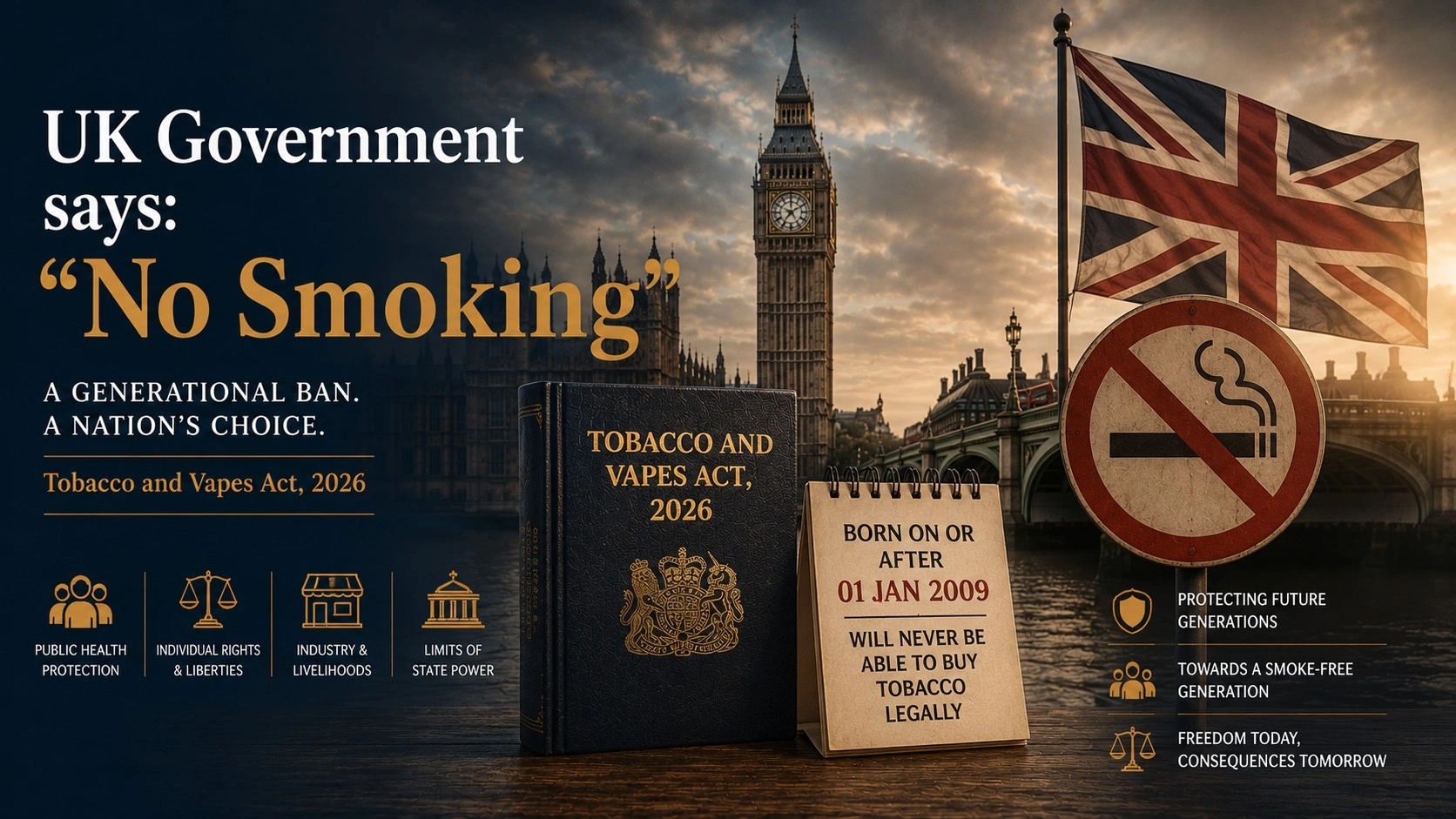
The United Kingdom’s decision to prohibit the sale of cigarettes to anyone born after 2009 by enactment of the Tobacco and Vapes Act, 2026, does something far more unconventional than an ordinary regulatory ban. Rather than criminalising existing smokers or abruptly outlawing consumption of tobacco, the said enactment adopts a gradual and generational approach: anyone legally permitted to purchase cigarettes today may continue to do so, but those born on/after 01st Jan 2009 will never, at any point in their lives, be allowed to buy tobacco products legally.1 In effect, the legal smoking age will rise incrementally every year until smoking disappears, however not through a sudden prohibition, but through demographic extinction over a period of time. The law therefore seeks not merely to regulate smoking, but to phase it out from society itself by ensuring that no new generation can lawfully purchase or consume tobacco products. The subject enactment which has come in force on 29th April 2026 has raised various concerns which are not limited to mere prohibition on consumption of tobacco but extend to individuals rights and liberties, which have been sought to be regulated by the said enactment. It becomes a deeper inquiry into the limits of State power: Whether a government can legitimately decide, in advance, that certain freedoms and the industries built upon them should never exist/operate?
Bentham’s Utilitarian Justification: The Greatest Good for the Greatest Number
If we examine the issue from the perspective of Jeremy Bentham, he would likely have approached the enactment with his theory of utilitarianism.2 This theory would have advocated that, the morality of any law rests entirely upon its consequences. The act of smoking, viewed in utilitarian terms, presents an unusually easy moral calculation. Tobacco causes disease, addiction, premature death, and immense strain on public healthcare systems. Against these harms stand the pleasures of smoking which are temporary, private, and often dependent upon the addiction itself. Even when viewed from the economic perspective, Bentham’s theory of utilitarianism remains fundamentally unchanged. The tobacco industry generates employment, sustains agricultural economies, and contributes substantial tax revenues, but these benefits must still be weighed against the aggregate suffering caused by smoking. If the total pain prevented exceeds the pleasure and economic utility lost, then the enactment is deemed as justified. Indeed, Bentham might argue that a State aware of preventable suffering has a moral obligation to intervene.
Yet a question arises as to the extent to which Bentham’s utilitarian theory can be extended. If liberty may be extinguished whenever its social costs exceed its benefits, then the principle admits very few limits. Tobacco today, alcohol tomorrow, unhealthy food the day after. The logic expands easily because the standard itself is infinitely adaptable. Worse still, utilitarian calculations often conceal the uneven distribution of sacrifice. The benefits of the smoking ban may be collective and long-term, but its economic burdens are immediate and concentrated. Tobacco farmers, small retailers, factory workers, and entire local economies structured around the industry may bear costs that utilitarian theory condensed into numbers. The calculus appears rational from above while feeling profoundly unequal below3.
Mill’s Harm Principle: Freedom Includes the Freedom to Make Mistakes
John Stuart Mill also a believer of utilitarianism would resist the enactment because of the paternalism that such enactment invites. His famous harm principle insists that the State may interfere with liberty only to prevent harm to others, not merely to protect individuals from themselves.4 Smoking complicates this distinction because it is not entirely self-regarding. Passive smoking, public health costs, and addiction among minors provide justifiable grounds for regulation. However, the enactment in its present form does not merely regulate external harms; it eliminates the future possibility of choice altogether. A person born on/after 01st Jan 2009 may reach adulthood fully informed of the risks of smoking and still be denied the freedom to choose it. For Mill, this is dangerous not because smoking is valuable, but because liberty itself requires the space to make even foolish or self-destructive decisions.5
Mill’s theory poses a deeper question that such an act of the State could become a precedent for the expansion of State power. A State that acquires authority to eliminate harmful choices may gradually expand that authority into every sphere of life touched by risk or dependency. Modern societies already confront growing anxieties around alcohol, processed food, gambling, social media addiction, and digital manipulation. Once the principle is accepted that harmful choices may be prevented before they arise, the distinction between governance and moral supervision begins to collapse. Mill understood that freedom is not merely the freedom to act wisely; it is also the freedom to err.6 A society that removes every dangerous choice may eventually remove the very conditions under which individuality, responsibility, and moral growth occur.
Nozick’s Libertarian Critique: The Primacy of Individual Rights
If viewed from the lens of Robert Nozick’s libertarian theory, we would find even Mill’s harm principle too conciliatory. As per Nozick’s libertarian theory, the issue is not whether smoking is harmful or whether eliminating it would improve public welfare. Those considerations are secondary. The central question is whether the State possesses the authority to prevent voluntary exchanges between consenting individuals. Nozick’s philosophy rests on the idea that individuals possess inviolable rights and side-constraints which cannot be overridden even in pursuit of desirable outcomes. If a person wishes to grow tobacco, another wishes to sell it, and a third wishes to consume it, then, so long as no coercion is involved, the resulting transaction is just. Justice, in Nozick’s entitlement theory, depends not on outcomes but on the legitimacy of acquisition and transfer.7
The smoking ban therefore represents, for Nozick, not merely regulation but a profound act of coercive moral ordering. It dismantles an entire market built upon voluntary exchange because the State disapproves of the outcome. Nozick famously argued that redistributive taxation resembles forced labour because it compels individuals to work toward ends, they did not choose.8 The same reasoning may extend here. Tobacco farmers, factory workers, distributors, and retailers are effectively told that their economic activities may no longer exist because society has judged them morally undesirable. The law therefore does not merely regulate harm; it redirects human labour and economic life toward State-approved ends. Even if the result is a healthier society, Nozick would insist that it remains unjust because it sacrifices individual sovereignty to collective welfare.
Autonomy as per Kant’s Theory
Theory of Autonomy as propounded by Immanuel Kant would approach the issue from a more psychologically difficult direction. For Kant, freedom is not simply the capacity to choose but the capacity to act according to rational will.9 This raises an uncomfortable question: is smoking truly a free choice at all? Nicotine addiction often begins early, before mature judgment develops, and frequently binds individuals through dependency rather than reasoned preference. If smoking undermines rational decision/choice making, then preventing individuals from becoming addicted may actually preserve autonomy rather than violate it. In this sense, the law may appear less paternalistic than protective.
This framework questions the certainty of the above conclusion. If the State may prohibit smoking because addiction compromises rational decision/choice making, then what prevents similar interventions by the state in other domains? For instance, Modern Digital economy increasingly profiting from compulsive behaviour, social media designed to capture attention, food engineered for craving, gambling platforms structured around psychological vulnerability. Once governments begin distinguishing between “authentic” and “distorted” choices, they acquire extraordinary authority over the boundaries of rational life itself. In Kant’s word it therefore transforms the debate from one about health into one about who gets to define autonomy. The danger is no longer simply paternalism, but the gradual replacement of individual judgment with institutional judgment masquerading as rationality.
Rawls and Justice as Fairness
John Rawls theory of justice as ‘fairness’ would likely view the issue through the lens of structural inequality. Smoking disproportionately affects poorer communities, reinforcing cycles of ill-health, reduced opportunity, and economic vulnerability. Behind Rawls’s veil of ignorance, where one does not know one’s future social position, a rational person may well choose a society that prevents such predictable harms from emerging.10 The generational smoking ban could therefore be defended as a measure designed to protect the least advantaged and preserve fair equality of opportunity.
But Rawls’s theory also generates a difficult internal tension. The same disadvantaged communities disproportionately harmed by smoking are often economically dependent upon the tobacco industry itself. Tobacco farming, manufacturing, transportation, and retail sustain livelihoods for millions across the world. Eliminating the industry may reduce one form of vulnerability while creating another. A just society cannot ignore the fact that moral reform often redistributes suffering rather than abolishes it. The enactment on the face of it promises long-term health gains, but the burden of transition may ultimately fall upon those already in economically weaker position. This forces us to confront a question that utilitarianism often obscures: who bears the costs of becoming a morally improved society?
Virtue Ethics of Aristotle
Aristotle’s virtue ethics, perhaps more than any modern thinker, would understand the law without apology. For him, law is not morally neutral. Its purpose is not merely to coordinate freedoms or maximise welfare, but to cultivate the virtues necessary for human flourishing.11 A society that permits industries to profit from addiction and self-destruction fails in its ethical purpose. The tobacco market, in this view, is not simply an economic institution but a moral one. To permit it is, in some sense, to endorse the habits it produces. The enactment therefore represents a public judgment about the good life itself a declaration that smoking is incompatible with the kind of society the community seeks to sustain.
And yet Aristotle’s clarity produces its own danger. Once the State assumes responsibility for shaping virtue, it must also determine which forms of life deserve encouragement and which deserve extinction. Tobacco today may appear an easy case. But the logic underlying the ban is broader than smoking itself. A society confident enough to eliminate one harmful market may eventually seek to regulate others gambling, pornography, unhealthy food, digital addiction each justified by reference to flourishing and collective well-being. The line between moral cultivation and moral authoritarianism is rarely visible at the moment it is crossed.
Practical Consequences Beyond Philosophy
Beyond these philosophical tensions lies the unpredictability of social reality itself. Eliminating a legal market does not necessarily eliminate desire; it may simply drive it underground. Black markets may emerge, supplying cheaper and more dangerous products. Corporations may pivot toward alternative nicotine systems, recreating cycles of addiction under different technological forms. Governments that once profited immensely from tobacco taxation may now present themselves as moral reformers, raising uncomfortable questions about whether States are genuinely principled or merely belatedly corrective. Entire communities dependent upon tobacco production may experience economic dislocation long before the promised public health benefits fully materialise.
Hart and Fuller: The Relationship Between Law and Morality
At this stage, the debate ceases to concern smoking alone and begins to reveal something deeper about law itself. H.L.A. Hart would likely insist that many of these moral anxieties are analytically separate from the question of legal validity. A law does not become invalid merely because it is paternalistic or morally controversial.12 If enacted through legitimate constitutional procedure and recognised by legal institutions, it remains law regardless of whether citizens approve of its moral content. Hart’s legal positivism introduces a cold institutional realism into the debate: one may condemn the smoking ban morally while still accepting its legal legitimacy.
Lon Fuller, however, would resist such clean separation between law and morality. Fuller believed that law possesses an internal morality, a requirement of coherence, reciprocity, and fairness embedded within legality itself.13 The smoking ban raises precisely the kind of difficulty Fuller would find significant. Two individuals standing beside each other at age forty may be treated differently forever merely because one was born days earlier than the other. One may legally purchase cigarettes; the other may not. The law appears formally rational, yet its moral coherence becomes harder to defend.
Conclusion: Public Health, Liberty, and the Future of State Power
Ultimately, the enactment cannot be understood merely as a public health measure. It represents a transformation in the philosophy of governance itself from regulating conduct to shaping the horizon of possible conduct, from discouraging harmful behaviour to ensuring that certain choices never emerge at all. It promises a healthier, more equal, and perhaps more virtuous society. Yet it achieves these ends by quietly narrowing the domain of both individual and economic freedom.
Whether this represents moral progress or the beginning of a subtler form of paternalism remains unresolved. To defend the law is to accept that some freedoms and markets may legitimately be extinguished in advance for collective welfare. The enactment advocates a theory where a choice stands extinguished by birth on a certain date. To oppose it is to insist that individuals must remain free even to make destructive choices, and that markets built upon those choices cannot simply be erased because society disapproves of them. Between these positions lies no final reconciliation, only the uneasy recognition that every society, in attempting to become better, must decide what it is willing to sacrifice in the process.
FAQs
-
Why is the UK banning cigarette sales for people born after 2009?
The UK is banning cigarette sales for people born on or after 1 January 2009 to create a “smoke-free generation.” The object of the law is preventive rather than punitive: instead of forcing existing smokers to quit, it seeks to stop future generations from ever legally entering the tobacco market. The underlying rationale is that smoking causes preventable disease, addiction, premature death, and pressure on public healthcare systems.
-
How does the new UK smoking ban law work?
The law works through a generational cut-off. Those who are already legally permitted to buy tobacco may continue to do so, but persons born on or after 1 January 2009 can never be legally sold tobacco products. This means the legal smoking age will effectively increase every year.
-
What are the economic and social impacts of the UK smoking ban?
Economically, the ban may affect the tobacco industry, retailers, distributors, and tobacco-linked livelihoods over time. It may also reduce public healthcare costs and improve productivity by lowering smoking-related illness. Socially, it may reduce addiction and health inequality, particularly because smoking often affects disadvantaged communities more severely. However, there are risks: black markets may emerge, enforcement may become difficult, and the industry may shift toward alternative nicotine products such as vapes. The deeper concern is whether eliminating a harmful market removes the harm itself or merely pushes it into less regulated spaces.
-
Will smoking become completely illegal in the UK in the future?
Not immediately, and not in the traditional sense. Existing smokers are not being criminalised, and those already legally entitled to buy tobacco are not barred from doing so. However, because no one born on or after 1 January 2009 can ever legally be sold tobacco, the lawful consumer base will shrink year by year. Over time, smoking may become legally and socially obsolete, not by sudden prohibition, but by generational phase-out.
References –
- Tobacco and Vapes Act 2026, UK.
- Michael J. Sandel, Justice: What’s the Right Thing to Do?, Ch. 2.
- Id. Chs. 1-2.
- Id. Ch 2.
- Id.
- Id.
- Id.
- Id.
- Id. ch. 5.
- Id. Ch. 6.
- Id. Ch. 8.
- H.L.A. Hart, Positivism and the Separation of Law and Morals, 71 Harv. L. Rev. 593, 594–601 (1958).
- Lon L. Fuller, The Morality of Law 33–94 (rev. ed. 1969).
 You wish to know more about Neeti Niyaman (the “Firm”) for your own information and use.