Regulating Equality: The Promise and Perils of the UGC (Promotion of Equity in Higher Education Institutions) Regulations, 2026
By – Shreya Dubey and Kaushiki
Table of Contents
Introduction
Universities are often described as the conscience of a nation spaces, where intellectual freedom flourishes, social mobility becomes attainable and constitutional values are not merely taught but lived. Yet beneath this idealised vision, Indian higher education has repeatedly confronted uncomfortable truths about exclusion, hierarchy and discrimination at various levels that reflect the social inequalities existing behind campus walls. From subtle biases in academic evaluation and supervision to more overt forms of social isolation and institutional indifference, inequity has persisted as a recurring feature of academic life despite the constitutional guarantees of equality enshrined in Articles 14, 15 and 21.
The enactment of the UGC (Promotion of Equity in Higher Educational Institutions) Regulations, 2012 (“UGC Regulations, 2012”) was targeted towards curtailing this discrimination within campuses and to establish a support system for victims by advocating for establishment of Equal Opportunity Cells and adoption of measures to prevent discrimination against Scheduled Castes, Scheduled Tribes, Other Backward Classes, minorities, women and persons with disabilities. Despite the beneficial and larger intent, the UGC Regulations, 2012 remained advisory in tone and failed to create a rigorous monitoring mechanism, necessitating the enactment of the UGC (Promotion of Equity in Higher Education Institutions) Regulations, 2026(“UGC Regulations, 2026”)1.
Equity under the UGC Framework
The UGC Regulations, 2026 represent both a structural and philosophical shift. At the level of principle, they articulate a broader concept of equity rooted in substantive equality rather than formal non-discrimination. They acknowledge that discrimination is not always explicit or intentional; it may operate indirectly through institutional cultures, structural disadvantage or decision-making patterns that disproportionately affect marginalised communities. By defining discrimination in expansive terms including direct and indirect forms of unequal treatment the Regulations attempt to address the complex and often subtle manifestations of exclusion within academic spaces.
A central innovation of the UGC Regulations, 2026 lies in its emphasis on institutional accountability. Instead of treating discrimination as an isolated personal grievance, the Regulations conceptualise it as a structural issue demanding sustained oversight. Every higher education institution is required to establish an Equal Opportunity Centre with defined responsibilities extending beyond complaint resolution to awareness programmes, sensitisation initiatives, data collection and periodic reporting. An Equity Committee is envisaged to conduct inquiries into complaints, and the regulatory architecture incorporates layered accountability, including escalation mechanisms.
The contrast with the UGC Regulations,2012 is indeed significant. While the earlier regime encouraged the creation of Equal Opportunity Cells, the UGC Regulations,2026 mandate a more comprehensive institutional apparatus with clearly delineated duties and reporting obligations. Time-bound procedures for grievance redressal have been prescribed, and the Commission is empowered to take coercive measures in cases of non-compliance, including withdrawal of grants and placing restrictions on academic privileges. Equity is thus repositioned as a regulatory condition linked to institutional recognition and funding rather than a voluntary best practice.
The grievance redressal mechanism under the new regime is also more structured. The 2012 Regulations lacked detailed procedural timelines and did not provide a clear escalation framework. In contrast, the 2026 framework envisages prompt institutional response and provides recourse to higher oversight bodies, including the Ombudsperson under applicable grievance regulations. This reflects a recognition that delayed responses often compound the icharm experienced by complainants and erode trust in institutional remedies.
Comparative Analysis
| UGC Regulations,2012 | UGC Regulations,2026 | |
| Regulatory Character | Reg 3 r/w Reg 4 encourage institutions to prevent discrimination but do not prescribe consequences of non-compliance. | Reg 3 make the Regulations binding on all Higher Education Institutions (HEI) and Reg 11 (Consequences of Non-Compliance) expressly provides enforcement measures including action under the UGC Act, 1956. |
| Conceptual Framework of Equity | Reg 2(d) defines “discrimination” primarily in terms of denial of equal opportunity; Reg 4 articulates non-discrimination in a formal equality sense. No recognition of indirect discrimination. | Reg 4 expands the equity mandate, where defined in Reg 3 discrimination includes both direct and indirect forms, thereby embedding a substantive equality framework. |
| Institutional Mechanism. | Reg 3(2)(f) mandates establishment of Equal Opportunity Cells (EOCs), composition, tenure, and reporting structure not rigidly prescribed. | Reg 5 mandates establishment of an Equal Opportunity Centre with prescribed composition, defined functions, record-keeping obligations, and institutional accountability. |
| Scope of Responsibilities | Reg 3(2)(g) limits the role largely to addressing complaints and promoting equal opportunity. | Reg 6 and 7 impose structured duties including sensitisation programmes, proactive equity measures, maintenance of complaint records, data collection, and compliance monitoring. |
| Grievance Redressal Procedure | Reg 5 provides for complaint handling but does not prescribe strict timelines, inquiry stages, or mandatory reasoned orders. | Reg 8 establishes a time-bound grievance redressal mechanism with defined stages of inquiry and requirement of reasoned decisions. |
| Escalation Mechanism | Reg 6 provides for appeal, but without a structured external statutory escalation framework. | Reg 9 provides escalation to the Ombudsperson under applicable UGC grievance redressal regulations. |
| Monitoring and Reporting | No express provision mandating periodic reporting to UGC or structured compliance oversight. | Reg 10 mandates periodic reporting to UGC and enables regulatory supervision and review. |
| Enforcement Powers of UGC | No dedicated consequences of non-compliance provision, reliance on general statutory authority under the University Grants Commission Act, 1956. | Reg 11 expressly authorises withholding/withdrawal of grants, suspension of financial assistance, withdrawal of recognition, and initiation of statutory proceedings for continued violation. |
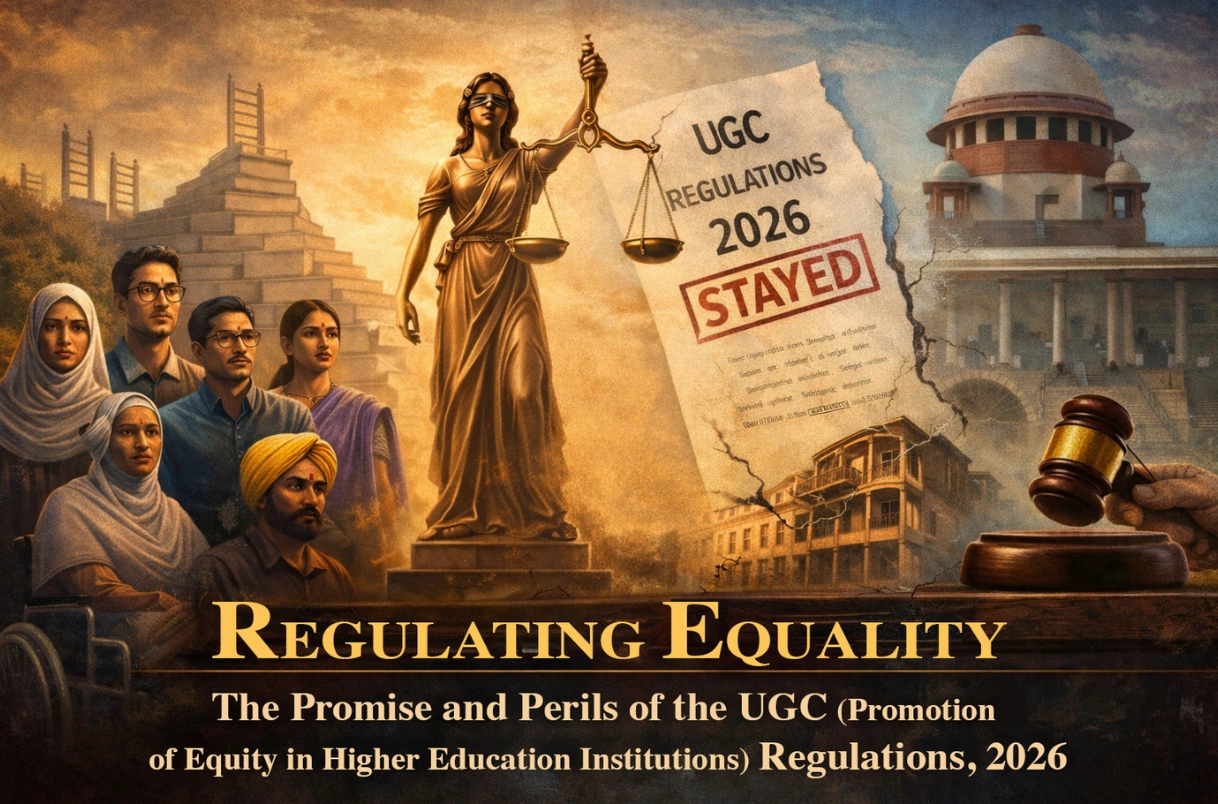
The new regulations seek not merely to prohibit discrimination, but to fundamentally restructure how higher education institutions conceptualise, prevent and respond to it. In doing so, they attempt to transform equity from an ethical aspiration into a binding regulatory mandate, an ambition that has become the subject matter of controversy and constitutional scrutiny, to the extent that the same have been stayed by the Supreme Court of India within a month from their notification.
Supreme Court on the UGC Regulations, 2026
Multiple writ petitions were filed challenging the validity of the 2026 Regulations. Among the principal petitions were W.P. (C) No. 101/2026 titled Mritunjay Tiwari v. Union of India & Anr., W.P. (C) No. 108/2026 titled Rahul Dewan & Ors. v. Union of India & Anr. and W.P. (C) No. 109/2026 titled Vineet Jindal v. Union of India & Anr.2 Particularly, the definition of “caste-based discrimination” under Section 3(c) is the subject matter of contention, since it restricts discrimination on the basis of caste or tribe against the members of the scheduled castes, scheduled tribes, and other backward classes only. Therefore, it has been argued to be restrictive and exclusionary since it will render persons belonging to non-reserved or general categories remediless under the statutory framework if they subjected to caste-based discrimination or institutional bias. Other provisions pertaining to inquiry as mandated under the regulations have also been challenged as violative of Articles 14, 15 and 21 of the Indian Constitution.
The Supreme Court has issued notice to the UGC and tagged the petitions with the connected matter titled Abeda Salim Tadvi v. Union of India3, which had earlier raised issues concerning institutional discrimination in higher education. The tagging of the matters signals that the Court has viewed the constitutional questions as interconnected and requiring comprehensive adjudication. Infact, the Supreme Court has expressed that some of the provisions of the UGC Regulations, 2626 suffer from certain ambiguities, and the possibility of their misuse cannot be ruled out. Pertinently, the Court has placed the UGC Regulations, 2626 in abeyance pending further consideration and directed that the 2012 Regulations would continue to operate until further orders. This interim stay effectively suspended the enforcement of the new framework while preserving existing anti-discrimination mechanisms. The Court’s intervention underscores the constitutional sensitivity of the issue, the UGC Regulations, 2626, will now be tested on the touchstone of fairness, non-arbitrariness and due process.
Supporters of the 2026 Regulations argue that the strengthened enforcement architecture is essential to dismantle entrenched and masked hierarchies within universities. They maintain that advisory norms have historically failed to prevent exclusion and that only binding obligations can ensure meaningful institutional accountability. Critics, on the other hand, caution against potential overreach. The explicit emphasis on specified social categories may create perceived hierarchies of grievance.
The Supreme Court’s decision to stay the Regulations reflects the delicate balance between substantive equality and procedural fairness. Substantive equality may demand targeted measures to address historical disadvantage, yet such measures must be carefully designed to avoid arbitrariness or disproportionate interference with institutional autonomy. Accountability and institutional autonomy, whether the new Regulations maintain a balance between the two is due to be examined.
Even in abeyance, the 2026 Regulations have reshaped the national conversation on equity in universities. They have compelled institutions to re-examine their internal cultures, complaint mechanisms and accountability structures. More broadly, they have foregrounded a fundamental constitutional question: how should the State regulate equality within autonomous academic spaces?
Conclusion
In conclusion, the UGC Regulations, 2026 represent an ambitious and contested attempt to recalibrate the governance of equality within Indian higher education. By moving beyond advisory norms to enforceable obligations, the Regulations seek to institutionalise accountability for discrimination. The ultimate fate of the 2026 framework will depend not only on judicial determination but also on the ability of policymakers to reconcile substantive justice with procedural fairness in a manner that strengthens, rather than polarises, the academic community.
FAQs
-
What are the UGC (Promotion of Equity in Higher Education Institutions) Regulations, 2026?
The UGC (Promotion of Equity in Higher Education Institutions) Regulations, 2026 are India’s new anti-discrimination rules notified by the University Grants Commission to replace the 2012 framework and promote equity and inclusion in higher education.
They mandate institutional mechanisms to prevent discrimination and ensure equal opportunity for all students and staff. -
How do the UGC Regulations 2026 differ from the UGC Regulations 2012?
The UGC Regulations 2026, shift from the recommendatory approach of the UGC Regulations, 2012 to a mandatory, enforcement-oriented framework with binding obligations on institutions. They expand the scope of protection, recognise both direct and indirect discrimination, and strengthen monitoring and grievance redressal mechanisms.
-
Why has the Supreme Court stayed the UGC Regulations 2026?
The Supreme Court has stayed the implementation of the UGC Regulations, 2026 because it found key provisions prima facie vague, capable of misuse and potentially discriminatory especially in how caste-based discrimination is defined, raising concerns about legal certainty and social impact.
-
What are the consequences of non-compliance under the UGC Regulations 2026?
Under the UGC Regulations 2026, non-compliance can invite regulatory action by the University Grants Commission, including warnings, directions for corrective measures, and monitoring. In serious cases, the UGC may recommend withdrawal of grants, derecognition, or other punitive measures against the defaulting institution.
-
What is meant by caste-based discrimination under the UGC Regulations 2026?
Under the UGC Regulations 2026, caste-based discrimination refers to any direct or indirect exclusion, harassment, humiliation, or denial of opportunity on the ground of caste within higher education institutions. It includes both overt acts and systemic practices that disadvantage individuals belonging to Scheduled Castes, Scheduled Tribes, or other socially disadvantaged groups.
References –
- Notified on 13 January 2026 vide Gazette of India notification under the UGC Act, 1956.
- 2026 SCC OnLine SC 134
- Abeda Salim Tadvi v. Union of India order dated 15.10.2025.


 You wish to know more about Neeti Niyaman (the “Firm”) for your own information and use.