From waste generation to waste responsibility: Supreme Court’s order on the Solid Waste Management Rules, 2026
By – Jane Kapai and Amisha Rathaur
Table of Contents
Introduction
The Solid Waste Management Rules, 2026 (“SWM Rules, 2026”) came into force on 01.04.2026 superseding the Solid Waste Management Rules, 2016 and seek to strengthen the framework governing the generation, segregation, collection, processing and disposal of solid waste. Significantly, the SWM Rules, 2026 place obligations not only on local bodies and waste-management authorities, but also directly on persons and institutions generating waste. The framework thus moves beyond treating solid waste management as a function to be performed primarily by municipal authorities and recognises the role of waste generators in ensuring effective compliance.
The importance of this approach was underscored by the Supreme Court in Bhopal Municipal Corporation v. Dr. Subhash C. Pandey & Ors., by its order dated 18.08.2026. While considering the continuing challenges in implementing the statutory framework for solid waste management, the Court emphasised that the responsibility for managing waste cannot rest solely with municipal authorities and sanitary workers, particularly when the waste itself is generated by individuals and institutions across society. The order therefore brings the obligations of waste generators, and particularly Bulk Waste Generators (“BWGs”) into focus and highlights the need for these obligations to be internalised as part of ordinary civic and institutional conduct.
The SWM Rules, 2026: Responsibility begins at the source
Under Rule 2, of the SWM Rules, 2026, the Rules apply expansively to urban as well as rural local bodies and cover governmental, private and public-private entities within their respective jurisdictions. Further, the definition clause under Rule 3 includes concepts such as decentralised processing, buffer zones, material recovery facilities and critically Bulk Waste Generator. A BWG is defined quantitatively i.e., an entity occupying 20,000 square metres or more of built-up area, consuming 40,000 litres of water a day, or generating 100 kilograms of solid waste daily, any single threshold sufficing. Institutional users, commercial users (malls, hotels, hospitals, wholesale markets, transport hubs) and residential societies meeting these thresholds are all swept in, widening the net so that entities with a disproportionate waste footprint cannot externalise the cost onto municipal machinery.
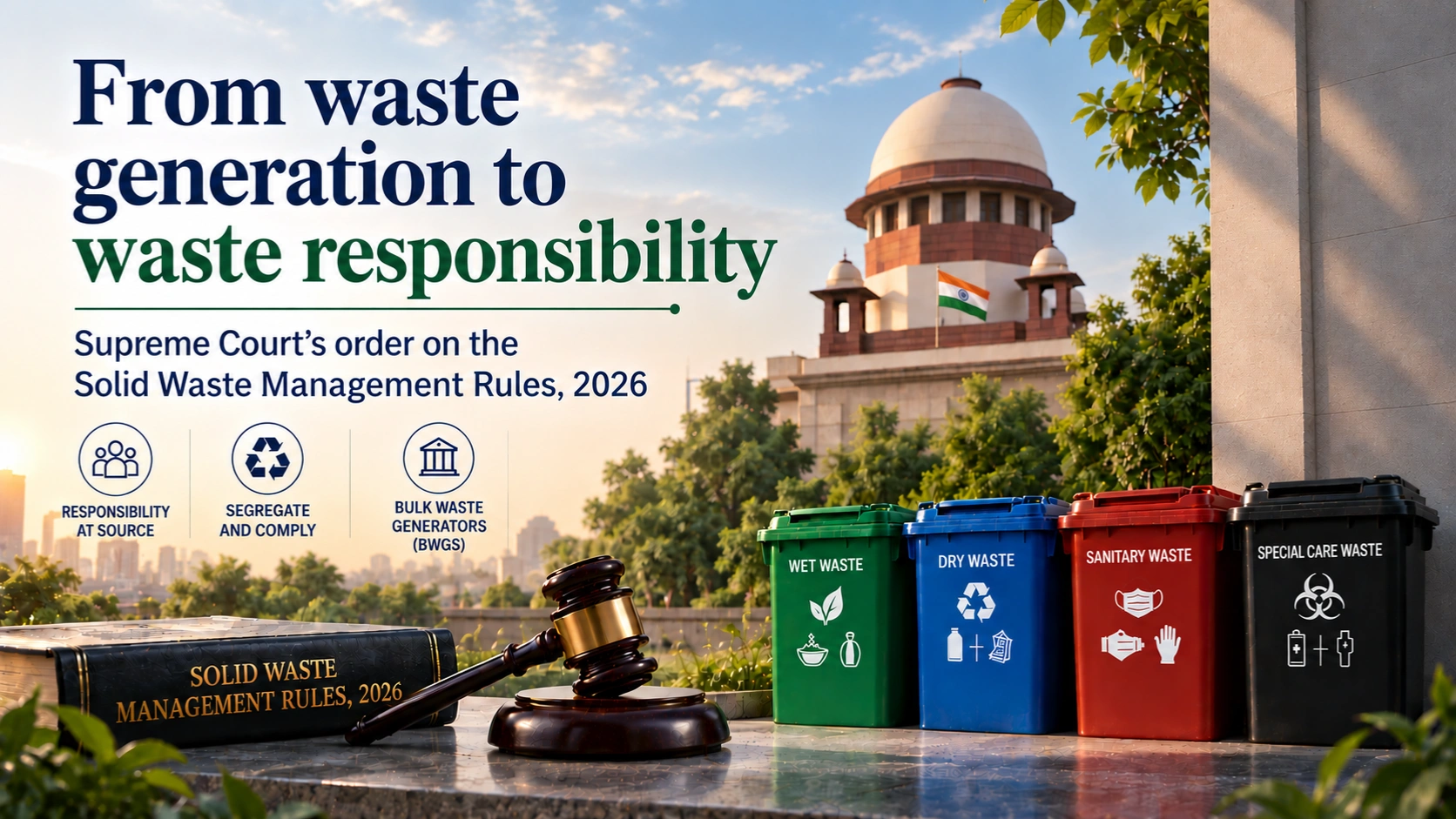
The Rules adopt a source-based approach under which segregation and proper handling of waste begins with the waste generator rather than only at the stage of collection by the local body. Accordingly, under Rule 5, every waste generator is required to segregate waste at source into wet, dry, sanitary and special-care streams and hand over the segregated waste only to authorised waste collectors or agencies. The Rules also prohibit the throwing, burning or burying of solid waste in streets, open public spaces, drains or water bodies.
The 2026 Rules place additional obligations on BWGs who are required to register on the centralised online portal and make arrangements for the collection and handling of different waste streams. New BWGs are additionally required to establish adequate facilities for processing wet waste, including through composting or bio methanation. The Rules also introduce Extended Bulk Waste Generator Responsibility (“EBWGR”), under which BWGs are required to ensure environmentally sound management of wet, dry, sanitary and special-care waste.
The framework correspondingly assigns substantial responsibilities to local bodies, including identification and geo-tagging of BWGs, monitoring waste generation and collection, prescribing spot fines for violations, undertaking awareness programmes and ensuring that segregated waste remains segregated during collection and transportation. Non-compliance attracts environmental compensation under Rule 17, levied on the polluter-pays principle and enforceable, ultimately, through Section 15 of the Environment (Protection) Act, 1986.
The Supreme Court’s order: Internalising responsibility
The Supreme Court’s order dated 18.08.2026 assumes significant importance against the aforesaid statutory framework wherein it observed that the establishment of committees and enforcement agencies, although necessary steps, cannot by themselves address the larger and continuing problems arising from non-compliance with the statutory framework. The Court drew attention to the fact that almost every person contributes to pollution through everyday activities, while responsibility for dealing with the resulting waste is often perceived as falling primarily upon sanitary workers. In view of this observation, it emphasised that this perception must change reinforcing a central principle underlying the SWM Rules, 2026 i.e., the responsibility for solid waste management begins with the waste generator, who must ensure their duty of segregation, safe storage and hand-over, as managed at source, rather than leaving its management entirely to municipal authorities. In this context, the Supreme Court referred to the obligations imposed upon waste generators under the SWM Rules, 2026 and reinforced these obligations through the constitutional responsibility under Article 51A(g) of the Constitution and the right to a clean and healthy environment under Article 21. The Supreme Court characterised the perception that the responsibility for managing waste rests primarily with sanitary workers as neither legally correct nor practically sustainable and emphasised that compliance with the segregation requirements is also informed by the broader constitutional obligations relating to environmental protection.
Directions relating to bulk waste generators
The order proceeds against the backdrop of a continuing mandamus, while acknowledging that the Supreme Court Monitoring Committee (“SCMC“), had given effect to the Court’s earlier orders by communicating, initiating and putting in place the statutory committees for implementation and enforcement of the SWM Rules, 2026, that these institutional steps, by themselves, did not address the larger and perennial hazards arising from non-observance of the Rules by stakeholders.
To operationalise the shift in responsibility towards waste generators, the Court set out a six-step administrative mechanism as under:
The first step records that powers under Section 5 of the Environment (Protection) Act, 1986 already stand delegated to District Collectors, with supervision through Special Cells under Section 23 already in place. The second step frames compliance as requiring active, rather than passive, participation by every individual. Building on this, the third step directs the SCMC, acting through the Chief Secretaries of the States, to require District Collectors to identify all BWGs within their respective jurisdictions, in cooperation with local bodies. The fourth step requires District Collectors, to communicate to identified BWGs the consequences of non-compliance with the SWM Rules, 2026, including temporary disconnection of power or water supply until the waste generated conforms to the Rules. Such supply is restorable upon submission of a compliance certificate by the concerned BWG. The fifth step clarifies the purpose of such communication i.e. to enable BWGs to put in place the facilities required for compliance and to report compliance online to local bodies, which would inspect and forward such reports to the District Collector. The sixth step directs District Collectors to enhance the participation of elected representatives of Gram Panchayats, Municipalities and Corporations, with urban, municipal and rural local bodies directed to notify waste that is accounted for and unaccounted for, and the steps taken to achieve full participation by stakeholders.
Strengthening compliance and public participation
In addition to the above directions of the Supreme Court’s introducing a more structured system for monitoring compliance, including the identification of BWGs, written communication of their obligations, online reporting and inspection providing an administrative mechanism for tracking implementation of the Rules, the Supreme Court has simultaneously emphasised the importance of public participation and awareness. It directed the involvement of educational institutions and students in creating awareness regarding solid waste management, including through integration of theoretical and practical knowledge and training students to encourage compliance at the household level.
The Supreme Court’s reference to Articles 21 and 51A(g) is relevant in this context as the statutory obligations relating to waste management are connected with the broader constitutional concern for protection of the environment and the right to a clean and healthy environment. Solid waste management is therefore not merely a matter of municipal administration or sanitation but also concerns the environmental consequences of the manner in which waste is generated and managed.
Towards self-regulation
The Supreme Court was explicit that law can only secure cooperation by prescribing rules and consequences it cannot, by itself, generate civic behaviour and that compliance is achieved only when generators internalise the obligation themselves. The administrative machinery it put in place, including the six-step mechanism directed at District Collectors and local bodies, was accordingly framed not as a permanent regime of external supervision but as what the Court called a “scaffold to accelerate that internalisation,” on the footing that indefinite, exclusive reliance on State supervision of a constitutionally literate citizenry would defeat the object of the Rules. The Supreme Court expressly recorded the object of the order as being “to sunset and transition to self-regulation.”
Conclusion
The Supreme Court’s order brings the responsibility of waste generators to the centre of the implementation of the SWM Rules, 2026. It does not alter the statutory scheme of the SWM Rules, 2026 so much as it operationalises the obligations already cast on waste generators under Rule 4 and Rule 5, by translating them into a concrete administrative sequence, identification of BWGs, written communication of their obligations, online reporting, inspection, and consequences of non-compliance thereof. It’s distinct contribution lies in treating this machinery as transitional rather than permanent, and in locating the constitutional basis for generator responsibility in Articles 21 and 51A(g), thereby placing solid waste management within the broader discourse on environmental rights rather than treating it as a matter of municipal housekeeping.
The effectiveness of the SWM Rules, 2026 will ultimately depend upon whether waste generators, particularly BWGs, recognise waste management as a responsibility arising from their own activities. The order therefore represents a step towards accelerating the system in which responsibility for solid waste is shared and starts at its source, with the larger objective of making compliance a part of ordinary civic and institutional conduct.
FAQs
-
What are the Solid Waste Management Rules 2026?
The Solid Waste Management Rules, 2026 were notified by the Ministry of Environment, Forest and Climate Change on 27.01.2026 and came into force on 01.04.2026, superseding the Solid Waste Management Rules, 2016. The Rules provide a comprehensive framework for solid waste management, including source segregation, collection, transportation, processing and environmentally sound disposal, while prescribing responsibilities for waste generators, local bodies and other stakeholders
-
What responsibilities do waste generators have under the SWM Rules 2026?
Under the SWM Rules, 2026, waste generators are required to segregate waste at source into wet, dry, sanitary and special-care waste streams, ensure its safe storage and hand it over only to authorised waste collectors or agencies. The Rules also prohibit the throwing, burning or burying of solid waste in streets, open public spaces, drains or water bodies. BWGs have additional obligations relating to registration, waste handling, wet-waste processing and Extended Bulk Waste Generator Responsibility
-
Who qualifies as a bulk waste generator under the new rules?
Under Rule 3 of the SWM Rules, 2026, an entity qualifies as a BWG if it meets any one of the prescribed thresholds: (i) buildings with floor are of 20,000 sq. m. or above; (ii) consumes 40,000 litres of water per day; or (iii) generates 100 kg of solid waste per day. The definition covers qualifying institutional and commercial establishments as well as residential societies.
-
What directions has the Supreme Court issued for waste management compliance?
In its order dated 18.08.2026, the Supreme Court directed the implementation of a structured compliance mechanism alongside the SWM Rules, 2026. This includes identification of BWGs by District Collectors in coordination with local bodies, communication of their obligations and the consequences of non-compliance, online reporting of compliance, and inspection by local bodies. The Court also directed that BWGs be informed that non-compliance may result in temporary disconnection of power or water supply, with restoration upon submission of a compliance certificate.
-
What are the penalties for non-compliance with the Solid Waste Management Rules 2026?
Rule 17 of the SWM Rules, 2026 provide for the levy of environmental compensation, based on the ‘Polluter Pays’ principle, for specified instances of non-compliance, including operating without registration, false reporting, submission of forged documents and improper solid waste management practices. The Central Pollution Control Board is required to prepare the relevant guidelines for levy of such compensation, while the State Pollution Control Boards and Pollution Control Committees are responsible for levying the environmental compensation in accordance with the prescribed framework. Additionally, action under Section 15 of the Environment (Protection) Act 1986, may also be taken for contravention of the provisions of the Rules.
 You wish to know more about Neeti Niyaman (the “Firm”) for your own information and use.