TIME-BARRED OR TIME-EXTENDED: SUPREME COURT ON EXTENDING ARBITRAL MANDATE UNDER SECTION 29A OF THE ARBITRATION AND CONCILIATION ACT, 1996
By – Astha Sehgal and Jane Kapai
Table of Contents
Introduction
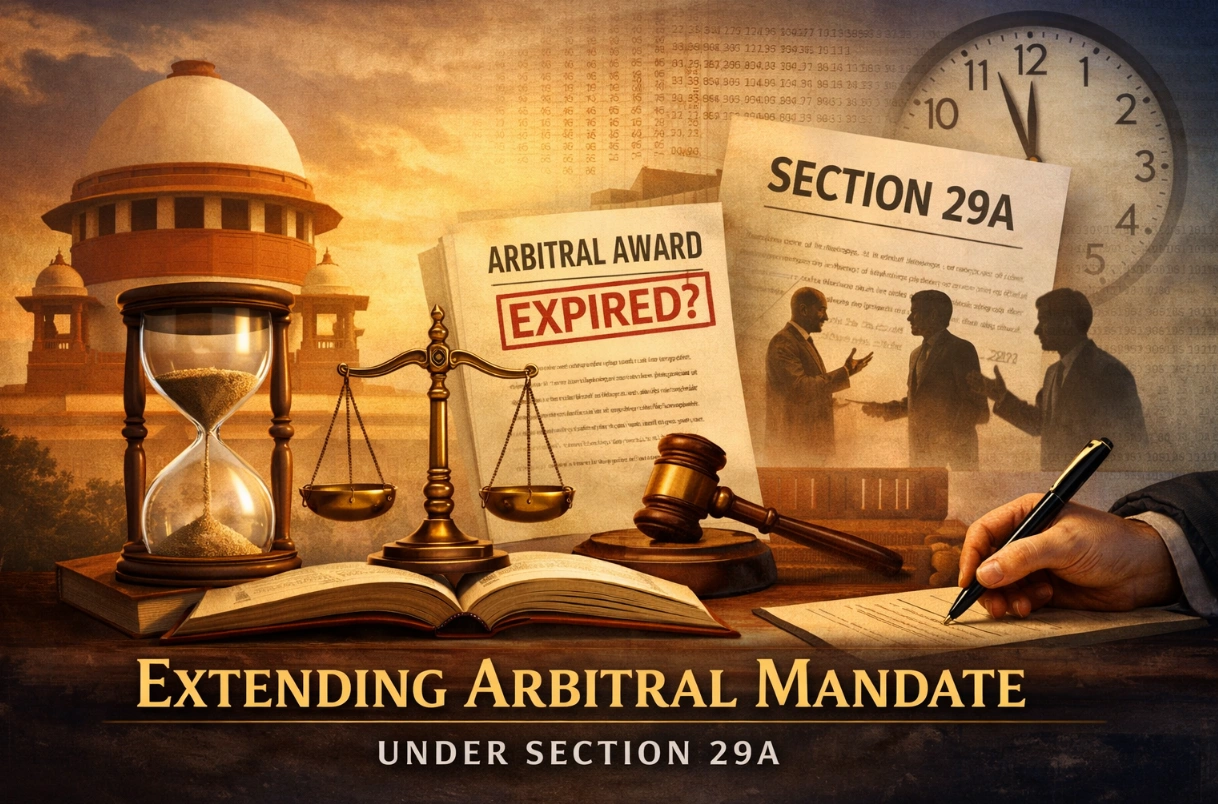
Arbitration is meant to be the faster, cleaner alternative to courtroom litigation i.e. structured, time-bound, and driven by party autonomy. Its timelines are often treated like hard stopwatches, once the clock runs out, everything that follows is assumed to collapse. But the reality of arbitration is rarely that neat. Hearings may conclude on time, submissions may be filed, and the matter may be reserved for orders, yet the award may still take longer than expected. At that point, a single procedural lapse, such as the expiry of the arbitrator’s mandate under the statutory timeline, can become a convenient weapon for the losing side to challenge the entire process. This tension between procedural timelines and substantive justice continues to shape arbitration jurisprudence in India, particularly under Section 29A of the Arbitration and Conciliation Act, 1996 (“the Act”), which prescribes time limits for arbitral awards. It also raises a recurring question: does a delay in passing the award automatically render it void, or can the law still step in to preserve it?
To properly frame this debate, one must first look closely at Section 29A, what it seeks to achieve, how it operates, and why it has become contentious.
SECTION 29A: MEANING, INTENT AND UNDERLYING ISSUE
Section 29A of the Act has been marked by a judicially ambiguous trajectory, owing to interpretative difficulties inherent in the language of the provision. Although enacted to impose definitive timelines on arbitral proceedings, the language of Section 29A left key questions unanswered i.e. what exactly happens when the arbitrator’s mandate expires, and how far can courts go in extending time? The lack of express statutory clarity on whether extensions could be granted after expiry (and in some cases, even after the award) led to conflicting views across High Courts. This resulted in inconsistent outcomes and a need for authoritative clarification.
Section 29A was introduced into the Act by way of the Arbitration and Conciliation (Amendment) Act, 2015 (“2015 Amendment Act”). The provision prescribes a specific timeline for the completion of the arbitral proceedings and rendering of the arbitral award. It also provides that the courts may grant an extension for rendering the award, provided a sufficient cause is shown in that regard. This section was introduced to impose a structured timeline of twelve months from the date of completion of pleadings under Section 23(4), and is further extendable by six months with party consent under Section 29A(3). Failure to pass an award within the said timeline would result in termination of the tribunal’s mandate, unless extended by the court under Section 29A(4), either prior to or after the expiry of the period so specified, extending the period. The extension under Section 29A(4) may be sought vide an application to the court by any of the parties, and upon showing sufficient cause, under Section 29A(5) of the Act.
The underlying issue arises in the interpretation of Section 29A. Despite its structured framework prescribing the timeline within which an arbitral award should be made, the Act fails to clarify whether an extension application under Section 29A(5) can still be entertained by the courts after the expiry of the mandate of the constituted tribunal. More importantly, it also remains unclear whether such extension can be granted even where an award has already been passed after the expiry of the arbitral mandate.
JUDICIAL POSITION ON EXTENSION OF MANDATE AFTER EXPIRY (PRE-AWARD STAGE)
Treading through this ambiguity of Section 29A particularly on whether an extension of the tribunal’s mandate can be granted under Section 29A(5) of the Act, after the expiry of the mandate, numerous High Courts have faced interpretative challenges. This has resulted in a series of conflicting decisions across jurisdictions. The discussion below maps the principal rulings of High Courts that have shaped this debate.
- The Delhi High Court in M/S Power Mech Projects Ltd. v. Doosan Power Systems India Pvt Ltd., highlighting the expression used in Section 29A(4) of the Arbitration Act i.e. the extension of the arbitral mandate “prior to or after expiry of the period so specified”, held that a court exercising jurisdiction under Section 29A is fully empowered to extend the mandate of an arbitral tribunal even after the expiry of the prescribed period. Herein the Delhi High Court placed reliance on the observations of the Bombay High Court in Nikhil H. Malkan v. Standard Chartered Investment and Loans (India) Ltd., wherein it was held that the very purpose for which Section 29A was introduced in the Act would be defeated if the court’s power to extend the mandate of the arbitrator were made conditional upon the extension application being filed prior to expiry of the mandate. The Court noted that there is nothing in the provision to indicate that merely because such an application or petition is filed after expiry of the arbitrator’s mandate, the court would be rendered powerless to exercise its authority. Section 29A is an enabling provision which permits the court to pass appropriate orders to ensure that arbitral proceedings reach their logical conclusion. Therefore, no purpose would be served by holding that the court cannot entertain an application for extension of mandate filed after expiry. The Court further clarified that any apprehension regarding inordinate or unexplained delay by the party approaching the court can be addressed by requiring the party to demonstrate sufficient grounds for extension. In other words, the court would extend the mandate only when it is satisfied that sufficient cause has been made out for such extension.
- Conversely, in Rohan Builders (India) (P) Ltd. v. Berger Paints India Ltd., the Calcutta High Court affirmed that once the mandate of an arbitral tribunal comes to an end due to expiry of the twelve-month period (or after the further six-month extension consented to by the parties), the court’s power to extend time under Sections 29A(4) and 29A(5) cannot be invoked or entertained. Taking a restrictive view of the provision, the Court reasoned that allowing extensions after the mandate has already expired would undermine the purpose of statutory timelines. It held that termination under Section 29A(4) operates automatically and cannot be undone unless an extension is sought while the tribunal’s mandate is still subsisting. The relevant extract is reproduced below:
“63. The mandate does not automatically revive post-termination simply on the making of an application for extension under 29-A(4). The respondents in these applications have refused to give their consent after the stage of section 29-A(1) or for the additional window of six months under section 29-A(3). Section 29-A(4) uses the express term that “…… the mandate of the arbitrator(s) shall terminate ….” which is the deciding factor. Once the mandate terminates, the arbitrator/arbitral tribunal becomes de jure unable to perform his/her functions akin to a situation under section 14(1)(a) of the Act. Moreover, if an award is made after extension of mandate, a disgruntled party can always argue that the award is a nullity as the tribunal did not have the power to make the award after termination of its mandate.”
- The position on this issue was ultimately settled by the Hon’ble Supreme Court while deciding a Special Leave Petition challenging the 2023 decision of the Calcutta High Court. The Supreme Court vide its judgment dated 12.09.2024 in Rohan Builders (India) Pvt. Ltd. v. Berger Paints India Ltd (“Rohan Builders Case”), clarified conclusively that an application under Section 29A(5) could be filed even after expiry of the statutory period, rejecting a rigid understanding of the word “termination” and emphasising that the term must be read as conditional, if no application, either before or after the expiry of the time period is filed by the contesting parties to seek an extension. Giving a contextual interpretation to the language employed in the provision and thereby reinforcing the principle of party autonomy that is central to arbitration, the Supreme Court provided clarity in observing that an interpretation which produces an unreasonable and impractical result is not to be imputed to a statute if there is some other equally possible construction which is acceptable, practical and pragmatic.
EXTENSION OF THE ARBITRAL MANDATE AFTER EXPIRY (POST-AWARD STAGE)
Another issue arising under Section 29A(5) of the Act concerns whether the application for extension of an arbitral mandate can be entertained ‘after’ an arbitral award has been rendered following the expiry of a tribunal’s mandate. While the Supreme Court in Rohan Builders Case conclusively settled that an application under Section 29A(5) of the Act may be filed even after the expiry of the mandate, the question persisted whether this principle would extend to situations where the award itself had already been pronounced after such expiry. With regard to this issue, the High Court of Madras in Surya Dev Alloys and Power Pvt. Ltd v. Shri. Govindaraja Textiles Pvt. Ltd., illustrated a distinction between the 1940 and 1996 Arbitration and Conciliation Act observing that while under Section 28 of the 1940 Act, courts possessed wide discretion to extend the time for making an award even after the expiry of the mandate and even subsequent to the pronouncement of the award itself, in contrast, Section 29A of the 1996 Act significantly curtails such power. Anchoring its reasoning in the language of Section 29A(4), which stipulates that if the award is not made within the prescribed or extended period, the mandate of the arbitrator shall terminate, it was held that although the court may extend time after the expiry of the mandate, it cannot retrospectively validate or ratify an award by extending the time period in a challenge petition. This position, however, was later revisited in a recent ruling, leading to judicial reconsideration in C. Velusamy v. K. Indhera (“Velusamy”).
JUDICIAL RECONSIDERATION IN VELUSAMY
The Hon’ble Supreme Court, in its judgment dated 03.02.2026 in Velusamy, has marked an important development in the interpretation of Section 29A. The Court revisited the issue of arbitral timelines and sought to harmonise the conflicting approaches adopted by different High Courts. The ruling signals a clear move towards preventing technical objections from derailing arbitration outcomes, while also clarifying the extent to which courts may intervene to extend the mandate of an arbitral tribunal under Section 29A of the Act.
Facts of the case:
The dispute arose out of three sale agreements, pursuant to which a sole arbitrator was appointed by the Madras High Court on 19.04.2022. Pleadings were completed on 20.08.2022, upon which the statutory twelve-month period under Section 29A commenced. With the consent of the parties, the period was further extended by six months, thereby fixing 20.02.2024 as the outer limit for passing the award. Although the matter was reserved for award in September 2023, it was subsequently reopened to explore settlement. The settlement discussions, however, did not fructify. The arbitrator ultimately delivered the award on 11.05.2024, i.e., after the mandate had already expired. This led to parallel proceedings.
The Respondent challenged the award under Section 34, contending that an award passed beyond the statutory timeline and after expiry of the tribunal’s mandate was non-est. The Appellant, on the other hand, filed an application under Section 29A(5) seeking extension of the tribunal’s mandate. By its order, the Madras High Court dismissed the Appellant’s extension application, while allowing the Respondent’s challenge and setting aside the award. The Madras High Court had rejected the application filed under Section 29A(5) of the Act and declined to apply the ruling in Rohan Builders Case, distinguishing the same on the basis of the procedural stage at which the applications arose. The Court observed that Rohan Builders Case dealt with a pre-award situation, where arbitral proceedings were still pending and no award had been rendered. In contrast, the case before it concerned an award that had already been delivered after expiry of the tribunal’s mandate. The Madras High Court held that once the statutory timeline elapsed, the tribunal’s mandate stood terminated by operation of law, leaving no scope for retrospective judicial extension. On this reasoning, it treated the award as a nullity. Aggrieved by the same, the Appellant approached the Hon’ble Supreme Court.
Observations
Thereby, in appeal against this judgment, the question of law consequentially arose before the Supreme Court i.e., whether the court’s power under Section 29A(5) to extend the mandate of an arbitral tribunal survives even after an arbitral award has been rendered beyond the statutory time limit. Answering the issue in the affirmative, the Bench disagreed with the Madras High Court’s approach and held that Section 29A of the Act does not impose any statutory bar on courts extending the mandate even after an award has been delivered. The Bench observed that termination of an arbitrator’s mandate under Section 29A(4) of the Act is not absolute and is expressly made subject to the court’s power to extend time “prior to or after the expiry” of the prescribed period, as also recognized in the Rohan Builders Case.
Central to the issue before the Court was the expression “if an award is not made” in Section 29A(4) of the Act. The Court held that this phrase operates as a trigger for judicial intervention, enabling the court to extend time before or after expiry, and does not bar jurisdiction merely because an award has already been rendered. The Bench also clarified the status of an award passed after mandate expiry: it is “non-est” only in the limited sense that it is unenforceable under Section 36 and need not be immediately challenged under Section 34 of the Act. The defect, the Court held, goes to enforceability rather than existence, and until the court decides the extension application, the award remains ineffective. Importantly, the arbitrator’s act of delivering the award beyond time does not oust the court’s jurisdiction to extend the mandate. The relevant extract from the judgment is reproduced below:
“23…we hold that an application under Section 29A(5) for extension of the mandate of the arbitrator is maintainable even after the expiry of the time under Sections 29A(1) and (3) and even after rendering of an award during that time. Such an award is ineffective and unenforceable. But the power of the court to consider extension is not impaired by such an indiscretion of the arbitrator…
“If the mandate is extended, the arbitral tribunal will pick up the thread from where it was left, and seamlessly continue the proceeding from the stage at which the mandate had expired, and conclude within the time granted.”
This interpretation also aligns Section 29A with its legislative objective. The provision was introduced to curb delay, not to frustrate arbitration. While timelines were intended to promote efficiency and accountability, the Bench noted that the judicial role under Section 29A of the Act is supervisory and enabling and meant to facilitate completion of proceedings where circumstances so warrant, rather than operate as a rigid mechanism resulting in automatic termination.
Further, while addressing concerns that permitting extensions after expiry may encourage procedural indiscipline, the Bench clarified that extension of mandate is not automatic. Extension under Section 29A(5) of the Act remains contingent upon the court’s satisfaction that sufficient cause exists and is subject to strict judicial scrutiny. The Bench also observed that apprehensions of uncertainty are misplaced, since judicial extension does not retrospectively condone delay as a matter of course. In deciding an extension application, the court may consider relevant factors, including reduction of the arbitrator’s fees in terms of the proviso to Section 29A(4), and may impose costs on the parties where warranted. Accordingly, the Bench held that Section 29A cannot be construed as creating a threshold bar against applications under sub-section (5) merely because the award was rendered after expiry of the tribunal’s mandate. When dealing with an extension application, the court must assess whether sufficient cause has been shown and may grant extension on appropriate terms and conditions in accordance with the Act.
CONCLUSION
The jurisprudence culminating in Velusamy represents a decisive consolidation of the law governing Section 29A of the Act. By affirming that the court’s power to extend the tribunal’s mandate survives not only after expiry but even where an award has been rendered beyond the prescribed period, the Hon’ble Supreme Court has adopted a purposive and continuity-oriented interpretation of arbitral timelines. In doing so, it carries forward the doctrinal approach set out in Rohan Builders and resolves the earlier divergence across High Courts. The judgment clarifies that ‘termination’ under Section 29A of the Act is not an inflexible statutory extinction of authority, and that judicial intervention under the provision is intended to be supervisory and facilitative and not destructive of the arbitral process.
As the law now stands, Section 29A of the Act reflects a calibrated balance between efficiency and fairness. It reinforces the discipline of timelines in arbitration, while ensuring that procedural lapses do not, by themselves, defeat the ultimate objective of arbitration i.e. resolution of disputes through a final, enforceable award.
FAQs
-
What is Section 29A of the Arbitration and Conciliation Act, 1996?
Inserted vide the Amending Act of 2015, Section 29A of the Arbitration and Conciliation Act, 1996 lays down a statutory timeline for delivery of arbitral awards from the date of completion of pleadings. The section also empowers courts to further extend the arbitral tribunal’s mandate if sufficient cause is shown.
-
What is the time limit for passing an arbitral award under Section 29A?
The arbitral award must be made within 12 months from the date of completion of pleadings which may be extended by 6 months with party consent. Any further extension requires an application to the court under Section 29A(5).
-
Can a court extend the arbitral mandate after expiry under Section 29A(5)?
Yes. The court can extend the tribunal’s mandate even after the statutory period has expired. The extension is not automatic and will be granted only if sufficient cause is demonstrated.
-
What did the Supreme Court hold in Rohan Builders and Velusamy regarding Section 29A?
In Rohan Builders (India) Pvt. Ltd. v. Berger Paints India Ltd., the Supreme Court held that an application for extension under Section 29A(5) is maintainable even after expiry of the mandate. In C. Velusamy v. K. Indhera, the Court further clarified that extension of an arbitral mandate may be granted even after an award has been delivered beyond the prescribed time. Such an award is unenforceable unless the court extends the mandate.
-
Does expiry of the arbitral mandate automatically terminate the arbitration proceedings?
Although Section 29A(4) states that the mandate “shall terminate” upon expiry, the Supreme Court has clarified that this termination is subject to the court’s power to extend time, meaning the proceedings are not automatically rendered void.
References –
- Arbitration and Conciliation (Amendment) Act, 2015, S. 15.
- 2024 SCC OnLine Del 4412
- 2023 SCC OnLine Bom 2575
- 2023 SCC OnLine Cal 2645
- 2024 SCC OnLine SC 2494
- 2020 SCC OnLine Mad 7858
- 2026 SCC OnLine SC 142


 You wish to know more about Neeti Niyaman (the “Firm”) for your own information and use.