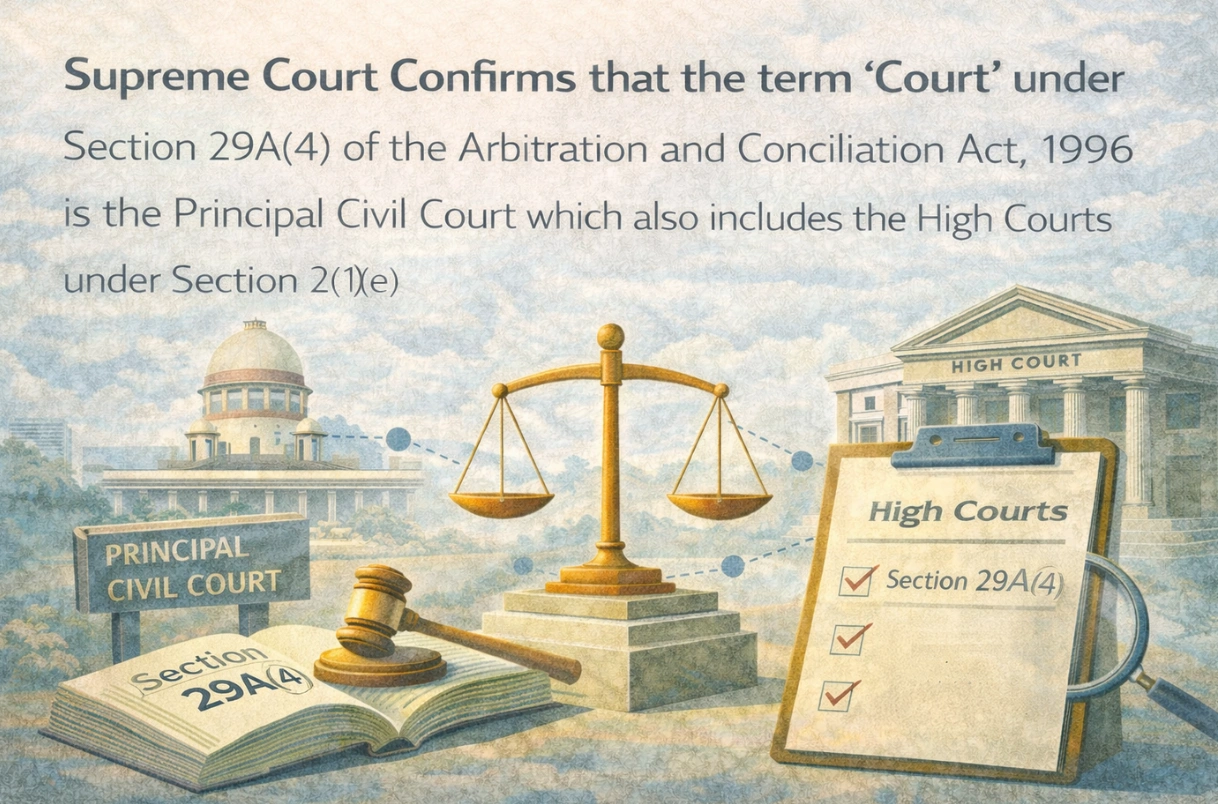
Supreme Court confirms that the term ‘Court’ under Section 29A(4) of the Arbitration and Conciliation Act, 1996 is the Principal Civil Court which also includes the High Courts under Section 2(1)(e).
By – Sangeeth Narayanan and Debasmita Goswami
Table of Contents
Introduction
Arbitration as a dispute resolution mechanism upholds the essence of party autonomy, ensuring minimal intervention of the judicial authorities which has been the guiding principle of the Arbitration and Conciliation Act, 1996(“ 1996 Act”). In the 1996 Act there was no provision of a statutory timeline for delivering awards and prescribing the consequences of not delivering them on time. In the event of failure of an arbitrator to act without undue delay, recourse was provided under Section 14 of the 1996 Act that is by approaching the arbitrator first and then the Court1. The absence of a statutory time limit under the 1996 Act had resulted in arbitrations remaining pending for several years, even without Court intervention, thereby defeating the very object of arbitration as speedy dispute resolution mechanism.
Therefore, the 1996 Act was amended with retrospective effect from 23.10.2015 to effectively deal with delays in arbitral proceedings by inserting Section 29A. The emphasis was on continuation of the arbitration, even pending applications for extension, so that procedural delays do not result in wastage of time, costs, or evidence already led. The legislative intent, therefore, was to ensure that an arbitral award is ultimately passed, with judicial intervention operating as a facilitative and corrective mechanism to curb delay, rather than as a means to abort the arbitral process.
Section 29A was inserted requiring the arbitral tribunal to render the award within twelve months from the date it enters upon the reference, with liberty to the parties to extend the period by a further six months, any extension thereafter is permissible only by order of the Court on sufficient cause being shown. The 1996 Act was further amended w.e.f 30.08.2019 to provide that, where an application seeking extension of time under sub section (5) of Section 29A is pending , the mandate of the arbitrator shall continue until such application is finally decided. It is further pertinent to mention that the Courts in this regard would grant an extension as provided under Section 29A(5) if the parties are able to satisfy that there existed ‘sufficient cause.’2
The conundrum regarding the term ‘court’ under Section 29A(4) of the 1996 Act:
The Supreme Court in Jagdeep Chowgule vs. Sheela Chowgule & Ors.3(“Jagdeep Chowgule”) delivered a conclusive decision on the issue concerning the forum of competent jurisdiction for applications under Section 29A(4) of the 1996 Act seeking extension of an arbitral tribunal’s mandate. The question for the consideration before the Supreme Court was if an arbitral tribunal appointed by the High Court or by the parties concerned does not complete proceedings within the required or extended time limit, can an application to extend time under Section 29A of the said Act be filed before the High Court or the Civil Court?
The meaning of ‘Court’:
Hon’ble Bombay High Court in the case of Mormugao Port Trust Vs. Ganesh Benzoplast4 has observed that the expression ‘Court’ in Section 29 -A is the Court as defined under Section 2(1) (e ) of the 1996 Act. As per the 1996 Act the term ‘Court’ means that in case of a domestic arbitration it is the principal Civil Court of original jurisdiction in a district and also includes the High Court in exercise of its ordinary original civil jurisdiction and would have the jurisdiction to decide the questions forming the subject – matter of the arbitration if the same had been the subject-matter of a suit but would not include any Civil Court of a grade inferior to principal Civil Court or any Small Causes court.
In the case of A.R. Antulay Vs. R.S. Nayak5 the Supreme Court has observed that it is the settled position in law that jurisdiction of courts comes solely from the law of the land and cannot be exercised otherwise. In India conferment of jurisdiction is possible either by the provisions of the Constitution or by specific laws enacted by the legislature. It has further observed that jurisdiction is the authority to hear and determine, and in order that it may exist the following are essential:
- A court created by law, organized and sitting;
- Authority given to it by law to hear and determine causes of the kind in question;
- Power given to it by law to render a judgment such as it assumes to render;
- Authority over the parties to the case if the judgment is to bind them personally as a judgment in personam, which is acquired over the plaintiff by his appearance and submission of the matter to the court, and is acquired over the defendant by his voluntary appearance, or by service of process on him;
- Authority over the thing adjudicated upon its being located within the court’s territory, and by actually seizing it if liable to be carried away;
- Authority to decide the question involved, which is acquired by the question being submitted to it by the parties for decision.
Facts of Jagdeep Chowgule:
The relevant facts that had transpired before the SLP came up for determination before the Supreme Court was that a Single Judge of the High Court of Bombay at Goa referred two questions to the Division Bench of the High Court for authoritative determination i.e. firstly, whether an application Section 29A(4) of the 1996 Act would lie before the High Court or the Civil Court having original jurisdiction in case of a domestic arbitration in cases where the arbitral tribunal was constituted by the High Court under Section 11(6) of the 1996 Act and secondly, whether an application Section 29A(4) of the 1996 Act would lie before the High Court or the Civil Court having original jurisdiction in case of a domestic arbitration in cases where the arbitral tribunal consisting of three arbitrators is constituted as per Section 11(2) of the 1996 Act? The Division Bench held that under the first scenario, the application under Section 29(4) of the 1996 Act would lie to the High Court and under the second scenario, the application under Section 29(4) of the 1996 Act would lie to the Principal Civil Court of original jurisdiction which also includes the High Court exercising ordinary original jurisdiction.
While determining the question, the Supreme Court considered the divergent view of various High Courts on the instant question. One set of High Court decisions took the view that ‘Court’ in Section 29A of the 1996 Act is the Court as defined in Section 2(1)(e). The High Courts of Bombay, Allahabad and Andhra Pradesh in Mormugao Port Trust v. Ganesh Benzoplast Ltd.6, M/s. A’Xykno Capital Services Private Ltd. v. State of U.P.7 and Dr. VV Subbarao v. Dr. Appa Rao Mukkamala & Ors.8respectively held that the expression ‘Court’ in Section 29A of the 1996 Act is the Court as defined in Section 2(1)(e) irrespective of the event that the arbitral tribunal was constituted under Section 11(2) or 11(6) of the 1996 Act. This stream of decisions further held that Section 29A stipulates no distinction between arbitrators appointed with the consent of parties or by Constitutional Courts under Section 11.
The other stream of decisions by some High Courts interpret the expression ‘Court’ under Section 29A in the context to disapply Section 2(1)(e). A catena of judgements passed by various High Courts including the Gujarat High Court, Delhi High Court, Bombay High Court, Calcutta High Court, Allahabad High Court and Madhya Pradesh High Court hold that in cases where the arbitrator is appointed under Section 11(6) of the said Act, the application under Section 29A cannot be made before the Civil Courts primarily because it will create a jurisdictional anomaly, that is, the High Court would be appointing the arbitrator and the Civil Court, a Court inferior to it, could be asked to extend the arbitrator’s mandate and would also have the jurisdiction to substitute the arbitrator appointed by the High Court. The High Courts holding this view also reason that a situation of “conflict of power” between the Civil Court and the High Court would arise in cases of domestic arbitration and a similar conflict would arise between the High Court and the Supreme Court in cases of international commercial arbitration. To prevent such a situation these lines of decisions adopt the interpretative principle of giving “contextual” meaning to the expression ‘Court’ in Section 29A by referring and relying on the phrase “in this Part, unless the context otherwise requires” in Section 2(1) of the 1996 Act. In this regard Supreme Court has held that interpretation based on a perception of status or hierarchy of Courts is opposed to the fundamental conception of rule of law.
The Supreme Court observed that the 1996 Act identifies Courts of varying jurisdiction and imposes distinct obligations on them. The power and jurisdiction to constitute an arbitral tribunal and to appoint an arbitrator in case of domestic arbitrations is vested in the High Court and in case of international commercial arbitration, in the Supreme Court. Exercise of jurisdiction under Section 11 stands exhausted upon the constitution of the arbitral tribunal. The referral Court becomes functus officio once appointment has been made, it has no role or function as a sub-judice Sentinel. Further, the Supreme Court held that under the true context of Section 29A of the 1996 Act, ‘Court’ shall be the Civil Court of ordinary original jurisdiction in a district and includes the High Court in exercise of its original civil jurisdiction under Section 2(1)(e), and shall not be the High Court or the Supreme Court under Section 11(6) of the 1996 Act. Equally, Section 42 of the 1996 Act relating to jurisdiction for application will not apply to Section 11 of the 1996 Act. The text as well as the context for identifying the Court in Section 29A(4) as well as 29A(6) is the ‘Court’ in Section 2(1)(e).
Further, the Supreme Court held that in State of West Bengal v. Associated Contractors9 a three judge bench of the Supreme Court held that no Court other than the one defined in Section 2(1)(e) gets qualified as ‘Court’ under Part I of the 1996 Act. Even in the context of Section 14 of the 1996 Act the Supreme Court in Nimet Resources Inc. & Anr. v. Essar Steels Ltd.10 held that an application under Section 14(2) of the 1996 Act would be maintainable only before the Principal Civil Court which may include a High Court jurisdiction. Therefore, an extension of mandate or substitution of an arbitrator under Section 29A does not partake the character of “appointment” under Section 11, but is a measure designed to ensure timely conclusion of arbitration. Absence of any contextual indicia to the contrary, the expression “Court” in Section 29A must, therefore, be accorded the meaning assigned to it under Section 2(1)(e). The Supreme Court in the present case also took note of Section 42 of the 1996 Act and it may be argued that since application under Section 11(6) for appointment is filed before High Court, all successive applications, including the one under Section 29A(4) must be made to such High Court. However, the same would not be tenable in view of the decision of a constitution bench of the Supreme Court in State of Jharkhand v. Hindustan Construction Co.11 which held that solely because a superior Court appoints the arbitrator, or issues directions or has retained some control over the arbitrator, it cannot be regarded as a ‘Court’ of first instance for purposes of Section 42.
Conclusion:
The decision of the Supreme Court in Jagdeep Chowgule has put a quietus to a rather confusing question regarding the court of competent jurisdiction for deciding the applications under Section 29A(4) of the 1996 Act. The confusion was made more complicated by the divergent interpretation and views of different High Courts. However, the Supreme Court has now decisively ruled that a High Court in its Section 11 capacity, has no residual supervisory authority for purposes of extending the mandate of an arbitral tribunal once constituted. The Supreme Court has emphasized that once an arbitral tribunal is constituted, the referral court becomes functus officio. Therefore, the term “Court” for the purposes under Section 29A(4) must be given the statutory meaning as provided under Section 2(1)(e) of the 1996 Act and therefore the Court of competent jurisdiction under Section 29A(4) is the Principal Civil Court which would also include those High Courts having ordinary original civil jurisdiction.
FAQs
-
What is the meaning of the term “Court” under Section 29A(4) of the Arbitration and Conciliation Act, 1996?
The term Court as defined under Section 2(1) (e ) of the Arbitration and Conciliation Act 1996 means that in case of a domestic arbitration it is the principal Civil Court of original jurisdiction in a district and also includes the High Court in exercise of its ordinary original civil jurisdiction and would have the jurisdiction to decide the questions forming the subject – matter of the arbitration if the same had been the subject-matter of a suit but would not include any Civil Court of a grade inferior to principal Civil Court or any Small Causes court.
In the case of international commercial arbitration, the term ‘Court’ means the High Court in exercise of its ordinary original civil jurisdiction, having jurisdiction to decide the questions forming the subject-matter of the arbitration if the same had been the subject-matter of a suit, and in other cases, a High Court having jurisdiction to hear appeals from decrees of courts subordinate to that High Court.
-
Whether an application for extension of arbitral mandate under Section 29A(4) lies before the High Court or the Principal Civil Court of original jurisdiction?
As held by the Supreme Court in the case of Jagdeep Chowgule Vs. Sheela Chowgule 2026 SCC Online SC 124 an application under Section 29-A(4) of the Arbitration and Conciliation Act, 1996 for extension of time lies before the Principal Civil Court of original jurisdiction or High Court exercising original civil jurisdiction. The forum does not change merely because the arbitral tribunal was appointed by the High Court under Section 11 of the Arbitration and Conciliation Act, 1996.
-
Does the forum change if the arbitrator was appointed by the High Court under Section 11(6) of the 1996 Act?
In the present case, after considering the divergent views of the various High Courts, the Supreme Court observed that the 1996 Act identifies courts of varying jurisdiction and imposed distinct obligations on them. The Supreme Court held that under the true context of the Sec 29A or the 1996 Act, ‘Court’ shall be the civil court of ordinary original civil jurisdiction in a district and includes the High Courts exercising ordinary original civil jurisdiction.
-
How did the Supreme Court resolve the conflicting views of various High Courts on Section 29A jurisdiction?
The Supreme Court held that Section 42 of the 1996 Act relating to jurisdiction for application would not apply to Section 29A (4) because the text as well as the context for identifying the Court in Section 29A (4) as well as 29A(6) is the ‘Court’ in Section 2(1)(e).
References –
- Please see C. Velusamy Vs. K. Indhera 2026 INSC 112
- Ibid
- 2026 INSC 92
- W.P. No. 3 of 2020
- 1988 2 SCC 602
- (WP No. 3 of 2020 (High Court of Bombay at Goa)
- 2023 SCC OnLine All 2991
- 2024 SCC OnLine AP 1668
- (2015) 1 SCC 32
- (2009) 17 SCC 313
- (2018) 2 SCC 602


 You wish to know more about Neeti Niyaman (the “Firm”) for your own information and use.