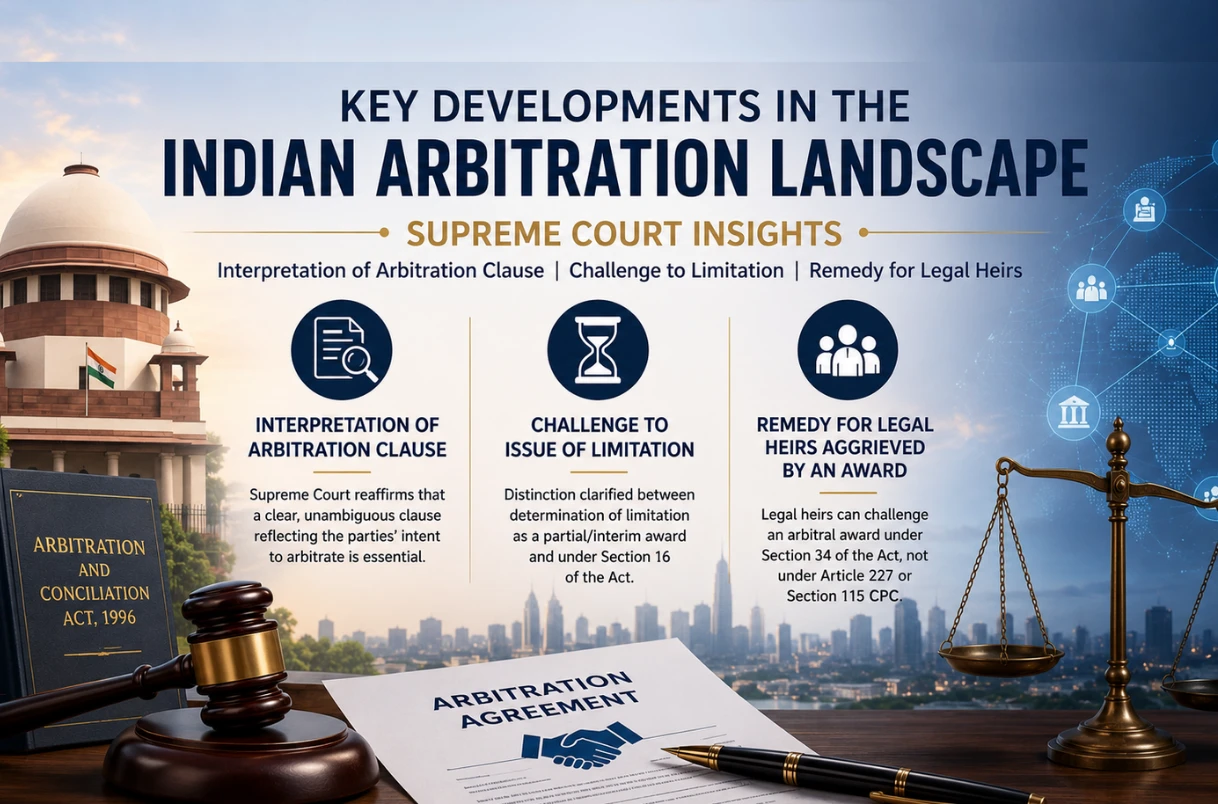
Key developments in the Indian Arbitration landscape: Supreme Court on interpretation of arbitration clause, challenge to issue of limitation and remedy available under the statute for legal heirs aggrieved by an award.
By – Sangeeth Narayanan
Table of Contents
The present article covers some of the important judgements passed by the Hon’ble Supreme Court pertaining to arbitration law in India. The Supreme Court has distinguished the crucial distinction between determination of the issue of limitation as a partial / interim award and under an application made under Section 16 of the Arbitration and Conciliation Act, 1996. It has also reiterated the importance of a clear, unambiguous arbitration clause reflecting the unilateral intention of all the parties to refer a dispute to arbitration instead of a nominal clause providing an option to refer the dispute to arbitration. The Supreme Court has also passed a judgement reinforcing the rights of legal representatives under arbitration.
On interpretation of arbitration clause in an agreement:
The Hon’ble Supreme Court by its Judgement dated 17.04.2026 in Nagreeka Indcon Products Pvt. Ltd. vs. Cargocare Logistics (India) Pvt. Ltd. – SLP (Civil) No. 19026 of 2023 has once again laid down the importance of having clearly worded arbitration clauses showing unequivocal intention of the parties’ intention to refer the disputes to arbitration. The arbitration clause in the contract under the present case read as under:
“The contract evaluated hereby or contained herein shall be governed by and construed according to Indian Laws. Any difference of opinion or dispute thereunder can be settled by arbitration or India or a place mutually agreed with each party appointing an arbitrator.”
The question for determination before the Supreme Court was whether the word ‘can’ appearing in the arbitration clause in the contract necessitate the reference of all disputes to arbitration or is recourse to other dispute resolution mechanisms, including that of Civil Court open for the parties. The present SLP arose from an arbitration application filed by the Appellant herein before the Bombay High Court seeking appointment of sole arbitrator which was dismissed by the Bombay High Court.
The Appellant’s case was that Section 7 of the Arbitration and Conciliation Act, 1996 (“the Act”) does not prescribe any form of an arbitration agreement and the intent of the parties to have arbitration as the chosen method of dispute resolution is evident from the bill containing a clause to that effect. The Appellant relied upon the judgment of the Supreme Court in Eastern Coalfields v. Sanjay Transport Agency and Anr.1 wherein it was held that the heading of the clause acquires importance. The Appellant further submitted that a pragmatic approach should be taken while interpreting an arbitration clause as held by the Supreme Court in Babanrao Rajaram Pund v. M/s. Samarth Builders and Developers2 and Enercon (India) Ltd. v. Enercon GmbH3. Referring to the judgement of Visa International Ltd. v. Continental Resources USA Limited4 without demonstration to the contrary, the drafting of an arbitration clause cannot be taken advantage of by any of the parties. Further referring to the judgement in Vidya Drolia v. Durga Trading Corporation5 it was submitted that at the stage of Section 11 application only the existence of a clause is to be looked into i.e. only a prima facie view is to be taken. Further the judgement of the Supreme Court in Zhejiang Bonly Elevator Guide Rail Manufacture Company Limited v. Jade Elevator Components6 was referred to submit that an arbitrator was appointed by the Supreme Court when the dispute resolution clause provided for “arbitration or the court”.
The Respondents relied upon the judgment of the Supreme Court in K.K. Modi v. K.N. Modi7 and Bihar State Mineral Development Corporation v. Encon Builders (I) (P) Ltd.8 and submitted that the necessary elements of a valid arbitration clause as set out in these judgments are not met in the present case. Further, the Respondents relied upon the judgments BGM and M-RPL-JMCT(JV) v. Eastern Coalfields Ltd.9 and Jagdish Chander v. Ramesh Chander10 submitted that the words such as ‘can’ do not constitute a binding arbitration agreement.
Analysing the objective of alternate dispute resolution and specifically arbitration, the Supreme Court observed that the sine qua non for arbitration is that parties must mutually intend to refer their disputes to arbitration and that consent is the source of arbitral tribunal’s jurisdiction over the parties. Arbitration can be a chosen method of alternate dispute resolution if all the parties to a dispute agrees to the same. The Supreme Court observed that in the present case the main dispute swings on the interpretation of the word ‘can’. The Supreme Court observed that the use of the word ‘can’ in judicial interpretative context is limited. Most often the words ‘may’ or ‘shall’ are used. The Supreme Court observed that the arbitration clause in the present case did not reflect the intention of the parties to refer the disputes to arbitration clearly for the reasons that firstly, the use of the word ‘can’ and secondly the arbitration clause did not provide the complete procedure for appointment of arbitrators, if any. The Supreme Court observed that the question of construction of an arbitration clause when it is vaguely worded only arise when the parties are ad idem as to arbitration. However, in the present case, the parties themselves cannot agree on arbitration being the chosen medium. In such a case, it is not for a Court to compulsorily send such parties before a jurisdiction which they have not chosen.
The Supreme Court observed that the principles of contractual interpretation are now well settled. The words chosen by the parties are the most reliable manifestation of the intent. The meaning of the words used in contract is not found in strict etymological propriety or popular usage of words as in the subject, occasion or context in which they are used, within the contractual realm. The latin maxim ‘Ex praecedentibus et consequentibus optima fit interpretatio’ signifies this statement. The written word is, therefore, the foundation of legal obligation. To disregard or to impute an obligation or meaning which was not intended would compromise party autonomy.
After taking due notice of the interpretation of the word ‘can’ as also well-established principles of contractual interpretation, the Supreme Court held that the arbitration clause in the present case stipulate that if there is any dispute between the parties, they can settle the same by arbitration. After distinguishing the judgements relied upon by the Appellant from the factual matrix of the present case, the Supreme Court dismissed the present Appeal on the ground that the arbitration clause indicated merely a future possibility to refer the disputes to arbitration and the same cannot be said to be a binding arbitration agreement.
On distinction between determination of the issue of limitation as a preliminary award and under an application under section 16 of the Arbitration and Conciliation Act, 1996:
The Hon’ble Supreme Court vide its judgement dated 21.04.2026 passed in Civil Appeal arising out of SLP No. 33075 of 2025 – M/s. MCM Worldwide Pvt. Ltd. vs. M/s. Construction Industry Development Council has clarified key distinction between determination of the issue of limitation as a preliminary award and under an application under section 16 of the Act.
The brief facts culminating into the present Appeal are that the Respondent filed an application under Order VII Rule 11 of the Code of Civil Procedure, 1908 seeking rejection of the Appellant’s claim on the grounds of limitation which was rejected by the Arbitrator. The said order of the Arbitrator was challenged by the Respondent by filing an appeal u/s. 34 of the Act before the District Judge which was rejected on the ground that the said order of the Arbitrator was not amenable to Section 34 of the Act. This order of the District Judge was challenged before the Delhi High Court which dismissed the same by granting liberty to the Respondent herein to file an application under Section 16 of the Act before the Arbitrator. Thereafter, the Respondent herein filed an application u/s. 16 before the Arbitrator seeking dismissal of the claim on the grounds of being barred by limitation. The said application was dismissed by the Arbitrator and the same was challenged before the District Judge. Before the District Judge, the Appellant herein objected to the maintainability of an application u/s. 34 of the Act against an order passed in an application filed u/s. 16 of the Act. The Respondent herein relied on the judgement of the Supreme Court passed in Indian Farmers Fertilizer Cooperative Limited vs. Bhadra Products11 (“IFFCL judgment”) wherein the Hon’ble Supreme Court had held that an award by an arbitrator deciding the issue of limitation can be set aside by u/s. 34 of the Arbitration Act. Relying on this judgement, the District Judge decided the application of the Respondent on merits and dismissed the same. The said decision was challenged by the Respondent before the Hon’ble Delhi High Court u/s. 37 of the Act. The Hon’ble Delhi High Court allowed the appeal filed by the Respondent vide its Order dated 08.05.2025. The Hon’ble Supreme Court has passed the present judgment under an appeal challenging the Order dated 08.05.2025 passed by the Hon’ble Delhi High Court.
The Hon’ble Supreme Court observed that a fundamental legal aspect was glossed over on a misunderstanding of a decision of the Supreme Court which called for clarification of the same. The Hon’ble Supreme Court distinguished the factual position under which the IFFCL judgement was passed from the factual position of the present case. The Hon’ble Supreme Court observed that the IFFCL judgement did not relate to an order passed under Section 16 of the Arbitration Act. The Supreme Court held that the issue of limitation under the IFFCL case was determined by the arbitrator in the form of a partial / interim award. The Supreme Court held that in the IFFCL case, the issue of limitation was decided by the arbitrator as an interim award stood decided finally and the same could not have been re-adjudicated before the arbitrator again. Under the IFFCL judgment, the Supreme Court held that a challenge to the final adjudication on the issue of limitation by an arbitrator can only be challenged u/s. 34 of the Act. However, in the present case, the Supreme Court observed that the arbitrator had decided the issue of limitation under an application filed u/s. 16 of the Act and in such a scenario, the aggrieved party has no other option than to wait till the conclusion of the arbitral proceedings and raise the issue by way of an application u/s. 34 against the final award. The Supreme Court clarified that the decision on the issue of limitation by the arbitrator u/s. 16 of the Act could be challenged at the final stage even after passing the final award. By way of the present judgement, the Supreme Court clarified the misunderstanding on the part of the District Judge and the Delhi High Court that a rejection of a plea u/s. 16 of the Act must be treated as an interim award and the same can be subjected to challenge u/s. 34 of the Act.
On appropriate remedy for legal heirs aggrieved by an arbitral award:
The Supreme Court vide its judgement dated 20.04.2026 in a Civil Appeal arising from SLP (Civil) No. 16162/2023 V.K. John v. S. Mukanchand Bothra and HUF (Died)
represented by LRS & Ors. has decided on the issue regarding whether the appropriate remedy for legal heirs aggrieved by an arbitral award would be a petition u/s. 34 of the Act or a petition under Article 227 of the Constitution / Section 115 of the Code of Civil Procedure.
The brief facts resulting in the present appeal are that an award dated 21.02.2011 was passed by a Ld. Sole arbitrator in favour of the Respondent No.1 herein and the Respondent No.2 herein was directed to execute a sale deed executed between the paternal uncle of the Appellant and the Respondent No. 1. An execution petition was also filed. It is the case of the Appellant that he was only informed about the arbitration proceedings after the filing of the execution petition. The Appellant came to be impleaded vide the Order dated 14 September 2021 passed by the Hon’ble Madras High Court. The Appellant has challenged the arbitral award by way of a Civil Revision Petition before the Hon’ble Madras High Court. The Hon’ble High Court vide the impugned order dismissed the civil revision preferred by the Appellant observing that the Appellant being a legal representative, the appropriate relief would lie under the Act.
The case of the Appellant is that the arbitral award stands vitiated as the appellant who has a substantial claim over the subject property was not heard before passing the award. Further, the arbitrator made no enquiry whether the Respondent No.2 was actually the legal heir. In these circumstances, the Appellant submitted that the only remedy available to him was to file a petition for revision under Article 227 of the Constitution. Since he was not a party to the arbitration proceedings he cannot challenge the award u/s. 34 of the Act.
Respondent No. 3 relied on the judgments of the Supreme Court in Bhaven Construction v. Executive Engineer, Sardar Sarovar Narmada Nigam Ltd. & Anr.12 and Ravi Prakash Goel v. Chandra Prakash Goel13 and submitted that the specific case of the Appellant is that since he is the sole surviving legal heir, the appropriate remedy lies u/s. 34 of the Act. The amici curiae appointed on behalf of the other unrepresented respondents submitted a different view stating that there is no binding agreement inter se between the parties and therefore the award is not executable against successors-in-interest.
After duly considering the submissions made by all the parties, the Supreme Court held that the appropriate relief for a legal representative to challenge an arbitral award is u/s. 34 of the Act and not under Article 227 of the Constitution or Section 115 of the Code of Civil Procedure. The Supreme Court observed that the Arbitration Act is a complete code in itself and Section 34 of the Act enumerates the grounds on which a Court may set aside an arbitral award. The Supreme Court further observed that judicial interference beyond the scope and procedure enumerated under Section 34 of the Act must only be exercised under exceptional rarity. The Supreme Court observed that the scheme of the Act does not envision an arbitration proceedings to cease with the death of a party. Section 40 of the Act specifically provides for the same and Section 35 of the Act extends the finality of an arbitral award not only to the parties to the award, but also to the parties claiming under them. The Supreme Court observed that when the scheme of the Act is towards continuity of arbitral proceedings, in the event of death of a party the natural corollary is that the legal representatives step into the shoes of the deceased party for the purposes of the Act. The Supreme Court relied upon its judgement in Rahul Verma and Ors. v. Rampat Lal Verma and Ors.14 wherein the Supreme Court noted that upon the death of the deceased, the legal heirs had stepped into the shoes of the deceased and therefore the arbitration clause continues to bind all the concerned parties. The Supreme Court further observed that when an arbitral award has been made enforceable against the legal representatives of a deceased party under the Act, the right to challenge such an award which is available under the Act to the parties shall also naturally flow to the said legal representatives.
The Supreme Court further observed that denying a legal representative a right to challenge an award under Section 34 of the Act would defeat the very object of the Act and its purpose as a self-contained complete code of dispute resolution. Allowing a legal representative to challenge an award u/s. 34 of the Act is also in furtherance of the continuity of arbitral proceedings as envisioned under the Act. The legal representative of a deceased party cannot be made remediless under the statute on one hand and on the other hand be made liable to fulfil the award. With these observations, the Supreme Court dismissed the appeal and granted the Appellant liberty to exercise his remedies under Section 34 of the Act.
FAQs
-
What makes an arbitration clause legally binding in India?
As laid down by the Supreme Court in a catena of judgements, the words used in an arbitration clause / agreement should disclose a determination and obligation to opt for arbitration and not only provide a possibility to opt for arbitration. Unequivocal intention amongst the parties to refer a dispute to arbitration makes it legally binding.
-
What is the difference between an interim award and an order under Section 16 of the Arbitration Act?
An interim award is an award passed by an arbitral tribunal at any time during the arbitral proceedings on any matter with respect to which it may make a final arbitral award. An Order under Section 16 refers to an Order passed by an arbitral tribunal on its own jurisdiction and any objections with respect to the existence or validity of an arbitration agreement.
-
Can the issue of limitation be challenged under Section 34 of the Arbitration and Conciliation Act, 1996?
Yes, the issue of limitation can be challenged under Section 34 of the Arbitration and Conciliation Act, 1996. As held by the Supreme Court in Indian Farmers Fertilizer Cooperative Limited vs. Bhadra Products (2018) 2 SCC 534 when the issue of limitation is decided as an interim / partial award, the same can be challenged u/s. 34 of the Arbitration and Conciliation Act, 1996. However, as held by the Supreme Court in M/s. MCM Worldwide Pvt. Ltd. vs. M/s. Construction Industry Development Council, if the issue of limitation is decided under an application u/s. 16 of the Act, the same can only be challenged u/s. 34 along with the Final award.
-
What remedy is available to legal heirs aggrieved by an arbitral award?
Upon the death of the deceased, the legal heirs steps into the shoes of the deceased and therefore the arbitration clause continues to bind all the concerned parties. When an arbitral award has been made enforceable against the legal representatives of a deceased party under the Act, the right to challenge such an award which u/s. 34 of the Act which is available to the parties shall also naturally flow to the said legal representatives.
-
Can legal representatives challenge an arbitral award under Section 34 of the Arbitration Act?
Yes, as held by the Supreme Court in its recent decision, the appropriate relief for a legal representative to challenge an arbitral award is u/s. 34 of the Act and not under Article 227 of the Constitution or Section 115 of the Code of Civil Procedure.
References –
- 2009 (7) SCC 345
- 2022 (9) SCC 691
- 2014 (5) SCC 1
- 2009 (2) SCC 55
- 2021 (2) SCC 1
- 2018 (9) SCC 774
- 1998 (3) SCC 573
- 2003 (7) SCC 418
- 2025 SCCOnLine SC 1471
- 2007 (5) SCC 719
- (2018) 2 SCC 534
- (2022) 1 SCC 75
- (2008) 13 SCC 667
- 2025 SCC OnLine SC 578
 You wish to know more about Neeti Niyaman (the “Firm”) for your own information and use.