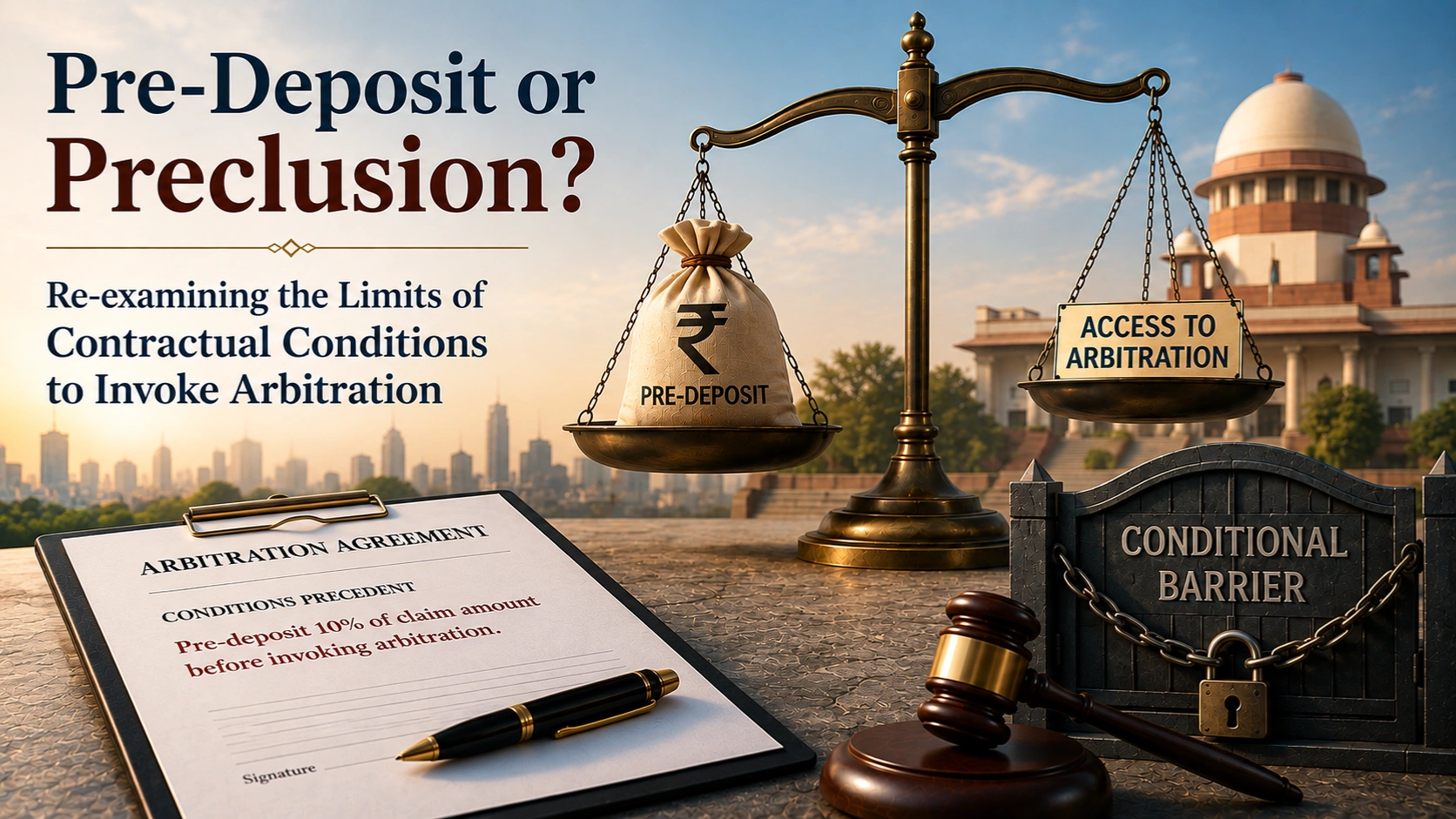
Pre-Deposit or Preclusion? Re-examining the Limits of Contractual Conditions to Invoke Arbitration
By – Tannishtha Chatterjee and Monalika Chaudhary
Table of Contents
Introduction
The Arbitration and Conciliation Act, 1996 (“Act”) is founded on the premise that parties may choose a private and efficient mechanism for resolution of their disputes. Yet, what happens when the very contract that provides for arbitration makes access to that mechanism conditional upon the Claimant pre-depositing a percentage of the claim amount before invoking arbitration?
This question has once again come to the forefront before the Supreme Court in M/s Santosh Associate Private Limited v. Haryana State Industrial and Infrastructure Development Corporation Ltd., where a two-Judge Bench comprising Justice Manoj Misra and Justice Manmohan has referred to a larger Bench the question of validity of contractual clauses requiring a contractor to make a pre-deposit before invoking arbitration. The Court expressed prima facie doubts regarding the continuing authority of the three-Judge Bench decision in S.K. Jain v. State of Haryana, which had upheld pre-deposit in order to prevent vexatious claims.
The reference is significant because the jurisprudence on pre-deposit clauses has evolved considerably since S.K. Jain (Supra). While ICOMM Tele Ltd. v. Punjab State Water Supply & Sewerage Board subsequently disapproved of such conditions, a later three-Judge Bench in Lombardi Engineering Ltd. v. Uttarakhand Jal Vidyut Nigam Ltd., found no direct conflict between the two decisions. The Constitution Bench in Central Organisation for Railway Electrification v. ECI-SPIC-SMO-MCML (JV), further reinforced the mandatory nature of equal treatment under Section 18 of the Act.
The present reference therefore raises a larger question: can party autonomy exceed contractual conditions which potentially make access to arbitration prohibitive?
The Issue
The dispute arose out of a contract awarded by Haryana State Industrial and Infrastructure Development Corporation Ltd. (“HSIIDC”) to Santosh Associate Private Limited (“SAPL”) for execution of storm-water drainage systems and associated works in Gurugram. The contract, originally valued at approximately ₹5.14 crore, contained an arbitration clause requiring a contractor raising a claim exceeding ₹1 lakh to deposit 10% of the claim amount as security before the dispute could be referred to arbitration.
The clause provided that the deposit would ultimately be adjusted against costs, if any, awarded against the Claimant, and the balance would be refunded following the Arbitral Award.
When disputes arose concerning the final settlement of payments, SAPL invoked arbitration, without making any pre-deposit and provisioned for in the arbitration agreement. HSIIDC objected under Section 16 of the Act, stating that the invocation was not maintainable on account of non-furnishing of the stipulated pre-deposit by SAPL. The Sole Arbitrator upheld the Respondent’s objection and directed the Appellant to deposit 10% of the claim amount within fifteen (15) days. Upon refusal, the Appellant’s claim was dismissed in entirety. The Commercial Court subsequently affirmed that decision, relying principally upon S.K. Jain.
Against a claim of ₹1.77 crore, SAPL would have been required to deposit ₹17.70 lakh before its claim could be adjudicated. SAPL argued that this was even higher than the ad valorem court fee payable on an equivalent civil claim in Haryana.
The issue, therefore, was not merely whether a contractual deposit is refundable. It is whether a Claimant would be required to finance access to the arbitral process before the merits of its claim have even been examined.
The Jurisprudential Diversion: S.K. Jain vs. ICOMM Tele
In S.K. Jain, a three-Judge Bench considered a clause requiring the contractor to deposit 7% of the amount claimed before invoking arbitration. The Claimant subsequently challenged the said clause requiring pre-deposit based on unequal bargaining power. The Court, while rejecting such a challenge, held that the deposit was a “balancing factor” intended to prevent frivolous and inflated claims and accordingly found the condition reasonable and non-arbitrary.
A decade later, the apex court in ICOMM Tele adopted a different approach. It held that a pre-deposit requirement would discourage parties from invoking arbitration and thereby undermine arbitration’s objective of reducing judicial burden. More importantly, the Court questioned the rational nexus between requiring a deposit and preventing frivolous claims, particularly because the frivolous nature of a claim cannot ordinarily be determined before the commencement of arbitral proceedings. The Court held that a mechanism designed to deter frivolous litigation ordinarily operates after the merits of the claims have been assessed, such as, through award of costs. A pre-deposit, by contrast, operates before the tribunal has had an opportunity to determine whether the claim is frivolous, genuine or meritorious.
The Supreme Court has now expressly acknowledged that it is prima facie in agreement with the reasoning in ICOMM Tele, but remains constrained by judicial discipline because ICOMM Tele, being a two-Judge decision, could not override the earlier three-Judge decision in S.K. Jain.
Party Autonomy Cannot Become a Barrier to Arbitration
At the heart of the controversy lies the principle of party autonomy. Parties are generally free to determine the terms on which they will resolve their disputes. However, party autonomy is not absolute. In Lombardi Engineering, a three-Judge Bench held that party autonomy cannot be stretched to permit contractual terms that violate fundamental rights of the parties. The Court specifically rejected the argument that a party which had voluntarily accepted a pre-deposit clause at the time of entering into the contract could subsequently challenge it as arbitrary under Article 14.
The Constitution Bench in CORE subsequently affirmed the mandatory nature of Section 18 of the Act, which requires equal treatment of parties at all stages of arbitral proceedings, including the appointment of the arbitrator. It also recognised that a pre-deposit clause may be arbitrary where it is excessive, disproportionate and operates as a deterrent to invocation of arbitration.
If the clause is contained in a government contract and requires only the private contractor to furnish a deposit, the question is not merely whether the contractor consented to the clause. It is whether a state instrumentality can contractually impose a condition which places a disproportionate burden on the other party seeking to exercise its contractual right to arbitrate.
The “Right to Sue” and Section 28 of the Contract Act
The Supreme Court also observed that the right to institute proceedings is inherent in an individual unless expressly prohibited by law. Referring to Ganga Bai v. Vijay Kumar, the Court noted that the apparent frivolousness of a claim does not, by itself, extinguish the right to institute proceedings.
The Court further considered Section 28 of the Indian Contract Act, 1872, which renders agreements in restraint of legal proceedings, void, subject to the statutory exception of arbitration. In this context, the Court emphasised that arbitration is an exception to ordinary litigation but cannot be converted into a mechanism through which contractual conditions make the right to pursue arbitration illusory. A pre-deposit, even if refundable, may therefore not automatically be valid merely because the Claimant eventually gets its money back.
Deterring Frivolous Claims: Is Pre-Deposit the Right Tool?
Consider a contractor with a ₹10 crore claim. A 10% pre-deposit requires ₹1 crore to be deposited by the contractor before the merits of the claim are adjudicated. For a contractor already facing delayed payments, project losses or cash-flow constraints, the requirement may effectively determine whether arbitration is commercially viable at all. The question is consequently not simply whether the deposit is eventually refunded, but whether the financial burden imposed at the threshold is proportionate to the legitimate objective sought to be achieved.
Considering the same, the Supreme Court formulated a separate question as to whether a refundable pre-deposit can nevertheless be legally valid. The strongest justification for pre-deposit clauses is the prevention of frivolous or inflated claims. Yet, the Supreme Court questioned the timing of such a mechanism.
At the stage of invocation, the tribunal has generally not yet assessed the merits of the claim. Requiring the Claimant to deposit a percentage of its claim therefore effectively treats the claim as financially risky before any such assessment has occurred.
The Act already provides mechanisms for dealing with unsuccessful or frivolous claims through costs. The Supreme Court has therefore questioned whether a pre-deposit bears a sufficient rational relationship with the objective of preventing frivolous claims when less restrictive mechanisms are available after adjudication.
In such view, the Supreme Court formulated the following questions, and has referred the said issues for consideration by a larger bench:
- Whether a stipulation requiring the contractor alone to make a pre-deposit of security/fees prior to reference of disputes to arbitration is contrary to Section 18 of the Act which mandates equal treatment of parties at all stages of arbitration?
- Whether pre-deposit conditions in contracts having Arbitration clause discourages Alternative Dispute Resolution and undermine its objective of declogging the court system?
- Whether a condition of pre-deposit of security/fees prior to reference to Arbitration is arbitrary and violative of the right to sue as well as Article 14 of the Constitution and Section 28 of the Indian Contract Act, 1872?
- Whether requirement of pre-deposit of security/fees has any rational relation to the object of curbing frivolous claims as at that stage it cannot be said that the claims are frivolous and moreover such frivolous claims may adequately be addressed under Section 31(8) of the Act through imposition of costs at the conclusion of the arbitration proceedings?
- Whether a pre-deposit condition is valid in an arbitration case where said deposit is refundable upon the conclusion of arbitration proceedings?
- Whether S.K. Jain is a valid and binding precedent?
The Larger Implications
The eventual ruling of the larger Bench could have significant consequences for construction, infrastructure and government contracts, where arbitration clauses frequently contain procedural and financial preconditions.
If such clauses are held invalid, contracting authorities may need to reconsider existing standard-form arbitration clauses requiring security deposits or similar financial conditions. Contractors, meanwhile, may gain greater certainty that contractual consent does not necessarily validate a term that materially impairs access to arbitration.
Conversely, if refundable deposits are upheld in appropriate circumstances, the larger Bench may be required to identify the boundaries of permissible conditions. Questions of quantum, proportionality, reciprocity, refundability, purpose and bargaining power could become relevant in determining validity.
The judgment may therefore ultimately produce a more nuanced test rather than an absolute prohibition.
Conclusion
The reference in Santosh Associate is significant not merely because it reopens the question decided in S.K. Jain, but because it places the pre-deposit issue within the broader evolution of Indian arbitration law.
The trajectory from S.K. Jain to ICOMM Tele, Lombardi Engineering and CORE reflects an increasing judicial emphasis on ensuring that arbitration remains an accessible and effective dispute-resolution mechanism. At the same time, the Supreme Court remains conscious of the doctrine of precedent and has therefore rightly left the reconsideration of S.K. Jain to a Bench of greater strength.
Ultimately, the larger Bench will have to balance two competing principles: the freedom of parties to determine the terms of their contracts, and the principle that contractual autonomy cannot be exercised so as to make access to justice illusory.
The real question may therefore not be whether every pre-deposit clause is inherently invalid. Rather, it may be whether a contractual condition that requires a party to pay a substantial price before it is even permitted to have its dispute heard is compatible with the fundamental character of arbitration as an accessible and effective mechanism for dispute resolution.
FAQs
-
Are Pre-Deposit Conditions Valid for Invoking Arbitration?
The validity of pre-deposit conditions is presently unsettled. S.K. Jain upheld such a requirement, while ICOMM Tele and subsequent jurisprudence have questioned its validity. In Santosh Associate, the Supreme Court referred the issue to a larger Bench, including whether such conditions violate Section 18, Article 14 and Section 28 of the Contract Act.
-
Can a Pre-Deposit Clause Restrict Access to Arbitration?
Yes. A substantial pre-deposit may operate as a financial barrier to arbitration, particularly where a party must deposit a percentage of its claim before the merits are examined. The Supreme Court has indicated that contractual conditions cannot be so onerous as to make the right to invoke arbitration effectively illusory or nugatory.
-
What Has the Supreme Court Said About Pre-Deposit Conditions in Arbitration?
In S.K. Jain, the Supreme Court upheld a 7% pre-deposit as a reasonable measure to deter frivolous and inflated claims; ICOMM Tele subsequently questioned this reasoning and its deterrent effect on arbitration. Santosh Associate has now referred the apparent conflict to a larger Bench, with the Court noting its prima facie agreement with the reasoning in ICOMM Tele.
-
How Do Pre-Deposit Conditions Affect Party Autonomy in Arbitration?
Party autonomy allows parties to determine their contractual dispute-resolution mechanisms, but it is not absolute and cannot justify terms that disproportionately restrict access to arbitration. Lombardi Engineering and CORE reinforce that contractual freedom must operate consistently with fundamental rights and the principle of equal treatment under Section 18.
-
Can Pre-Deposit Requirements Be Justified to Prevent Frivolous Arbitration Claims?
Preventing frivolous or inflated claims can constitute a legitimate objective, but the Supreme Court has questioned whether requiring a deposit before adjudication bears a sufficient rational nexus to that objective. Since arbitral tribunals can address unsuccessful claims through costs, a mandatory pre-deposit may be viewed as a more restrictive mechanism, particularly where it substantially deters genuine claims.
References –
- 2026 SCC OnLine SC 1584
- (2009) 4 SCC 357
- (2019) 4 SCC 401
- (2024) 4 SCC 341
- (2025) 4 SCC 641
- (1974) 2 SCC 393
 You wish to know more about Neeti Niyaman (the “Firm”) for your own information and use.