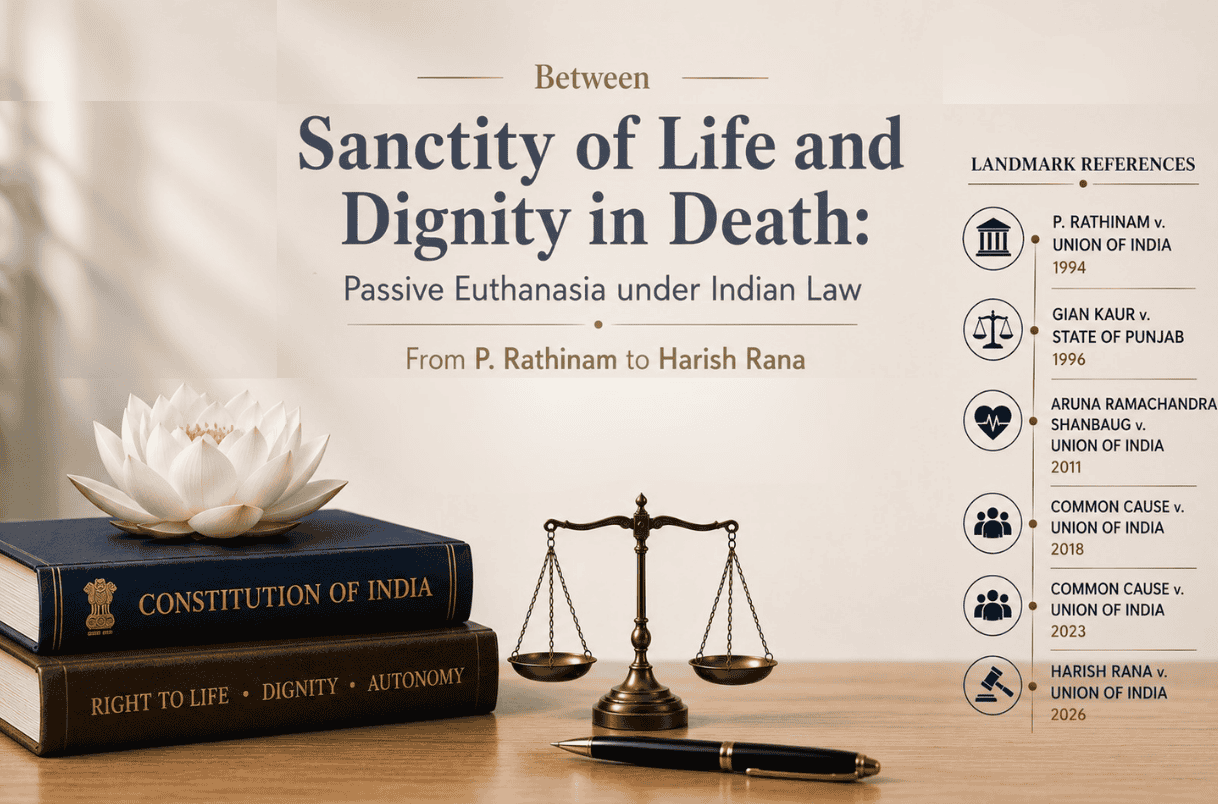
Between Sanctity of Life and Dignity in Death: Passive Euthanasia under Indian Law (From P. Rathinam to Harish Rana)
By – Asmita Narula and Kaushiki
Table of Contents
Introduction
Euthanasia remains one of the most sensitive and debated issues in constitutional law, medical ethics and human rights jurisprudence. It raises profound questions concerning the sanctity of life, personal autonomy, bodily integrity, dignity, and the role of the State in end-of-life decisions. Advances in medical science and life-support technology have further complicated this debate by enabling biological survival even in circumstances where recovery is medically impossible. The legal position on euthanasia laws in India has evolved gradually through judicial interpretation rather than legislative enactment, with the Supreme Court attempting to strike a careful balance between preserving life and recognising the constitutional right to die with dignity under Article 21 of the Constitution of India. This article examines the concept and classifications of euthanasia, traces the evolution of Indian jurisprudence from the early ‘right to die’ cases to the landmark judgments in Aruna Ramachandra Shanbaug, Common Cause and Harish Rana, and analyses the constitutional principles, safeguards and practical challenges governing passive euthanasia in India today.
Understanding Euthanasia
The word ‘euthanasia’ originates from the Greek expression ‘eu’ meaning ‘good’ or ‘well’ and ‘thanatos’ meaning ‘death’, collectively meaning ‘good death’. It means the intentional ending of a person’s life, or permitting death to occur, for compassionate reasons, such as relief from unbearable pain, suffering, irreversible medical distress, loss of bodily control, or prolonged dependence on artificial life support. Euthanasia embodies the idea of ‘death with dignity’, where a person possesses the autonomy to choose a dignified and painless death. Euthanasia is generally classified based on the method adopted for causing death (active and passive euthanasia) and consent (voluntary, non-voluntary and involuntary euthanasia).
Active euthanasia is a positive, deliberate and overt act intended to bring about the death of a person. For instance, administering a lethal injection, prescribing a fatal dose of medication, etc. It involves direct human intervention with the intention to cause immediate termination of life. Thus, it is prohibited in most legal systems across the world being inconsistent with medical ethics and criminal law principles. Passive euthanasia involves withholding or withdrawing life-sustaining treatment that artificially prolongs life. For instance, removing ventilators, withdrawing artificial nutrition and hydration, not providing resuscitative measures, etc., where the treatment has become futile and recovery is impossible. It allows the natural process of dying to take place with dignity rather than causing direct death of a person, which reason forms the very basis for its legal acceptance in several jurisdictions.
Voluntary euthanasia is based on the principle of autonomy and self-determination as it involves a competent individual consciously, freely and willingly requesting assistance in ending their life due to reasons such as terminal illness or unbearable suffering. Non-voluntary euthanasia is when an individual is incapable of expressing consent or refusal and the decision for continuation or withdrawal of treatment is often taken by family members, guardians, or medical professionals. For instance, in cases of coma, persistent vegetative state, severe cognitive impairment, or unconsciousness. This form may raise significant concerns since the wishes of the patient may not be clearly ascertainable, thereby necessitating strict safeguards against misuse. Involuntary euthanasia is ending a person’s life without their consent and against their wishes, which is universally condemned and illegal.
Physician-assisted suicide is when the doctor provides the means or information to a patient to end their own life. Some jurisdictions, which prohibit euthanasia, permit physician-assisted suicide under limited circumstances. Indirect Euthanasia occurs where medical treatment administered primarily to relieve pain or suffering unintentionally accelerates death as a secondary consequence. For instance, administration of high doses of pain-relieving medication.
Constitutional Dimensions of Euthanasia
Our Constitution does not categorically recognise euthanasia. The entire debate revolves around life, liberty, dignity, personal autonomy and interest of the State. The law on euthanasia in India has developed and evolved gradually through judicial interpretation rather than statutory legislation. The constitutional dimensions of euthanasia involve a complex balancing exercise between an individual’s ‘right to die with dignity’ and the State’s obligation to preserve life and protect vulnerable persons. The judgments discussed in this article collectively demonstrate the gradual evolution of the law on euthanasia in India towards its conditional recognition. While active euthanasia and physician-assisted suicide continue to remain illegal, passive euthanasia in India has now acquired constitutional legitimacy under Article 21 through judicial interpretation.
Article 21 guarantees the fundamental right to life and personal liberty and provides that “No person shall be deprived of his life or personal liberty except according to procedure established by law”1. In India, ‘dignity’ has been treated as an inseparable component of Article 21. The term ‘life’ under Article 21 is more than mere biological survival. Forcing prolonged invasive treatment on a patient who is terminally ill or permanently unconscious or whose life is being sustained artificially, with no hope of improvement or recovery, may violate the person’s dignity. In Common Cause v. Union of India (2018)2, which is discussed in detail later in this article, the Supreme Court has held that the ‘right to die with dignity’ is a part of Article 21. The right to privacy has also been recognised as a fundamental right3. The Supreme Court has held that ‘privacy’ includes decisional autonomy related to bodily integrity and control over personal choices.
The principle of autonomy forms a central constitutional dimension of the jurisprudence of euthanasia i.e., the capacity of individuals to make informed decisions concerning their own bodies and lives. In Common Cause (2018)4, the Court held that a competent individual possesses the right to refuse unwanted medical treatment and to decide whether life-sustaining treatment should continue in circumstances where recovery is impossible. This reflects a broader constitutional principle that individuals possess sovereignty over decisions affecting their bodily integrity and personal existence.
Article 14 requires that the law on euthanasia and the legal processes concerning it operate in a fair, equal and non-arbitrary manner. The freedom of religion and conscience may also play a role in this discussion. Different religions, cultures and traditions in India have varied views about life and death. The concept of euthanasia has also faced opposition on religious grounds however, such decisions ought not be governed by religion or morals alone.
While the fundamental rights of a person must be protected, the interest of the State also requires to be given equal weightage. The autonomy discussed earlier is not absolute. The State also possesses compelling constitutional interests in preserving life, preventing abuse, and protecting vulnerable persons, which arises from the principle that human life possesses intrinsic social value and that the Constitution imposes an obligation upon the State to safeguard life and public welfare. This concern is particularly significant in relation to vulnerable individuals such as the elderly, disabled, economically dependent, mentally ill, or terminally ill. The State has a legitimate interest in regulating medical practice to ensure that healthcare professionals do not misuse euthanasia as a means of discrimination, negligence, or elimination of inconvenient patients. The fear which delves in is that legalisation on euthanasia without safeguards may expose such vulnerable individuals to coercion, undue influence, neglect, or social pressure.
Another constitutional concern relates to the possibility of a ‘slippery slope’ i.e., the formal recognition of right to die may gradually weaken and dilute the legal and moral respect for human life. Once the State accepts the principle that life may be intentionally terminated under certain circumstances, the scope of such exceptions may progressively expand beyond narrowly defined cases of terminal illness or irreversible vegetative states into broader and more subjective categories such as chronic disability, mental suffering, old age, depression, or diminished quality of life.
It is for these reasons that a cautious and balanced approach has been adopted under the Indian law. While recognising dignity and autonomy, the Supreme Court has simultaneously insisted upon procedural safeguards to prevent misuse, which has been discussed in this article.
Development of Law on Euthanasia in India
It is the interpretation of Article 21 which plays a pivotal role in the development of law on euthanasia in India and has been the fulcrum of judicial interpretation – whether the ‘right to life’ includes a ‘right to die’ under Article 21. This debate first arose in context of Section 309 of the Indian Penal Code, 1860 (“IPC”), which criminalized the attempt to commit suicide. To understand the jurisprudence of ‘right to die’, it is essential to analyse the judicial pronouncements pertaining to Section 309 IPC.
This issue first arose in a writ petition before the Bombay High Court in the year 1986 where the constitutionality of Section 309 IPC was challenged on the ground of being ultra vires Article 14 and 215. While striking down Section 309 IPC as unconstitutional, the Court observed that the normal urge of a human being is to live and to continue to enjoy the fruits of life till nature intervenes to end it however, there is nothing unnatural about the desire to die. The urge to live is normal for ordinary human beings who are in possession of their normal mental, intellectual and physical faculties and suicide or an attempt to commit suicide is an incident of abnormality or of an extra-ordinary situation or of an uncommon personality trait, for instance, mental diseases and imbalances, unbearable physical ailments, affliction by socially dreaded diseases, decrepit physical condition disabling a person from taking normal care of his body and performing the normal chores, etc. Even though this case did not pertain to euthanasia or mercy-killing, the Court drew a distinction between suicide and euthanasia / mercy-killing, which according to the Court was nothing but homicide, dehors the circumstances in which it is affected, given that it involves intervention to end life.
The Andhra Pradesh High Court adopted a different approach in a criminal appeal before it in the year 19876. Even though the constitutionality of Section 309 IPC was not under challenge, the Court delved into it in view of the reliance of the accused on the judgment passed by the Bombay High Court. The Court was of the opinion that even though the right to life is not specifically mentioned in Articles 19 and 21, there can be no other fundamental right unless a person is assured of physical existence, in view of which it is difficult to hold that the right to life impliedly guaranteed by the Constitution includes the right to die under Article 21.
In the year 1994, the Supreme Court upheld the judgment of the Bombay High Court only qua Article 21 and overruled the judgment of the Andhra Pradesh High Court in P. Rathinam v. Union of India and Another7. The Court concluded that Article 21 has enough positive content in it, and it can be said to bring in its trail the right not to live a forced life. The term ‘life’ means something more than mere animal existence. It means the right to live with human dignity and takes within its fold some of the finer graces of human civilization, which make life worth living. A person cannot be forced to enjoy right to life to his detriment, disadvantage or disliking. The Supreme Court distinguished between euthanasia and suicide but was also cognizant of the fact that euthanasia is not wholly unrelated to the act of committing suicide.
The position qua the right to die under Article 21 was substantially altered by the Supreme Court in Gian Kaur v. State of Punjab8, whereby the Constitution Bench overruled the judgment passed in P. Rathinam9. The Court was of the view that the decisions relied upon in P. Rathinam10 relate to other fundamental rights, which deal with different situations and ‘positive’ rights, where it was held that the right to do an act includes the right not to do an act in that manner. If the right has a negative aspect of not depriving a person of its continued exercise, for instance the right to life or personal liberty, it does not mean that the converse positive act also flows therefrom to expressly permit its discontinuance or extinction by the holder of such right. The positive overt acts required to commit suicide are not included within the protection under Article 21 i.e., ‘extinction of life’ cannot be read to be included in ‘protection of life’.The Court concluded that Article 21 does not include within it the ‘right to die’. Nevertheless, the Court was cognizant of an important distinction between the ‘right to die with dignity’ at the end of life and the ‘right to die an unnatural death’ curtailing the natural span of life.
Notably, a provision corresponding to Section 309 IPC has not been included in the Bharatiya Nyaya Sanhita 2023, which replaces IPC. The provision has been removed completely, which is aligned with the Mental Healthcare Act, 2017, which is aimed at reducing the stigma around suicidal ideation.
A major turning point came with the decision of the Supreme Court in Aruna Ramachandra Shanbaug v. Union of India11, where the Court considered non-voluntary passive euthanasia. Aruna Shanbaug, who was a staff nurse in a hospital in Mumbai, was left in a persistent vegetative state after a brutal attack and assault. While the Court did not permit withdrawal of treatment in the particular facts of the case, it recognised passive euthanasia in India for the first time and laid down certain guidelines to be following across the country till a legislation is framed. To understand the law on euthanasia in India at present, a detailed analysis of this judgment is essential. During arguments, several important concepts were raised and considered, including the following:
- Principle of self-determination or informed consent – The patient possesses the right not to consent to a treatment i.e., a patient of sound mind wanting life support to be discontinued.
- Living Will – A passing reference was also made to a living will i.e., where a patient expresses consent at an earlier date before he becomes unconscious or otherwise incapable of communicating it, in anticipation of his incompetent situation.
- Substituted judgment / judgment of a surrogate – Where a patient is not in a condition to express his consent and has not given any prior indication of his wishes, the Courts in America have adopted this approach.
- Best interest of the patient – The Courts have also adopted this approach where a responsible and competent body of medical persons determine whether it is in the best interest of the patient that his life should be prolonged by the continuance of life support treatment.
- Persistent Vegetative State (PVS) – In this case, the brainstem remains alive and functioning, but the cortex loses its function and activity. In simple terms, the patient can breathe unaided, digest, and keep his eyes open but, he cannot see, hear, smell, taste, speak, voluntary move, etc.
- When is a person considered to be dead? – A person is dead when there is a total brain failure i.e., no breathing and no circulation. In accordance with international standards, brain dead means ‘whole-brain dead’ i.e., the higher brain, midbrain and brainstem have all ceased to function, which is different from persistent vegetative state.
The Court has placed heavy reliance on Airedale N.H.S. Trust v. Bland12, where Anthony Bland was left in a persistent vegetative state after an accident. The medical practitioners sought a declaration from the High Court to discontinue medical care and artificial feeding as no useful purpose would be served, which was granted and affirmed in appeal. The observations of this case, as summarized below, formed the basis for the decision rendered in the Aruna Ramachandra Shanbaug case, which lay down the foundation for recognition of euthanasia in India.
- A medical practitioner is not under any duty to continue treatment where no benefit would be served at all. A vegetative state with no possibility of recovery is not of any benefit to the patient.
- A person is considered dead only when his brain, particularly the brainstem, is destroyed. Otherwise, he is considered alive under law.
- Principle of sanctity of life is not an absolute one. On one hand, it does not force a medical practitioner to keep a patient, who is terminally ill, alive where it would only prolong suffering, and on the other hand, it prohibits active measures to cut short a life.
- There is a difference between a case where a doctor decides not to provide / continue patient treatment to prolong life and a case where a lethal drug is administered to bring a life to an end. The former may be lawful, but the latter is not.
- A medical practitioner is supposed to decide whether treatment should be continued. However, an application should be made to the Court to endorse or reverse the decision to protect the patient and the doctor and to reassure patient’s family and the public.
- Same principles apply in case the patient is of an unsound mind or has been rendered unconscious, making him incapable of giving consent. However, in all cases, the best interest of the patient is of paramount importance.
After a detailed consideration of all relevant aspects, including foreign judgments, the Supreme Court passed a historic judgment permitting passive euthanasia in India in certain situations. In the absence of any legislation, the Court followed the footsteps of Vishaka v. State of Rajasthan13 and has laid down the law which is to be followed throughout the country till a legislation is passed:
- The decision to discontinue life support should either be taken by the parents or the spouse or other close relatives, and in their absence, the decision can be taken by a person / body of persons acting as next of friend or by the doctors attending to the patient. In every case, the decision should be bona fide in the best interest of the patient and requires approval of the High Court, as has been laid down in the Airedale case and in consonance with the well-known principle of parens patriae.
- This power can be exercised by the High Court under Article 226 of the Constitution which gives abundant power to the High Courts to not only issue writs but also directions or orders. Such applications shall be considered by a Bench of at least two Judges.
- The Bench shall seek the opinion of a committee of three reputed doctors (neurologist, psychiatrist and physician) to be nominated by the Bench, for which purpose the High Court may prepare a panel of doctors in consultation with the State Government / Union Territory. The said committee shall submit a report to the High Court after carefully examining the patient and the record and taking the view of the hospital staff.
- The High Court shall issue notice to the State and close relatives of the patient (or next friend in their absence), supply a copy of the medical report to them and pass a reasoned order as expeditiously as possible, after hearing them and considering the best interest of the patient.
The Supreme Court however cautioned the Courts of unscrupulous persons who may misuse the law to eliminate a person with the ill-intention of inheriting or grabbing property. It further cautioned the doctors to ensure that there is no reasonable possibility of any improvement by some new discovery in the near future before declaring a case to be hopeless.
Aruna Ramachandra Shanbaug ultimately passed away in May 2015 due to pneumonia, but her ordeal permanently altered the law and medical jurisprudence in India.
The most significant constitutional development took place when the Supreme Court recognised that the ‘right to die with dignity’ is an intrinsic facet of Article 21 in the landmark judgment of Common Cause (2018)14. A writ petition was filed inter alia seeking a declaration that the ‘right to die with dignity’ is a fundamental right within the fold of ‘right to live with dignity’ guaranteed under Article 21, and to enable persons of deteriorated health or terminally ill patients to execute a document titled ‘My Living Will and Attorney Authorisation’. The earlier decisions rendered in P. Rathinam15, Gian Kaur16 and Aruna Ramachandra Shanbaug17 and the Airedale case were discussed in detail. The Court observed that passive euthanasia comes within the ambit of Article 21 as a part of right to die with dignity, where a dying person is terminally ill or in a persistent vegetative state, however active euthanasia requiring positive steps to be taken to cause death, does not fall under it. The Court considered the principle of self-determination and autonomy in depth and stated that the doctors will be bound by it on being satisfied that the patient’s illness is incurable and there is no hope of it being cured, otherwise it would not be in the best interest of the patient. If a man is allowed or forced to undergo suffering and pain because of unwarranted medical treatment, the meaning of dignity will be lost. The possibility of abuse cannot curb the right to die with dignity, and it can be eliminated by enforcing safeguards. The Court gave due weightage to autonomy, bodily integrity, privacy, and informed consent as constitutional values central to end-of-life decision-making, while at the same time, laid down detailed procedural safeguards to prevent misuse.
The Supreme Court laid down detailed directives for passive euthanasia in cases where the patient is terminally ill and undergoing prolonged treatment for an incurable illness, which shall remain in force till there is a legislation on this subject. In view of difficulties in implementation, the directives were revised in Common Cause v. Union of India (2023).
- Physician may inform the hospital, which hospital shall then constitute a Primary Medical Board in prescribed manner. The Board shall discuss with family physician (if any) and next of kin/next friend/guardian, apprise such person of pros and cons of withdrawal/refusal for further treatment and record the minutes in writing. The Board may certify the course of action to be taken preferably within 48 hours, if family consents in writing, which may be regarded as a preliminary opinion.
- Where the Primary Board certifies the option of withdrawal/refusal – Hospital shall constitute a Secondary Medical Board in the prescribed manner, and the Board shall physically examine the patient. The Board may concur with the previous opinion, which shall then be communicated to the JMFC and family members preferably within 48 hours. The High Court shall also be informed.
- Where the Primary Board does not certify this option or the Secondary Board does not occur with it – Patient’s nominee/family member/treating doctor/hospital staff can approach the High Court under Article 226 for approval, which shall be heard by a Division Bench. The Court can constitute an independent committee of doctors in the prescribed manner. The Court shall pass a reasoned order at the earliest after hearing the State and considering the best interest of the patient.
In Common Cause (2018)19, the Court recognised the concept of ‘Advance Directive’ or ‘Advance Care/Medical Directive’ whereby a person can specify medical decisions and identify the person who will take those decisions for him in a situation where he is unable to communicate his wishes. This can take various forms, including a living will and medical power of attorney. We will discuss these concepts in detail in a subsequent article.
Harish Rana’s case – India’s first court approved passive euthanasia
InHarish Rana v. Union of India and Others20, the Supreme Court delivered its first court-approved passive euthanasia order by permitting withdrawal of life support of a patient who fell from the fourth floor leading to a diffuse axonal injury, due to which he was in a persistent vegetative state for over 12 – 13 years i.e., bedridden, unresponsive, fed through a PEG tube, breathing through a tracheostomy and with 100% permanent disability. The Court held that continuation of artificial life support served no curative purpose. In Harish’s case, both the Primary and Secondary Medical Boards concluded that he would remain in a vegetative state for years, with no hope of recovery, which would not be in his best interest. His parents and brother were also of the view that his suffering should be ended. The Court also emphasised on the need for a comprehensive legislation governing passive euthanasia in India.
The Delhi High Court had dismissed the plea of his parents seeking passive euthanasia on the ground that he was not on ventilation and if the feeding tube is withdrawn, it would amount to active euthanasia. Thereafter, the Supreme Court directed the Government to provide home care support however, when his condition worsened, his parents approached the Supreme Court again. Before arriving at a decision, the Supreme Court analysed the previous decisions on this subject and made the following key observations:
- The difference between active and passive euthanasia lies in the source of the harm that leads to death and not merely in the nature of the conduct. Active euthanasia is causing death as it introduces a new external agency of harm which was previously not present, thereby disrupting the natural path towards death. Passive euthanasia is allowing death to occur naturally by no longer continuing the medical intervention that was artificially prolonging life.
- In the previous decisions, the Court has unequivocally held that the ‘right to live with dignity’ under Article 21 extends beyond the preservation of life to encompass the ‘right to die with dignity’.
- Where a person can make decisions, he has a right in common law to refuse medical treatment and his dignity, autonomy, liberty and self-determination is paramount. The choice is absolute and free from any kind of control.
- Where a person is incapable of making a decision, specific threshold conditions must be met – (a) patient must be diagnosed to be suffering from a medical ailment and be classified as terminally ill or in persistent vegetative state or like conditions, (b) patient must be undergoing prolonged medical treatment indicating that the intervention has ceased to be temporary, and (c) ailment must be irreversible i.e., incurable condition or no hope of being cured.
- There is no real conflict between the patient’s right to dignity and the State’s interest. However, when the degree of bodily invasion progressively increases and prognosis for recovery progressively decreases, the State’s absolute interest in preserving life must become subservient to the patient’s dignity.
- When a doctor withholds or withdraws medical treatment in the best interest of the patient and according to the procedure under Common Cause21, it is a step taken in furtherance of duty to care.
- Active euthanasia can only be legalised by way of a legislation.
The Supreme Court held that the use of the term ‘passive euthanasia’ is an obsolete and confusing term and the same ought to be replaced with ‘withdrawing or withholding of medical treatment’, which should be strictly governed by the guidelines and procedural safeguards established for passive euthanasia in Common Cause22.
The Court also examined the meaning, scope and contours of the principle of best interest of the patient, based on several foreign decisions and applied the principle under the conditions prevalent in India.
- The test is not whether it is in the patient’s interest to die, but whether it is in their interest to continue life-sustaining treatment that offers no hope of recovery.
- When treatment merely prolongs biological existence without therapeutic benefit, dignity becomes central to the analysis. Sanctity of life remains the starting point however, the State’s interest in preserving life is not absolute.
- ‘Best interest’ includes a holistic balance between both medical considerations (futility of treatment, irreversibility of condition, absence of therapeutic purpose, invasiveness of treatment, pain, suffering, etc.) and non-medical considerations (the patient’s wishes, values, beliefs, personality, prior lifestyle and preferences, psychological and social dimensions, etc.).
- Decision-makers must put themselves in the place of the patient and ask what his wishes and attitude to treatment would likely have been.
- The test must be applied throughout the process, by doctors, Boards, family/next of kin/guardian, and Courts.
The Supreme Court added to the directives issued in Common Cause23.
- Withholding or withdrawal of medical treatment is not a single and abrupt act. It entails a structured and stepwise process, anchored in a clearly articulated withdrawal plan as a part of an appropriate Palliative and End-of-Life (“EOL”) care framework. It must be carried out in a humane manner and due importance should be given to the patient’s comfort. Such care can be given either in the hospital or at home, for which the Guidelines for EOL Care issued by AIIMS, New Delhi can be followed.
- In case the patient is undergoing prolonged medical treatment in a home-setting, the next of kind/next friend/guardian, who is undertaking such treatment, would have an option to admit the patient in any hospital of their choice, after which the procedure laid down in Common Cause has to be followed by the physician and the hospital.
- In case such admission is not possible, the next of kind/next friend/guardian can approach any hospital for the limited purpose of designating a primary treating physician, who shall be responsible for initiating the process.
- CMOs of all concerned districts shall prepare and maintain a panel of registered medical practitioners possessing the required qualifications for nomination to the Secondary Medical Board preferably within 48 hours from receipt of such request in terms of Common Cause.
- In case of incompetent patients, the decision to withdraw or withhold medical treatment should be implemented only after 30 days i.e., reconsideration period, to enable court intervention if required.
- The next of kind/next friend/guardian is also permitted to approach the High Court under Article 226 in case the physician fails to initiate the process as contemplated.
Position across the world
Different countries across the world have adopted distinct approaches with respect to euthanasia, giving due consideration to their constitutional values, ethical traditions, medical practices, and societal attitude. While active euthanasia is illegal all over the world, unless permitted by a legislation, passive euthanasia or physician assisted dying is legal even in the absence of a legislation, subject to certain conditions and safeguards. Comparative international practice demonstrates that legal systems across the world have attempted to address euthanasia through varying constitutional and ethical frameworks.
Netherlands was the first country in the world to formally legalise euthanasia and physician-assisted suicide through its Termination of Life on Request and Assisted Suicide (Review Procedures) Act, 2002, in very specific cases and circumstances. The physician is required to act in accordance with the criteria of due care and report euthanasia to a Review Committee. There are several conditions which must be fulfilled – suffering should be unbearable with no sign of improvement, request must be voluntary and must persist over time, patient must be fully aware of his condition, prospects and options, consultation with at least one independent doctor, method should be medically appropriate and patient must be at least 12 years old (parental consent required till 16 years of age). A separate protocol has also been developed for children under the age of 12 years.
Belgium is the second country to legalise euthanasia through its Belgian Act on Euthanasia, 2002 in cases where the patient is suffering from constant and unbearable physical or psychological pain because of an accident or incurable illness. Unlike Netherlands, initially, minors were not permitted to seek euthanasia however, now the age restriction has been removed, subject to parental consent. In fact, Belgium became the first country to extend euthanasia to minors.
Switzerland has legalised assisted suicide, even if performed by non-physicians, unless the motive behind it is selfish. However, active euthanasia is illegal. In fact, the recipient does not necessarily have to be Swiss national.
The position in the United Kingdom was comparatively restrictive as both euthanasia and assisted suicide were prohibited. Active euthanasia continues to attract criminal liability, while assisted suicide is punishable under the Suicide Act, 1961. However, the Courts gradually started recognising the importance of patient autonomy in EOL care. Withdrawal of life-sustaining treatment in cases of persistent vegetative state has been permitted under judicial supervision following the landmark decision in Airedale case24, as discussed above, which has been followed in several judgments thereafter. In case of patients who are incapable of giving consent, the doctor can withdraw artificial life support if the decision is based on informed medical opinion and is in the patient’s best interests.
In United States of America, active euthanasia is illegal however, physician-assisted death or ‘medical aid in dying’ is legal in some States. The legal position varies significantly from State to State because healthcare and criminal law largely fall within State jurisdiction. Oregon was the first State to legalise physician-assisted death, which was regulated by the Oregon Death with Dignity Act, 1997. Washington followed its footsteps by enacting the Washington Death with Dignity Act, 2008. In Montana, it was legalised by the judiciary and not the legislature. Additionally, several other States have legalised it, including but not limited to Vermont, California, Colorado, Washington DC, Hawaii, New Jersey, and New Mexico. The law in Oregon was treated as the model legislation.
Canada legalised Medical Assistance in Dying (MAiD) after the judgment of the Supreme Court in Carter v. Canada. The Court held that the blanket prohibition on physician-assisted dying was violative of the constitutional guarantees relating to life, liberty, and security of the person. The framework under the Canadian law gives due weightage to dignity, autonomy, and informed consent, and incorporates the necessary safeguards such as independent medical assessments and waiting periods.
Spain legalized euthanasia and medically assisted dying in 2021. Austria decriminalized assisted suicide in 2022. Germany had historically adopted a restrictive approach towards euthanasia however, the jurisprudence has evolved over the years. In 2020, the Federal Constitutional Court recognised a right to a self-determined death and struck down a statutory prohibition on organised assisted suicide. Active euthanasia continues to remain unlawful. In France, active euthanasia remains prohibited, but passive euthanasia and deep continuous sedation are legally recognised under certain circumstances. French law permits withdrawal of futile treatment and recognises advance medical directives.
All the States in Australia have legalized Voluntary Assisted Dying (VAD) between 2017 and 2023, with Victoria being the first State to legalize it in 2017. The law in Victoria, which came into operation in 2019, became the model law for other States.
Conclusion
The jurisprudence on euthanasia in India reflects the gradual shift of the judiciary towards recognising dignity, autonomy and informed consent as integral facets of the right to life under Article 21. While active euthanasia and physician-assisted suicide continue to remain prohibited, passive euthanasia has now acquired constitutional legitimacy, subject to stringent procedural safeguards designed to prevent abuse and protect vulnerable individuals. Through decisions such as Aruna Ramachandra Shanbaug, Common Cause and Harish Rana, the Supreme Court has sought to harmonise the sanctity of life with the equally important principle that life must be lived with dignity and not reduced to mere biological existence.
Despite Law Commission Reports and several private members’ bills, no legislation has been formulated till date. The need for a legislation has been time and again emphasised in various judicial decisions as well, including Common Cause and Harish Rana. In the absence of a comprehensive parliamentary legislation, the euthanasia law in India continues to rest primarily on judicial directives, creating practical and procedural uncertainties in implementation. The need of the hour is a carefully drafted statutory framework which balances compassion with caution, respects individual autonomy while ensuring adequate safeguards, and provides clarity to patients, families and medical professionals navigating deeply difficult EOL decisions.
FAQs
-
What is passive euthanasia under Indian law?
Passive euthanasia in India refers to the withdrawal or withholding of life-sustaining treatment (like ventilators or feeding) to allow a terminally ill patient to die naturally.
-
What is the difference between active and passive euthanasia?
Active euthanasia involves deliberately causing a patient’s death (such as giving a lethal injection), while passive euthanasia means withdrawing or withholding life-support, so the patient dies naturally. Active euthanasia is illegal in India, whereas passive euthanasia is allowed under strict conditions.
-
How does Article 21 relate to the right to die with dignity?
Article 21 of the Constitution of India guarantees the right to life and personal liberty, which has been judicially interpreted to include the right to live with dignity.
This interpretation extends to the right to die with dignity, allowing terminally ill patients to refuse life-sustaining treatment and avoid prolonged suffering. -
Is passive euthanasia legal in India?
Yes, passive euthanasia is legal in India under strict safeguards.
It allows withdrawal or withholding of life-sustaining treatment for terminally ill patients to let them die with dignity. -
What was the significance of the Aruna Shanbaug case?
The Aruna Shanbaug v. Union of India case was significant because it was the first time the Supreme Court of India recognised passive euthanasia under strict guidelines.
It also laid down a legal procedure requiring court approval for withdrawal of life-support in certain cases, recognizing the right to die with dignity in limited circumstances.
References –
- Sunil Batra v. Delhi Administration, (1978) 4 SCC 494
- (2018) 5 SCC 1
- K.S. Puttaswamy and Another v. Union of India and Others, (2017) 10 SCC 1
- supra
- Maruti Shripati Dubal v. State of Maharashtra, 1986 SCC OnLine Bom 278
- Chenna Jagadeeswar and Another v. State of Andhra Pradesh, 1987 SCC OnLine AP 263
- (1994) 3 SCC 394
- (1996) 2 SCC 648
- supra
- supra
- 2011 (4) SCC 454
- 1993 AC 789 : (1993) 2 WLR 316 : (1993) 1 All ER 821 (CA and HL)
- (1997) 6 SCC 241
- supra
- supra
- supra
- supra
- (2023) 14 SCC 131
- supra
- 2026 SCC OnLine SC 358
- supra
- supra
- supra
- supra
 You wish to know more about Neeti Niyaman (the “Firm”) for your own information and use.