Online Child Safety and Intermediary Liability
By – Kamatham Rishitha and Kausar Chaudhary
Table of Contents
Introduction
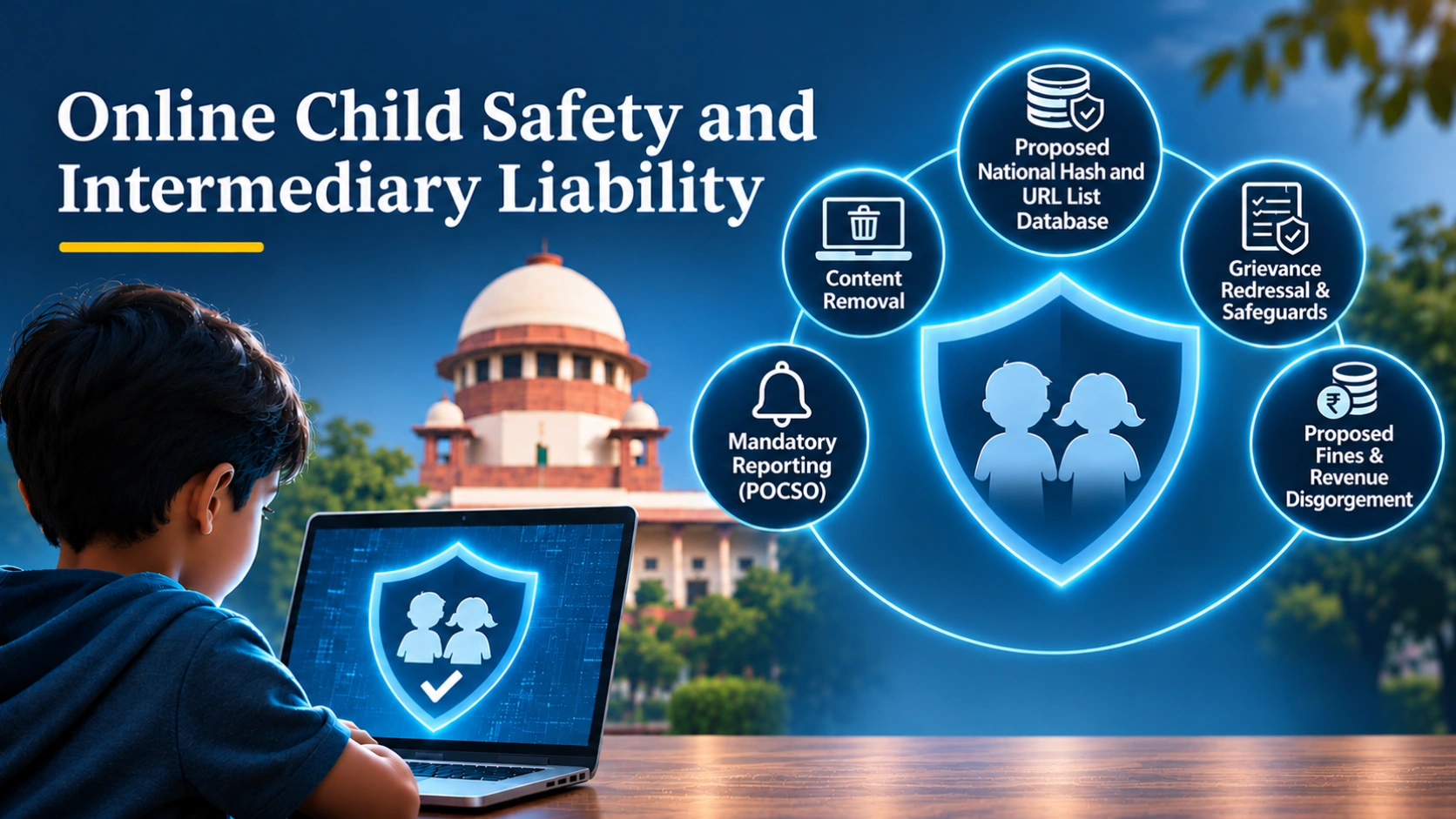
The circulation of child sexual exploitation and abuse material (CSEAM) presents a systemic challenge that cannot be adequately addressed through isolated complaints and individual takedown orders. Such material may be reproduced, modified to circumvent detection mechanisms, hosted on external websites, or disseminated through hyperlinks that redirect users beyond the platform on which they appear. Consequently, the removal of material from one platform does not prevent its continued circulation through other services. In Just Rights for Children Alliance & Anr. v. S. Harish & Ors (2026 Order), the Supreme Court of India revisited this challenge in its order dated 15.10.2026, following its judgment dated 23.09.2024 in Just Rights for Children Alliance & Anr. v. S. Harish & Ors (2024 Judgment). The 2024 Judgment addressed the interpretation of the Protection of Children from Sexual Offences Act, 2012 (POCSO Act), and the Information Technology Act, 2000 (IT Act), including the statutory obligations applicable to intermediaries. The 2026 Order records the Court’s concern regarding continuing deficiencies in compliance with its earlier directions, including the circulation and paid promotion of CSEAM through social media platforms and redirect links. In response, the Court contemplated a shift from fragmented, platform specific enforcement towards a coordinated framework involving a proposed national database of hashes and URLs, defined reporting timelines, and more accountable grievance redressal mechanisms.
1. Statutory Obligations of Intermediaries: Content Removal and Mandatory Reporting
The 2024 Judgment established the legal foundation for the directions subsequently issued by the Court in the 2026 Order. The Court held that an intermediary’s entitlement to the safe harbour protection under Section 79 of the Information Technology Act, 2000 (IT Act), in respect of third party information, data or communication links, is contingent upon compliance with the applicable due diligence requirements. Such obligations extend beyond the removal of CSEAM and include reporting offences to the authorities in accordance with the POCSO Act, and the Protection of Children from Sexual Offences Rules, 2020 (POCSO Rules). In this regard, the Court referred to Sections 19 and 20 of the POCSO Act and Rule 11 of the POCSO Rules, which prescribe reporting obligations applicable to the relevant persons and entities, including reporting to the Special Juvenile Police Unit (SJPU), local police or other authorities. The 2026 Order reiterates the distinction between the obligations to remove unlawful content, report offences under the POCSO framework and comply with intermediary due diligence requirements. Compliance with one obligation does not discharge the others. This distinction assumes particular significance where online dissemination does not involve the direct uploading of the underlying material to a platform. In the 2024 Judgment, the Court recognised that links may be shared or sold to facilitate access to material hosted elsewhere, thereby enabling access without requiring users to download or store the material directly. Consistent with this concern, the 2026 Order addresses hyperlinks and other means of circulation as part of the broader regulatory challenge, rather than limiting the response to material hosted directly on a platform.
2. Limitations of Platform Specific Detection and Removal Mechanisms
The Court identified fragmentation in the existing detection framework as a significant weakness. When an intermediary identifies and removes CSEAM, that identification does not automatically notify other intermediaries, which may be required to detect the same material independently. Consequently, the material may remain accessible through other services pending separate detection and removal. The 2026 Order therefore considers complementary technological measures to facilitate coordinated detection and removal, including:
- Hash matching creates a digital identifier for a known image or video so that copies can be detected.
- Conventional hashes may be defeated by resizing, reformatting or otherwise altering the file.
- Perceptual hashing seeks to address this limitation by considering characteristics such as colour, composition and audio-visual features, making it more capable of identifying altered versions of previously identified material.
- URL listing identifies the web addresses at which confirmed CSEAM is hosted, including where a platform circulates a link to an external website rather than hosting the material itself.
The Court observed that the IT Rules, did not prescribe the relevant technological measures with sufficient specificity for intermediaries. It clarified that the solution need not be confined to an exhaustive, statutorily prescribed list of technologies, given the evolving nature of technological capabilities. Accordingly, the Court directed the Union Government to formulate comprehensive and periodically revisable guidelines or a standard operating procedure (SOP) specifying the tools and measures to be deployed, and to consider appropriate amendments to the IT Rules where necessary. The Court further required the Union Government to furnish information regarding existing practices and the feasibility of deploying such measures across the industry.
3. Establishment of a National Hash and URL List Database: Verification and Accountability Safeguards
The principal structural measure contemplated by the Court is the establishment of a National Hash and URL List Database for the coordinated detection and removal of CSEAM. The database is intended to consolidate identifiers of material verified as CSEAM, enabling intermediaries to cross check their services against a common repository. The Court contemplated that the database could be established through the existing Sahyog Portal, managed by the Indian Cyber Crime Coordination Centre, or through a separate repository. Significantly, the database is intended to contain hash identifiers and/or URLs of confirmed material, rather than the material itself. Although a centralised database may facilitate faster and more consistent removal, an erroneous entry could have consequences extending across multiple intermediaries. The inclusion of a lawful image or video in the database could result in its removal across connected platforms. To mitigate this risk, the Court prescribed a multilevel verification process. While specialised software may assist in preliminary screening, the final determination must be undertaken by at least three trained human analysts, each independently assessing whether the material constitutes CSEAM. Only identifiers relating to confirmed material may be entered into the database, and the entries must be transmitted through encrypted channels.
The Court also envisaged safeguards to ensure accountability and facilitate the correction of errors. These include maintaining records of the source of the material, the analysts involved, their findings and the date of entry, alongside access logs and periodic independent audits. The framework further contemplates the prompt correction of erroneous entries and communication of such corrections to intermediaries, enabling content removed pursuant to an erroneous identification to be restored without undue delay. The Union Government is required to formulate a standard operating procedure defining the respective responsibilities of the database authority, intermediaries and law enforcement agencies, while incorporating the prescribed safeguards. The order further distinguishes between CSEAM of “known origin” and “unknown origin”, prescribing different responses for each category. Material of known origin matches an existing database entry and must be disabled and removed immediately by the intermediary, without awaiting fresh verification at its end. Material of unknown origin does not match an existing entry and must therefore be assessed through the intermediary’s own due diligence process. Where such material is confirmed and removed, it must be reported to the appropriate authorities and the database authority for assessment and possible inclusion in the database.
4. Procedural Safeguards and Grievance Redressal for Content Removal
The Court’s approach seeks to ensure that the expeditious removal of CSEAM does not come at the expense of procedural safeguards. Where an intermediary removes material on the ground that it constitutes CSEAM, it must display a notice in place of the removed content specifying whether the action resulted from its own detection or a match with the national database. The notice must not reproduce the material or describe it in a manner that risks further dissemination. The obligations to preserve relevant material and associated data, and to report the matter to the appropriate authority, remain unaffected by the removal. The mechanism for challenging a removal depends on the basis on which the decision was taken. Where removal follows an intermediary’s independent assessment, the challenge must first be pursued through its grievance redressal mechanism and, where applicable, before the Grievance Appellate Committee under the IT Rules. Conversely, where removal results from a match with the national database, the challenge must be available before the authority responsible for maintaining the database, since the dispute may concern the accuracy of the underlying entry rather than the intermediary’s implementation of the match. The Union Government is required to formulate guidelines governing this database level grievance redressal mechanism.
The Court further directed the introduction of a distinct and clearly labelled reporting category for CSEAM, accessible within two steps from the relevant content, profile, group or link, alongside the prominent display and regular updating of grievance officer details. Complaints must be assessed contextually, considering accompanying text, captions, keywords, hyperlinks and the function of any promoted tool or application, rather than examining the image or video in isolation. The final determination must be made by a trained grievance officer; automated tools may assist with preliminary screening but cannot be substitute for human review. The findings must be recorded and digitally signed. Complaints must be acknowledged within 24 hours, assigned a reference number and concluded with a decision or action, together with reasons communicated to the complainant. The Court also called for amendments to extend these requirements to all intermediaries handling CSEAM complaints, rather than limiting their application to significant social media intermediaries.
5. Reporting Obligations, Compliance Monitoring and Transparency
The Court addressed the uncertainty surrounding the timelines within which intermediaries must report CSEAM to the authorities specified under the POCSO Rules. The final directions prescribe distinct reporting timelines based on the circumstances in which the material is detected and removed. Where material of unknown origin is removed following a complaint or grievance, it must be reported forthwith upon resolution of the complaint and, in any event, within two hours of such resolution. Where material of unknown origin is removed pursuant to the intermediary’s own due diligence process, a competent court order or a reasoned intimation from the appropriate Government, the report must be made within two hours of removal. In the case of known origin material removed following a match with the national database, the intermediary must submit a consolidated weekly report to the database authority. To facilitate effective monitoring and verification of compliance, the Court also called for a prescribed reporting format and the submission of monthly compliance reports by intermediaries. These reports must specify the number of complaints received, the action taken, the time taken to resolve complaints, and the content, information or links removed or disabled, with CSEAM related complaints reported separately. The reports are to be subject to periodic audits by an appropriate authority designated by the Ministry of Electronics and Information Technology.
6. Intermediary Non-Compliance: Monetary Penalties, Revenue Disgorgement and Regulation of Paywalled Content
The Court also examined the adequacy of the existing consequences for intermediary non-compliance, particularly considering repeated failures to discharge statutory and regulatory obligations. It called upon the Union Government to consider developing an appropriate framework for imposing exemplary monetary fines, having regard to the gravity, duration and recurrence of the violation, as well as the size and turnover of the intermediary. This direction must be distinguished from the creation of an enforceable penalty regime; the Court required the Union Government to consider and develop the relevant framework. The 2026 Order separately addresses CSEAM and other prohibited material hosted, uploaded, promoted or circulated, directly or indirectly, through paywalls or subscription-based services generating revenue from such content. It provides that revenue derived from such material should be forfeited and disgorged and calls for rigorous scrutiny of paywalled and subscription-based content under the IT Act, the IT Rules, and other applicable laws. The Union Government is required to formulate guidelines governing the scrutiny of paywalled content and the adoption of reasonable and proportionate measures to regulate children’s access to such content.
7. Constitutional Dimensions of Child Safety and Internet Access
The 2026 Order situates the regulation of intermediaries within the broader constitutional framework governing children’s safety and access to the internet under Article 21, r/w Article 19(1)(a) of the Constitution. The Court acknowledged the internet’s significance in facilitating access to information, education and expression, as well as social participation, particularly for children residing in remote areas and children with special needs. It rejected the proposition that child safety should be pursued by excluding children from the digital environment. Instead, the order emphasises targeted measures against harmful content and those responsible for its circulation or monetisation, while recognising the need for proportionate safeguards to protect children. This constitutional perspective reinforces the need for procedural safeguards within the proposed detection and removal framework. While known CSEAM must be identified and removed expeditiously, the framework must also provide effective mechanisms to detect and rectify false matches, communicate the reasons for removal, and restore lawful content where erroneous removal has occurred. Further, effective reporting and grievance redressal mechanisms must be complemented by digital safety awareness, age-appropriate education and measures supporting children’s well-being.
This approach places online child safety at the centre of proportionate regulation and supports meaningful social media child protection without excluding children from the digital environment. The discussion also engages with the broader debate on the right to internet as a fundamental right and the right to internet in India; however, the 2026 Order does not establish an absolute or standalone entitlement to unrestricted internet access. Its emphasis is on internet safety for children through proportionate safeguards, effective content regulation and accessible grievance redressal.
Conclusion
The 2026 Order in Just Rights for Children Alliance v. S. Harish builds upon the position adopted by the Supreme Court in 2024 that intermediary due diligence encompasses compliance with statutory reporting obligations under the POCSO framework and cannot be confined to content removal or private reporting arrangements. It identifies the limitations of fragmented, platform specific detection mechanisms and envisages a coordinated framework incorporating hash matching, perceptual hashing, URL listing and a National Hash and URL List Database. These measures are accompanied by safeguards, including human verification, audit trails, notices of removal, differentiated grievance redressal mechanisms, standardised reporting requirements and enhanced accountability for persistent non-compliance. Although centralised detection may reduce the repeated circulation of CSEAM, its legitimacy depends on accurate classification, reasoned and transparent decisions, and the timely correction of errors. Effective implementation remains essential. The Union Government must formulate the prescribed guidelines and standard operating procedures, consider the necessary amendments and report on the progress made.
FAQs
-
Why did the Supreme Court recognise the right to internet as a fundamental right in India?
The Supreme Court held that internet access is a fundamental right under Article 21 read with Article 19(1)(a) because it is essential for free speech, access to information, education and personal development. Building on earlier judgments, the Court recognized that the internet is particularly important for children in remote areas who depend on it for learning.
-
Why did the Supreme Court reject social media age bans for children?
The Court held that blanket age bans punish children instead of addressing the actual problem: harmful content and those responsible for it. Such bans can threaten privacy through mass age verification, push children towards unsafe platforms and discourage reporting of abuse. Instead, the Court favored targeted safeguards, including child friendly modes and restrictions on inherently harmful content.
-
What measures did the Supreme Court direct to improve online safety for children?
The Court directed the Union Government to develop guidelines for detecting and removing child sexual abuse material (CSEAM), establish a National Hash and URL List Database and amend IT Rules where necessary. Platforms must provide accessible reporting mechanisms, appoint trained grievance officers, follow strict removal and reporting timelines, and submit compliance reports. The Court also called for digital safety education, counselling for victims and consideration of financial penalties.
-
How does the National Hash and URL List Database help detect and remove child sexual abuse material?
The database will store verified digital fingerprints (hashes) and URLs, not the abusive material itself. At least three trained human analysts must independently verify each entry. Platforms can then match uploaded content against the database and immediately remove known material, including altered copies detected through perceptual hashing. This helps prevent the same material from circulating across multiple platforms.
-
What responsibilities do social media platforms have under the IT Act and POCSO Act to protect children online?
Social Media Platforms must take reasonable steps to prevent and remove child sexual abuse material and comply with applicable reporting obligations under the IT Rules and POCSO framework. Relevant reports must be made to the appropriate police authorities or designated reporting channels; private reporting arrangements alone are insufficient. Failure to comply may affect safe-harbour protection under Section 79 of the IT Act. The Court’s 2026 directions further emphasize examining the entire context of content, including promotional advertisements and links, and reporting specified removals within prescribed timelines.
References –
- Just Rights for Children Alliance & Anr v S Harish & Ors 2026 INSC 1149
- Just Rights for Children Alliance & Anr v S Harish & Ors 2024 INSC 716.
- The Protection of Children from Sexual Offences Act 2012.
- The Protection of Children from Sexual Offences Rules 2020.
- The Information Technology Act 2000.
 You wish to know more about Neeti Niyaman (the “Firm”) for your own information and use.