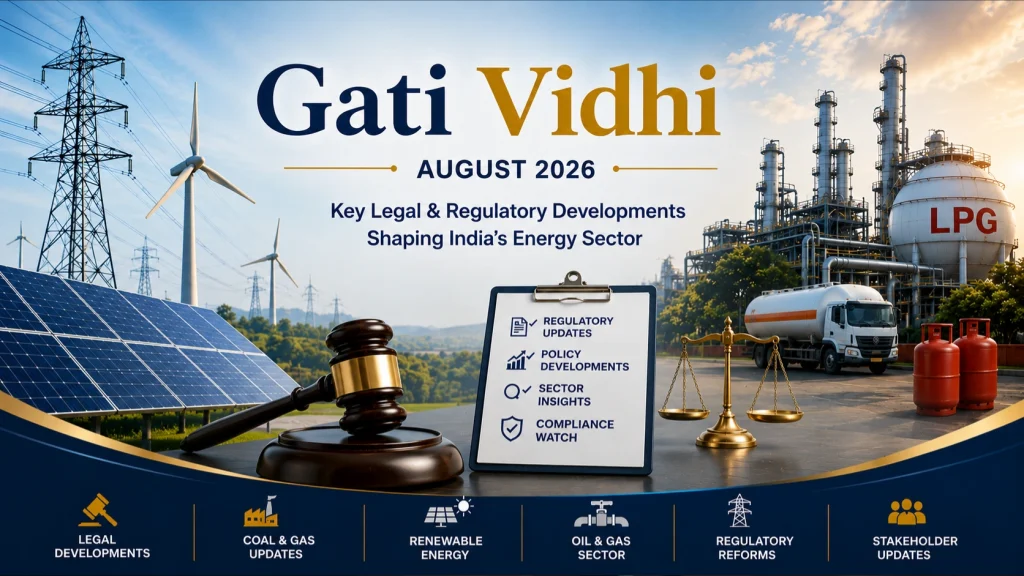
Gati Vidhi – August 2026
SC holds that provisional assessment order under Electricity Act is unsustainable if Inspection Report lacks finding and evidence of Theft
The Supreme Court (SC) vide judgement dated 12.08.2026 in Special Leave Petition (Civil) No.33179 of 2025, M/S. Himadri Steel Pvt. Ltd. v. Jharkhand Urja Vikas Nigam Limited & Ors has held that the inspection report forming the basis of proceedings for theft of electricity must record evidence collected during inspection which disclose theft of electricity.
The proceedings arose from an inspection of the Petitioner’s metering arrangement, during which certain irregularities were noted. However, the inspection report did not record any actual theft, the seals were found intact, and no material evidence was seized. Despite, the Respondent Authorities disconnected electricity supply and raised a provisional assessment of approximately INR 3.24 crores.
The SC held that mere suspicion or irregularities in a metering arrangement could not justify proceedings for theft under Section 135. The Court distinguished Section 126, which dealt with unauthorized use of electricity and was civil in nature, from Section 135, which created a criminal offence requiring both actus reus and mens rea. The Court observed that an inspection report forming the basis of action under Section 135 of Electricity Act had to clearly disclose the alleged theft, the evidence supporting it and the authorized officer’s satisfaction that theft had occurred. Since the report in the present case did not establish theft and the prescribed procedure, including seizure of relevant material, had not been followed, the Court held that the provisional assessment was unsustainable. Accordingly, the Court allowed the appeal, set aside the judgment of the Division Bench and restored the Single Judge’s order quashing the provisional assessment.
MoC amends Rule 9 of the Colliery Control Rules, 2004
The Ministry of Coal (“MoC”) has, vide notification dated 06.08.2026, amended Rule 9 of the Colliery Control Rules, 2004 (“2004 Rules”) by way of the Colliery Control (Amendment) Rules, 2026 (“Amendment Rules”).
Rule 9 provides for requirement of prior approval for opening a coal mine, seam or section of a seam. The amendment is as follows:
- Amendment in sub-rule (1) – Prior approval is required from the Board of the company where the owner is a company registered under the Companies Act, 2013, or from the Governing Authority / Board / Committee of statutory corporations established by or under any Central or State Act. Corresponding amendment has also been made in the proviso to sub-section (1). Under the erstwhile Rule 9, prior written permission of the Central Government was required.
- Amendment in sub-rule (2) – No owner of a colliery, which is not a company registered under the Companies Act, 2013 nor a statutory corporation, shall open a coal mine or a seam or a section of a seam, without prior approval of the Coal Controller Organisation.
The other sub-rules of Rule 9 continue to remain the same as last amended vide notification dated 23.12.2025.
The Amendment Rules can be accessed here.
MoC invites bids for Coal / Lignite Gasification Projects under Category II and III
The MoC has, vide notice dated 13.08.2026, invited applications for setting up Coal / Lignite Gasification Projects under Category II (Private Sector and Government PSUs) and Category III (Demonstration Projects and / or Small-Scale Product-Based Plants). The MoC has issued Request for Proposals (“RfPs”) for the third round of financial incentives on 13.08.2026.
The Scheme aims to promote the financial and technical viability of coal / lignite gasification, value addition to coal, downstream products and indigenous gasification technology.
- Category II – Against an overall provision of Rs. 3,850 crores, Rs. 1,866.94 crores remain available after allocation of Rs. 1,983.06 crores to three selected projects. A lump-sum Financial Incentive will be provided in 2 equal instalments of 15% of the Capex or Rs. 1,000 crores, whichever is lower, for each of the identified project(s).
- Category III – Against an overall provision of Rs. 600 crores, Rs. 400 crores remain available after allocation of Rs. 200 crores. The incentive is capped at Rs. 100 crores per project or 15% of Capex on coal / lignite gasification unit, whichever is lower.
To qualify for the Available Financial Incentive, the selected Bidder will have to undertake to set up a manufacturing plant of minimum output of 0.4 million tonnes per annum of either single eligible downstream product or a combination of eligible downstream products through coal / lignite gasification in terms of the Scheme.
The Bid Due Date for both categories is 12.10.2026 at 5 PM.
The notice dated 13.08.2026 can be accessed here. The RFP for Category II can be accessed here. The RFP for Category III can be accessed here.
MNRE invites comments / suggestions on standardized nomenclature for solar PV cells
The Ministry of New and Renewable Energy (“MNRE”) has, vide office memorandum dated 03.08.2026, invited comments / suggestions from stakeholders on the proposed standardized nomenclature for solar PV cell models enlisted under the Approved List of Models and Manufacturers (“ALMM”) List-II. The comments / suggestions can be submitted by 13.08.2026.
The proposal seeks to introduce uniformity in the identification of solar PV cell models. The existing ALMM List-II contains model names furnished by individual manufacturers based on their proprietary naming conventions, resulting in variations in the manner in which solar PV cells are identified.
MNRE has proposed a standardized 14-digit alphanumeric nomenclature for all solar PV cell models enlisted under ALMM List-II, incorporating key technical and origin-related information, including wafer origin, ingot origin, polysilicon origin, wafer size, number of busbars, etc. The proposed nomenclature is intended to provide a unique identification number for each enlisted model and facilitate their identification and traceability.
The office memorandum dated 03.08.2026 can be accessed here.
MNRE clarifies applicability of ALMM List-II for solar PV cells
The MNRE has, vide office memorandum dated 04.08.2026, clarified the applicability of ALMM List-II for solar PV cells.
The clarification is as follows:
- For projects awarded through bidding (where bids were live on 28.07.2025) – If the last date of bid submission was on or before 31.08.2025 (one month after publication of original list dated 31.07.2025), the projects are exempt from ALMM List-II, otherwise not. However, if the last date was between 09.12.2024 and 28.07.2025 and the bid conditions provided for usage of solar PV cells from ALMM List-II, such conditions will continue to apply.
- For Net-Metering and Open Access Projects – If such project is commissioned by 31.12.2026, the project is exempt, otherwise not. Residential rooftop solar consumers / rooftop solar projects for residential building availing the ‘Give It UP Subsidy’ under PM Surya Ghar: Muft Bijli Yojana are exempt from ALMM List-II till the end of the scheme i.e., 31.03.2027, subject to the application being made mandatorily through the PMSG National Portal. However, ALMM List-I will continue to apply.
- For Rooftop Solar Projects on Government buildings awarded through bidding – If the last date of bid submission was on or prior to 09.12.2024 or from 28.07.2025 to 31.08.2025, the project will be exempt. If the last date was between 09.12.2024 and 28.07.2025, the project will be governed by the tender conditions. If the last date was after 31.08.2025, there is no exemption.
- For Rooftop Solar Projects on Government buildings not awarded through bidding – Projects commissioned by 31.12.2026 will be exempt, otherwise not.
- Behind-The-Meter Projects – Such plants used solely for captive consumption by consumers / group of consumers (other than Government entities or Public Sector Enterprises) will be exempt from ALMM List-I and List-II. Such plants for captive consumption of Government entities or Public Sector Enterprises must comply with ALMM List-I but are exempt from List-II if commissioned by 31.12.2026. Both lists have to be compiled with if commissioned after 31.12.2026.
MNRE has further clarified that ALMM provisions do not modify or relax the Domestic Content Requirement (DCR), which continue to be governed by the respective Scheme Guidelines and applicable clarifications.
The office memorandum dated 04.08.2026 can be accessed here.
MNRE invites comments on the draft revised specifications for the solar pump controller
The MNRE vide office memorandum dated 12.08.2026, has invited comments on the draft revised specifications for the solar pump controller prepared by the National Institute of Solar Energy (“NISE”). The comments can be submitted by 28.08.2026.
The draft revised specifications aim to establish a standardized, reliable and future-compatible framework for solar pump controllers under Component-B of the PM-KUSUM scheme. It addresses changing module ratings, wide DC input operating ranges, and long-term maintainability to ensure maximum efficiency, robust maximum power point tracking (MPPT), and inter-operability with various motor technologies like AC induction, permanent magnet synchronous motors (PMSM), and brushless direct current (BLDC) motors.
The specifications introduce advanced provisions for multi-functional solar pump controllers operating in off-grid, with or without battery storage, and hybrid grid-interactive/grid-feeding modes. These features enable the system to power secondary agricultural equipment such as flour mills and chaff cutters, as well as domestic loads, thereby addressing the seasonal pump underutilization of solar pumping systems and improving utilisation of installed solar assets. The draft specifications also prescribe rigorous safety, power quality, and environmental compliance requirements, including IP65 ingress protection, anti-islanding, overvoltage / impulse-voltage protection and withstand requirements, along with mandatory integration with a Remote Monitoring System featuring GSM / GPRS and geo-tagging capabilities.
The office memorandum dated 12.08.2026 can be accessed here.
SECI issues EOI for identification of CO2 sources in India to support future production of Green Urea and RFNBO-compliant Green Methanol
The Solar Energy Corporation of India Limited (“SECI”), a Government of India Enterprise under the MNRE, has issued an Expression of Interest (“EOI”) dated 03.08.2026 to assess the availability, location and readiness of Carbon Dioxide (“CO2”) sources in India to support future production of Green Urea and RFNBO-compliant Green Methanol.
The EOI is only a market consultation exercise and the information that will be provided will be used only for policy formulation, scheme design, internal assessment by SECI / MNRE and potential formulation of a Carbon Capture, Utilization and Storage (CCUS)-linked policy framework for Green Urea and Green Methanol under the National Green Hydrogen Mission (NGHM).
The scope of the EOI is structured into two distinct parts based on the differing eligibility conditions for the intended end-uses.
- Part I is concerned with CO₂ sourcing for RFNBO-compliant Green Methanol intended primarily for the international shipping / European market under applicable EU regulations, including RED II/III and related EU regulatory requirements. It identifies biogenic CO₂ and Direct Air Capture (DAC) as future-proof sources, while also considering eligible fossil industrial CO₂ subject to specified EU-ETS requirements and sunset periods.
- Part II covers CO₂ sourcing for Green Urea intended primarily for domestic consumption and considers all credible industrial and other CO₂ sources, including fertilizer, refinery, cement, steel, distillery, pulp and paper, waste-to-energy, biomass / biogas and DAC sources, with locational preference for sources proximate to existing operational or upcoming / under-development urea plants.
Responses can be submitted by the stakeholders ahead of the scheduled pre-EOI meeting on 18.08.2026 at 2.30 PM.
The EOI dated 03.08.2026 can be accessed here.
PNGRB Committee Report recommends optimisation of LPG and Petroleum Product transportation
The Petroleum and Natural Gas Regulatory Board (“PNGRB”), through its Committee Report on Optimization of LPG and Petroleum Product Movements dated July 2026, has recommended measures to reduce inefficient transportation and optimise the use of existing logistics infrastructure.
The Committee observed that a significant quantity of LPG continues to be transported by road, notwithstanding the greater efficiency and reliability of pipeline transportation. During FY 2023-24, approximately 15,665 TMT of LPG was transported by road, 2,166 TMT by rail and 13,455 TMT through pipelines, with pipelines accounting for only approx. 45% of total LPG movement.
The Committee has recommended reducing dependence on road transportation, strengthening pipeline connectivity to LPG bottling plants, and enabling greater sharing and optimisation of existing pipeline and other infrastructure. It has also proposed a common-carrier framework to facilitate equitable access, together with industry-wide planning and optimisation of pipeline infrastructure.
For petroleum products, the Committee has recommended fast-tracking pipelines connecting critical demand nodes. Where pipeline connectivity is not economically viable, it has favoured multimodal solutions, including rail-fed facilities under the PM Gati Shakti National Master Plan. Overall, the recommendations seek to reduce transportation costs and road movement, improve supply-chain resilience and security, optimise infrastructure utilisation, and reduce the environmental footprint of petroleum logistics in India.
The Committee Report can be accessed here.
PNGRB unveils Action Plan for 2026–27
The PNGRB has released its Action Plan for 2026–27 on 06.08.2026, outlining regulatory and institutional measures aimed at expanding natural gas infrastructure, promoting transparency and competition, and improving ease of doing business in the petroleum and natural gas sector.
Key initiatives include facilitating CBG tie-in with natural gas pipelines, CGD-to-CGD connectivity, strategic gas storage and pipeline-based transportation of petroleum products, including conceptualisation of a National Product Pipeline Grid. The Action Plan also proposes promoting third-party access to infrastructure, unbundling of functions and exploring the creation of an Independent Transmission System Operator.
The Action Plan further proposes significant tariff, consumer protection, safety and digitalisation reforms, including progressive movement towards “One Nation, One Tariff”, automated tariff determination, a Customer Protection Regulation and an integrated online consumer grievance portal.
PNGRB has further proposed a regulatory and institutional framework for Renewable Gas Certificates for CBG, supply-security regulations, LPG road-movement safety regulations, enhanced T4S standards, GHG-emission monitoring and hydrogen-pipeline preparedness.
The Action Plan can be accessed here.
MPERC proposes Multi Year Tariff Distribution Regulations, 2026 for the FY2027-32 control period
The Madhya Pradesh Electricity Regulatory Commission (“MPERC”), vide Public Notice dated 05.08.2026, has proposed to revise the Madhya Pradesh Electricity Regulatory Commission (Terms and Conditions for Determination of Tariff for Supply and Wheeling of Electricity and Methods and Principles for Fixation of Charges) Regulations, 2021 (“RG-35(III) of 2021”), and has invited comments, suggestions and objections from the general public and stakeholders on the draft Madhya Pradesh Electricity Regulatory Commission (Terms and Conditions for Determination of Tariff for Supply and Wheeling of Electricity and Methods and Principles for Fixation of Charges) Regulations, 2026 (“draft Regulations”), proposed in exercise of MPERC’s powers under Section 181(1) and Section 181(2)(zd), (ze) and (zf), read with Sections 45, 61, 62 and 86 of the Electricity Act, 2003.
As RG-35(III) of 2021 is due to cease being in force on 31.03.2027, the draft Regulations have been framed to specify the terms and conditions for determination of Distribution Tariff for the next Control Period, running for five years from 1 April 2027 to 31 March 2032. The draft Regulations will apply to all existing and future Distribution Licensees in Madhya Pradesh for determination of the Aggregate Revenue Requirement (“ARR”) and tariff for wheeling and supply of electricity to be charged by the Distribution Licensees from 1 April 2027 onward, and all petitions for such determination from that date are required to be filed in accordance with the draft Regulations.
Persons intending to file suggestions, objections or comments on the draft Regulations may send these to the Secretary, MPERC, 5th Floor, Metro Plaza, Bittan Market, E-5 Arera Colony, Bhopal 462016 by 01.09.2026 and the same may also be submitted by email to secretary@mperc.nic.in & sanjaykbaghel@gmail.com. A copy of the draft Regulations may be obtained from the Commission on any working day up to that date on payment of the prescribed fee. MPERC has scheduled a public hearing on the proposal for 08.09.2026 at 12:00 hrs, to be held in hybrid mode.
A copy of the draft Regulations can be viewed here.
BERC invites stakeholder comments on proposed 1st amendment to the Resource Adequacy Framework Regulations
The Bihar Electricity Regulatory Commission (“BERC”), by Notice No. 08 dated 03.08.2026, has invited comments, suggestions and objections from the general public and stakeholders on the draft Bihar Electricity Regulatory Commission (Framework for Resource Adequacy) (1st Amendment) Regulations, 2026 (“draft Amendment Regulations”), proposed pursuant to Suo-Motu Proceedings No. 34 of 2026, in exercise of BERC’s powers under Section 181 read with Sections 61, 66 and 86 of the Electricity Act, 2003.
The draft Amendment Regulations propose to modify Clause 9 of Chapter 4 of the principal Framework for Resource Adequacy Regulations, which governs generation resource assessment and planning described as the step following demand assessment and forecasting, involving an assessment of a distribution licensee’s existing and contracted resources by reference to their capacity credit, and identification of the incremental capacity required to meet forecast demand, including the planning reserve margin.
Under the proposed clause, a distribution licensee would be required to prepare its Resource Adequacy Plan in consultation with State and Central Sector Generating Companies, other distribution licensees, transmission companies, the National, Regional and State Load Despatch Centres, and the Central Electricity Authority, and may additionally make enquiries with trading companies, over-the-counter (“OTC”) platforms and power-surplus states to estimate the likely availability and price of power across the country during peak, off-peak and normal periods.
The proposed clause further permits a distribution licensee to contract power through State or Central Generating Stations, Independent Power Producers (“IPPs”), Captive Power Plants (“CPPs”), renewable power plants including co-generation plants, central agencies, intermediaries, traders, aggregators and power exchanges, or through agreements or banking arrangements with other distribution licensees, OTC platforms or other platforms recognised by the Central Electricity Regulatory Commission, and any other source approved by BERC under Section 62 or Section 63 of the Electricity Act, 2003, subject to compliance with the applicable competitive bidding guidelines.
BERC has invited written comments, suggestions and objections on the draft Amendment Regulations, addressed to the Secretary, BERC, Vidyut Bhawan-II, J.L. Nehru Marg, Bailey Road, Patna – 800021 on or before 24.08.2026, and has scheduled a public hearing on the draft Amendment Regulations on 27.08.2026 at 11:30 A.M.
A copy of the draft Amendment Regulations can be viewed here.
BERC invites comments on draft Bihar Electricity Grid Code, 2026
BERC vide Notice No. 09 dated 07.08.2026, has invited comments, suggestions and objections from the general public and stakeholders on the draft Bihar Electricity Grid Code, 2026 (“draft Code”), which the Commission proposes to notify in exercise of its powers under Section 181 read with Section 86(1)(h) of the Electricity Act, 2003. The draft Code has been placed before the public pursuant to Suo-Motu Proceeding No. 36 of 2026, and is proposed to supersede the existing Bihar Electricity Grid Code, 2010, which has been in force since 20 July 2010.
In its accompanying consultative paper, BERC noted that over the sixteen years since the 2010 Code was notified, several issues concerning grid conditions and the obligations of stakeholders have come to the Commission’s attention through petitions and general stakeholder consultation. BERC also pointed to significant developments at the central level, including the notification by the Central Electricity Regulatory Commission (“CERC”) of the Central Electricity Regulatory Commission (Indian Electricity Grid Code) Regulations, 2023 and the Central Electricity Regulatory Commission (Connectivity and General Network Access to the inter-State Transmission System) Regulations, 2022, together with three subsequent amendments to the latter. The draft Code has accordingly been prepared to align the State grid code with these developments, to bring it in conformity with the Electricity Act and the Rules and guidelines issued by the Ministry of Power, and to make the regulatory framework more operationally relevant and efficient.
The draft Code will apply to all Users, the Bihar State Load Despatch Centre and Area Load Despatch Centres, all renewable energy generators, solar and wind power parks and renewable energy hybrid park developers connected to the intra-State transmission system (“In-STS”), and to qualified coordinating agencies, aggregators and lead generators connected to the In-STS. It sets out a comprehensive framework spanning the constitution and functions of a Grid Code Review Panel and its functional committees, the roles of the State Load Despatch Centre, Area Load Despatch Centres, the State Transmission Utility, transmission and distribution licensees and users, resource planning and demand forecasting, the technical requirements for connection to the grid, protection settings and protection audits, the process for commissioning and declaration of commercial operation of generating stations, the operating philosophy governing system security, frequency control and real-time operation, scheduling and despatch procedures for intra-State transactions, cyber security requirements, and the monitoring of compliance with the Code.
BERC has invited written comments, suggestions and objections on the draft Code, to be addressed to the Secretary, BERC at Vidyut Bhawan-II, J.L. Nehru Path, Patna, on or before 04.09.2026. Interested persons, organisations and companies may also appear at the public hearing scheduled to be held on 10.09.2026 at 11:30 A.M. in the Commission’s court room at Patna.
A copy of the draft Code can be viewed here.
MSPGCL, in compliance of the direction of MERC, invites suggestions / objections on its Petition pertaining to Unit No. 6 of the Bhusawal Thermal Power Station
In compliance of the directions of the Maharashtra Electricity Regulatory Commission (“MERC”), the Maharashtra State Power Generation Company Limited (“MSPGCL”) has, vide Public Notice dated 14.08.2026, invited suggestions / objections from the stakeholders on its Petition for approval of the capital cost and determination of final tariff, approval of Aggregate Revenue Requirement (“ARR”), provisional true-up for FY 2024-25 and determination of Multi-Year Tariff (“MYT”) for the control period FY 2025-26 to FY 2029-30 of Unit No. 6 (1×660 MW) of the Bhusawal Thermal Power Station.
MSPGCL has sought approval of capital cost of Rs. 5,812.38 crores as on Commercial Operation Date (“COD”), comprising hard cost of Rs. 4,690.35 crores and Interest During Construction (IDC) of Rs. 1,122.03 crores, with additional capitalisation proposed post-COD and during MYT control period (the total capital cost being Rs. 6,986 crores).
MSPGCL has proposed operating norms, including a target availability and Plant Load Factor (PLF) of 85% each, Gross Station Heat Rate (GSHR) of 2,139.05 kcal/kWh, and transit loss of 0.80%. auxiliary energy consumption has been considered at 5.75%, with 0.20% of additional auxiliary energy consumption (towards Emission Control System – SCR).
The Petition proposes annual fixed charges of Rs. 120.84 crores for FY 2024-25, increasing to Rs. 1,484.58 crores in FY 2029-30. For the MYT control period, the proposed energy charge rate ranges from Rs. 3.580/kWh in FY 2025-26 to Rs. 3.781/kWh in FY 2029-30.
The suggestions / objections can be submitted by 05.09.2026 5 PM and the e-Public Hearing is scheduled for 10.09.2026 at 11 AM.
The public notice dated 14.08.2026 can be accessed here. The Petition filed by MSPGCL can be accessed here.
GERC holds Associated Transmission System Bank Guarantee applies uniformly to State-planned and developer-driven connectivity
The Gujarat Electricity Regulatory Commission (“GERC”), vide Order dated 05.08.2026 passed in Petition No. 2634 of 2026, M/s. Saraca Asoca Renewables Private Limited & Anr. v. Gujarat Energy Transmission Corporation Limited, has rejected the plea of Saraca Asoca Renewables Private Limited and BA Prerna Renewables Private Limited (“Petitioners”) seeking inter alia a declaration that the Associated Transmission System Bank Guarantee (“ATS BG”) requirement under Clause 5.7(iv) of the Connectivity Procedure, 2025 does not apply to connectivity applications at State-planned substations.
The Petitioners, Special Purpose Vehicles promoted by BA Prerna Renewables Private Limited, had sought connectivity for renewable energy projects at the 400 kV Babarzar Pooling Station, a State-planned substation listed under Clause 5.1(ii) of the Connectivity Procedure, 2025, forming part of the long-term transmission plan of Gujarat Energy Transmission Corporation Limited (“GETCO”). The Petitioners contended that since such infrastructure is planned and developed by the State Transmission Utility independently of any individual developer’s request, it carries no risk of stranded assets, unlike infrastructure created specifically for a developer’s project under Clause 5.2. On this basis, the Petitioners sought a declaration that the ATS BG of ₹20 lakh per MW under Clause 5.7(iv) should apply only to developer-driven infrastructure under Clause 5.2, and not to applications at State-planned substations under Clause 5.1(ii).
GETCO opposed the petition, contending that it was, in substance, a petition for review or modification of the Connectivity Procedure, 2025, which had already been approved by GERC after due stakeholder consultation, and was barred by limitation. GETCO further submitted that the ATS BG requirement had been consciously retained for applications under Clause 5.1(ii) despite similar representations at the draft stage, and that the requirement served to secure the seriousness and commitment of connectivity applicants regardless of how the associated transmission infrastructure was planned.
GERC held that Clause 5.7(iv) of the Connectivity Procedure, 2025 makes no distinction between applications under Clause 5.1(ii) and Clause 5.2, and applies uniformly to both. GERC noted that the very distinction now pressed by the Petitioners had been specifically raised by stakeholders during the draft consultation process, but was not accepted by GETCO while finalising and approving the Connectivity Procedure, and that an issue considered and rejected at the consultation stage cannot be revisited through a petition for clarification under Section 94 of the Electricity Act, 2003. GERC observed that carving out such a distinction would, in substance, amount to amending the approved Connectivity Procedure, which could only be done through the due consultative process under Regulation 20 of the GERC (Terms and Conditions of Intra-State Open Access) Regulations, 2011, and not through the present proceedings. Accordingly, GERC held that the Petitioners were required to furnish the ATS BG in the same manner as other similarly placed applicants and disposed the petition.

 You wish to know more about Neeti Niyaman (the “Firm”) for your own information and use.