Gati Vidhi – March 2026
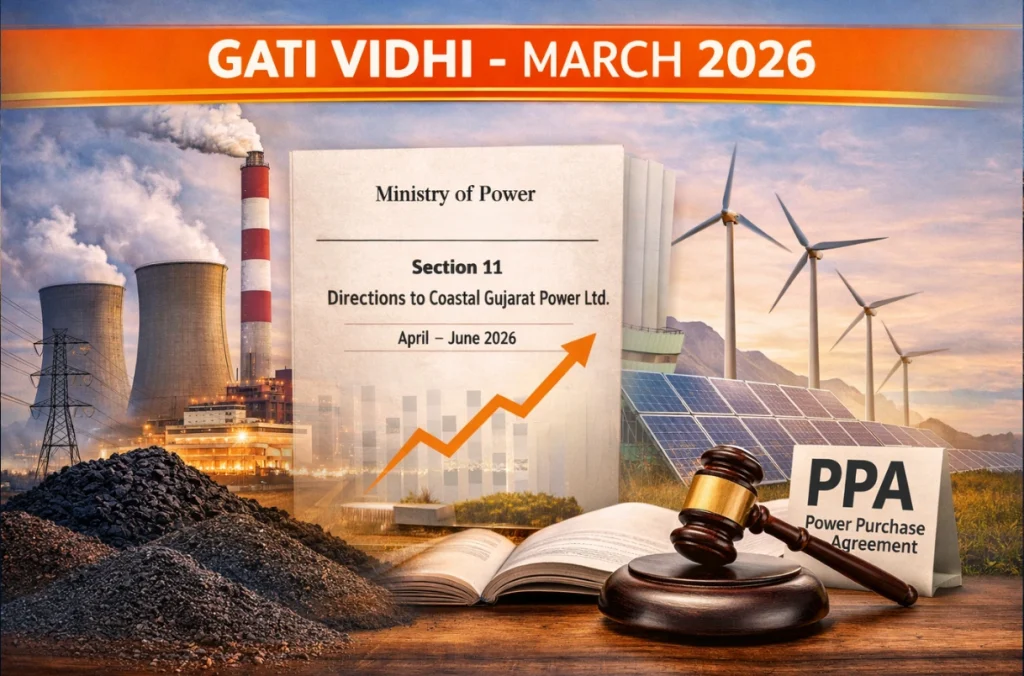
MoP has issued directions under Section 11 of the Electricity Act, 2003 to Coastal Gujarat Power Ltd.
The Ministry of Power (“MoP”) has, vide order dated 22.03.2026, issued directions under Section 11 of the Electricity Act, 2003 to Coastal Gujarat Power Ltd. (“CGPL”) in view of the demand-supply scenario and the expected rise in electricity demand in the coming months to ensure adequate availability of electricity. The said directions are valid from 01.04.2026 to 30.06.2026.
The MoP has issued the following directions:
- The Imported Coal-Based (“ICB”) power plant of CGPL shall operate and generate power to their full capacity.
- The rates at which power shall be supplied to PPA holders shall be worked out by a committee constituted by MoP, which shall be reviewed every 15 days.
- The fixed charge will be as per PPAs or as mutually agreed, and the PPA holders will have an option to pay the benchmark rate worked out by the committee or a rate mutually negotiated.
- The power generated will be supplied to the PPA holders and any surplus power will be sold in the power exchanges.
- Where the plant has PPA with multiple DISCOMs, one of which does not schedule any quantity of power according to its PPA, the power will be offered to other PPA holders and remaining quantity will be sold through power exchanges.
- If a DISCOM is unable to enter into mutually negotiated rates and is not willing to procure power at the benchmark rate, or is unable to make weekly payment, then such quantity shall be sold in the Power Exchanges.
- If power is not scheduled by the procurer, the generator will bid the power in the power exchange at the tariff to be determined by the Committee or at a mutually agreed tariff.
- Net profit of the power sold in the power exchanges shall be equally shared between the generator and the PPA holder on a monthly basis.
- As per the PPA, the Payment Security Mechanism (PSM) shall be maintained.
- Payment by the procurer will be made on a weekly basis. A rebate in accordance with CERC norms or as per the PPA, whichever is higher, shall be applicable.
- The generator shall maintain coal stock as per the extant norms.
- A weekly report is to be submitted for the generation and sale of power from the ICB plants.
Additionally, the order provides for directions in case the PPA holder does not wish to requisition power from ICB plant for the following week/weeks and the manner in which ECR and mining profit is to be calculated.
A copy of the order can be accessed here.
APTEL holds that commercial unviability does not qualify as Force Majeure and rejects claim for reduction/amendment of contracted capacity under PPA.
The Appellate Tribunal for Electricity (“Tribunal”), vide judgment dated 16.03.2026 in Appeal No. 128 of 2021 (M/s Simbhaoli Power Pvt Ltd v. Uttar Pradesh Electricity Regulatory Commission & Ors), has upheld Order dated 25.01.2021 of the Uttar Pradesh Electricity Regulatory Commission (“UPERC”) in Petition No.1557 of 2020 (“Impugned Order”), rejecting the claim of the generator for reduction in contracted capacity under existing Power Purchase Agreements (“PPA”) as a force majeure event.
The Appellant, Simbhaoli Power Private Limited (“SPPL”) executed PPA with the Uttar Pradesh Power Corporation Limited (“UPPCL”) for export of contracted capacity of 19 MW from its two generating units of capacity 12 MW and 19 MW. The Appellant under a separate PPA exported surplus power of 16 MW from its generating unit of 18 MW. However, the 12 MW unit lost efficacy on account of becoming very old and its technology becoming obsolete. Accordingly, the Appellant isolated and dismantled the unit to avoid breakdowns and heavy cost of repair. However, due to the dismantling, the inhouse consumption of 12 MW was met from the 19 MW unit, reducing the surplus export available for UPPCL from 19 MW to 7MW. The Appellant approached UPERC for reduction in its export capacity under the PPA. UPERC vide the Impugned Order dismissed the Petition holding that dismantling was a purely commercial decision of the Appellant.
The Appellate Tribunal while examining the reasons cited by the Appellant, observed that mere hardship, increased cost, or commercial unviability does not frustrate a contract or excuse performance under law. It further observed that contracted capacity forms an essential term of the PPA and therefore cannot be altered unilaterally in the absence of an enabling provision. Accordingly, the Tribunal dismissed the claim for force majeure and held that the Appellant was not entitled to reduction of contracted capacity or amendment of the PPAs.
APTEL clarifies hotels in Andaman and Nicobar to be categorized under the Commercial tariff category
The Appellate Tribunal for Electricity in Appeals 296,297 and 298 of 2022 (Electricity Department of Andaman and Nicobar Administration v. Sea Shell Hotels & Resorts and Ors.) held that hotels in the Andaman & Nicobar Islands be classified under the Commercial category, and not the Industrial category, for the purpose of determining the applicable tariff.
The appeals arose from Orders passed by the Joint Electricity Regulatory Commission (“Impugned Orders”), whereby the Commission categorized hotels under the Industrial category, based on concessions by the Andaman & Nicobar Administration (“A&N Administration”) and past practices in other jurisdictions such as Goa.
The Tribunal on the issue of classification of hotels, analysed the distinction between ‘industrial’ and ‘commercial’ activities, and observed that while industrial activity is generally associated with manufacturing or production, commercial activity pertains to trade and services. Applying this test, the Tribunal held that hotels are fundamentally service-oriented establishments engaged in hospitality and accommodation and therefore fall under the Commercial category. The Tribunal differentiated the categorization of hotels in Goa based on the significant difference in the geography and economics of power generation in Andaman and Nicobar from that of Goa.
Accordingly, the Tribunal held that hotels must be placed under the Commercial category for electricity tariff purposes. The Tribunal set aside the Impugned Orders to the extent they categorised hotels as Industrial and directed that the hotels be placed under the Commercial category for the time covered by the Appeals.
CERC notifies Second Amendment to Tariff Regulations, 2026 introducing framework for Energy Storage Systems
The Central Electricity Regulatory Commission (“CERC”), by Notification dated 20.03.2026, has notified the CERC (Terms and Conditions of Tariff) (Second Amendment) Regulations, 2026 (“Tariff Amendment, 2026”), amending the CERC (Terms and Conditions of Tariff) Regulations, 2024 (“Principal Regulations”).
The Tariff Amendment, 2026 introduces a framework for integrated energy storage systems (“ESS”) within the tariff regime. The applicability of the Principal Regulations has been extended (Regulation 2), and detailed definitions have been introduced through Regulation 3A covering parameters such as auxiliary energy consumption, declared capacity, round-trip efficiency and state of charge.
The amendment incorporates ESS within the tariff framework by including it as part of generating stations and transmission systems through changes across multiple provisions, including Regulations 3, 5, 8, 9 and 13. The useful life of lithium-ion battery based ESS has also been specified, with provision for separate treatment of new technologies.
A framework for determination of supplementary tariff for ESS has been introduced through amendments including Regulations 8, 9, 14, 15 and 16. Generating companies and transmission licensees are required to seek in-principle approval and file petitions within prescribed timelines, with tariff comprising supplementary fixed storage charges and supplementary energy charges based on the source of charging and adjusted for efficiency and auxiliary consumption.
The amendment also lays down operational norms for ESS, including norms for availability, round-trip efficiency and auxiliary consumption (Regulation 70), along with provisions for scheduling and utilization of stored energy (Regulation 74). It further provides for additional capitalization and sharing of gains and incorporates ESS within tariff determination and filing requirements.
CERC (Terms and Conditions of Tariff) (Second Amendment) Regulations, 2026 can be accessed here.
CERC notifies First Amendment to REC Regulations, 2026 expanding eligibility and introducing VPPA Framework
The Central Electricity Regulatory Commission (“CERC”), by Notification No. RA-14026(11)/1/2022-CERC dated 24.03.2026, has notified the CERC (Terms and Conditions for Renewable Energy Certificates for Renewable Energy Generation) (First Amendment) Regulations, 2026 (“REC Amendment, 2026”), amending the CERC (Terms and Conditions for Renewable Energy Certificates for Renewable Energy Generation) Regulations, 2022 (“Principal Regulations”).
The REC Amendment, 2026 introduces new definitions under Regulation 2 of the Principal Regulations. A new clause (g-i) defines “Designated Consumer” with reference to the Energy Conservation Act, 2001; clause (o-i) defines “Renewable Consumption Obligation” or “RCO”; and clause (u-i) defines “Virtual Power Purchase Agreement” or “VPPA” with reference to the CERC Power Market Regulations, 2021.
The scope of eligibility under the Renewable Energy Certificates mechanism has also been expanded. Regulation 4 now includes renewable energy generating plants with self-consumption, even where such plants do not fulfil the conditions of captive generating plants under the Electricity Rules, 2005 as amended.
The amendment further introduces a defined timeline for issuance of RECs. Under the substituted Regulation 10, applications by distribution licensees or open access consumers must be made within three months from certification by the concerned State Commission, failing which no certificates shall be issued for such applications.
The REC multiplier framework has also been revised under Regulation 12. Projects commissioned between 05.12.2022 and the date of effect of the REC Amendment, 2026 shall continue with specified multipliers, while projects commissioned thereafter shall be governed by Appendix-1 based on factors such as tariff levels, stage of technology, and ability to support grid demand, with multipliers applicable for fifteen years.
Additionally, a new Regulation 14A provides for treatment of RECs under VPPAs, where RECs are transferred to the consumer or designated consumer for RPO or RCO compliance, extinguished upon use, and not eligible for trading, though surplus RECs may be carried forward. The Central Agency shall extinguish such certificates upon use and update its records.
Copy of the CERC (Terms and Conditions for Renewable Energy Certificates for Renewable Energy Generation) (First Amendment) Regulations, 2026 can be accessedhere.
RERC adopts the RCO targets under the MoP Notification dated 27.09.2025
Rajasthan Electricity Regulatory Commission (“RERC”) vide Suo-Motu order dated 19.03.2026 has adopted the Renewable Consumption Obligation (“RCO”) targets, compliance framework, computation methodology, fungibility provisions, exclusions, reporting formats and all other provisions of the Ministry of Power (“MoP”) Notification S.O. 4421(E) dated 27.09.2025, (“MoP RCO Notification”) including its notes, annexures, and illustrative examples. It has further observed that the RPO targets previously specified by RERC shall stand subsumed within the RCO targets w.e.f FY 2024-25 and no additional or separate RPO shall be applicable.
It has further mentioned that all obligated entities shall furnish information in the formats prescribed in Annexure -II of the MoP RCO Notification. For distribution licensees, the information shall be certified by the State Load Dispatch Centre (“SLDC”), and for other designated consumers, by a Bureau of Energy Efficiency (“BEE”) empanelled accredited energy auditing firm, in accordance with Clause 11 of the MoP RCO Notification. Non-compliance, including shortfall in meeting RCO, non-submission or incorrect submission of information, shall attract penalty under Section 26(3) of the Energy Conservation Act, 2001, as per Clause 13 and 14 of the MoP RCO Notification.
RERC has further observed that the instant order shall remain in force until RERC notifies the formal Amendment to the RERC RPO Regulations or until further orders, whichever is earlier. In case of any ambiguity, the MoP RCO Notification shall prevail.
Suo-Motu order dated 19.03.2026 can be accessed here.
RERC mandates submission of Resource Adequacy Plans by Discoms under Interim Framework
RERC issued a Suo motu order dated 24.03.2026 to ensure compliance with the Resource Adequacy framework mandated under Rule 16 of the Electricity (Amendment) Rules, 2022. The Commission noted that although draft Resource Adequacy Regulations are under consideration and likely to be finalized soon, interim directions are necessary to prevent any regulatory gap.
Exercising its powers under Section 86(1)(b) of the Electricity Act, 2003, the Commission directed all distribution licensees to prepare and submit a comprehensive Resource Adequacy Plan in accordance with the Central Government’s guidelines and vetted by the Central Electricity Authority (“CEA”). These plans must address demand projections, existing and proposed capacity arrangements, renewable energy integration, energy storage needs, and anticipated deficits or surpluses, along with measures to bridge such gaps. The licensees are also required to maintain an appropriate planning reserve margin over projected peak demand and adhere to submission timelines prescribed in the draft regulations.
The order further clarifies that failure to comply may lead to disallowance of costs during tariff determination or other regulatory action. It preserves existing arrangements and pending matters and will remain effective until formal Resource Adequacy Regulations are notified or further orders are issued. In case of any ambiguity, the Central Government’s guidelines will prevail.
RERC issues Directions for verification of Captive Status under Electricity Amendment Rules, 2026
RERC vide its order dated 19.03.2026 in Suo-motu Petition has addressed the adoption of the Electricity (Amendment) Rules, 2026, whereby Rule 3 of the Electricity Rules, 2005 has been substituted with a revised framework governing Captive Generating Plants (“CGPs”). The amended rules expand the scope of captive user to include consumption through energy storage systems(“ESS”), broaden the concept of ownership to include group entities, clarify the treatment of special purpose vehicles as associations of persons, and prescribe proportionate consumption requirements for captive users.
The Commission has observed that under Rule 3(4)(a), the State Government is required to designate a nodal agency to verify the captive status of intra-state power plants and to issue the procedure for such verification, including the format for declarations by captive users seeking interim protection from cross-subsidy surcharge (“CSS”). Further, under Rule 3(4)(b), the State Government is required to constitute a Grievance Redressal Committee to hear appeals against the decisions of the nodal agency. It is also recorded that while the amended rules came into force on 13.03.2026, sub-rule (2)(d)(ii), (iii) and sub-rule (4) of Rule 3 shall come into effect from 01.04.2026.
Accordingly, the Commission has directed the State Government to designate the nodal agency and constitute the Grievance Redressal Committee in terms of the aforesaid provisions. It has further clarified that the verification of captive status shall be undertaken by the designated nodal agency in accordance with the procedure prescribed under the Electricity Rules, 2005 as amended, and that the Grievance Redressal Committee shall function in terms of Rule 3(4)(b).
Copy of the order dated 19.03.2026 issued by RERC can be accessed here.
APERC has issued the APERC (Terms and Conditions for Determination of Tariff for Wheeling and Retail Sale of Electricity) (Eighth Amendment) Regulation, 2026
The Andhra Pradesh Electricity Regulatory Commission (“APERC”) has notified the Eighth Amendment to the APERC (Terms and Conditions for Determination of Tariff for Wheeling and Retail Sale of Electricity) Regulation, 2005 on 23.03.2026, which will come into effect from 01.04.2026.
The amendment introduces key changes to the Fuel and Power Purchase Cost Adjustment (“FPPCA”) mechanism, with the objective of ensuring timely and cost-reflective tariff recovery for distribution licensees. A key amendment is the removal of the existing cap on the monthly FPPCA pass-through to mitigate sudden tariff shocks for consumers, reduce sunk costs for manufacturers and industries, resolve billing disputes between owners and tenants, and alleviate financial stress on the distribution licensees.
The revised framework substitutes Regulation 12.5 with a detailed formula for FPPCA, thereby enabling distribution licensees to undertake accurate and timely monthly pass-through of actual FPPC variations. The amendment introduces a structured mechanism for FPPCA computation and recovery, including detailed provisions on calculation methodology, billing, and adjustment procedures. This is aimed at reducing regulatory lag and minimising the accumulation of unrecovered costs.
The Regulation can be accessed here.
 You wish to know more about Neeti Niyaman (the “Firm”) for your own information and use.