Gati Vidhi – March 2026
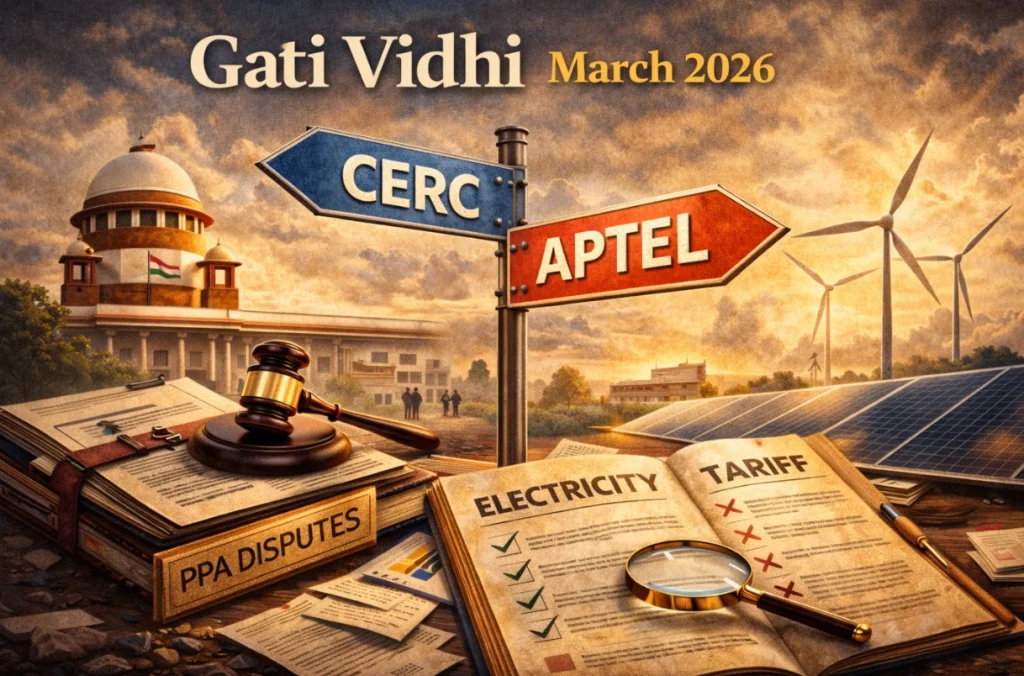
APTEL clarifies jurisdiction of CERC vis-à-vis arbitrability of disputes arising from PPAs
The Appellate Tribunal for Electricity (“Tribunal”), vide judgement dated 25.02.2026 in Appeal No.348 of 2025 (Gujarat Urja Vikas Nigam Limited v. Tata Power Company Limited and Others) overruled the decision of the Central Electricity Regulatory Commission (“CERC”) to refer disputes for arbitration in petitions filed under Sections 79(1)(b) and (f) read with Section 63 of the Electricity Act, 2003 (“Act”).
The appeal arose from a common order passed by the CERC in Petition Nos. 107/MP/2023, 85/MP/2022, 123/MP/2022, 56/MP/2023, 185/MP/2023 and 205/MP/2023 on 19.11.2025 (“Impugned Order”). In the said order, CERC directed that the disputes between the procurers and the generating company under the long term PPA be referred to arbitration, holding that non-tariff contractual disputes must be mandatorily resolved through arbitration.
In the Impugned Order, CERC had observed that even if non-tariff disputes involving the generating company did not fall within the ambit of clauses (a) to (d) of Section 79(1) and could not therefore be adjudicated by the CERC under the first part of Section 79(1)(f) of the Electricity Act, such a dispute would, nonetheless, be arbitrable, and can be referred to arbitration by the CERC. In regard to this issue, the Tribunal observed that the jurisdiction conferred on the Central Commission, under the first limb of Section 79(1)(f), is confined to adjudication of such disputes “in regard to matters connected with” clauses (a) to (d) of Section 79(1).
The Tribunal rejected this position taken by the CERC that it could refer disputes to arbitration merely because it lacked jurisdiction to adjudicate them holding that the power to refer a dispute to arbitration is not independent of the power to adjudicate. It further observed that CERC can only refer those disputes to arbitration over which it can exercise its jurisdiction under Section 79(1) of the Act.
With respect to the relationship between tariff disputes and arbitrability, the Tribunal held that following the judgment in Madhya Pradesh Power Management Company Ltd. V. Damodar Valley Corporation & Ors. (Judgement of APTEL in Appeal 309 of 2019 dated 28.08.2024), disputes which fall within the ambit of the regulatory functions of the CERC, or which impact tariff either directly or indirectly, are non-arbitrable, and, not withstanding an arbitration agreement in existence and cannot be referred to arbitration.
Regarding the classification of disputes as tariff related or non-tariff related, the Tribunal observed that CERC was not justified in characterizing the disputes as a mere breach of contract and to be a non-tariff dispute; and in treating all other claims, even if it related to tariff, as consequential and ancillary to the main relief. It was further observed that what the CERC ought to have done is to undertake a detailed examination as to whether the alleged breach of contract impacted tariff, directly or indirectly.
The next issue in this appeal was with respect to procedural compliance with Arbitration & Conciliation Act, 1996 (“1996 Act”). It was held that the provisions of Section 8(1) of the 1996 Act apply strictly to CERC proceedings. Under Section 8(1), a party seeking to invoke arbitration must apply not later than the date of submitting its first statement on the substance of the dispute. In the present batch of cases, TPCL completely failed to make such an application before filing its reply to the petitions instituted by PSPCL and HPPC. Furthermore, TPCL had even filed its own independent petition before the CERC. The Tribunal held that non-compliance with the mandatory timeline under Section 8(1) vitiated the CERC’s decision to refer the dispute to arbitration.
MoP extends timeline for submission of comments and suggestions on the Draft National Electricity Policy, 2026
The Ministry of Power (“MoP”) had, vide letter dated 20.01.2026, circulated the Draft National Electricity Policy, 2026 and invited comments and suggestions from the stakeholders within 30 days i.e., by 19.02.2026.
Vide letter dated 25.02.2025, MoP has extended the timeline for submission of comments or suggestions till 19.03.2026 in view of the requests received from several stakeholders.
A copy of the letter dated 25.02.2026 can be accessed here.
MNRE amends the procedure for inclusion / updating Wind Turbine Model in the Approved List of Models and Manufacturers of Wind Turbine
The Ministry of New and Renewable Energy (“MNRE”) has, vide Office Memorandum dated 16.02.2026, further amended the procedure for inclusion / updating Wind Turbine Model in the Approved List of Models and Manufacturers of Wind Turbine.
The procedure for inclusion / updating Wind Turbine Model in the Revised List of Models and Manufacturers of Wind Turbines (RLMM) issued on 01.11.2018 was amended on 31.07.2025 (“amendment”). According to the revised Para 4(h), the Type Certificate of the wind turbine model shall mandatorily include Blade, Tower, Gearbox, Generator and Special Bearings (Main, Pitch and Yaw Bearing) assembly / manufacturing facility, which shall be inspected by a Technical Team and subsequent thereto, a separate list would be prepared. It further provided that these components shall only be sourced from such facilities which are included in the list.
After considering the supply chain constraints, MNRE has decided to grant additional time for complying with Para 4(h) of the amendment with respect to Special Bearings.
- Main bearings are exempted for compliance for all the projects already bided or to be bided before 31.07.2027, which will be mandated after a review of the supply chain scenario post 2 years.
- An additional exemption of 1 year has been granted for compliance for Yaw and Pitch bearings up to 31.01.2028 and an exemption of 2 years has been granted for Main bearing subject to review, up to 31.01.2029.
A copy of the Office Memorandum dated 16.02.2026 can be accessed here.
CERC notifies Sixth Amendment to Appointment of Consultants Regulations, 2026
CERC, vide notification dated 16.02.2026, has issued the Central Electricity Regulatory Commission (Appointment of Consultants) (Sixth Amendment) Regulations, 2026, amending the 2008 Principal Regulations governing the engagement, tenure, remuneration, and service conditions of consultants and staff consultants.
- Regulation 4 has been substituted to provide that a consultant may be engaged for a total period of up to six years. The engagement shall be reviewed after completion of the first year and, upon satisfactory performance, extended for a further period of three years.
- Regulation 5A has been amended to insert the words “engaged for full time” after the word “Consultant”.
- Under Regulation 6, in addition to selection on the basis of the “least cost system,” the amendments insert Quality-cum-Cost Based Selection (QCBS), Fixed Budget Selection (FBS), and Single Source Selection as permissible modes of selection under Regulations 6A and 6C(6).
- Regulation 7(1A) has been substituted to provide that an individual consultant may be engaged in the category of “Adviser” with a maximum consolidated fee of Rs. 2,00,000 per month (excluding GST, if applicable) or in the category of “Senior Adviser” with a maximum consolidated fee of Rs. 2,50,000 per month (excluding GST, if applicable), commensurate with qualifications, experience, and domain expertise.
- Regulation 7(6) provides that engagement shall initially be for one year, extendable by three years upon satisfactory performance, and thereafter by up to two additional years, subject to a total cap of six years. An annual escalation up to 10% of the fee may be granted with the approval of the Chairperson based on performance during the preceding year.
- Regulation 8 has been amended to include engagement “on an assignment basis,” and the amount under Regulation 8(3) has been revised from Rs. 0 lakh to Rs. 20 lakh.
- Under Regulation 8A, the table prescribing the monthly fee ranges for staff consultants, Research Associate (“RA”), Research Officer (“RO”), Senior Research Officer (“SRO”), and Principal Research Officer (“PRO”), has been substituted with revised fee ranges linked to experience.
- Regulation 8(6) provides for initial engagement for one year, extendable by three years and thereafter by up to two additional years, subject to a total period of six years. In deserving cases, an annual escalation up to 10% of the fee may be granted with the approval of the Chairperson based on performance.
- A new Regulation 8C has been inserted providing for reimbursement of medical insurance for OPD/IPD treatment, ranging from Rs. 20,000 to Rs. 34,000 per annum depending on category, and reimbursement towards books and periodicals up to Rs. 1,800 per month for RAs/ROs/SROs/PROs and up to Rs. 2,400 per month for Advisers/Senior Advisers.
Copy of the Central Electricity Regulatory Commission (Appointment of Consultants) (Sixth Amendment) Regulations, 2026 can be accessed here.
TGERC has issued Draft Third Amendment to the Licensee’s Duty for Supply of Electricity on Request Regulation, 2013
The TGERC has issued Draft TGERC (Licensee’s Duty for Supply of Electricity on Request) (Third Amendment) Regulation, 2026 on 19.02.2026, further amending the APERC (Licensee’s Duty for Supply of Electricity on Request) Regulation, 2013 (“Principal Regulation”).
The draft amendment proposes to extend the concept of uniform and load-based Service Line Charges (“SLC”) framework, which was earlier introduced for new Low Tension (“LT”) connections under the Second Amendment, to High Tension (“HT”) service connections at 11kV and 33kV voltage levels.
The amendment stipulates that for new HT connections or additional load through common feeders within a 20 km radius of the electrified network, the Distribution Licensee shall collect SLC on a per kVA basis, excluding terminal and metering costs. The proposed SLC rates are as follows:
- 11kV: ₹3,500/kVA (Overhead) and ₹8,000/kVA (Underground)
- 33kV: ₹7,000/kVA (Overhead) and ₹12,000/kVA (Underground)
For supply involving a combination of overhead lines and underground cables, SLC shall be levied on a proportionate basis corresponding to the length of each component. Development charges will continue to apply as per the Principal Regulation.
The draft also proposes that Clauses 6.3 and 6.4 of the Principal Regulation shall not apply to service connections covered under this amendment.
Vide public notice dated 19.02.2026, the concerned stakeholders have been invited to submit comments / suggestions / objections on the draft amendment on or before 12.03.2026.
The Public Notice dated 19.02.2026 alongwith draft amendment can be accessed here.
TGERC has recalled suo motu proceedings in RPPO non-compliance case and converted it into a Petition under the RPPO Regulation for verification of RPPO compliance
The TGERC has, vide order dated 26.02.2026 in O.P. No. 35 of 2025, recalled the proceedings initiated suo-motu under Sections 142 and 146 of the Electricity Act, 2003 (“Electricity Act”) for alleged non-compliance with Renewable Purchase Power Obligation (“RPPO”) requirements for FY 2023 – 24.
The proceedings were initiated based on a report submitted by the Telangana State Load Despatch Centre (TGSLDC), which indicated that 27 out of 50 obligated entities had not complied with RPPO obligations for FY 2023 – 24. Notices were issued to the said entities for action under Sections 142 and 146 of the Electricity Act.
Upon examination, the Commission observed that action had been initiated without first determining compliance under the applicable regulatory framework. Referring to Regulation 6(5) of TGERC RPPO (Compliance by Purchase of Renewable Energy / Renewable Energy Certificates) Regulation, 2022, the Commission clarified that the proper course is to first verify compliance based on the State Agency’s report before proceeding with penal action. In view of the same, the Commission has recalled the record of proceedings from the date of issuance of notice and converted the suo-motu proceedings into a Petition under Regulation 6(5) for verification of RPPO compliance. The matter is now listed on 10.03.2026.
TGERC has deferred the implementation of the Retail Supply Tariff Order dated 29.04.2025 in respect of unblocking of leading kVArh for the purpose of kVAh billing for LT consumers
The Telangana Electricity Regulatory Commission (“TGERC”) has, vide order dated 27.02.2026 in Proceedings No. 07/Tariff/TGERC, deferred the implementation of the Retail Supply Tariff Order dated 29.04.2025 in respect of unblocking of leading kVArh for the purpose of kVAh billing for LT consumers until 31.03.2026.
The issue arose pursuant to earlier Retail Supply Tariff Orders for FY 2024 – 25 and FY 2025 – 26, wherein TGDISCOMs were permitted to unblock leading kVArh for power factor (PF)/kVAh computation, subject to issuance of 3 months’ prior notice to the consumers.
Subsequently, the Commission received representations from consumers and associations raising concerns regarding inadequate notice, insufficient time to procure corrective equipment, technical difficulties in maintaining uniform power factor, and non-availability of suitable devices in the market. After considering the submissions and response of TGNPDCL, the Commission has deferred the implementation and has directed that all excess bills, if any, raised on LT consumers due to such unblocking from the date of implementation up to the date of this order, shall be revised and adjusted in 3 monthly instalments, commencing April 2026. Copy of the Order dated 27.02.2026 can be accessed here.
APERC has issued Draft Second Amendment to the APERC (Green Energy Open Access, Charges, and Banking) Regulation, 2024
The Andhra Pradesh Electricity Regulatory Commission (“APERC”) has issued Draft Second Amendment to the APERC (Green Energy Open Access, Charges, and Banking) Regulation, 2024, on 19.02.2026. The APERC has proposed key changes to the Green Energy Open Access framework in the State to provide regulatory clarity with respect to definition, metering arrangements, scheduling, energy accounting, settlement of injected and withdrawn energy, and deviation treatment for Renewable Hybrid Energy Projects.
The proposed changes are as follows:
- Insertion of definition of ‘Renewable Hybrid Energy Project’ – a renewable energy project that produces electricity from a combination of renewable energy sources connected at the same or different interconnection points, provided that the rated capacity of generation from one source is at least 25% of the rate power capacity of the other source. Further, each 1 MW of contracted wind-solar hybrid project shall achieve a minimum CUF of 40%.
- Non-Colocated Renewable Hybrid Energy Projects will be treated as a single generating project for scheduling purposes, with separate source-wise scheduling and metering at respective interconnection points.
- Exemption of distribution / wheeling charges for eligible Clean Energy and RE Manufacturing Projects availing Open Access under the Regulations, and for the exemption period mentioned in GO.Ms.No.37 dated 30.10.2024, where injection and drawal occur at the same voltage level within the State.
- In case of Renewable Hybrid Energy Projects, the wheeling charges and loss allocation will be applied to each component based on its respective voltage where the components are connected at different voltage levels.
Vide public notice dated 19.02.2026, the concerned stakeholders have been invited to submit comments / suggestions / objections on the draft amendment on or before 12.03.2026.
The Public Notice dated 19.02.2026 alongwith draft amendment can be accessed here.
MERC has invited objections and suggestions on the suo motu Draft Order for determination of Generic Tariff for Renewable Energy Technologies for FY 2026 – 27
The Maharashtra Electricity Regulatory Commission (“MERC”) has, vide Public Notice dated 28.02.2026, issued a notice in Case No. 1/SM/2026 regarding the hearing on the Draft Order for determination of Generic Tariff for Renewable Energy Technologies for FY 2026 – 27, prepared suo motu pursuant to Regulation 8 of the MERC (Terms and Conditions for Determination of Renewable Energy Tariff) Regulations, 2019.
The stakeholders and public can submit objections and suggestions to the same on or before 6 PM on 20.03.2026. A public hearing will be conducted through video conference on 24.03.2026 at 11 AM, for which no separate notice will be issued.
The Public Notice dated 28.02.2026 alongwith Draft Order can be accessed here.
 You wish to know more about Neeti Niyaman (the “Firm”) for your own information and use.