Gati Vidhi – February 2026
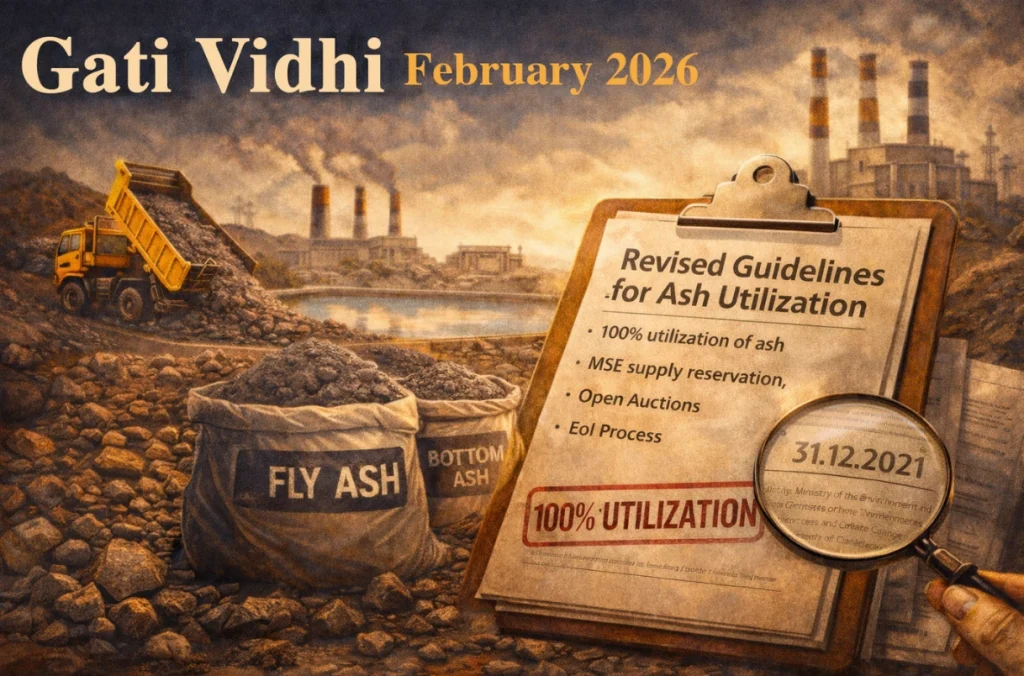
MoP issues Revised Guidelines for Coal and Lignite based Thermal Power Plants to utilize ash as stipulated in the MoEF&CC Notification dated 31.12.2021
The Ministry of Power (“MoP”), vide notice dated 30.01.2026, has issued Revised Guidelines for Coal and Lignite based Thermal Power Plants (“TPPs”) to utilize ash as stipulated in the MoEF&CC Notification dated 31.12.2021 (amended on 30.12.2022 and 01.01.2024). The revised guidelines are in supersession of the guidelines issued on 15.03.2024.
The primary objective is to enforce 100% utilization of ash with least burden on the electricity consumers. The revised guidelines mandate that all the coal and lignite based TPPs (Central / State / Private sector), including captive and co-generating stations, shall follow the guidelines for disposal of current and legacy ash.
The salient features are as follows:
- TPPs are required to declare the issuable ash (fly ash, bottom ash and pond ash separately) prior to start of the ash disposal process. It is the quantity of ash available for issue in a year, after excluding ash for existing tie-ups and other commitments, subject to technical restrictions, dyke safety and current / future ash generation.
- TPPs shall provide ash to agencies for eco-friendly purposes through transparent mechanisms.
- TPPs may adopt other low-carbon options (waterways, rail, rail-cum-road, roll-on/roll-off, pipeline system, etc.) for ash transportation besides conventional road transport.
- TPPs shall reserve a certain percentage of issuable quantity of fly ash for supply at concessional rates to Micro and Small Enterprises and local users, on an ‘as is where is’ basis. The quantum to be reserved shall be determined by the Committee constituted at the plant level and shall be allocated through an Expression of Interest (“EoI”) process.
- All coal and lignite based TPPs shall undertake sale through a transparent mechanism, such as an Open Auction with a predefined floor price of “Rupee One per Metric Ton (MT)”.
- Unutilized quantity shall be offered free of cost through an EoI process for lifting ash on ‘as is where is’ and ‘first come first serve’ basis with transportation expenses borne by the user. If there is any further unutilized ash, TPPs shall serve notices to agencies of identified avenues within a radius of 300 kms for delivering ash free of cost and bearing cost of transportation.
- After compliance of (v) and (vi), for any prospective ash utilization avenue involving transportation beyond 300 km, the financial responsibility of TPPs towards transportation costs will be capped at the notional equivalent of road transport for up to 300 km, irrespective of the actual transport mode.
- Where the transportation cost is to be borne by TPPs, TPPs are required to empanel transportation agencies through competitive bidding.
A copy of the Revised Guidelines can be accessed here.
MoC invite comments / suggestions on the draft amendments to the rules contained in Coal Block Allocation Rules, 2017
The Ministry of Coal (“MoC”), vide Notice dated 03.02.2026, has invited comments / suggestions on the draft amendments to the rules contained in Coal Block Allocation Rules, 2017 (“Principal Rules”).
The following are the proposed amendments:
- Insertion of Clause (sa) in Rule 2 – “performance security” means bank guarantee, insurance surety bond or any other financial instrument of similar nature as may be specified by the Central Government.
- Substitution in Rule 8(4) – the word “bank guarantee” be substituted with the word “security”.
- Substitution in Rule 8(8) – the word “bank guarantee” be substituted with the word “security”.
- Substitution in Rule 9(8) – the word “bank guarantee” be substituted with the word “security”.
The comments / suggestions can be sent within 30 days of publication of the notice.
A copy of the notice along with the draft amendment can be accessed here.
MoC has invited comments on the draft Coal Mines (Special Provisions) (First Amendment) Rules, 2026
The MoC, vide Office Memorandum dated 04.02.2026, has invited comments on the draft Coal Mines (Special Provisions) (First Amendment) Rules, 2026. The amendment proposes to insert Clause (ia) in Rule 2 after Clause (i) which defines “performance bank guarantee”. As per Clause (ia), “performance bank guarantee” means and includes a bank guarantee or an insurance surety bond or any other financial instrument of similar nature as may be specified by the Central Government.
The comments can be submitted within 15 days.
A copy of the Office Memorandum can be accessed here.
PNGRB has approved Guidelines for CBG injection into gas networks
The Petroleum and Natural Gas Regulatory Board (“PNGRB”) has, vide Press Release dated 11.02.2026, approved the Guidelines for Injection of Compressed Biogas (“CBG”) into Natural Gas Pipelines (“NGPL”) and City Gas Distribution (“CGD”) Networks. These Guidelines provide a comprehensive framework for the safe, efficient, and standardized integration of CBG into authorized natural gas infrastructure.
The Guidelines were developed through an extensive and inclusive consultative process. A technical committee comprising representatives from CBG producers, CGD entities, and NGPL pipeline operators was constituted to address the technical, operational, and safety aspects specific to CBG injection. Comments were invited to the draft Guidelines and the comments received were examined and appropriately incorporated into the final Guidelines.
The salient features of the Guidelines are as follows:
- Design and technical standards, aligned with the technical Standards and specifications including Safety Standards (“T4S”) Regulations for NGPL and CGD networks;
- CBG quality and specifications, with reference to the Access Code Regulations for NGPL and CGD networks and relevant BIS Standards;
- Installation procedures for CBG injection facilities;
- Operational, monitoring, and maintenance practices; and
- Safety requirements, including odorization and control systems.
The Guidelines also include illustrative schematic drawings detailing typical CBG injection configurations, intended to facilitate uniform interpretation, design consistency, and smooth implementation across CGD and NGPL networks. The integration of CBG into the natural gas grid is expected to enhance the availability of domestically produced green gas, reduce dependence on imported LNG, improve energy security, and support country’s climate and carbon reduction goals. Pipeline-based evacuation of CBG will also facilitate higher utilization of agricultural residue, cattle dung, municipal solid waste, and other organic feedstocks.
The issuance of these Guidelines is an important step towards enabling the injection and transportation of CBG through NGPL. It fills a key gap in the CBG ecosystem by setting clear technical and safety requirements. It is also expected to support sector growth and strengthen the goal of the Government of making biogas a mainstream part of India’s clean energy transition.
A copy of the Press Release can be accessed here. The Guidelines can be accessed here.
APTEL has dismissed IEX Plea Against CERC Order Implementing Market Coupling
The Appellate Tribunal for Electricity (“Tribunal”), vide judgement dated 13.02.2026 in Appeal No.298 of 2025 (India Energy Exchange Limited v. Central Electricity Regulatory Commission & Ors.) upheld CERC Order dated 23.07.2025 in Petition No.8/SM/2025 (“Impugned Order”), directing implementation of market coupling for day ahead market in terms of the Central Electricity Regulatory Commission (Power Market) Regulations, 2021.
Indian Energy Exchange (“IEX”), India’s dominant and leading power exchange challenged the decision to implement market coupling, questioning whether it is justified, lawful, and supported by adequate evidence, or only intended to redistribute market share. IEX contended violations of the Power Market Regulations, 2021, principles of natural justice, lack of transparency, and anti-competitive effects under the Electricity Act, 2003.
CERC vide Order dated 23.07.2025 had decided to initiate implementation of market coupling in the following manner –
- Coupling of Day-Ahead Market (DAM) of the power exchanges in a round-robin mode by January 2026, whereby the power exchanges may act as the Market Coupling Operator on a rotational basis.
- Coupling of Real-Time Market (RTM) of the power exchanges at a later stage after gaining operational experience from the coupling of DAM.
- Examine coupling of RTM with SCED with suitable regulatory interventions and after stakeholder consultation and
- Feasibility of coupling of the Term-Ahead Market (including Contingency Contracts) of the power exchanges by running a shadow pilot.
CERC also directed regulatory amendments, consultations with Grid-India and exchanges, development of software, and a three-month shadow pilot for the Term-Ahead Market, with exchanges required to share necessary data.
In deciding the validity of the Impugned Order, the Tribunal first examined whether the Impugned Order issued without any enabling provision, in suo moto proceedings initiated by the Commission, formed part of CERC’s legislative or quasi-judicial functions. The Tribunal analysed an extensive line of judgements as well as the legal jurisprudence on both the legislative as well as quasi-judicial role of the Commission. Whereafter, it held that the Impugned Order is in the nature of an administrative order. The Tribunal held the Impugned Order did not create any binding rules, altering the legal status of the parties and that any enforceable impact would arise only after formal regulations were framed applied.
Having held so, the Tribunal decided on the whether IEX had the locus to appeal against the Impugned Order as a “person aggrieved” under Section 111 (1) of the Electricity Act, 2003. It held that the Impugned Order neither recorded any non-compliance by IEX nor deprived it of any legal right. The reference to the round-robin mechanism in the Impugned Order was indicative and non-binding at the stage and did not independently operationalise market coupling. Therefore, the Tribunal held that the Impugned order merely contemplated future steps, subject to regulatory amendments and hence no prejudice was caused to IEX.
Laying emphasis on the settled test to determine a “person aggrieved”, the Tribunal held that such entity must suffer a legal grievance or imposition of liability. Mere commercial disappointment at CERC’s intent to introduce market coupling does not confer such status. Accordingly, the Tribunal held that the Impugned proceedings/Order qualify as an “order” under Section 111(1) of the Electricity Act, 2003. However, IEX is not a “person aggrieved” and therefore not entitled to any relief in appeal. The Tribunal observed that IEX would be entitled to challenge the Regulations, when they are notified, in appropriate legal proceedings.
APTEL observes that a Solar Developer cannot benefit from their own Delay
APTEL vide its judgement dated 03.02.2026 in Appeal No.04 of 2020 (Krishna Windfarms Developers Pvt Ltd v. Sh. B. Shreekumar & Ors.) upheld the CERC decision allowing encashment of bank guarantee and tariff reduction due to delay in commissioning of Solar Power Plant Project. The Tribunal held that the renewable energy developer, Krishna Windfarm (“Developer”) cannot claim protection under force majeure to benefit from its own delay in commissioning the power project within the agreed upon Scheduled Commercial Operation Date.
Solar Energy Corporation of India Ltd (“SECI”) claimed delay on part of Krishan Windfarm in commissioning of the Plant and invoked two Performance Bank Guarantees as well as reduced tariff to be paid to Krishna Windfarm. Krishan Windfarms on the other hand, contended that the Scheduled Date of Commissioning of the Project is considered from the date of signing of PPA, and not the “effective date” defined under the PPA.
The Tribunal relied on the provisions of the PPA and held that Article 5.1.5 of the PPA which requires the developer to commission the power project within 13 months from the date of the PPA, appears to have been retained in the PPA due to inadvertence. That the same cannot override the dominant intention of the parties. The dominant intention of the parties could be gathered from Article 1 (definition section) and Article 2.1 of the PPA, which specifically provided the effective date and the scheduled commissioning date in the PPA. Thus, the Tribunal held that the developer was required to achieve financial closure within 7 months from the “effective date” and commission the project within 13 months from the “effective date”.
On the issue of force majeure, the Tribunal held that the Developer had agreed to undertake all Conditions Subsequent, including obtaining all relevant clearances within seven months from the effective date as per the PPA and hence, affirmed that the Developer was obligated to take necessary steps and complete all such activities within the effective date. The Tribunal emphasized on the obligation of the developer to issue notice as a precondition for any entitlement of the affected party to claim relief under the PPA. Further, in the absence of sufficiently proving that the delay caused was due to factors beyond the control of the Developer, the Tribunal rejected invocation of the force majeure event agitated by the Developer.
CERC holds GST on O&M and Lease Rentals as “Change in Law”
The Central Electricity Regulatory Commission (“CERC”), vide its order dated 09.02.2026 in Rising Sun Energy Private Limited & Ors. v. NTPC Limited & Anr., Petition No. 163/MP/2022, held that the introduction of Goods and Services Tax (GST) qualifies as a “Change in Law” under the Power Purchase Agreements (PPAs) executed for 140 MW solar projects at Bhadla Solar Park, Rajasthan. The petitioners had sought compensation for the financial impact of GST, including certain unresolved pre-commissioning claims and recurring post-Commercial Operation Date (COD) expenses. While a substantial portion of the pre-COD claims had already been reconciled and paid, disputes remained in relation to equipment costs and GST imposed on Operation and Maintenance (O&M) services and lease rentals.
Relying on the judgment of APTEL in the Parampujya Solar Energy Private Limited &Ors. vs. CERC & Ors. [Appeal No. 256 of 2019 & batch] case, the Commission held that the term “relief” under the PPA must be interpreted broadly to maintain commercial balance. CERC allowed compensation towards GST paid on O&M services, lease rentals, and other recurring post-COD liabilities. The Commission also allowed carrying cost, to be calculated from the date of payment of GST until the date of the Order. NTPC has been directed to make payment to the developers, with reimbursement to be made by Rajasthan Urja Vikas Nigam Limited (RUVNL). The Commission clarified that payment to the developers should not be made contingent upon reimbursement by RUVNL.
However, CERC noted that directions issued so far as they relate to compensation for the period post Commercial Operation Date of the projects in question as also towards carrying cost (pre-COD & post-COD) shall not be enforced and shall be subject to further orders of the Supreme Court in Civil Appeal No. 8880/2022 in Telangana Northern Power Distribution Company Limited & Anr. V. Parampujya Solar Energy Pvt. Limited & Ors, and connected matters.

 You wish to know more about Neeti Niyaman (the “Firm”) for your own information and use.