Gati Vidhi – January 2026
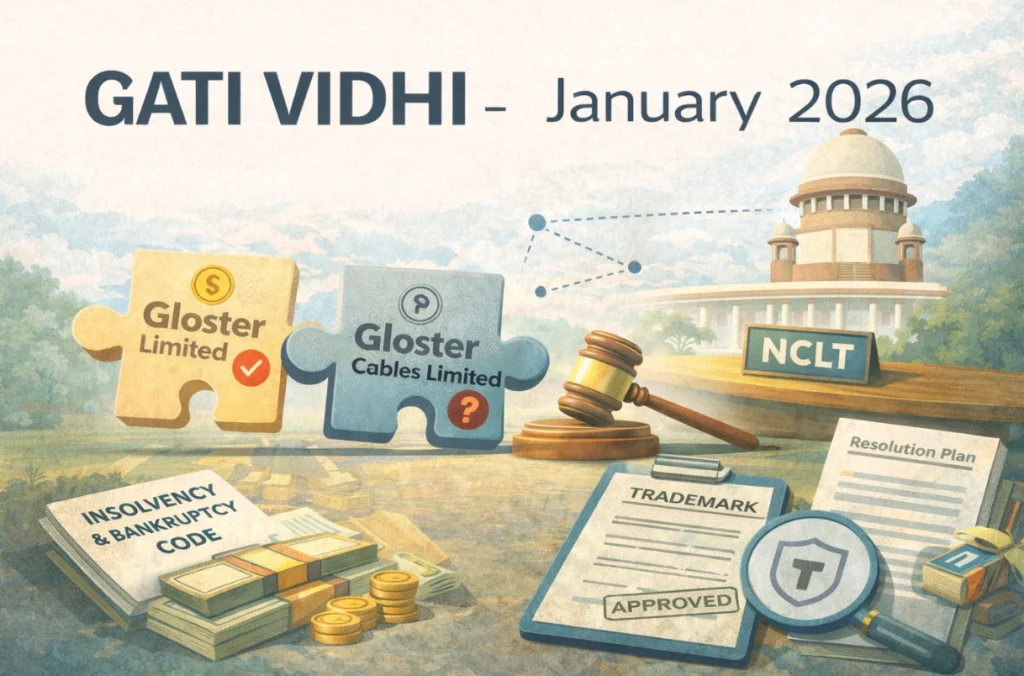
Supreme Court on NCLT’s power to declare title to a trademark in CIRP
In Gloster Limited v. Gloster Cables Limited (C.A. No. 2996 of 2024), the Supreme Court examined whether, during CIRP and while approving a resolution plan, the NCLT could grant a declaration of entitlement/title in favour of the Successful Resolution Applicant (Gloster Limited) over the trademark “Gloster”, particularly when the approved plan itself acknowledged rival claims to the trademark.
The Court noted that the RP had not filed any avoidance application (preferential/undervalued/fraudulent transactions) and the counterparty was not put on notice on those grounds.
Against this background, the Court held that the Adjudicating Authority could not have, while approving the plan in the form voted by the CoC, gone further to grant a declaration of entitlement to the trademark in favour of the Successful Resolution Applicant.
The Court also addressed the NCLT’s approach of effectively treating the trademark assignment as hit by Sections 43 and 45 without a properly pleaded application, recording that such findings were beyond the scope of the enquiry and raised natural justice concerns; it agreed with the reasoning that action could not be taken in that manner without an appropriate application and pleadings.
Ultimately, the Supreme Court set aside the NCLT’s finding that the trademark “Gloster” is an asset of the corporate debtor, clarified that its observations were only for that limited purpose and would not preclude adjudication of title in other proceedings, and also held that the NCLAT’s observations on title could not be sustained in the circumstances.
NCLAT holds that proceedings cannot be permitted to be withdrawn under Section 12A of the Insolvency and Bankruptcy Code, 2016 after the initiation of the liquidation process
In Narayan Maheshwari v. Ms. Kavitha Surana, Liquidator of M/s Shri Veerganapathi Steels (P) Ltd. and Anr., Company Appeal (AT) (CH) (INS) No. 63 / 2024, vide judgement dated 17.12.2025, the National Company Law Appellate Tribunal (“NCLAT”) has held that insolvency proceedings cannot be withdrawn under Section 12A of the Insolvency and Bankruptcy Code, 2016 (“IBC”) once a Corporate Debtor has entered liquidation.
In this case, the Corporate Debtor was subjected to Corporate Insolvency Resolution Process (“CIRP”) proceedings under Section 7 of IBC. Since no Resolution Plan or a satisfactory one was submitted, the Resolution Professional filed an application seeking initiation of the liquidation process, which was allowed by the National Company Law Tribunal vide order dated 19.07.2023. After the Corporate Debtor was put into liquidation, the Bank communicated that its promoters and guarantors were eligible and willing to enter into a One Time Settlement (OTS) scheme, which was acted upon and accepted by the Bank.
The issues which arose in this case are as follows:
- Whether the OTS proposal could be accepted at this stage in the absence of any specific provision under Chapter III of IBC permitting withdrawal?
- Whether the terms of the OTS proposal can be taken as a substitute for the provisions contained under Section 12A of IBC so as to borrow and apply the same for withdrawal of proceedings initiated under Section 7 of IBC at this stage?
While dismissing the appeal, the NCLAT has held as follows:
- The procedures contemplated for the NCLT and NCLAT are regulated by judicial intervention and must be strictly confined within the framework of procedural and substantive law as envisaged under IBC. [Arun Kumar Jagatramka v. Jindal Steel and Power Ltd., 2021 SCC OnLine SC 220]
- Once Section 12A of IBC was inserted, prescribing withdrawal of proceedings under Sections 7, 9 or 10 if IBC, it was done with a clear object and intent by confining its application exclusively to Chapter II i.e., the CIRP stage.
- There was an intentional, intelligible, and conscious legislative distinction in not extending the provisions of Section 12A or any similar provision permitting withdrawal of proceedings to the stage of liquidation.
- This intent is further reinforced by the absence of any corresponding amendment or insertion in Chapter III governing liquidation proceedings.
- The exercise of inherent powers cannot be distorted or extended in a manner that contravenes, conflicts with, or ignores express provisions of law contained in the IBC.
- Since there is an express exclusion of the applicability of Section 12A at the Chapter III stage, the provision cannot be stretched by interpretation or inference without logical and legal backing.
The Selection Committee of the Lok Sabha has suggested modifications to several provisions of the Insolvency and Bankruptcy Code (Amendment) Bill, 2025
The Selection Committee of the Lok Sabha has suggested modifications to several provisions of the Insolvency and Bankruptcy Code (Amendment) Bill, 2025. The Insolvency and Bankruptcy Code (Amendment) Bill, 2025 was introduced in the Lok Sabha in August 2025 to amend the IBC, after which it was referred to a Selection Committee of the Lok Sabha. The Committee submitted its report in December 2025 suggesting modifications to several provisions of the Bill.
The proposed amendments include prescription of statutory timelines for admission of insolvency applications, revised provisions governing withdrawal of applications under Sections 7, 9 and 10 of the IBC, enhanced role of the Committee of Creditors during liquidation, and introduction of a new framework for a Creditor-Initiated Insolvency Resolution Process (CIIRP). The Bill also contains enabling provisions relating to group insolvency, cross-border insolvency, treatment of avoidance transactions, and clarification of rights and obligations of creditors, resolution professionals, and liquidators.
The Amendment Bill can be accessed here. The Report of the Selection Committee can be accessed here.
NCLAT has upheld the initiation of insolvency proceedings against a personal guarantor under Section 95 of the Insolvency and Bankruptcy Code, 2016, on the basis of a demand notice issued under Section 13(2) of the Securitization and Reconstruction of Financial Assets and Enforcement of Security Interest Act, 2002
In Ujwal Gupta v. Union Bank of India & Ors., Company Appeal (AT) (Ins) No. 2001/2024, vide judgment dated 07.01.2026, the NCLAT has upheld the initiation of insolvency proceedings against a personal guarantor under Section 95 of the Insolvency and Bankruptcy Code, 2016, on the basis of a demand notice issued under Section 13(2) of the Securitization and Reconstruction of Financial Assets and Enforcement of Security Interest Act, 2002 (“SARFAESI Act”).
In this case, the Appellant contended that the personal guarantee had not been validly invoked as the notice under the SARFAESI Act was not specifically addressed to him in his capacity as a guarantor and it did not expressly invoke the guarantee. This contention has been rejected by the NCLAT.
The NCLAT has made the following observations:
- It is the terms and conditions of the agreement executed between the parties with regard to the guarantee which would be relevant to assess as to whether the guarantee has been sufficiently invoked or not.
- Whether a guarantee has been invoked or not depends on the terms of the guarantee and the content of the notice.
- If the notice clearly demands payment from the personal guarantor in terms of the guarantee, it can be treated as an invocation of the guarantee.
- Where the Guarantee Deed does not prescribe any specific or particular process, form or mode of invocation, a notice specifically demanding the outstanding payment within a specific time period is sufficient in so far as invocation of guarantee is concerned. However, it should sufficiently demonstrate the liability of the guarantor and have a clause for discharge of its liability for the credit facilities extended to the Corporate Debtor.
The Tribunal has held that the notice under the SARFAESI Act clearly called upon the addressees, including the Appellant, to discharge the outstanding dues within the stipulated period and, read with the terms of the guarantee, constituted a valid invocation. The appeal was accordingly dismissed.
IBBI has issued the Revised Forms for Liquidation Process
The Insolvency and Bankruptcy Board of India (“IBBI”) has, vide circular dated 05.01.2026, has issued Revised Forms for the Liquidation Process, pursuant to the Insolvency and Bankruptcy Board of India (Liquidation Process) (Amendment) Regulations, 2026.
Vide the Amendment Regulations, Regulation 47B of the Principal Regulations i.e., IBBI (Liquidation Process) Regulations, 2016, has been amended to provide that the liquidator shall file the Forms along with enclosures on the electronic platform of the Board in accordance with notified timelines.
Under the revised forms framework, four forms (LIQ-1 to LIQ-4) have been introduced to cover the entire liquidation lifecycle, from commencement of liquidation to dissolution or closure. The revised forms consolidate and rationalize data requirements, enable auto-population of information already available on the portal, and replace the existing forms with effect from 01.01.2026 (with LIQ-2 becoming applicable from 01.02.2026).
IBBI has further provided that no penalty will be levied for delayed filings during the initial quarter (January 2026 to March 2026) to facilitate transition. The circular also enables post-filing modification of forms through a portal-based utility, allowing insolvency professionals to correct errors or omissions before the due date.
The Amendment Regulations can be accessed here. The Circular can be accessed here.
Madras High Court observes that an unexplained and exorbitant delay of more than 7 years in passing an award is in conflict with the public policy of India
In Tamil Nadu Housing Board v. M/s N.C.C Ltd., Arb O.P. (Com. Div.) No. 35/2022, vide order dated 08.12.2025, the Madras High Court has held that the underlying public policy resorting to arbitration is to make it a time saving mechanism for resolving disputes and an award passed with an unexplained and exorbitant delay of more than 7 years is certainly in conflict with the public policy of India.
In a dispute between the Petitioner and the Respondent, the arbitration clause was invoked. An award passed by a 3-member tribunal was set aside by the High Court in the year 2007 and a sole arbitrator was appointed. The proceedings under the sole arbitrator commenced in the year 2008 and the arguments were concluded on 24.11.2013 however, no award was passed. After about 6.5 years, on 03.02.2020, the sole arbitrator took up the case and thereafter, passed the award on 30.07.2020, which was challenged before the High Court under Section 34 of the Arbitration and Conciliation Act (“A&C Act”). The sole arbitrator last heard the parties in the year 2013 but the award was passed in 2020 only based on materials that were available before the sole arbitrator.
The High Court observed that the sole arbitrator did not assign any reason in the entire award as to why the award was passed with such an exorbitant delay. Further, the sole arbitrator has also imposed interest at the rate of 9% per annum from the date of filing of the claim petition till the date of the award, and interest of 18% per annum from the date of the award till the date of realisation if the amount is not paid within 2 months. The High Court held that the delay of 7 years was not attributable to either party and thus, it was unreasonable and patently illegal to burden the Petitioner with interest even for the period of delay in passing the award.
The High Court set aside the award for infraction under Section 34(2)(b)(ii) and Section 34(2A) of the A&C Act.
 You wish to know more about Neeti Niyaman (the “Firm”) for your own information and use.