Gati Vidhi – January 2026
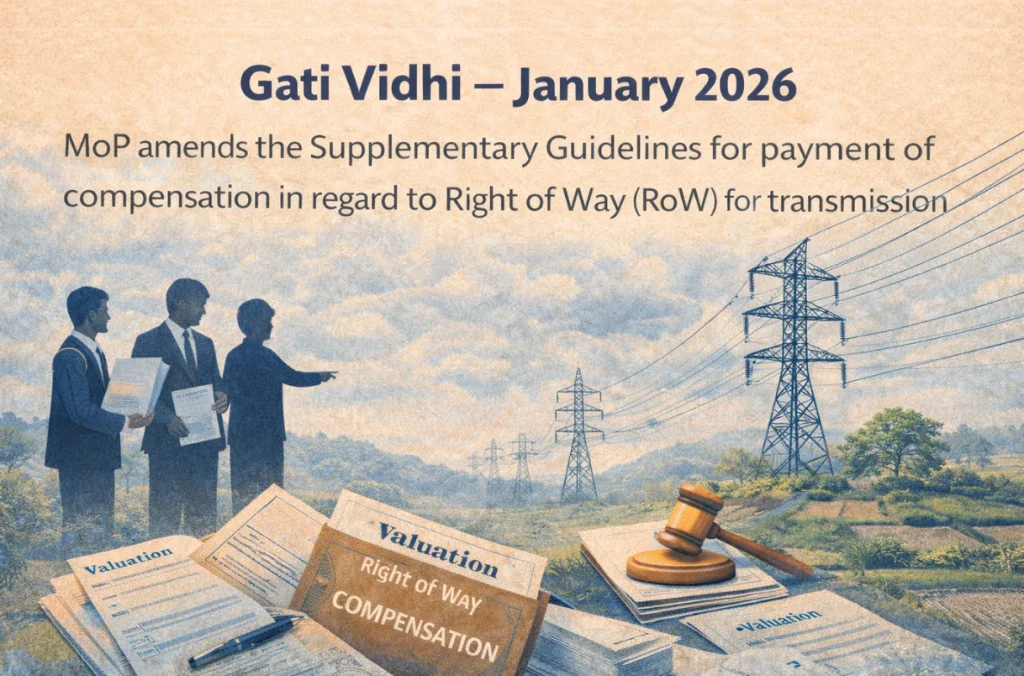
MoP amends the Supplementary Guidelines for payment of compensation in regard to Right of Way (RoW) for transmission lines
The Ministry of Power (“MoP”), vide Notice dated 15.12.2025, has amended Para 3 of the Supplementary Guidelines for payment of compensation in regard to the Right of Way (“RoW”) for transmission lines dated 21.03.2025 (“principal guidelines”). Para 3 provides for the Land Valuation Methodology.
The amendment has been introduced as there have been instances where the land valuer nomination by the representative of landowners and submission of valuation reports to the District Magistrate (“DM”) is taking a long time.
The amendment in Para 3 is as follows:
- Para 3 (1) – The Market Rate Committee (“MRC”) shall engage the land valuers empanelled by the Insolvency and Bankruptcy Board of India (IBBI) as per the list available on its website. The valuers should preferably be from the same State or, if an adequate pool of valuers is not available, from adjoining States.
- Para 3 (2) – The MRC shall appoint 3 valuers, one each nominated by representative of landowners, Transmission Service Provider (“TSP”) and DM, on the same day the MRC meets.
- Para 3 (3) – The representative of the landowners in the MRC shall be from among the affected landowners.
- Para 3 (4) – The nominated valuers shall submit their reports in sealed envelopes directly to the DM within 21 days of their nomination by the MRC. After receipt of all the three reports by the DM, two reports shall be opened by selection through lottery system.
- Para 3 (5) provides for the determination of the reference market rate.
- If the difference in the market rates worked out by the selected valuers is less than 20% over the lower value – the average of the two valuations will be taken.
- If the difference exceeds 20% – it will be determined as 10% higher than the lower valuation. In case of dispute, the report of the third valuer shall be considered, and the reference market value shall be determined as the average of the two lowest valuations.
- Para 3 (6) – The assessed reference market rate shall serve as the basis of determination of market rate by the MRC.
- Para 3 (7) – The land valuers shall be paid equal professional fee/charged by the TSP as found out by the TSP through due process, which shall form part of the RoW compensation cost.
A copy of the amendment can be accessed here.
MNRE grants extension of time in Scheduled Commissioning Date of Renewable Energy Power Projects due to delay in grant of approval under Section 68 of the Electricity Act, 2003
The Ministry of New and Renewable Energy (“MNRE”) has, vide Order No. 283/1/2025-GRID SOLAR dated 12.01.2026, issued certain directions in view of the several representations received by it for grant of extension in Scheduled Commissioning Date (“SCD”)/Scheduled Commencement Supply Date (“SCSD”) for renewable power projects where the grant of approval under Section 68 of the Electricity Act, 2003 (“EA 2003”) for laying of overhead power transmission line was delayed due to the pendency of the final judgement by the Supreme Court in W.P. (C) 838/2019.
The following directions have been issued by MNRE:
- All Renewable Energy (“RE”) implementing agencies of the MNRE shall treat delay in grant of approval under Section 68 of the EA 2003 as akin to ‘Force Majeure’ based on evidences/documents produced by the developers in support of their claims and shall grant time-extension in SCD / SCSD for the period commensurate to the period from the date of the application or 21.03.2024, whichever is later, to 19.12.2025 (date of the final judgment by the Supreme Court).
- This is subject to the developer submitting an undertaking to the concerned agency that in case the route of the line or some portion of the route falls in the Great Indian Bustard (GIB) area, it shall comply with the orders of the Supreme Court in W.P. (C) 838/2019 and the directions of the technical/expert committee constituted by the Court or any other authorized entity in this regard.
- The concerned agency shall also commensurately extend the timelines for intermediate milestones, if any, for a project, within the time-extension granted as above.
- The developers, who have received time-extensions, may also pass on the benefit of the same to other stakeholders down the value-chain by way of granting similar time-extensions.
- All RE project developers have to make a formal application to the concerned agency giving all documentary evidence(s) in support of their claim and time extensions shall be granted based on facts.
- This is not applicable to those RE power projects, whose SCD was prior to 21.03.2024, and to those RE power project developer who has not applied prior to 19.12.2025.
- If a RE power project has already received time-extension due to some other order, the overlapping period shall be excluded from the total time-extension to be given on account of delay in grant of approval under Section 68 of the EA 2003.
A copy of the Order can be accessed here.
APTEL sets aside KSERC Order on Tariff Determination for Small Hydro Project
The Appellate Tribunal for Electricity (“APTEL”), vide its judgment dated 05.01.2026 in Appeal No. 431 of 2019 Minar Renewable Energy Projects Pvt. Ltd. v. Kerala State Electricity Regulatory Commission & Ors., has allowed the appeal filed by the Generator/ Appellant and set aside the order dated 06.09.2019 passed by the Kerala State Electricity Regulatory Commission (“KSERC”).
The appeal arose from KSERC’s decision in Petition No. OA 8 of 2018, where the Appellant had sought determination of generic tariff for its 8 MW small hydro power project for FY 2016–17 and subsequent years under Section 86(1)(e) of the Electricity Act, 2003. Instead of determining generic tariff, KSERC proceeded to determine a project-specific tariff, relying on a decision of the State Government dated 01.07.2017.
APTEL noted that under the Kerala State Electricity Regulatory Commission (Renewable Energy Regulations), 2015, the Commission is required to determine generic tariff, and project-specific tariff can be determined only upon an application by the project developer. In the present case, the Appellant had not applied for project-specific tariff. The Tribunal also observed that the project was allotted under the Kerala Small Hydro Power Policy, 2012, which contemplated procurement of power at the tariff fixed by KSERC.
APTEL held that tariff determination is a quasi-judicial function of the State Commission and cannot be controlled by State Government decisions or directions. Even assuming a policy direction under Section 108 of the Electricity Act, the Commission is only to be “guided” by such directions and is not bound by them. In the present case, no formal policy direction under Section 108 was shown to have been issued.
Accordingly, APTEL set aside the impugned order and remanded the matter to KSERC with a direction to determine the generic tariff for the Appellant’s project in accordance with the applicable policy and regulations. The Tribunal also directed that, in the meantime, the Appellant shall continue to be paid interim tariff at Rs. 4.65 per unit. KSERC was directed to complete the exercise within three months.
APTEL allows NTPC’s appeal on relaxation of Target Availability due to coal shortage
APTEL, vide its judgment dated 13.01.2026 in Appeal No. 399 of 2019, NTPC Ltd. v. Central Electricity Regulatory Commission & Ors., has allowed the appeal filed by NTPC Limited, setting aside the order dated 28.08.2019 passed by the Central Electricity Regulatory Commission (“CERC”).
The appeal arose from CERC’s order in Petition No. 46/MP/2018, by which the Commission had rejected NTPC’s request for relaxation of the Normative Annual Plant Availability Factor (“NAPAF”) for the period 01.04.2017 to 31.03.2019 for the following generating stations: Mouda Thermal Power Station Stage I and II, Solapur Thermal Power Station, and Simhadri Super Thermal Power Station Stage I. CERC had held that NTPC was not entitled to any relaxation on account of coal non-availability.
NTPC had approached CERC seeking relaxation of the target NAPAF of 85%, contending that it could not achieve the norm due to shortage of domestic coal, restrictions on coal imports arising from Government of India policy directions, and circumstances beyond its control. NTPC submitted that despite continuous representations to the Ministry of Power, Ministry of Coal, and Coal India Limited, coal supply remained inadequate during the relevant period.
Before APTEL, NTPC argued that the coal shortage was caused by policy decisions of the Government of India and that these circumstances justified relaxation under the CERC Tariff Regulations, 2014. NTPC relied on an earlier judgment of APTEL in Appeal No. 318 of 2019, where the Tribunal had granted relaxation of NAPAF from 85% to 83% in similar circumstances. The Respondents contended that fuel procurement is the responsibility of the generator, that there was no absolute ban on coal imports, and that NTPC had options such as e-auction procurement and optimal coal allocation across stations.
After examining the record, APTEL held that the executive directions of the Government did not amount to a force majeure or change in law. However, the Tribunal noted that under the 2014 Tariff Regulations, a general relaxation of NAPAF from 85% to 83% had earlier been provided due to coal shortage and uncertainty in assured supply, with a requirement of review after three years. APTEL observed that no such review was undertaken by CERC, and that the coal supply situation had not materially improved during the relevant period.
APTEL further held that the facts of the present case were identical to those considered in the Vallur judgment, and that as a coordinate bench decision, it was binding. The Tribunal found that CERC had wrongly refused to exercise its power to relax under Regulation 54 of the 2014 Tariff Regulations.
Accordingly, APTEL set aside the impugned order and directed CERC to allow relaxation of NAPAF from 85% to 83% for NTPC’s generating stations for the period 01.04.2017 to 31.03.2019 for the purpose of recovery of fixed charges.
APTEL dismisses Appeal challenging lapse of Rooftop Solar PPA in Karnataka
APTEL, vide its judgment dated 09.01.2026 in Appeal No. 105 of 2018, Smt. L. Nagarathna Vs KERC and Ors, has dismissed the appeal filed by Smt. L. Nagarathna against the order of the Karnataka Electricity Regulatory Commission (“KERC”).
The appeal arose from KERC’s order dated 21.09.2017, by which the Commission dismissed the Appellant’s petition challenging the communication issued by Bangalore Electricity Supply Company Limited (“BESCOM”) on 16.11.2016, informing her that the Power Purchase Agreement (“PPA”) dated 11.12.2015 for a 1000 kW rooftop solar project had lapsed and was non-enforceable.
Under Regulation 11(3) of KERC, (Implementation of Solar Roof Top Photovoltaic Power Plants) Regulations, 2016, Commission approval was required for rooftop solar projects of 500 kW and above. KERC granted approval to the PPA on 01.01.2016, subject to the condition that proof of availability of 9700 sq. m. of rooftop area be submitted to the Commission within 15 days.
It was not disputed that the required proof of rooftop area was not submitted to the Commission within the stipulated period. Subsequently, KERC informed BESCOM that the approval granted to several PPAs, including that of the Appellant, had lapsed due to non-submission of the required proof. Based on this, BESCOM issued the impugned communication dated 16.11.2016 to the Appellant.
Before APTEL, the Appellant argued that she was not directly communicated the approval conditions, that the delay occurred due to internal communication within BESCOM, and that no prior notice was issued before treating the PPA as lapsed. The Respondents contended that the approval was conditional, the condition was not fulfilled, and therefore the PPA never came into force.
APTEL held that although the approval letter was addressed to BESCOM, a copy was marked to the Appellant, and there was no case that she had not received it. The Tribunal observed that the Appellant was aware of the condition imposed by the Commission but neither complied with it herself nor ensured compliance through BESCOM. It was also noted that the available rooftop area with the Appellant was less than the area required under the approval.
The Tribunal further held that since the Commission’s approval was conditional and the condition was not fulfilled, the PPA did not come into effect at all. In such a situation, the procedure for termination under the PPA did not apply, as there was no subsisting and enforceable agreement.
Finding no error in the order passed by KERC, APTEL dismissed the appeal and upheld the conclusion that the PPA had lapsed due to non-compliance with the conditions of approval.
BERC approves BERC (Deviation Settlement Mechanism and Related Matters) Regulations, 2025
The Bihar Electricity Regulatory Commission (“BERC”) vide its order dated 06.01.2026 in in Suo-Motu Case No. SMP -31/2025, has finalised and approved the BERC (Deviation Settlement Mechanism and Related Matters) Regulations, 2025 (“BERC DSM Regulations”). These regulations represent a significant overhaul of the intra-State deviation settlement framework in Bihar and replace the existing DSM Regulations, 2020. The revised framework has been notified to align the State-level mechanism with the CERC (Deviation Settlement Mechanism and Related Matters) Regulations, 2024 and subsequent amendments, following an extensive process of public consultation and stakeholder hearings involving DISCOMs, SLDC, STU, generators, and other market participants.
The BERC DSM Regulations apply to all grid-connected State entities including DISCOMs, open access consumers, and renewable generating stations with exportable capacity of 1 MW or more connected to the intra-State transmission system.
BERC has addressed several operational concerns raised by stakeholders. The deviation settlement cycle has been revised from a weekly to a monthly basis. For renewable energy, the Qualified Coordinating Agencies (“QCAs”) are made responsible for scheduling, deviation accounting, and interfacing with SLDC through IT-enabled systems, with defined timelines for data exchange and discrepancy resolution. A transition period has also been provided to allow SLDC and stakeholders to upgrade IT systems and procedures before full commercial enforcement.
Copy of the BERC DSM Regulations can be accessed here.
RERC invites stakeholder comments regarding the amendment of the RERC (Terms and Conditions for Determination of Tariff) Regulations, 2025
Rajasthan Electricity Regulatory Commission (“RERC”) invites comments from the stakeholders regarding the amendment of Regulations 2(77), 16(2), 17(5) and 50(4) of the RERC (Terms and Conditions for Determination of Tariff) Regulations, 2025 to allow the addition of the capital cost and expenditure relating to the biomass (torrefied/non-torrefied) co-firing in coal based thermal power plants to the capital cost, additional capitalization and landed cost of fuel.
On 08.10.2021, the Ministry of Power issued the Revised Policy for Biomass Utilization for Power Generation through co-firing in Pulverized Coal Fired Boilers, which made it compulsory for electricity generators such as Rajasthan Rajya Vidyut Utpadan Nigam Limited (“RRVUNL”) to co-fire their coal -based power plants with atleast 5% utilisation of biomass pellets. Further, through a notification dated 16.06.2023, the Ministry of Power increased the mandatory bio-mass co-firing requirement to 7%. However, Regulations 16,17 and 50 of the RERC (Terms and Conditions for Determination of Tariff) Regulations, 2025 do not permit RRVUNL to claim bio-mass co-firing related costs as capital cost, additional capitalization, and landed cost of fuel.
In the light of the hardship faced by RRVUNL, it has filed a Petition 2377/2025 before RERC seeking amendment of the Regulations 2(77), 16(2), 17(5) and 50(4) of the RERC (Terms and Conditions for Determination of Tariff) Regulations, 2025 to allow the addition of the capital cost and expenditure relating to biomass co-firing in coal based thermal power plants to the capital cost, additional capitalization and landed cost of fuel. RERC in this regard has invited comments from the stakeholders and the last date for the submission of comments is 22.01.2026.
Copy of Petition filed before RERC can be accessed here.
TGERC has invited objections / suggestions / comments on the petitions filed by TGSPDCL and TGNPDCL seeking approval on revised ARR, FPT and CSS proposals for FY 2026 – 27
The TGERC has, vide public notice dated 08.01.2026, invited objections / suggestions / comments on the petitions filed by the Southern Power Distribution Company of Telangana Limited (TGSPDCL) and the Northern Power Distribution Company of Telangana Limited (TGNPDCL) for the revised Aggregate Revenue Requirement (ARR), Filing of Proposed Tariff (FPT) and Cross Subsidy Surcharge (CSS) proposals for FY 2026 – 27 for their Retail Supply Business.
The petitions contain details of projected expenditure, revenue gap, and category-wise tariff proposals for various consumer classes, along with schedules setting out fixed charges, energy charges, demand charges, and other applicable components.
The objections / suggestions / comments can be sent on or before 31.01.2026 and the public hearing is scheduled for 07.03.2026.
The Public Notice issued by TGERC can be accessed here.
TGERC has notified the TGERC (Licensee’s Duty for Supply of Electricity on Request) (Second Amendment) Regulation, 2026
The Telangana Electricity Regulatory Commission (“TGERC”) has notified the TGERC (Licensee’s Duty for Supply of Electricity on Request) (Second Amendment) Regulation, 2026 on 17.01.2026(“Amendment Regulations”) to further amend the TGERC (Licensee’s Duty for Supply of Electricity on Request) Regulation, 2013, (“Principal Regulations”) which governs supply of electricity under Section 43 of the Electricity Act, 2003. The First Amendment was notified on 20.01.2015.
The Second Amendment has introduced a uniform and load-based Service Line Charges framework for new Low Tension (“LT”) connections and Additional Load under LT categories within a 1 km radius of the existing electrified network, in place of a case-by-case estimation. The charges are specified category-wise for LT consumers i.e., Domestic (LT-I), Commercial (LT-II), Industries (LT-III), Cottage Industries (LT-IV), Agriculture (LT-V), Street Lights and PWS Schemes (LT-VI), General (LT-VII) and Electric Vehicle Charging Stations (LT-IX), with slab-based rates linked to the contracted load. For apartments, commercial complexes, and multi-storied buildings, the combined contracted load will be considered for levy of charges.
The Second Amendment further provides that the Distribution Licensee shall supply, erect and maintain the Distribution Transformer for LT connections covered under the new provision, without charging its cost. It also revises the treatment of Dedicated Transformers for larger LT loads in apartments and commercial complexes, clarifying when Development Charges may or may not be levied.
The Amendment Regulations issued by TGERC can be accessed here.

 You wish to know more about Neeti Niyaman (the “Firm”) for your own information and use.