Gati Vidhi – December 2025
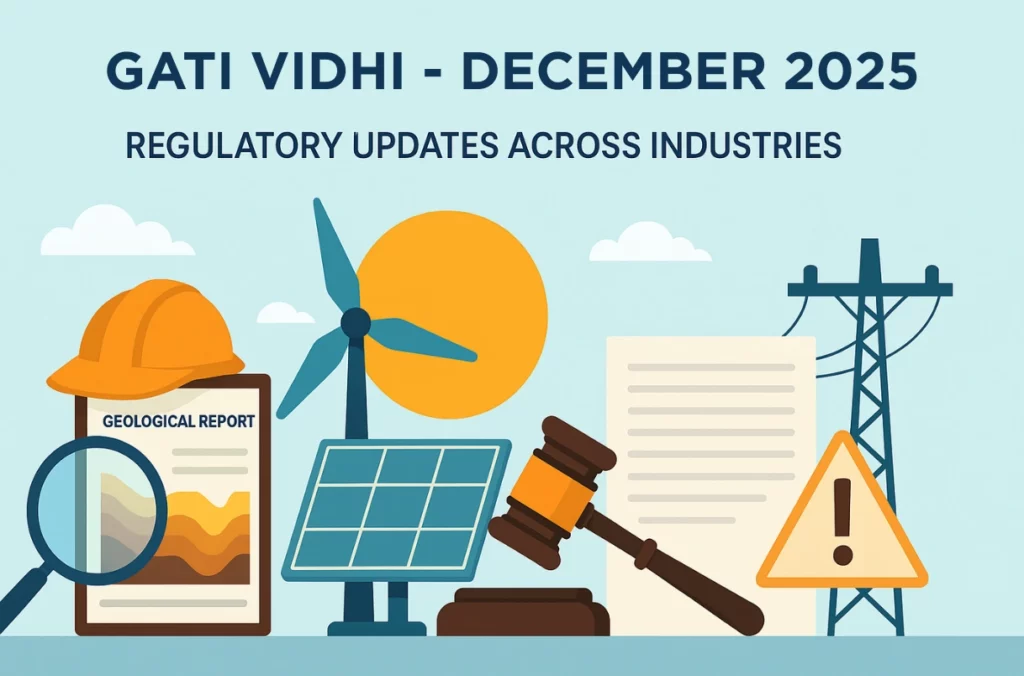
MoC revises the methodology for evaluation and approval of exploration programs and Geological Reports
The Ministry of Coal (“MoC”) has, vide Office Memorandum dated 28.11.2025, has revised its existing methodology for evaluation and approval of exploration programs and Geological Reports.
Vide Office Memorandum dated 24.01.2022, the MoC had constituted a committee for evaluation and approval of exploration programs and Geological Reports of coal and lignite blocks prepared by Accredited Prospecting Agencies (accredited by QCI-NABET) (“APA”), which has now been withdrawn.
The said Office Memorandum dated 28.11.2025, provides:
- Evaluation and approval of exploration programs and Geological Reports prepared by APA notified under Section 4(1) of the Mines and Minerals (Development and Regulation) Act, 1957 (“MMDR Act”) read with Clause 21-B(1)(iii) of the Mineral Concession Rules, 1960 (“MC Rules”), and peer reviewed by another such APA shall be treated as approved.
- The APA conducting peer review shall examine that the exploration programs and Geological Reports are in accordance with provisions of the MMDR Act, the MC Rules and applicable guidelines and procedures.
- Once peer review is completed, the final Geological Reports shall be submitted by the project proponent to CMPDIL for inventory updation in the Indian Coal and Lignite Resources by Geological Survey of India.
A copy of the Office Memorandum dated 28.11.2025 can be accessed here.
MoC issues Draft Colliery Control (Amendment) Rules, 2025
The MoC has, vide Notification dated 02.12.2025, has issued the Draft Colliery Control (Amendment) Rules, 2025 (“Draft Amendment Rules”) to amend the Colliery Control Rules, 2004 (“Principal Rules) in exercise of the powers under Section 18 (1) and (2) of the MMDR Act. The MoC has further invited the views / observations / comments / suggestions from the stakeholders within 15 days.
The salient features of the Draft Amendment Rules are as follows:
- Amendment to Rule 9 (1) – The owner of a colliery shall not open a coal mine, seam or a section of a seam without prior approval of the Board of the company (instead of prior written permission of the Central Government).
- Insertion of provisos to Rule 9 (1) – While according approval, the Board shall ensure that all requisite permissions have been obtained and compliances done, and an intimation shall be sent to Coal Controller Organisation within 15 days of opening the coal mine or the seam or a section of the seam.
- Amendment to Rule 9 (2) – No owner of a colliery, which is not a company registered under the Companies Act, 2013, shall open a coal mine or a seam or a section of a seam, without prior approval of the Coal Controller Organisation (instead of no owner of a colliery shall commence mining operations in a colliery or seam or a section of a seam, in which mining operation has been discontinued for a period exceeding 180 days, without the prior written permission of the Central Government).
- Insertion of Rule 9 (3) – Rule 9 (1) and (2) shall also be applicable with respect to the commencement of mining operation in a mine or a seam or a section of a seam where operation has been discontinued for a period of 180 days or more.
- Insertion of Rule 9 (4) – The Coal Controller Organisation shall maintain an indicative list of permissions required from the Central Government, the State Government and statutory bodies required under Rule 9 (1) and (2).
A copy of the Draft Amendment Rules can be accessed here.
MNRE has amended the Standard Operating Procedure for Approved List of Models and Manufacturers – Wind (ALMM-Wind) and Wind Turbine Components (ALMM-WTC)
The Ministry of New and Renewable Energy (“MNRE”) has, vide Office Memorandum dated 01.12.2025, amended Clause 8.1 of the Standard Operating Procedure for Approved List of Models and Manufacturers (“ALMM”) – Wind (ALMM-Wind) and Wind Turbine Components (ALMM – WTC) issued on 29.10.2025.
Clause 8.1 initially mandated that it is mandatory to carry out the prototype testing in India. The amended Clause 8.1 now encourages the manufacturers to carry out the prototype testing in India and that the said testing would be mandatory after 2 years from the date of issuance of the amendment, subject to a review.
A copy of the Office Memorandum dated 01.12.2025 can be accessed here.
MNRE has sought views / comments / suggestions on Draft Order for increasing threshold solar PV module efficiencies for enlistment in ALMM List – I of solar PV modules
The MNRE has, vide Order dated 28.11.2025, sought views / comments / suggestions from stakeholders on the Draft Order for increasing threshold solar PV module efficiencies for enlistment in ALMM List – I of solar PV modules latest by 27.12.2025.
MNRE has proposed the new minimum module efficiency thresholds for enlistment to ensure that the list is reflective of the commercially available high efficiency solar PV modules having quality and efficiency above a minimum prescribed threshold, which is dynamic and reflective of the advancements in solar PV module manufacturing sector and also acts as a barrier to keep low efficiency obsolete technologies out of the list.
As per the Draft Order, the solar PV modules, which are presently enlisted in ALMM or get enlisted in ALMM in next few months but have efficiencies below the revised module efficiency thresholds as proposed, will be removed once the new thresholds become effective.
A copy of the Draft Order can be accessed here.
CERC to hold a public hearing on the Draft CERC (Terms and Conditions for Renewable Energy Certificates for Renewable Energy Generation) (First Amendment) Regulations, 2025
CERC vide its public notice dated 05.12.2025 has directed to hold a public hearing on the Draft Central Electricity Regulatory Commission (Terms and Conditions for Renewable Energy Certificates for Renewable Energy Generation) (First Amendment) Regulations, 2025 on 22.12.2025 at 11:00 hrs.
The key features of the draft regulations are as follows:
- The draft expands the existing Renewable Purchase Obligation (RPO) framework by adding the Renewable Consumption Obligation (RCO), which applies to large industrial “Designated Consumers.” This broadens renewable compliance requirements beyond the power sector and into energy-intensive industries.
- The amendment formally includes VPPAs, allowing corporate consumers to buy renewable attributes financially rather than physically. RECs generated under a VPPA will automatically go to the consumer for meeting RPO or RCO but cannot be traded in the market.
- The draft requires distribution licensees and open access consumers to apply for RECs within three months of receiving certification. Any delay beyond this period results in the forfeiture of the certificates.
- The amendment replaces fixed technology-based multipliers with a new scoring system that values technologies based on tariff levels, maturity, and grid support. This results in differentiated REC values, higher multipliers for storage, pumped hydro, and offshore wind compared to solar and onshore wind.
Copy of Draft Central Electricity Regulatory Commission (Terms and Conditions for Renewable Energy Certificates for Renewable Energy Generation) (First Amendment) Regulations, 2025 can be accessed here.
CERC invites suggestions on the Draft CERC (Terms and Conditions of Tariff) (Second Amendment) Regulations, 2025
CERC vide its public notice dated 01.12.2025 invited suggestions on the Draft Central Electricity Regulatory Commission (Terms and Conditions of Tariff) (Second Amendment) Regulations, 2025. Last date for submission of the comments/suggestions/objections is 30.12. 2025. The key features of the draft are as follows:
- Introduction of a complete regulatory framework for integrated energy storage systems (I-ESS) within existing generating stations and transmission systems, including detailed definitions for technical terms such as state of charge, round-trip efficiency, auxiliary consumption, declared capacity, and availability factor.
- Supplementary tariff determination made mandatory for generating companies and transmission licensees installing I-ESS, requiring them to file for supplementary tariff within 30 days of commercial operation. The supplementary tariff will separately include fixed storage charges and energy charges with clear formulas for cost components.
- Operational norms for energy storage systems are clearly defined, including a normative availability factor of 90%, round-trip efficiency of 85%, and auxiliary consumption of 5%. An incentive of 25 paise/kWh is proposed for energy discharged beyond the level corresponding to normative efficiency.
- Energy scheduling and dispatch rules for storage systems will be standardized, with beneficiaries getting first right to use the stored energy, subject to grid safety. Regional Power Committees will prepare the detailed procedures for scheduling, dispatch, and energy accounting.
- Guidelines for additional capitalization of storage assets are introduced, requiring justification of technology choice, cost-benefit analysis, phased investments, and impact on tariffs. Approved expenditure will be added to the supplementary tariff after prudence checks.
- Special conditions for transmission-level storage systems are proposed, covering aspects such as grid reliability benefits, transmission deferral advantages, and permitting limited use of storage assets for other business applications subject to regulatory conditions.
- Revised tariff filing forms are introduced requiring detailed technical data such as battery module specifications, cycle life, C-rate, response time, and energy management system details to ensure transparency and accurate tariff assessment.
- A regulatory sandbox provision is added, allowing innovation, pilot, and R&D projects using storage technologies with extra financial support of up to 0.5% of annual fixed cost or ₹100 crore, encouraging new technologies and experimentation.
Copy of the Draft Central Electricity Regulatory Commission (Terms and Conditions of Tariff) (Second Amendment) Regulations, 2025 can be accessed here.
RERC issues RERC (Electricity Supply Code and Connected Matters) (Third Amendment) Regulations, 2025
Rajasthan Electricity Regulatory Commission (“RERC”) issued RERC (Electricity Supply Code and Connected Matters) (Third Amendment) Regulations, 2025 (“Third Amendment Regulations”) and proposes to amend Regulation 6 and Schedule 1 of the RERC (Electricity Supply Code and Connected Matters) Regulations, 2021 (“Principal Regulations”).
It proposes to add a new sub-regulation under Regulation 6 which deals with the application procedure for connection. The new sub-regulation mentions that supply of electricity may be provided to applicants requiring High Tension (“HT”)/ Extra High Tension (“ETH”) supply from two sources with simultaneous use /or standby source, subject to technically feasibility and compliance with Safety Regulations. In this case consumers will be at liberty to use contracted demand either of the source from zero to contracted demand.
The Third Amendment Regulations further proposes to amend Schedule-1 of the Principal Regulations which deals with the application fee. It proposes to amend Schedule I, 2.2(b) by adding a proviso to the same. Schedule I , 2.2(b) mentions that for HT supply the actual cost estimates of all works shall be prepared by concerned officer of distribution licensee and for EHT supply such estimate shall be prepared by the concerned officer of the distribution licensee in consultation with transmission licensee, if required, after conducting actual survey as per the field conditions. The cost estimates will be charged on material cost including civil works plus labour and overhead charges as applicable plus Rs. 400/- per kVA of contract demand towards plant cost. The advance amount deposited with application shall be adjusted against the estimate prepared. Provided that if consumer applies for dual source of supply with use of both sources simultaneously/ or standby source, double the plant cost will be charged.
RERC in this regard has invited the comments from the stakeholders and the last date for submission of the comments is 19.12.2025. RERC (Electricity Supply Code and Connected Matters) (Third Amendment) Regulations, 2025 can be accessed here.
MERC strengthens Rooftop Solar Rights: Net Metering cannot be denied During OA
The Maharashtra Electricity Regulatory Commission (MERC), in its Order dated 01.12.2025 in Case No. 219 of 2024, has allowed the Petition filed by Sou Sushila D. Ghodawat Charitable Trust (SSDGCT) challenging MSEDCL’s denial of net-metering benefits for its 560 kW rooftop solar system during several months of 2024. SSDGCT argued that even after the MERC (Distribution Open Access) Second Amendment Regulations, 2023 (“2023 Amendment”) expressly permitted consumers to use rooftop solar under net metering while simultaneously availing Open Access (OA), MSEDCL unilaterally switched to gross-metering settlement, resulting in an excess recovery.
SSDGCT maintained that this billing change was illegal, done without prior intimation, inconsistent with earlier approvals, and contrary to both the MERC (Grid Interactive Rooftop Renewable Energy Generating Systems) Regulations, 2019 and the amended DOA framework.
MSEDCL defended its action by claiming that SSDGCT had not applied for OA under the new GEOA process and that the approvals issued earlier were therefore invalid. It also stated that Regulation 3.4 of the MERC (Distribution Open Access) Regulations, 2016 (simultaneous OA + net metering) was ambiguous and required clarification in a separate pending Petition.
MERC rejected MSEDCL’s arguments and held that the 2023 Amendment clearly removed the earlier requirement of gross-metering settlement during OA periods. The Commission observed that MSEDCL itself had delayed the implementation of the new GEOA procedures by nearly ten months, causing confusion for consumers who continued to apply under the earlier system because MSEDCL kept issuing OA approvals using the old formats. MERC held that MSEDCL cannot penalize consumers for a procedural lapse created by its own delay, nor can it deny net-metering benefits after having approved the OA transactions. MERC therefore directed MSEDCL to uniformly apply the same approach in SSDGCT’s case as well.
Accordingly, MERC allowed the Petition and directed MSEDCL and SSDGCT to jointly reconcile the excess billing amounts for the disputed six months within 30 days. MSEDCL must thereafter issue credit adjustments for the reconciled amount in the next billing cycle, along with interest at the prevailing bank rate. The Commission clarified that since detailed working sheets were not provided with the Petition, the refund amount will be finalised only after reconciliation. MSEDCL has also been directed to continue extending net-metering benefits during OA periods in line with the 2023 Regulations, subject to the outcome of MSEDCL’s pending clarificatory Petition in Case No. 232 of 2024.
 You wish to know more about Neeti Niyaman (the “Firm”) for your own information and use.