The hidden cost of an Interim Order: understanding the effect of an Interim Order on the underlying rights and liabilities
By – Asmita Narula and Sanya Miglani
Table of Contents
Introduction
The principles of prima facie case, balance of convenience, and irreparable injury, the three foundational requirements for the grant of interim relief, have become so deeply embedded in the Indian jurisprudence that their invocation is a reflex in almost every proceeding initiated before the adjudicatory forums. Once these requirements are found to be satisfied, the immediate consequence is ordinarily the grant of a ‘stay order’, which can be couched in different terms – ‘maintain status quo’, ‘stay of operation of Impugned Order’, ‘no coercive / precipitative action to be taken’, ‘interim relief grated is extended until the next date of hearing’ etc.
While judicial discourse has extensively examined the standards governing the grant or refusal of an interim relief, far less attention has been devoted to the legal consequences that follow once a stay order comes into operation. Does a stay order merely suspend the enforceability of the impugned action, or does it also suspend the underlying rights and liabilities arising therefrom? Do the rights under challenge remain in abeyance during the operation of the stay, or do they continue to exist? Does a stay order itself modify the legal relationship between the parties, or does it merely preserve the status quo until the dispute is finally adjudicated by the court? Does the period of operation of the stay constitute a legal vacuum with rights and liabilities held in suspension, or are any distinct legal consequences attributable to such period?
Principles Governing the Power to Grant Interim Relief
The jurisdiction to grant an interim relief is founded on a combination of statutory authority, equitable principles and inherent powers of a court. For instance, civil courts derive the power to grant an interim relief from provisions such as Section 94 (c) read with Order XXXIX Rules 1 and 2 and Section 151 of the Code of Civil Procedure, 1908 (“Civil Procedure Code”). Likewise, the statutory Tribunals and Commissions derive such power either from express provisions contained in the parent statute or from incidental and ancillary powers considered indispensable for effective exercise of their adjudicatory jurisdiction. For instance, the Commissions established under the Electricity Act, 2003 derive the power to grant an interim relief under Section 94 (2) of the said Act.
Under Order XXXIX Rules 1 and 2 of the Civil Procedure Code, before any temporary injunction is granted, the three foundational requirements to be satisfied are that (a) there is a prima facie case in favour of the party seeking interim relief, (b) the balance of convenience is in the favour of such party, and (c) irreparable injury would be caused to such party if the interim relief sought is not granted1. An order of injunction is generally issued to a party forbidding it from doing certain acts. A stay order is generally addressed to the court prohibiting it from proceeding further or staying the operation of an order passed by such court. The test applied before an injunction order is granted is squarely applied by all the forums to the cases where an interim relief is sought, irrespective of the nature of the case and the statute under consideration.
The rationale underlying the grant of an interim relief remains uniform, dehors the diverse statutory and constitutional sources from which a forum can derive such power, i.e., a forum, entrusted with the power to adjudicate the rights and liabilities of a party, must necessarily possess the power to preserve the subject matter of the dispute and prevent the final decision from being rendered nugatory by irreversible consequences which may ensue during the pendency of proceedings. The grant of interim relief is, therefore, an indispensable adjunct to the adjudicatory process itself.
Jurisprudential Character of an Interim Relief
There is a distinction between quashing or setting aside of an order and stay of operation of an order. This distinction has been considered and discussed in detail by the Supreme Court in Shree Chamundi Mopeds Ltd. v. Church of South India Trust Association2. Quashing of an order results in the restoration of the position as it stood on the date of the passing of such order. A stay order, on the other hand, does not lead to the same result. It merely suspends the operation of the impugned order for the period during which the stay order remains in force. It does not mean that the order which has been stayed is wiped out of existence – it continues to exist in law. Thus, the proceedings under which such order has been passed cannot be said to be revived merely on the stay of operation of the order.
An interim stay, in essence, is a procedural safeguard and device designed to maintain status quo and protect the efficacy of the adjudicatory process. A stay order does not undo anything which has already been done. It only stops further action in the direction of execution3. It neither amounts to an adjudication on the merits nor constitutes a determination of the substantive rights of the parties. While the legal consequences of a stay order i.e., temporary suspension of the operation and enforceability of the impugned order, is now well settled, a more difficult and comparatively unexplored question remains – What is the legal consequence of such suspension on the rights, obligations, and liabilities of the concerned parties flowing from the impugned order?
This determination can be tested against the two possible outcomes of a proceeding – if the challenge succeeds and if the challenge fails.
The challenge succeeds: When the impugned liability under challenge is set aside
The scenario where the challenge to the impugned order ultimately succeeds is comparatively straightforward. Once the order giving rise to the liability is set aside or quashed or declared untenable in law, the very legal foundation upon which liability rests ceases to exist. The interim stay granted in the matter ultimately merges with the final relief granted, rendering the impugned liability incapable of enforcement.
The only question that survives is whether, during the subsistence of the interim order, either party derived an undue advantage or suffered a corresponding prejudice solely by reason of the interim order. It is this limited consequence that the ‘doctrine of restitution’ seeks to address. The doctrine of restitution is founded upon the maxim actus curiae neminem gravabit, which means that an act of the court shall prejudice no one, thereby ensuring that no person suffers any loss or prejudice due to a mistake made by the court itself.
The Civil Procedure Code statutorily recognises the principle of restitution. Section 144 therein stipulates that where a decree or order is varied or reversed or modified or set aside in appeal, revision or other proceedings, the Court which passed the decree or order shall cause such restitution to be made, on an application or otherwise, which will place the parties in a position which they would occupied but for such decree or order. The ambit of Section 144 is wide enough to include power to make varied orders such as orders for the refund of costs and for the payment of interest, damages, compensation and mesne profits.
In Binayak Swain v. Ramesh Chandra Panigrahi4, the Supreme Court recognised the inherent jurisdiction of courts to restore parties to the position they would have occupied but for an erroneous judicial order. The question before the Court was whether the Appellant was entitled to restitution of his properties purchased by judgment-debtor in execution of an ex-parte decree, which was eventually set aside and the matter was remanded for re-hearing and fresh disposal. The Court held that the Appellant is entitled to restitution of the properties sold in execution of the ex-parte decree, subject to equities to be adjusted in favour of the Respondent decree-holders.
The doctrine of restitution was further developed by the Supreme Court in South Eastern Coalfields Ltd. v. State of M.P. and Others5. Multiple writ petitions were filed by consumers challenging the enhanced coal royalty by the Government, sought to be recovered by the Coalfields. The High Court stayed recovery of the enhanced rate as an interim measure and later quashed the notification enhancing the royalty. The Supreme Court subsequently stayed the High Court’s judgment, making the enhanced royalty recoverable, whereupon the consumers paid the differential royalty. When the Government later demanded interest for the delayed payment, the High Court held that its interim orders had merely suspended enforcement of the enhanced royalty and had not extinguished the underlying liability, which continued to subsist throughout. With respect to the liability of the consumers to pay the interest for the period for which the interim order was in operation, the Court observed that no one shall suffer by an act of the court. The test is whether on account of an order being passed, which in the end has been held to be unsustainable, a party has gained an advantage which it would not have otherwise earned or the other party has suffered which it otherwise would not have.
The Supreme Court observed that the term ‘restitution’ means restoring to a party what has been lost to him in execution or in direct consequence of a decree or order, on the modification, variation or reversal of the said decree or order. In law, this term is used in the following senses:
- return or restoration of some specific thing to its rightful owner / status;
- compensation for benefits derived from a wrong done to another; and
- compensation or reparation for the loss caused to another.
One of the most important principles recognised by the Supreme Court was that the Courts have an inherent power to order restitution so as to do complete justice. Section 144 of the Civil Procedure Code is a mere statutory recognition of this principle and not the fountain source of the same.
Essentially, a litigant cannot retain an advantage obtained solely by virtue of an interim order, if the final adjudication does not sustain that advantage. Any interim relief granted by a court is always subject to the final outcome of the proceedings, and upon the failure of the legal basis on which such relief was granted, the court is empowered to grant relief so as to neutralise any unjust enrichment or prejudice occasioned during the pendency of the litigation.
The challenge fails: When the impugned liability under challenge is upheld
In this scenario, a more complex question arises with respect to the survival of liability, accrual of interest, and consequential obligation during the operation of the interim relief / stay order. The answer to this question lies in the earlier discussion in this article about the continued existence of the order in law despite the suspension of its operation. The liability under the order does not get wiped merely because the operation of the order has been stayed as an interim relief.
In Kanoria Chemicals and Industries Ltd. and Others v. U.P. State Electricity Board and Others6, the Supreme Court was faced with the issue of deciding whether late payment surcharge remained enforceable during the period when the operation of the revised rates was stayed by the Courts. The challenge in appeal was ultimately dismissed by the Supreme Court. The Court meticulously dissected the implications of interim stay orders on the enforceability of late payment surcharges and held that the grant of stay did not have the effect of relieving the consumers of their obligation to pay late payment surcharge and / or interest on the amount withheld by them, after their petitions were ultimately dismissed. Anything contrary would have the impact of prejudicing the Electricity Board on account of the orders passed by the court and for no fault of theirs.
Building on the decision in Shree Chamundi Mopeds Ltd.7 and Kanoria Chemicals and Industries Ltd.8, the Supreme Court consolidated the settled principles governing the legal consequences of an interim stay in State of Uttar Pradesh and Others v. Prem Chopra9. The Court reiterated that a stay merely renders an order temporarily inoperative and does not wipe out its legal existence and the liabilities under it, unless the order is quashed. Once the proceedings, wherein a stay was granted by the Court, is ultimately dismissed, the interim order merges with the final order and comes to an end. On the dismissal of the proceedings or vacation of the interim order, the beneficiary of the interim order shall have to pay interest on the amount withheld or not paid by virtue of the interim order.
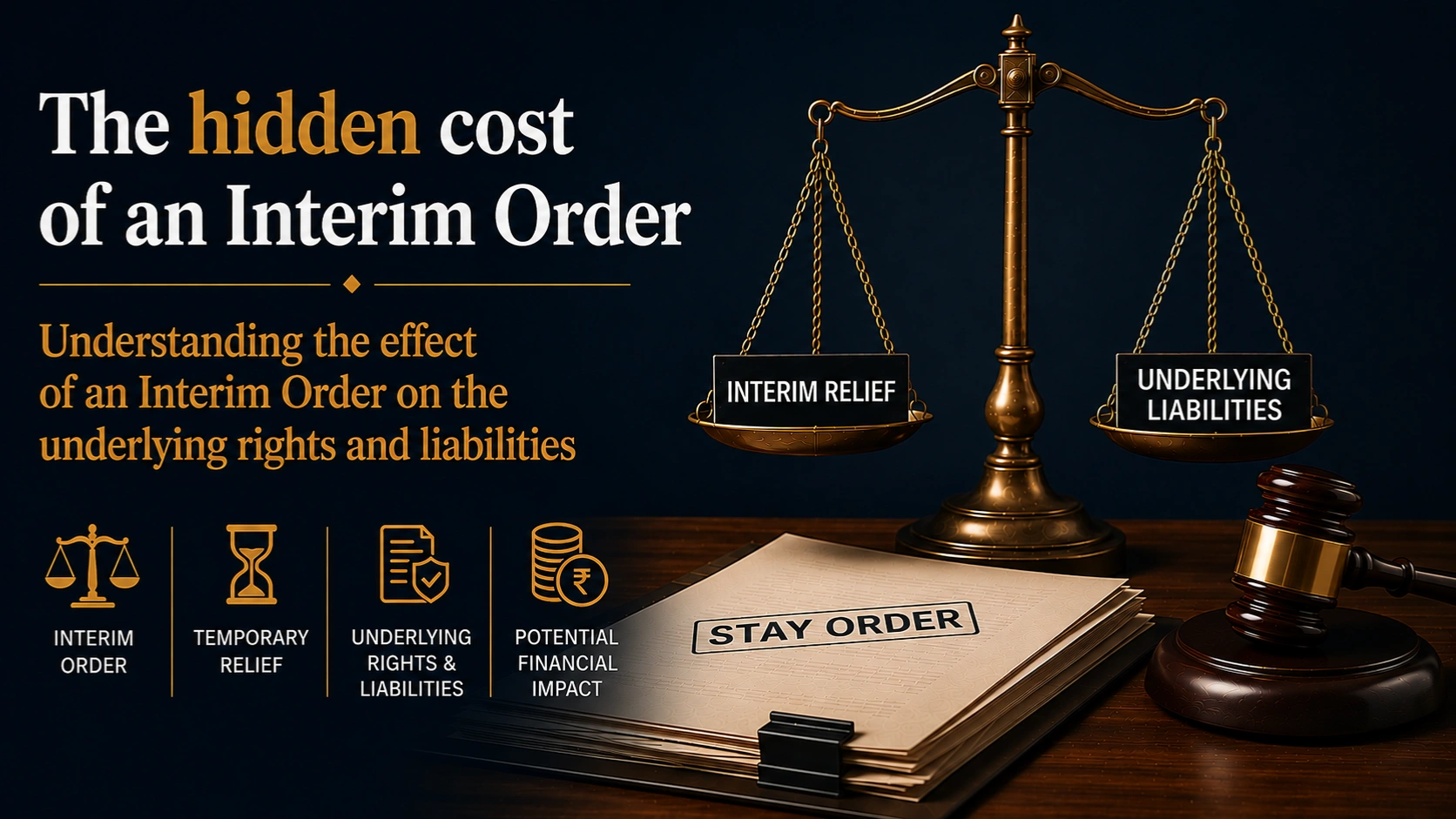
The hidden cost of an interim relief or stay order can thus be summarized in the following manner:
- An interim relief or stay order merely suspends the operation or enforceability of the impugned order or action. It does not quash, obliterate or extinguish the rights and liabilities arising thereunder.
- When the challenge ultimately fails, the liability is not created a fresh. It was existing throughout with the only embargo being on its enforcement.
- An interim order does not confer any independent or vested substantive right upon the party obtaining it. It is conditional upon and subject to the final adjudication of the dispute.
- The doctrine of restitution obligates the court to restore the parties to the position they would have occupied had the interim order not been passed, thereby preventing any unjust enrichment resulting solely from judicial intervention.
- The statutory consequences, which are an incident of the underlying liability, including compensatory interest and other ancillary obligations, continue to accrue during the subsistence of the interim order, unless the governing statute or the court expressly provides otherwise.
Legal consequences flowing from an Interim Relief must be examined in the context of the Statutory framework governing the liability in question
While the above principles constitute the settled legal position, a decision of the High Court of Delhi rendered in 2025, highlighted the importance of examining the consequences of an interim relief in the context of the statutory framework governing the liability in question. In United India Insurance Company Limited v. Competition Commission of India10, the Court was required to decide whether interest can be levied on the monetary penalty due to the Commission for the period when the operation of the penalty was stayed by the Appellate Tribunal.
The Commission imposed a penalty on the Appellant and three other companies for engaging in cartelization. The Appellate Tribunal conditionally stayed the operation of the penalty and ultimately reduced the penalty amount while upholding the finding on contravention. Subsequently, the Commission demanded payment of interest on the delayed payment of the penalty and also passed an order to that effect. The Single Bench of the High Court upheld the demand for interest under Regulation 5 of the Competition Commission of India (Manner of Recovery of Monetary Penalty) Regulations, 2011 (“2011 Regulations”). The Division Bench however set aside the order passed by the Single Bench.
The Division Bench gave due weightage to the statutory preconditions for levy of interest under Regulation 5 of the 2011 Regulations, which according to the court had not been satisfied. The Court held that the liability to pay interest under the 2011 Regulations was not an automatic statutory consequence of the penalty itself, but arose only upon the issuance of a valid demand notice in respect of a recoverable penalty. Since the Appellate Tribunal had stayed the penalty before the demand notice was served, there was no legally recoverable penalty on the date of service. Consequently, the demand notice became inoperative or a ‘dead letter’, and could not trigger liability to pay interest. Under the 2011 Regulations, the Commission was required to withdraw its earlier demand notice and issue a fresh one reflecting the modified penalty. As the reduced penalty was immediately paid, before issuance of a fresh demand notice, there was no delay in payment of any recoverable amount.
The Court distinguished the earlier decisions of the Supreme Court holding that those cases involved situations where liability to pay interest had already arisen or where the stay was ultimately vacated without altering the underlying liability.
The decision of the Division Bench has been challenged before the Supreme Court however, the said challenge is presently pending11.
Conclusion
The jurisprudence governing interim orders has progressively evolved beyond the simplistic proposition that a stay merely suspends the operation of the impugned order. The legal consequences flowing from an interim order cannot be determined in the abstract or by applying a uniform rule. It must necessarily be examined in the context of the statutory framework that creates, regulates and conditions the liability in question. The decision of the High Court of Delhi demonstrates this evolution. It recognises that while an interim stay does not extinguish the underlying rights and liabilities, the consequential obligations, such as interest, depends upon the satisfaction of the statutory requirements for its enforcement.
The ‘hidden cost’ of an interim order, therefore, lies in the fact that an order of stay does not operate in isolation. Its legal consequences are inextricably linked to the nature of the rights and liabilities under challenge and the statutory framework governing them. An interim order neither creates nor extinguishes substantive rights, it merely regulates their enforcement pending adjudication. It is this contextual approach that now marks the evolution of the law on interim relief, one that reconciles the settled doctrine that a stay suspends enforcement without annihilating legal rights, with the equally important principle that the incidents of those rights must ultimately be traced to the statute that creates them, and not to the interim order that temporarily restrains their enforcement.
FAQs
-
What is interim relief under the Civil Procedure Code?
Interim relief refers to a temporary order granted by a court during the pendency of a suit. The Civil Procedure Code provides Courts with the power to grant interim relief in order to protect the rights of the parties. The purpose of interim relief is to prevent irreparable harm, maintain the status quo, and ensure that the final decision of the court is effective.
-
How does an interim order affect the underlying rights and liabilities of the parties?
An interim order does not finally determine the rights and liabilities of the parties. An interim order suspends the operation or enforceability of the impugned order or action until the time period prescribed in t. It does not quash, obliterate or extinguish the rights and liabilities arising thereunder.
-
What is the difference between an interim order, a stay order, and a temporary injunction?
An interim order is a broad term for temporary relief passed by a court during the pendency of a case to protect the rights of the parties or preserve the subject matter of the dispute. Stay order on the other hand is a specific type of interim order that suspends legal proceedings, the execution of a decree, or the operation of an order/action until further directions. Temporary injunction is an interim relief granted under Order XXXIX Rules 1 and 2 of the Civil Procedure Code, that restrains a party from doing a particular act or, directs an act to prevent irreparable harm and maintain the status quo until the final disposal of the suit.
-
Can liabilities and interest continue to accrue during the operation of an interim order?
Yes. Liabilities and interest continue to accrue during the operation of an interim order unless the court expressly directs otherwise. An interim order generally suspends the enforcement of rights or obligations but does not extinguish the underlying legal liability. Therefore, if the final judgment is against the party benefitting from the interim relief, they may be required to pay the accrued interest, costs, or other liabilities subject to the specific directions in the court’s final decision as well as the statute governing such liability.
-
How does Section 144 CPC and the doctrine of restitution apply after an interim order is vacated?
When an interim order is vacated or reversed, Section 144 of the Civil Procedure Code and the doctrine of restitution require the court to restore the parties, as far as possible, to the position they would have occupied had the interim order not been passed. Any benefit gained or loss suffered because of the interim order may be reversed, and the party who received the benefit may be required to return property, money, profits, or pay interest and costs to ensure that no one gains an unjust advantage from a temporary order.
References –
- Neon Laboratories Limited v. Medical Technologies Limited and Others, (2016) 2 SCC 672
- (1992) 3 SCC 1
- Mulraj v. Murti Raghonathji Maharaj, 1967 SCC OnLine SC 260
- 1965 SCC OnLine SC 350
- (2003) 8 SCC 648
- (1997) 5 SCC 772
- supra
- supra
- (2024) 12 SCC 426
- 2025 SCC OnLine Del 8245
- Special Leave Petition (Civil) No. 6199/2026
 You wish to know more about Neeti Niyaman (the “Firm”) for your own information and use.