TECHNOLOGY IN THE SKIES, LAW ON THE GROUND: RISE OF DRONES IN INDIA
By – Asmita Narula and Tannishtha Chatterjee
Table of Contents
Introduction
Drones are no longer rare or unusual in India. They are increasingly being deployed across a wide range of sectors, including agriculture, policing, national defence, and even commercial delivery services. In fact, one can see them being recreationally used in weddings by photographers and by tourists and content creators for travelling. What once appeared to be a novel technological gadget in the hands of a few has now emerged as an integral tool in governance, business operations and public life. Recognising their transformative potential, the Government of India has actively encouraged the adoption and development of drone technology, viewing it as a driver of technological advancement, innovation, and economic growth. As a result, drones are now a frequent sight not only in urban centres but also in rural areas across the country.
The proliferation of drone usage has however also given rise to significant concerns relating to security, privacy, and public safety, while simultaneously presenting complex legal challenges. A drone can fly over private property, hover near residential premises, or enter restricted areas without any individual physically trespassing onto the land, which creates a new challenge from a legal perspective. Recently, an issue has arisen before the Karnataka High Court as to whether a drone can commit criminal trespass. The Punjab and Haryana High Court has expressed serious concerns about increasing use of drones to smuggle drugs across the international borders. Such developments illustrate that while drone technology has advanced at a rapid pace, the legal framework governing its use is still evolving. In light of these emerging legal questions and regulatory developments, the present article examines the various uses of drones, the different categories of drones, the Governmental initiatives aimed at promoting their adoption, and the evolving drone laws regulating their operation in India.
Drones – Classification, Uses, Advantages and Limitations
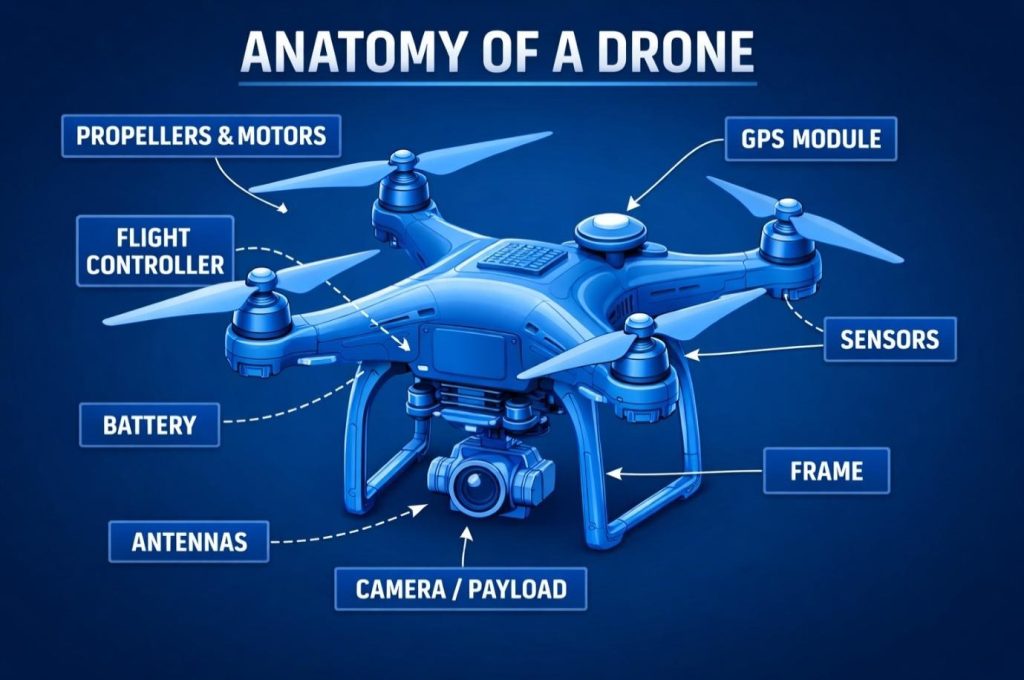
A drone is an Unmanned Aerial Vehicle (“UAV”) / aircraft which operates without an onboard pilot, and it can be controlled remotely, either by a human operator using a controller or autonomously using computers, sensors, etc. A drone is a part of a full Unmanned Aircraft System (“UAS”), which includes the drone itself, an on-ground control system (remote controller, computer or mobile application), and a communication system. The key components of a drone are a Frame (the structure which holds all the other components), Flight Controller (controls the stability), GPS Module (enables navigation), Motors and Propellers (enable lift and movement), Battery (power source), Sensors (gyroscope, accelerometer, barometer etc.) and Camera (for photography).
Source: Image generated using ChatGPT (OpenAI), 2026
Classification of drones
Drones can be classified based on design, size or weight and purpose.
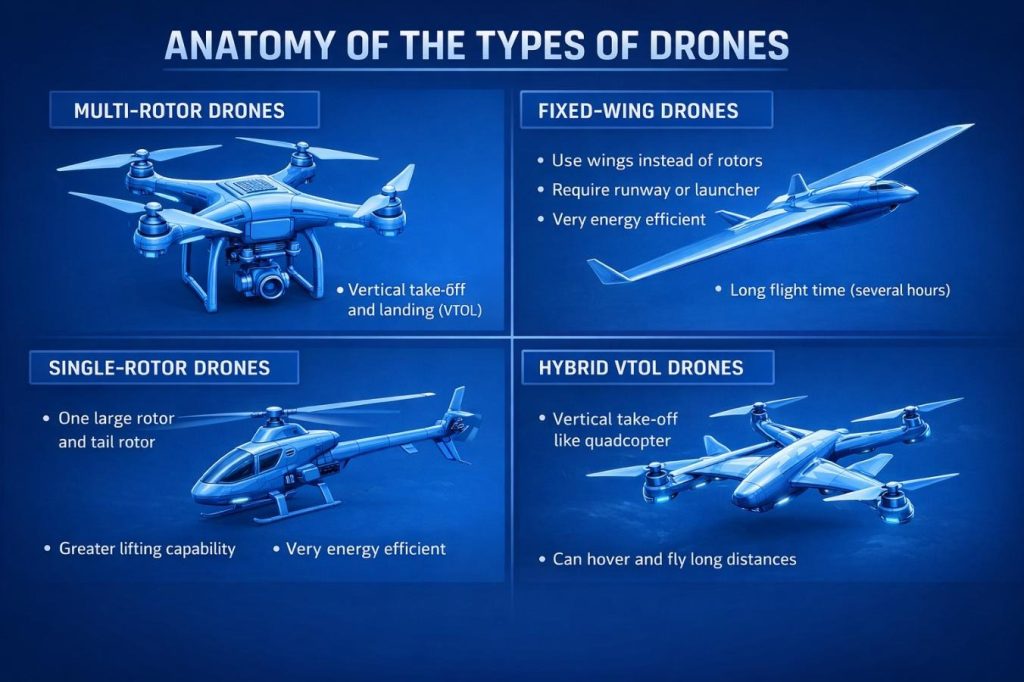
Based on design, drones can be classified in the following categories:
- Multi-Rotor Drones are the most common drones with either 4 rotors (Quadcopters), 6 rotors (Hexacopters) or 8 rotors (Octocopters). These drones have a short flight time of about 20 to 40 minutes and vertical take-off and landing and are highly stable and easy to control. These are often used for photography and videography, surveillance, agriculture spraying, etc.
- Fixed-Wing Drones look like aeroplanes as they have wings instead of rotors. These drones require a launcher, are energy efficient, have a long flight time (several hours) and can cover a large area. These are often used in military, for land and border surveillance and large-scale mapping.
- Single-Rotor Drones look like helicopters with one large rotor and one tail rotor. These drones have a high lifting capacity and are mechanically complex. These are often used for delivery and industrial inspection.
- Hybrid VTOL Drones, which are a combination of multi-rotor and fixed-wing drones. These drones have a vertical take-off and landing and long flight time. These are often used in military and for environment monitoring.
Source: Image generated using ChatGPT (OpenAI), 2026
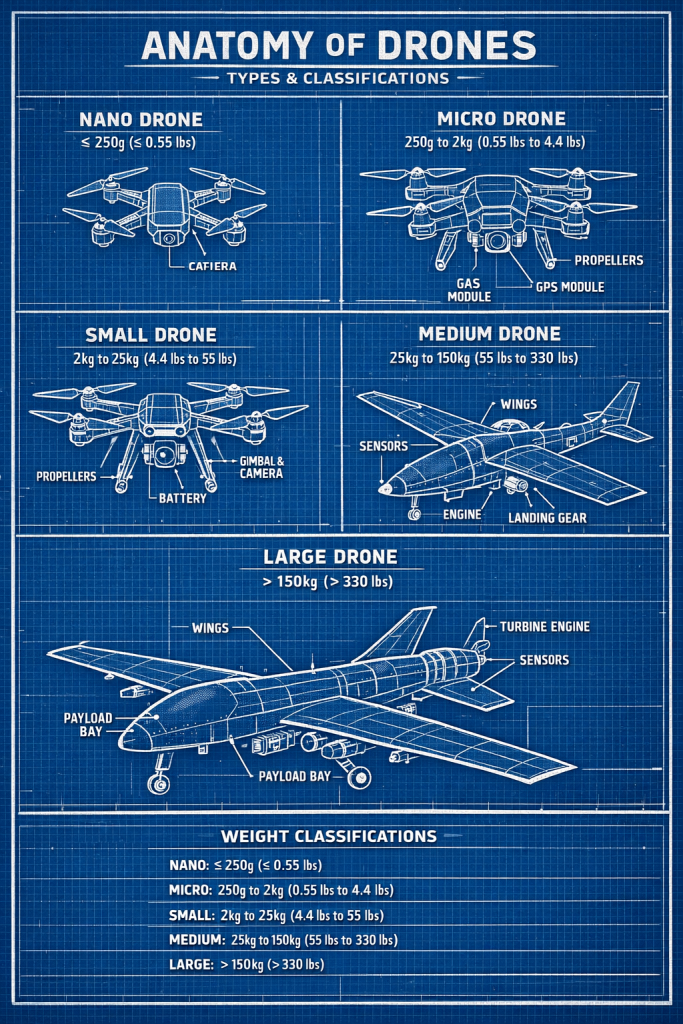
Based on size or weight, drones can be classified in the following categories:
- Nano Drones, which weigh less than or equal to 250 grams
- Micro Drones, which weigh between 250 grams and 2 kg
- Small Drones, which weigh between 2 kg and 25 kg
- Medium Drones, which weigh between 25 kg and 150 kg
- Large Drones, which weigh more than 150 kg
Source: Image generated using ChatGPT (OpenAI), 2026
Based on purpose, drones can be classified in the following categories:
- Military and Defence – Modern warfare, border and surveillance, target tracking and combat operations.
- Agriculture – Crop monitoring, precision pesticide and fertilizer spraying, soil analysis, real-time field data collection, saving chemicals and water, boosting yield, and crop health monitoring.
- Law Enforcement and Urban Management – Traffic surveillance, public safety monitoring, identifying violations, uncovering suspicious behaviour more effectively, and infrastructure inspection, including monitoring railways and highways.
- Photography and filmmaking – Movies and documentaries, real estate, wedding and tourism.
- Delivery and Logistics – Food delivery, medical supply delivery and e-commerce delivery.
- Disaster Management – Finding missing persons, search and rescue operations, mapping disaster areas and monitoring disasters and emergencies such as fires and floods.
Drones offer several advantages such as cost effectiveness and speediness, accessibility to unsafe or inaccessible areas, high-quality data collection, and reduction in human effort. However, there are certain limitations also posed by drones such as privacy invasion, security risks due to misutilisation, limited battery life, lack of human interference, limitations imposed by law and regulations, weather sensitivity etc.
Growth of Drone Usage in India and Government Initiatives
In the recent years, the use of drones in India for multiple purposes has grown rapidly, moving well beyond recreational flying into mainstream commercial and public-service roles. According to official figures, as of February 2026, there are over 38,500 registered drones, 39,890 DGCA-certified remote pilots, and 244 approved training organisations.
With the increase in usage of drone technology worldwide, India has over the years evolved a structured and regulated drone ecosystem which is being deployed in various governance and developments sectors, including but not limited to public service delivery, infrastructure management, agriculture, and national security. Drones in India are being used for land and property surveys, precision agriculture, infrastructure inspection, disaster management, railway and highway monitoring, and defence applications. The Government of India is launching several initiatives to advance the drone ecosystem in the country to enhance innovation and efficiency at every level and to make India a global Drone hub by the year 2030.
In April 2020, the Government launched the Survey of Villages and Mapping with Improvised Technology in Village Areas (SVAMITVA) Scheme, with the objective of conducting drone-based mapping for survey of rural land to settle disputes and improve access to bank credit. Under the scheme, as of February 2026, 3.28 lakh villages have been surveyed using drones, and 2.76 crore property cards have been prepared for 1.82 lakh villages across 31 states. In September 2021, the Ministry of Civil Aviation (“MoCA”) launched the Production-Linked Incentive Scheme (“PLI Scheme”) to encourage the manufacturing of drones and drone components. In November 2023, the Government launched the Namo Drone Didi Scheme with the objective of providing drones to Women Self Help Groups (SHGs) to encourage modern farming practices, including improving efficiency, increasing productivity, reducing costs, and creating sustainable livelihood opportunities for them. The members of these SHGs have also been trained as drone pilots. As of February 2026, 1,094 drones have been distributed to women SHGs, including more than 500 drones under this scheme.
The Ministry of Agriculture & Farmers Welfare has initiated the Sub-Mission on Agricultural Mechanization (SMAM), which aims to promote farm mechanization across India and provide subsidies for agricultural machinery, including for purchasing drones. Financial assistance is being granted for establishment of Custom Hiring Centres (CHCs) to provide machinery (including drones and other new technology) on rent to farmers who cannot afford to purchase the same. Under SMAM, 2122 drones have been approved for distribution from 2023 – 24 to 2025 – 26.
The National Highways Authority of India has made aerial mapping for highway development mandatory for all highway projects and the contractors are required to upload both current-month and prior-month drone footage on the database for monthly comparison. Similarly, the Ministry of Railways has mandated deployment of drones in all zones and divisions to monitor and maintain railway tracks, bridges, and other infrastructure, and the Railway Protection Force has been using drones for security surveillance. The North East Centre for Technology Application and Reach has developed a special drone system to monitor disaster situations such as floods, landslides, etc., which helps rescue teams and make the rescue mission more effective.
In cities like Indore and Mysuru, the police forces have undertaken a ‘digital patrolling’ initiative and have deployed high-resolution drones for traffic surveillance and public safety monitoring, identifying violations etc. India is also using drones to defend the country along with the air defence systems, radar networks, and command centres, by surveilling the borders, gathering intel and carrying out precise strikes. For instance, the most recent example of drones being successfully used during warfare is during Operation Sindoor.
The Ministry of Electronics and Information Technology has launched a project, namely Capacity Building for Human Resource Development in Unmanned Aircraft Systems / Drones & related technology titled as ‘SwaYaan’, to develop the UAS ecosystem in India. The objective is to develop around 40,000+ trained manpower in UAS / Drone & related technology by way of academic, non-formal, research, and knowledge-sharing activities.
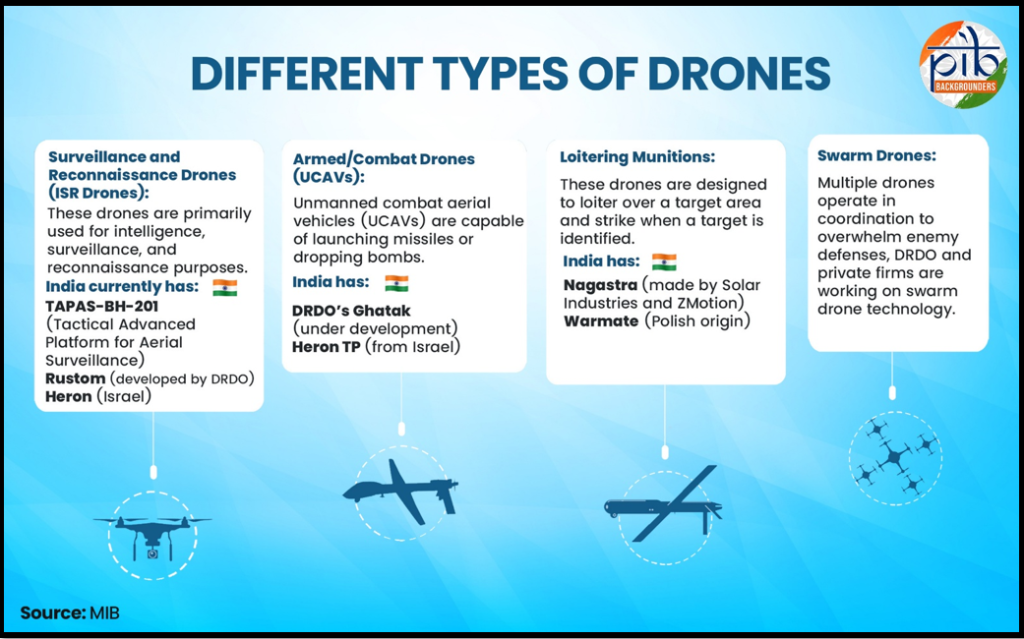
Source: Press Information Bureau (PIB)
Evolution of law in India to regulate the use of drones
With the growing use of drones in India, there was a pressing need for regulation of the same. The use of drones in India is regulated by the Directorate General of Civil Aviation (“DGCA”) and is presently being governed by the Bharatiya Vayuyan Adhiniyam, 2024 (which repealed the Aircraft Act, 1934) (“2024 Act”), along with the Drone Rules, 2021 (as amended from time to time) (“Drone Rules”). The 2024 Act provides the overarching statutory framework for aviation in India, while the Drone Rules specifically deal with UAS.
In October 2014, DGCA issued a public notice banning the launch of any UAS in the Indian Civil Airspace for any purpose whatsoever. This move was necessitated in view of (a) absence of any standards and recommended practices issued by the International Civil Aviation Organisation, (b) potential safety and security issue due to high density of manned aircraft traffic, and (c) lack of regulation, operating procedures and standards, and uncertainty of technology. However, the DGCA notified that it is in the process of formulating globally harmonised drone regulations in India lafor certification and operation of use of UAS.
In November 2017, the Aircraft (Eleventh Amendment) Rules, 2017 were notified by MoCA whereby the definitions of ‘Remote Pilot’, ‘Remote Pilot Station’, ‘Remote Piloted Aircraft’ and ‘Remotely Piloted Aircraft System’ were inserted and it provided for the conditions for operation of Remotely Piloted Aircraft Systems. Simultaneously, MoCA also published the Draft Regulation of Civil Aviation Requirements.
Civil Aviation Requirements issued by DGCA
In August 2018, the DGCA issued the first Civil Aviation Requirements (“CAR”) for regulating the use of drones in India, which came into force with effect from 01.12.2018. The CAR was issued under the provisions of the Aircraft Rules, 1937, which were formulated in exercise of powers under the Aircraft Act, 1934 (now repealed by the 2024 Act). It applied to Civil Remotely Piloted Aircraft Systems (“Civil RPAS”) being remotely piloted from a remote pilot station and laid down the operational restrictions, requirements for obtaining Unique Identification Number (“UIN”) and the exceptions thereto, Unmanned Aircraft Operator Permit (“UAOP”) and the exceptions thereto, security and safety protocols, equipment standards, pilot training requirements and penalties for violations.
Additionally, in November 2018, the Airports Authority of India issued AIP Supplement with effect from 01.12.2018, which provided for the procedure for operation of Civil RPAS in Indian Airspace with the objective of implementing the CAR within the air traffic management and airspace framework of India. It establishes the procedure for interaction with the Air Traffic Control (“ATC”), airspace usage rules, flight plan requirements, airspace classification and restrictions and operational approval through the ‘Digital Sky Platform’. This is an online platform launched in December 2018 for regulation and management of UAS in India, which enables automated and transparent drone governance.
In June 2020, the MoCA published the Draft Unmanned Aircraft System Rules, 2020 (“UAS Rules”), subsequent to which the UAS Rules 2021 were notified in March 2021 and later superseded by the Drone Rules. The UAS Rules 2021 provided for several restrictions on the use of drone, including restrictions on the altitude and the speed, despite obtaining the required permissions and licences. Several areas were included under the list of ‘Prohibited Area’.
Drone Rules, 2021
In August 2021, the MoCA notified the Drone Rules (amended in February 2022 and September 2023), which have been implemented through the DGCA. These Rules have replaced the earlier regulatory framework governing UAS in India and have liberalised the entire framework in the country. In September 2021, the Drone Airspace Map was published which opened up nearly 90% of Indian airspace as Green Zone for drone flying up to 400 feet.
The key features of the Drone Rules are as follows:
- The Rules apply to all persons who own, operate, lease, possess, transfer, or maintain drones in India, all drones registered in India and those operating in or above Indian territory, except the drones used by armed forces and drones weighing more than 500 kg.
- Drones have been classified by type (Aeroplane, Rotorcraft and Hybrid drones), which have been further classified into RPAS, Model RPAS and Autonomous UAS, and by size / weight (Nano, Micro, Small, Medium and Large), which is relevant for licensing, registration, and operational requirements.
- Unless exempted, all drones must be registered on the Digital Sky Platform and assigned a UIN before operation, and all drones (except for nano drones and model RPAS used for research or recreation) must obtain a Type Certificate from the DGCA.
- “No Permission – No Takeoff” (NPNT) feature and other safety features such as real-time tracking beacon and geo-fencing capability have been introduced.
- Airspace has been divided in 3 zones – (1) Green Zone (generally up to 400 feet in uncontrolled airspace and drones can operate without prior permission subject to exclusions), (2) Yellow Zone (permission is required from ATC authorities) and (3) Red Zone (highly restricted and operation is allowed only with Central Government approval).
- Operators have to verify airspace status through Digital Sky Platform prior to each flight.
- Operators were earlier required to obtain a Remote Pilot Licence (RPL) from an authorised training organisation, except for nano drones and micro drones used for non-commercial purposes. However, after the 2022 amendment, a Remote Pilot Certificate from the organisation is sufficient.
- Remote Pilot Training Organisations (RPTO) must obtain authorization from DGCA, follow prescribed training curriculum and maintain the requisite infrastructure and instructors.
- The Rules provide for a UAS Traffic Management (UTM) framework, which coordinates drone operations in airspace, integrates drones with manned traffic and enables safe drone corridors for cargo transport.
- Drone operations are subject to third-party insurance requirements under the Motor Vehicles Act, 1988, with modifications, except for nano drones.
- These Rules provide for penalties of up to Rs. 1,00,000 for violations and flying in restricted zones may even constitute a cognizable offence. DGCA has been empowered to suspend or cancel licences and authorizations.
- By way of the 2023 amendment, the requirement of a passport for pilot certification was removed and replaced with any Government-issued ID.
In the year 2021, the DGCA launched eGCA, which is a single window platform to provide transparency, accountability and ease of doing business. Gradually, by July 2025, regulatory services such as drone registration, Remote Pilot Certification, Type Certificate and RPTO authorisation were shifted from Digital Sky Platform to eGCA however, operational services such as flight plan and airspace map continues to be integrated with the Digital Sky Platform.
Draft Civil Drone (Promotion and Regulation) Bill, 2025
Recently, in September 2025, the Ministry of Civil Aviation has published the Draft Civil Drone (Promotion and Regulation) Bill, 2025 for public consultation. The proposed legislation seeks to replace the Drone Rules with a comprehensive legal framework for drones, including stricter compliances, accountability and penalties.
Growing legal concerns and recent events
In Odisha, several individuals have been caught operating drones over the Jagannath Temple in Puri, which has been declared as a “Red Zone” by the DGCA until September 2028 as it is a high security area. Additionally, the administration has also prohibited drone activity around that area. In January 2023, the Odisha High Court denied anticipatory bail to a freelance tourist and a YouTube blogger for his alleged involvement in offences inter alia under Section 10 of the Aircraft Act, 1937 for flying a drone over the temple premises during his visit. Since the year 2024, multiple drones have been seized by the police which were being operated over the temple and in January and February 2026, cases have been registered against individuals for flying a drone over the temple.
In the recent years, there has been growing concern over smuggling of drugs using drones. In December 2022, the Punjab and Haryana High Court rejected the anticipatory bail of a person accused of smuggling drugs into Punjab from Pakistan, wherein drones were also being used. The Court observed that the investigating agencies must be given complete latitude in investigating such cases with the increased use of drones to transport drugs and weapons cross-border. In December 2024, in another case involving smuggling of drugs using drones, the Court rejected the regular bail of the accused, while observing that the manner in which the drugs were being smuggled using drones highlights the sophisticated network being used which demands a resolute and uncompromising response. In September 2025, the Court rejected the anticipatory bail of the accused who was involved in smuggling of drugs using drones. The Court observed that the cross-border smuggling of illicit drugs through drones has been steadily increasing these days, which poses a grave threat not only to the security of the nation but also impacts the youth of the nation. There are several such other cases where drugs are being smuggled using drones.
Can drones commit criminal trespass?
In February 2026, an interesting issue arose before the Karnataka High Court in the matter titled NewSpace Research and Technologies Pvt. Ltd. vs State of Karnataka, W.P. No. 3862/2026, arising from Crime No. 24/2026 registered by P.S. Doddaballapura Rural under Section 447 of the Indian Penal Code, 1860, wherein one of the licenced research drones of the company allegedly drifted into the adjoining private property during a routine test flight due to a mid-flight battery malfunction. The drone was being operated within the ‘Green Zone’ i.e., the company’s facility in Doddaballapura, under valid authorization from the DGCA in compliance with the Drone Rules. Despite the absence of any reported damage, injury, or any complaint from the landowner, the police suo motu invoked the provision of criminal trespass alleging that the drone had trespassed into private property. The company approached the High Court seeking quashing of the FIR.
After hearing the arguments of the parties, the High Court observed that this case projects a unique crime as it has been registered against an inanimate object and criminal trespass has been alleged against a drone. While directing the concerned police officer to file a response affidavit to the Petition, the Court granted an interim stay on the investigation of Crime No. 24/2026 vide order dated 06.02.2026, which was continued thereafter. As per the recent update on the official website of the High Court, the Petition has been allowed on 24.02.2026 however, a copy of the order or the judgment has not been uploaded yet.
Section 441 of the Indian Penal Code, 1860 defines criminal trespass as “Whoever enters into or upon property in the possession of another with intent to commit an offence or to intimidate, insult or annoy any person in possession of such property, or having lawfully entered into or upon such property, unlawfully remains there with intent thereby to intimidate, insult or annoy any such person, or with intent to commit an offence, is said to commit criminal trespass”. The same definition has been retained under Section 329 of the Bharatiya Nyaya Sanhita, 2023. Therefore, under both the statutes, the offence hinges on two essential elements – entry into a property in possession of someone else and the presence of criminal intent, both of which must co-exist simultaneously.
The provision, as it stands today, is a pre-digital era provision and is meant to deal with situations which involve entry in another’s property by a person and not by an inanimate object. The language of the provision begins with the words “Whoever enters”, which necessary presupposes (i) a human capable of forming an intention and (ii) conscious act of entry into property. When this provision was enacted, the legislature did not contemplate a situation as had arisen before the Karnataka High Court. A drone is an inanimate technological device / object, which cannot independently form an intention to commit an offence or otherwise. Now, in these circumstances, whether a drone can commit the offence of criminal trespass or whether such liability can be imposed on the person who owns the drone or is operating the drone is yet to be tested in Court. Further, whether the hovering or landing of a drone on a private property would constitute “entry” in terms of the provision also requires consideration. The Courts will also have to consider whether the police has jurisdiction to deal with such situations when the use of drones in India is governed solely by the Drone Rules.
Conclusion
The rapid rise of drone technology in India reflects a broader technological transformation that is reshaping governance, commerce, and everyday life. From agriculture and infrastructure monitoring to defence, disaster management, and content creation, drones are increasingly becoming an indispensable tool across various sectors. Recognising this potential, the Government has taken several policy decisions and launched multiple initiatives to encourage innovation and technological advancement, while simultaneously attempting to regulate the usage of the same. The widespread use of drones however raises complex legal and regulatory questions as well, which are yet to be tested by the Courts. Issues relating to privacy, national security, cross-border smuggling, misuse in sensitive areas, and liability for drone-related incidents are increasingly coming before Courts and law enforcement agencies. The recent proceedings before the Karnataka High Court illustrate how the statutes, many of which were drafted in a pre-digital era, are now being tested by emerging technologies. As drone usage continues to grow, the legal framework governing them must evolve to address these emerging concerns without stifling innovation and technological advancement. The proposed Civil Drone (Promotion and Regulation) Bill, 2025 indicates that the legislature is actively considering a more comprehensive statutory regime for drones in India. Going forward, the challenge for policymakers will be to strike a careful balance between enabling technological growth and ensuring safety, accountability, and protection of individual rights. The law must remain adaptive, ensuring that while technology continues to rise in the skies, the rule of law remains firmly grounded.
FAQs
-
What are the current drone laws in India?
Drone operations in India are regulated by the Directorate General of Civil Aviation (DGCA) under the Drone Rules, 2021, which have undergone further updates in recent years. The regulatory framework seeks to balance technological innovation with safety by laying down structured guidelines for the operation and management of drones. Key features of the regime include mandatory registration of drones, digital approval for operations through the Digital Sky platform, clearly demarcated no-fly zones, and penalties for non-compliance. The framework generally applies to drones with an all-up weight ranging from 250 grams to 500 kilograms.
-
What are the different categories of drones based on weight in India?
Under the Drone Rules, 2021, drones are classified primarily on the basis of their weight, which determines the level of regulatory compliance required. The categories include Nano drones, weighing up to 250 grams; Micro drones, weighing more than 250 grams but not exceeding 2 kilograms; Small drones, weighing more than 2 kilograms but not exceeding 25 kilograms; Medium drones, weighing more than 25 kilograms but not exceeding 150 kilograms; and large drones, weighing more than 150 kilograms.
-
What is the Digital Sky Platform and how does it regulate drones in India?
The Digital Sky Platform is an online portal maintained by the Directorate General of Civil Aviation (DGCA) that serves as the central system for regulating drone operations in India. It operationalises the “No Permission, No Take-off” (NPNT) principle by requiring operators to obtain necessary approvals before conducting any flight. Through this platform, drones are registered and assigned a Unique Identification Number (UIN), remote pilot certifications are processed, and flight permissions are granted.
-
What are the key features of the Drone Rules, 2021 in India?
The Rules apply to drones with an all-up weight of up to 500 kg, thereby increasing the earlier regulatory limit of 300 kg, and classify drones into five categories- nano, micro, small, medium, and large-based solely on weight, with earlier criteria such as maximum speed and altitude being removed. The Digital Sky Platform, maintained by the Directorate General of Civil Aviation (DGCA), functions as a single-window portal for registration, certification, and operational permissions, mandating that all drones be registered and assigned a Unique Identification Number (UIN) prior to operation. Manufacturers are required to obtain a Type Certificate for each drone model through authorised entities such as the Quality Council of India, following which individual drones must secure a UIN before use. Remote Pilot Certificates are mandatory for operators, except in the case of nano drones or micro drones used for non-commercial purposes. The Rules also introduce an airspace classification system comprising green, yellow, and red zones, with prior permissions required for operations in restricted areas, while granting certain exemptions to research institutions, start-ups, and educational bodies conducting testing in controlled green zones. Additionally, third-party insurance requirements akin to those under the Motor Vehicles Act, 1988 apply to drone operations, and the government has proposed the establishment of an Unmanned Aircraft System Promotion Council to foster the growth of the drone ecosystem in India, with areas such as beyond visual line-of-sight operations, drone swarms, and delivery systems remaining subject to future regulatory development.
-
In which sectors are drones commonly used in India?
In India, drones are increasingly deployed across multiple sectors. They are widely used in agriculture for spraying pesticides and fertilisers, in defence and surveillance for monitoring activities, and in infrastructure inspection to oversee assets such as roads, railways and power lines. Drones are also being explored for logistics and delivery services. With growing government support and a more enabling regulatory framework, their applications have expanded to include disaster management, mining operations, three-dimensional land mapping, and urban surveying.
References –
- Directorate General of Civil Aviation
- Press Release titled “India’s Drone Ecosystem” issued by the Press Information Bureau on 17.02.2026
- Press Release titled “India’s Drone Ecosystem” issued by the Press Information Bureau on 17.02.2026
- Press Release titled “India’s Drone Ecosystem” issued by the Press Information Bureau on 17.02.2026
- Press Release titled “Incentive of Rs. 120 crore has been provided for Indian manufacturers of drone and drone components under PLI Scheme” issued by the Press Information Bureau on 09.12.2021
- Press Release titled “India’s Drone Ecosystem” issued by the Press Information Bureau on 17.02.2026
- Press Release titled “Government Promotes AI and Drone Technologies to Boost Agricultural Productivity and Farmer Livelihoods” issued by the Press Information Bureau on 16.12.2025
- Press Release titled “India’s Drone Ecosystem” issued by the Press Information Bureau on 17.02.2026
- Press Release titled “Operation Sindoor demonstrated operational effectiveness and strategic value of indigenous Unmanned Aerial Vehicles & Counter-Unmanned Aircraft Systems, says Chief of Defence Staff” issued by the Press Information Bureau on 16.07.2025
- Came into effect on 01.01.2025
- Aircraft Act, 1934
- Public Notice dated 07.10.2014 issued by the Directorate General of Civil Aviation (DGCA)
- Aircraft (Eleventh Amendment) Rules, 2017
- Press Release titled “Draft Regulation of CAR on Civil Use of Drones Announced” issued by the Press Information Bureau on 02.11.2017
- Requirements for Operation of Civil Remotely Piloted Aircraft System (RPAS) issued on 27.08.2018 by the office of the Director General of Civil Aviation
- Aircraft Rules, 1937
- AIP Supplement No. 164/2018 dated 30.11.2018 issued by the Airports Authority of India
- Press Release titled “Digital Sky Platform launched – India to start registration of drones, pilots, and operators Registration portal for online permission” issued by the Press Information Bureau on 01.12.2018
- Draft Unmanned Aircraft System Rules, 2020
- Unmanned Aircraft System Rules, 2021
- Drone Rules, 2021
- Drone (Amendment) Rules, 2022
- Drone (Amendment) Rules, 2023
- Press Release titled “Ministry of Civil Aviation releases India’s airspace map for drone operations” issued by the Press Information Bureau on 24.09.2021
- Draft Civil Drone (Promotion and Regulation) Bill, 2025
- Animesh Chakraborty v. State of Odisha, ABLAPL No. 16622/2022, Order dated 05.01.2023 (SLP filed against this order before the Supreme Court became infructuous as the Petitioner was taken into custody)
- Gurmeet Singh v. State of Punjab, CRM-M-30966-2022 (O&M), Order dated 21.12.2022 (SLP against this order before the Supreme Court was dismissed)
- Sher Singh v. State of Punjab, CRM-M-54048/2024, Order dated 06.11.2024
- Robert Masih v. State of Punjab, CRM-M-20005/2025, Order dated 22.09.2025
- https://www.barandbench.com/news/litigation/can-a-drone-commit-criminal-trespass-karnataka-high-court-to-examine
- Punishment for criminal trespass.- Whoever commits criminal trespass shall be punished with imprisonment of either description for a term which may extend to three months, or with fine which may extend to five hundred rupees, or with both.
- Case Status from the official website of Karnataka High Court


 You wish to know more about Neeti Niyaman (the “Firm”) for your own information and use.