The Doctrine of ‘Unjust Enrichment’: application in the power sector
By – Debasmita Goswami and Jane Kapai
Table of Contents
Introduction
The law of unjust enrichment is concerned with situations where a party is enriched at the expense of another in circumstances which the law recognises as unjust. One’s enrichment is a pre cursor to a claim for unjust enrichment and until such enrichment is identified, its return cannot be claimed. This principle was first given a formal recognition in 1991 by the House of Lords in the case of Lipkin Gorman Vs. Karpnale1.
Restitution is a remedy for unjust enrichment.2 It can be defined as something which a reasonable person would consider to be of value.3 The word ‘restitution’ in its etymological sense means restoring to a party on the modification, variation or reversal of a decree or order, what has been lost to him in execution or decree or order or the court or in direct consequence of a decree or order. The term ‘restitution’ is used in three senses:
- Return or restoration of some specific thing to its rightful owner or status;
- Compensation for benefits derived from a wrong done to another;
- Compensation for the loss caused to another.4
In the case of Dargamo Holdings Ltd. & Anr. Vs. Avonwick Holdings Ltd. and Others5 it was observed by the England and Wales Court of Appeal that the purpose of a claim in unjust enrichment is to correct a normatively defective transfer of value from the Claimant to the Defendant, usually by restoring the parties to their pre-transfer positions.6
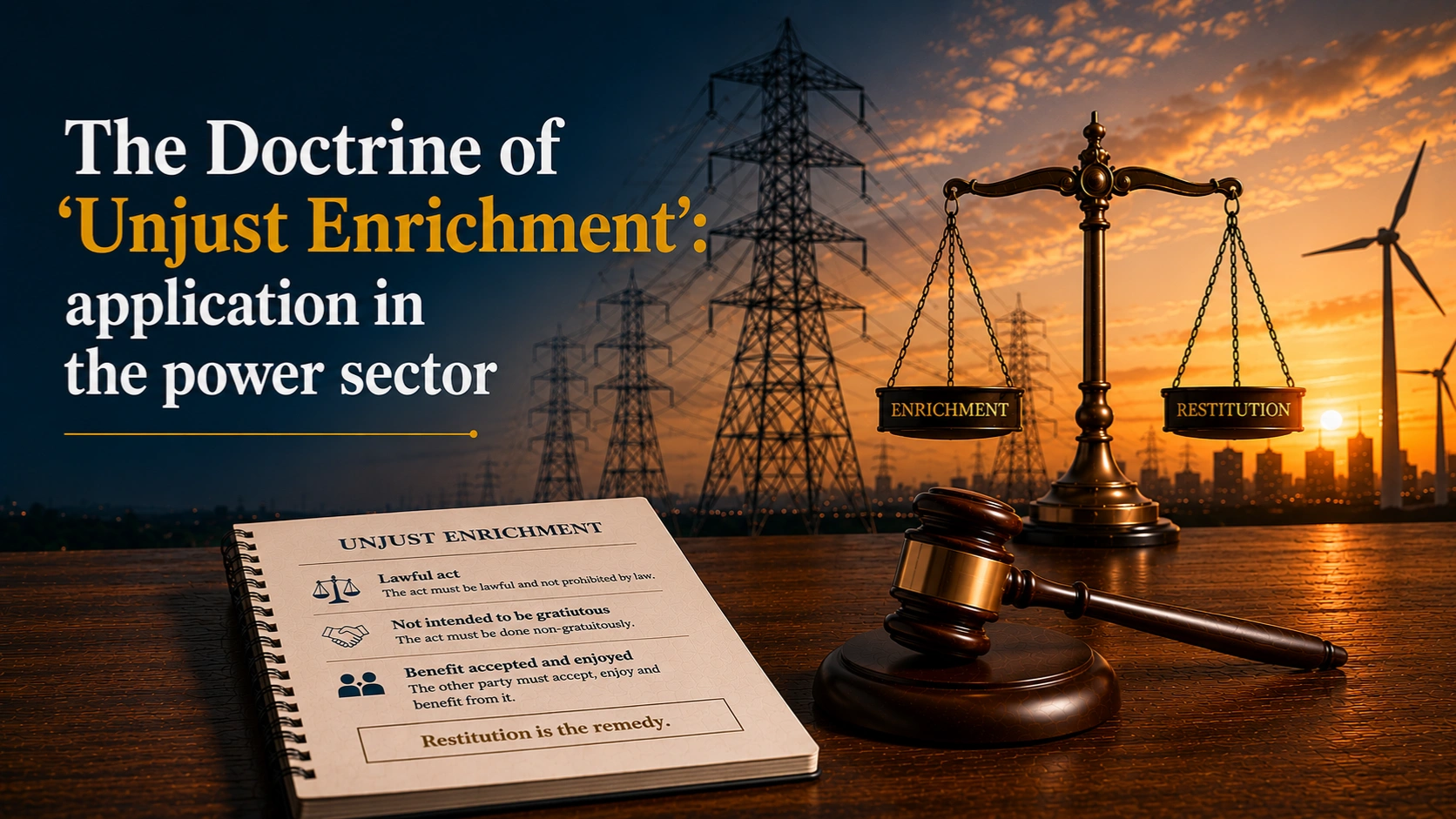
Section 70 of the Indian Contract Act, 1872 recognises that where a person lawfully does anything for another person, or delivers anything to him, not intending to do so gratuitously, and such other person enjoys the benefit thereof, the latter is bound to make compensation to the former in respect of, or to restore, the thing so done or delivered. In this regard Supreme Court of India in the case of Mulamchand Vs. State of M.P.7 has observed that if the conditions imposed by Section 70 of the Indian Contract Act are satisfied then the provisions of that section can be invoked by the aggrieved party to the void contract. The first condition is that a person should lawfully do something for another person or deliver something to him; the second condition is that in doing the said thing or delivering the said thing he must not intend to act gratuitously and the third condition is that the other person for whom something is done or to whom something is delivered must enjoy the benefit thereof. If these conditions are satisfied, Section 70 imposes upon the latter person the obligation to pay compensation to the former in respect of, or to restore, the thing so done or delivered.
Emphasis on regulatory compliance and existence of a lawful act: Applicability in the power sector
In Kamachi Sponge & Power Corporation Ltd. Vs. TANGEDCO & Ors.8 the captive generating plant, synchronized its first unit on 21.10.2011 and injected approximately 23.03 lakh units of electricity into the grid during the period between synchronization, declaration of commercial operation, and grant of open access. Although the generator had requested distribution company to purchase the energy, no Energy Purchase Agreement was ever executed, no approval for sale of such power was granted, and the injections were made without any scheduling or clearance from the State Load Despatch Centre (“SLDC”). Further, the connectivity approval and the subsequent open-access approval issued by State Transmission Utility (“STU”) expressly stipulated that the generator was not to inject power into the grid except in accordance with the approved framework and that any excess energy injected without a valid contractual arrangement would not be accounted for payment.
Rejecting the generator’s claim for compensation, including its reliance on principles of unjust enrichment, Appellate Tribunal for Electricity (“APTEL”) held that the entire quantum of electricity injected during the disputed period constituted as unauthorised injection. APTEL emphasised that the applicable regulatory regime required a valid contractual arrangement, together with SLDC scheduling and approval, before power could lawfully be injected and claimed for payment. In the absence of such approvals and agreements, the mere fact that generator had physically received and utilised the electricity did not create an entitlement to compensation. APTEL accordingly held that no payment was due and affirmed the principle that a generator cannot claim remuneration for electricity injected into the grid outside the sanctioned contractual and regulatory framework.
Similarly, in Renew Wind Energy (AP) Private Limited Vs. Karnataka Electricity Regulatory Commission & Ors.9, the generating company commissioned an 18 MW wind project on 29.06.2013 and obtained only a provisional interconnection approval, which expressly stated that it provided mere technical connectivity, that injection of power without a contractual arrangement was impermissible, and that prior approval of the SLDC was required before any power could be injected into the grid. Notwithstanding these conditions, the generator injected energy from the date of commissioning and subsequently sought compensation for the period from 29.06.2013 to 08.08.2013, invoking Section 70 of the Indian Contract Act, 1872 and contending that the distribution licensees had received, consumed and benefited from the electricity. The claim related specifically to the initial 30-day period following its open-access application, before execution of the Wheeling and Banking Agreement (“WBA”). APTEL rejected the claim and held that the generator had injected power in clear disregard of the conditions governing interconnection and grid operation. It was observed that where a generator voluntarily supplies electricity despite being aware of the applicable restrictions, the equitable principles embodied under Section 70 cannot be invoked to seek compensation merely because electricity was absorbed by the grid. This act of the generator cannot be termed as lawful as the distribution licensees had no other choice but to absorb the power so pumped by the generator into the grid. The Tribunal thereby held that no liability could be fastened upon the distribution licensees for energy injected unilaterally as power so injected without their knowledge has to be absorbed instantly and cannot be rejected.
Construction of a Quasi-Contract
Discernibly, in Green Energy Association Vs. Maharashtra Electricity Regulatory Commission & Ors.10, a case arose out of DISCOM’s prolonged and unexplained delays in processing open-access applications and issuing credit notes to a number of solar generators. Although the generators had applied for open access and sale of power, the DISCOM neither processed the applications within the timelines prescribed by its own Citizen Charter nor took timely decisions on power procurement. In the meantime, the generators continued to inject electricity into the grid. DISCOM accepted the power, utilized it for supply to consumers, and derived corresponding revenue from such supply. The generators accordingly sought compensation on the basis that the DISCOM could not retain the benefit of electricity received and consumed without paying for it.
Drawing inference from the Green Energy Association judgment APTEL in the case of Greenko Maha Wind Energy Pvt. Ltd. Vs. Maharashtra Electricity Regulatory Commission & Ors.11 has given similar observation affirming the principle of unjust enrichment wherein it had granted compensation to the generator for the power injected by it into the grid from the date of its commissioning till the date of disconnection even in the absence of a valid Energy Purchase Agreement. APTEL further observed that the generator was entitled to the credit notes from the DISCOM for the energy supplied till its disconnection.
Unlike the case of Kamachi Sponge and Renew Wind Energy, APTEL did not dismiss the claim on the ground that the absence of an Energy Purchase Agreement or open-access approval the injection of power was by itself fatal or unlawful. Instead, APTEL expressly examined the concepts of quasi-contract, unjust enrichment, and Section 70 of the Indian Contract Act, relying on the Supreme Court judgment in State of West Bengal Vs. B.K. Mondal & Sons12 as well asMulamchand Vs. State of M.P.13 and observed that the parties’ conduct, continued supply of electricity by the generators and its acceptance, utilization and monetization by DISCOM could give rise to obligations resembling those created by contract. APTEL noted that DISCOM had provided connectivity, had never objected to the injections, had utilized the energy, and had financially benefited from it. Accordingly, APTEL held that the generators were entitled to compensation for the electricity supplied, treating DISCOM’s conscious acceptance, utilization and monetization of the energy as giving rise to a restitutionary obligation under Section 70 of the Indian Contract Act, 1872. APTEL thus recognized that, even in the absence of a concluded contractual arrangement, the law would imply a quasi-contractual duty to pay where one party has non-gratuitously conferred a benefit and the other has knowingly enjoyed and profited from it.
Unenforceability of the contractual agreement distinguished from unlawfulness of the supply
APTEL, in a recent judgment dated 07.07.2026 in Vibrant Greentech India Pvt. Ltd. Vs. APERC & Ors.14, similarly considered an important observation with respect to Section 70 of the Indian Contract Act, 1872 and the doctrine of unjust enrichment. In the impugned order, the State Commission held that the Power Purchase Agreement executed between the generator and the DISCOM was unenforceable because it had never been placed before the State Electricity Commission and had thereby not received its approval. Nevertheless, the Commission held that compensation was payable for the electricity supplied and consumed.
APTEL affirmed the finding that the Power Purchase Agreement was unenforceable for want of regulatory approval, and equally affirmed the State Commission’s finding allowing compensation under Section 70 of the Contract Act, reasoning that Section 70 is designed to operate precisely where an enforceable contract is absent; that a claim under Section 70 survives the invalidity of the underlying contract; and that once a benefit is voluntarily accepted and enjoyed, an independent obligation to compensate may arise notwithstanding the unenforceability of the contractual arrangement. APTEL noted that DISCOM had itself executed the Power Purchase Agreement, permitted synchronization of the project, allowed evacuation of power, recorded the injected energy through jointly signed meter readings, and continuously received and utilized the electricity without objection.
Distinguishing Kamachi Sponge and Renew Wind Energy, APTEL emphasised that those cases involved either no contractual arrangement at all or express regulatory prohibitions in the open-access grant against injection without prior approval, whereas the generator operated pursuant to a formally executed Power Purchase Agreement that was acted upon by the utility for several years before its unenforceability was asserted. The Tribunal expressly held that the subsequent finding that a Power Purchase Agreement is unenforceable does not retrospectively render the underlying supply of electricity “unlawful” for the purposes of Section 70, particularly where the generation, synchronization and injection of power were not prohibited by law and the benefit was knowingly accepted and enjoyed by the distribution licensee. On that basis, it upheld the Commission’s award of compensation under Section 70, holding that the provision exists to prevent unjust enrichment where electricity has been supplied non-gratuitously and voluntarily received.
Conclusion
Tested against the three conditions laid down by the Supreme Court in State of West Bengal Vs. B.K. Mondal & Sons15 as well asMulamchand Vs. State of M.P.16, the APTEL decisions discussed above show a consistent application of the same test to differing facts, rather than any shift in the Tribunal’s understanding of Section 70. In Kamachi Sponge and Renew Wind Energy, the first condition that the act itself be lawful was never satisfied: the injection of power was factually restrained by the terms of the connectivity and open-access approvals, which expressly prohibited injection without a contractual arrangement and prior SLDC consent, and the licensees’ absorption of power that could not be stored was compelled rather than voluntary. The act of injection was therefore unlawful from its inception, and no subsequent conduct of the licensee could cure that defect or find a claim under Section 70. In Green Energy Association, and Greenko Maha Wind Energy Pvt. Ltd by contrast, all three conditions stood satisfied, the generators’ supply was not prohibited but merely awaited a delayed approval of open access applications, supply was plainly non-gratuitous, and DISCOM’s continued, unobjected-to receipt and monetisation of the power amounted to voluntary acceptance and enjoyment of its benefit. In Vibrant Greentech, the same three conditions were again satisfied whereby there was no prohibition on the act of injection at any point, the supply proceeded under a formally executed Power Purchase Agreement that both parties treated as valid and acted upon for three years.
These decisions illustrate that Section 70 is itself intended to operate in situations where no enforceable contract exists, provided the act was lawfully done, was not intended to be gratuitous, and the benefit thereof was accepted and enjoyed by the other party but the first of these conditions, that the act itself be lawful and not prohibited by law, remains indispensable. Therefore, in order to apply the doctrine of unjust enrichment it must be established that a person should lawfully do something for another person or deliver something to him, that in doing the said thing or delivering the said thing he must not intend to act gratuitously; and that the other person for whom something is done or to whom something is delivered must enjoy the benefit thereof.
FAQs
-
What is the Doctrine of Unjust Enrichment under Indian Law?
Unjust enrichment means where a person lawfully does anything for another person, or delivers anything to him, not intending to do so gratuitously, and such other person enjoys the benefit thereof, the latter is bound to make compensation to the former in respect of, or to restore, the thing so done or delivered. In order to apply the doctrine of unjust enrichment it must be established that the Defendants/Respondents have been enriched by the receipt of a “benefit”; the enrichment is “at the expenses of the Plaintiff” and the retention of the enrichment is unjust.
-
How does Section 70 of the Indian Contract Act 1872 apply to power sector disputes?
APTEL has consistently interpreted Section 70 of the Indian Contract Act, 1877 as embodying the equitable doctrine of unjust enrichment, holding that a person who knowingly accepts and enjoys the benefit of electricity supplied lawfully and non-gratuitously cannot retain such benefit without compensating the supplier. While the Tribunal has denied restitution where the supply was in breach of the applicable regulatory framework, or where the injection of electricity was expressly prohibited and thereby unlawful, it has recognised compensation under Section 70 even in the absence of an enforceable PPA where the electricity was voluntarily accepted, utilised and the recipient derived a corresponding benefit without any objection whatsoever.
-
Can a power generator claim compensation for electricity supplied without a PPA?
Yes, a power generator can claim compensation for electricity supplied without a PPA under the doctrine of unjust enrichment. APTEL in the case of Vibrant Greentech India Pvt. Ltd. Vs. APERC & Ors.17 APTEL affirmed the finding that the PPA was unenforceable for want of regulatory approval, and equally affirmed the State Commission’s finding allowing compensation under Section 70 of the Contract Act, reasoning that Section 70 is designed to operate precisely where an enforceable contract is absent; that a claim under Section 70 survives the invalidity of the underlying contract; and that once a benefit is voluntarily accepted and enjoyed, an independent obligation to compensate may arise notwithstanding the unenforceability of the contractual arrangement.
-
What is the role of Quasi Contract in electricity supply disputes?
APTEL in plethora of cases has expressly examined the concepts of quasi-contract, and unjust enrichment relying on the Supreme Court judgments in the State of West Bengal Vs. B.K. Mondal & Sons18 as well as Mulamchand Vs. State of M.P.19 For instance in the case of Green Energy Association Vs. Maharashtra Electricity Regulatory Commission & Ors.20, APTEL observed that the continuous supply of electricity by the generators and its acceptance, utilization and monetization by DISCOM could give rise to obligations resembling those created by contract. APTEL noted that DISCOM had provided connectivity, had never objected to the injections, had utilized the energy, and had financially benefited from it. APTEL held that the generators were entitled to compensation for the electricity supplied, treating DISCOM’s conscious acceptance, utilization and monetization of the energy as giving rise to a restitutionary obligation under Section 70 of the Indian Contract Act, 1872.
-
How has APTEL interpreted the principle of Unjust Enrichment in power sector cases?
APTEL has interpreted the principle of unjust enrichment in power sector cases as preventing distribution licensees from retaining the benefit of electricity supplied lawfully and non-gratuitously without compensating the supplier. In Vibrant Greentech India Pvt. Ltd. v. APERC & Ors., APTEL reaffirmed that this principle applies even where the underlying Power Purchase Agreement is unenforceable, provided the electricity was lawfully supplied and voluntarily accepted and utilised by the recipient.
References –
- Please see, [1991] 2 AC 548
- Please see, Remedies_restitution_(5-107-4865)_(1).pdf
- Please see, Benedetti Vs. Sawiris [2013] UKSC 50
- Please see, Southeastern Coalfields Limited Vs. State of Madhya Pradesh and Others (2003) 8 SCC 648
- Please see, [2021] EWCA Civ 1149
- Please see, Supra n.1
- Please see, AIR 1968 SC 1218
- Please see, Appeal No. 120 of 2016, decided on 08.05.2017
- Please see, Appeal No. 117 of 2016, decided on 13.09.2017
- Please see, Appeal No. 187 of 2017, decided on 28.08.2024
- Please see ,APL No. 103 of 2021
- Please see, AIR 1962 SC 779
- Please see, AIR 1968 SC 1218
- Please see, Appeal Nos. 11 and 468 of 2022
- Please see, AIR 1962 SC 779
- Please see, AIR 1968 SC 1218
- Please see, Appeal Nos. 11 and 468 of 2022
- Please see, AIR 1962 SC 779
- Please see, AIR 1968 SC 1218
- Please see, Appeal No. 187 of 2017, decided on 28.08.2024
 You wish to know more about Neeti Niyaman (the “Firm”) for your own information and use.