Tricked, Trapped and Transferred: Understanding Indian Legal Landscape of Digital Arrest Scam
By – Sanya Miglani and Riya Parihar
Table of Contents
The growing prevalence of digital arrest scams has brought the misuse of technology and cheating by personation of State authority into sharp focus. Recognising the seriousness of the problem, the Supreme Court in In Re: Victims of Digital Arrest Related to Forged Documents1 has been monitoring the issue through suo motu proceedings and has called for a coordinated response involving law-enforcement agencies, banks, telecom service providers, intermediaries and regulatory authorities. The Court through its Order dated 4 August 2026 observed that its earlier directions already addressed investigations by the CBI, mule accounts, misuse of SIM cards and SIM boxes, cooperation by intermediaries, grievance redressal and restoration of defrauded money. The Court issued further directions for authorities to strengthen mechanisms for preventing digital-arrest scams, recovering defrauded amounts, investigating such offences and developing a possible framework for shared liability and victim compensation. The Court’s continuing intervention is founded upon addressing the growing cases and complexities concerning cyber frauds and digital arrest.
I. Understanding Digital Arrest: Modus Operandi of a Digital Arrest
Ever received a call saying, “your account has been flagged in an RBI investigation, click on the link in the message”, “you are required by CBI to join a video call” or “parcel has been booked in your name containing illegal items”. Digital platforms and technology are no longer something we simply use, it is where most of our everyday life happens. A significant part of our official and financial interactions now take place through digital platforms. We have become accustomed to verifying identity and sharing information in order to access services. The very premise of cyber frauds and digital arrest scams is premised on the massive integration of technology and dependency of users on digital platforms.
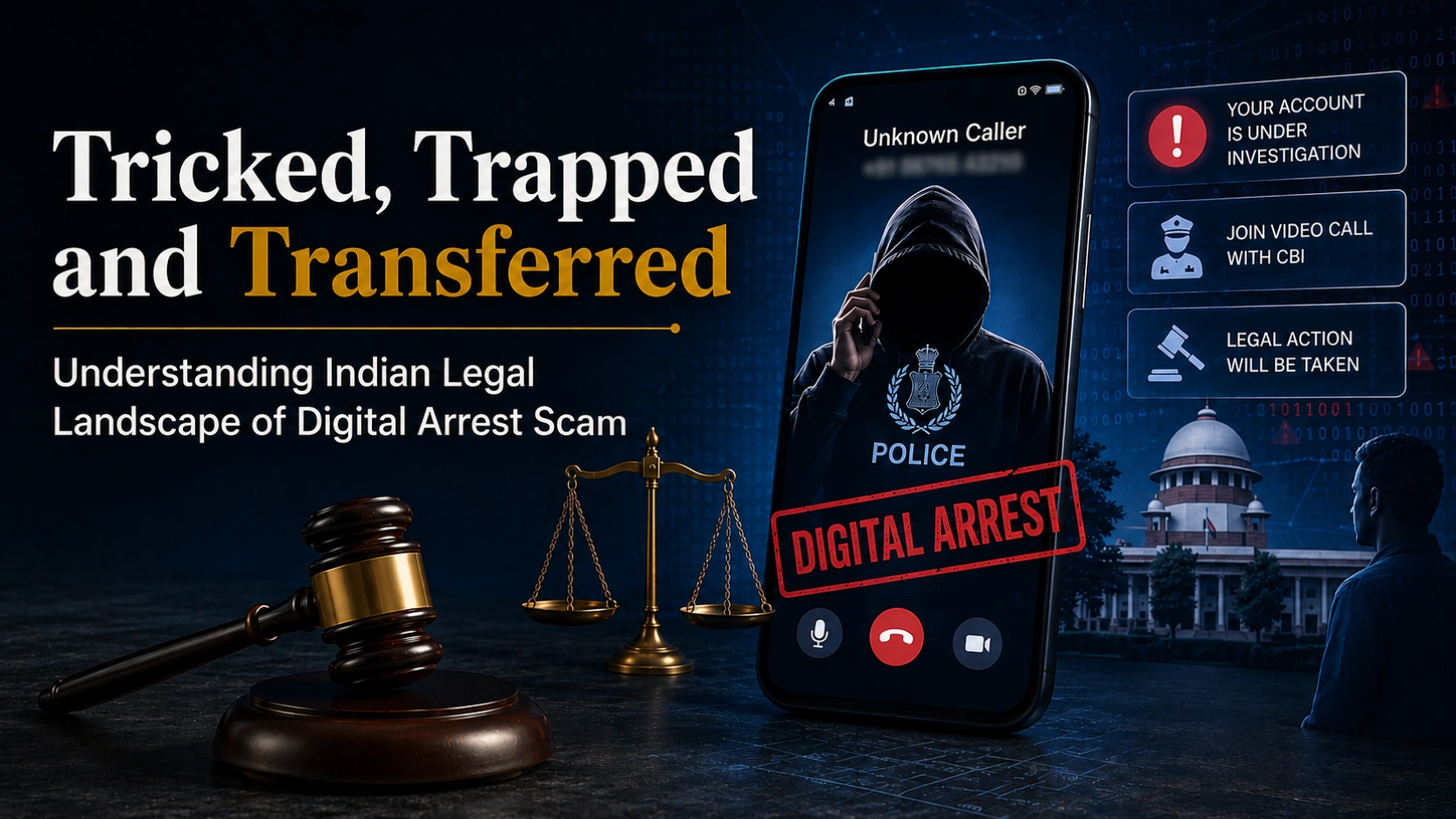
The Ministry of Home Affairs, through the Indian Cyber Crime Coordination Centre (“I4C”) in its Advisory dated 6 March 20252 specifically addressed the growing cases of digital arrest scams. The Advisory identified digital arrest as an organized economic online crime. The I4C Advisory addresses both the modus operandi and the preventive response to digital arrest scams. It identified a four-stage pattern through which digital arrest scams are ordinarily carried out – (i) impersonation (ii) intimidation (iii) digital confinement and (iv) monetary extortion. The scam typically begins with a phone or IVR call from a person impersonating officials of agencies such as the police, CBI, Narcotics Department, RBI, Telecom Department or ED, often using spoofed telephone numbers. The impersonator then alleges that the individual is connected to a serious offence for example, the shipment of contraband, money laundering, terrorist activity or illicit transactions and uses the allegation to create fear and urgency. The individual may then be subjected to prolonged video calls, sometimes accompanied by a fabricated police station setting, and instructed to remain on camera until the scammers’ demands are met. The final stage involves a demand for money, often presented as a payment to settle the fabricated case or prevent the supposed legal consequences.
II. Decoding the Legal Fiction of a Digital Arrest
With the increasing prevalence and sophistication of digital arrest scams, it has become necessary to examine whether the existing legal framework is equipped to identify, investigate and prosecute such cyber scams. Despite its widespread use, “digital arrest” is not an independently recognised form of arrest, nor does Indian criminal law create a standalone offence bearing that name. The law does not provide for any alternative mode of exercising the power of arrest through digital means. It does not confer any authority upon a police officer or investigating agency to place a person under “digital arrest” through a telephone call, video call or messaging platform. A legal arrest involves exercise of lawful State authority and is governed by the procedural safeguards prescribed under the Bharatiya Nagarik Suraksha Sanhita, 2023 (“BNSS”). Chapter V of BNSS governs ‘Arrest of Persons’ and prescribes the procedure of when and in what circumstances a person may be arrested, the manner in which an arrest is to be effected, production of the arrested person before a Magistrate within the prescribed period and other such procedures concerning a lawful arrest. A digital arrest, by contrast, is a fabricated representation of the exercise of such legal authority.
The legal response to a digital arrest scam at present is therefore constructed by identifying the independent unlawful acts embedded within the scam and applying the existing substantive offences to each of them. The Bharatiya Nyaya Sanhita, 2023 (“BNS”) supplies the principal substantive framework, while the Information Technology Act, 2000 (“IT Act”) becomes relevant where the conduct involves specific forms of cyber-enabled cheating or identity theft. The anatomy of a typical digital arrest scam can be illustrated by way of a composite scheme –
- False official identity – Impersonating Public Authority – Section 204, BNS – Personating a Public Servant
- Fabricated accusation – Representing that victim is involved in a crime – Section318-319, BNS – Cheating / Cheating by Personation
- Threat of arrest or prosecution – Creating fear through exercise of State Authority – Section 351, BNS – Criminal Intimidation
- Demand for money – Obtaining property through threats or fear – Section 308, BNS Extortion
- Digital impersonation / credential misuse – Use of Electronic Identity or communication resources – Section 66C, 66D, IT Act – Identity Theft, Cheating by Personation
- Fake warrants / notices / orders – Use of fabricated official documents – Section 336, BNS – Forgery
- Multiple coordinated actors – Organised Participation – Section 61, BNS – Criminal Conspiracy
The absence of a standalone offence called “digital arrest” does not, therefore, create a legal vacuum. However, in view of the ever-increasing cases, it remains pertinent to examine whether the existing combination of criminal and cyber crime laws in India is sufficient to deal with the unique features of these scams.
III. How Indian Courts Responded to Digital Arrest
The growing judicial response to digital-arrest scams shows that courts are proactively acknowledging how such scams are different from conventional case of cheating. In the case of In Re: Victims of Digital Arrest Related to Forged Documents, Supreme Court was faced with determining scam of more than 1 crore rupees involving a senior couple through the use of forged Supreme Court orders bearing fake judicial seals and signatures, which were shown to them through WhatsApp and video calls. The Court saw the misuse of forged judicial documents as a serious challenge to public confidence in the judiciary and other authorities and department and therefore took suo moto cognizance of the issue. Subsequently, the Supreme Court issued a number of interim orders, including Order dated 1 December 2025, 16 December 2025, 9 February 2026 and 4 August 2026, gradually widening the institution’s response to digital-arrest scams. The latest interim instructions as per Order dated 4 August 2026 are as follows:
- RBI to issue a mandatory Standard Operating Procedure (SOP) within four weeks for banks to place temporary debit holds on accounts linked to cyber fraud and money-mule activity;
- States and law-enforcement agencies to operationalise grievance and money-restoration mechanisms under MHA’s SOP concerning “NCRP-CFCFRMS, Customs and Restoration of Money and Grievance Redressal” dated 02.02.2026;
- States/UTs to establish Cybercrime Coordination Centres and adopt e-Zero FIRs;
- Authorities to promote cybercrime awareness and assist victims in recovering funds;
- Banks and intermediaries to develop tools to prevent digital arrests and facilitate fund recovery, including a possible call “kill switch”;
- Inter-Departmental Committee to examine a shared-liability and compensation framework;
- Recovered funds to be expeditiously returned to victims;
- Action against errant telecom providers and measures to curb SIM/KYC misuse;
- CBI to investigate organised networks, with the Inter-Departmental Committee coordinating implementation.
The emerging judicial response has also involved the High Courts. In Re: In the Matter of Tackling the Issue of Digital Arrest Scams, Cyber Crime and Saving the Innocent People from Losing Their Money and Lives3, the Rajasthan High Court took suo motu cognizance of the increasing problem and re-iterated that digital arrest has no legal standing. The Court stressed the need to create awareness among the public and called for the creation of mechanisms through which fraudulent transactions could be stopped immediately after a complaint was received, thus minimizing further financial loss to victims.
The Delhi High Court, in its turn, has pointed out the difficulties of investigation which such organized fraud presents. In Ashok Kumar v. State (NCT of Delhi)4 , the Court in the case of a digital-arrest scam involving 22.92 crore rupees, recognized the need for a specialized and sensitive approach to investigation, especially when senior citizens are targeted. The Court also highlighted the need to trace the mule accounts, recover the defrauded money and effectively probe the larger network behind such scams in light of the broader directions of the Supreme Court.
Further, in The State of West Bengal v Jatin Anup Ladwal and Ors.5, Kalyani District Court in July 2025 recorded its first full trial conviction in a digital arrest fraud case, sentencing nine members to life imprisonment for coercing a victim into transferring 1 crore rupees to their accounts. The court prosecuted the virtual confinement under a combined matrix of the Information Technology Act (Sections 66C and 66D) and penal provisions governing extortion, impersonation of public officials, document forgery (including BNS Section 338), and criminal conspiracy, establishing an aggressive judicial precedent that elevates digital arrest from routine online fraud to severe organized extortion.
Such judicial intervention in the cases suggest the beginning of a departure from the legal response of treating digital arrest as merely another form of cyber fraud once the loss has been suffered, towards a more active and coordinated response involving financial institutions, law enforcement agencies, telecommunications operators and other intermediaries.
IV. The Trap: Understanding the Rising Cyber Crime Cases
Several institutional and administrative measures have been undertaken by the Government and the enforcement authorities. The National Cyber Crime Reporting Portal (NCRP) was established and ‘1930’ helpline was created under the Citizen Financial Cyber Fraud Reporting and Management System for filing reports related to cyber fraud cases. In addition to these measures, the Government has also employed technical interventions such as suspending suspicious SIM cards, IMEIs, Skype identities and WhatsApp accounts, as well as initiating steps for restricting international spoof calls using Indian phone numbers. The above strategies have been accompanied by widespread campaigns aimed at raising public awareness regarding digital-arrest frauds via print and electronic media, social media, radio channels, among others. Furthermore, there have been special alerts for the risk of impersonation by fraudsters who masquerade as police personnel, officials of CBI or RBI and other governmental agencies.6 The Courts and the Government have been proactively implementing measures to combat digital arrests. The manner in which Court have been proactive in addressing digital arrest cyber frauds and the various steps taken by institutions is a big leap forward in addressing the issue.
However, the significance of digital arrest lies not merely in the manner the scam is executed but also the vulnerability of how complex cybercrime is. The growing dependence on digital communication and the ease with which personal information can be obtained together enable cybercriminals to devise increasingly convincing forms of deception. The scale of the problem is equally striking. The National Human Rights Commission in its press release on the Open House Discussion on “Safeguarding human rights against digital arrest scams” conducted on 9 June 2026 observed that Indians had lost approximately 52,976 crore rupees to cyber fraud over the preceding six years, with digital-arrest scams accounting for nearly 8% of these losses. Therefore, in addition to the reforms and responses in place, the challenge is in formalising a centric legal and institutional response to cyber frauds, including digital arrest.
The international response to cyber frauds premised on deception reveals an important shift, the focus is no longer limited to punishing the offender, but extends to preventing fraud, protecting victims, disrupting the mechanisms through which scams are perpetrated, and allocating responsibility for financial losses. Different jurisdictions illustrate different aspects of this emerging approach: Australia has strengthened its cybercrime framework and penalties for identity-related and telecommunications-enabled offences, coupled with active law-enforcement intervention against large-scale scam networks. The United States of America has placed significant emphasis on prevention, public awareness and accessible reporting through institutions such as the Federal Trade Commission and the Internet Crime Complaint Center (IC3), thereby treating victim awareness as an important component of cyber fraud prevention. The United Kingdom has gone further in shifting part of the financial risk from victims to financial institutions through its mandatory Authorised Push Payment (APP) Fraud Reimbursement Scheme, under which qualifying victims are generally reimbursed by their payment service providers. Singapore, meanwhile, has adopted a technology-driven preventive model, including the use of artificial intelligence and network-level measures to identify and block scam communications at an early stage. Collectively, these approaches demonstrate that an effective response to digital-arrest scams requires a combination of criminal-law enforcement, preventive technological intervention, institutional accountability, victim restitution, and educating the general public, rather than reliance solely on prosecution after the fraud has occurred.
In the Indian context, in furtherance of the ongoing measures undertaken by the Government as well as the Supreme Court including the proactive interim directions issued by the Court in Re: Victims of Digital Arrest Related to Forged Documents 2026 SCC OnLine SC 1532, the growing incidence of digital arrest scams and cyber frauds call for centric legal framework. The directions issued by the Supreme Court reflect the need to treat digital arrest not as an isolated form of online cheating, but as part of a larger ecosystem of cyber fraud. involving impersonation, intimidation, use of forged documents, digital confinement and financial extortion. The emerging framework therefore requires legal and institutional mechanisms that impose clearer responsibilities on financial and digital intermediaries, enable real-time prevention and recovery of fraudulently transferred funds, and strengthen coordinated investigation and victim compensation. While the existing framework addresses the individual unlawful acts involved in such scams through offences relating to cheating, impersonation, intimidation, extortion and cyber-enabled identity theft, these isolated offences are not sufficient to capture the organised, technology-enabled and rapidly evolving nature of cyber fraud. A comprehensive legal framework is required which addresses independent investigation mechanisms, clearer legal powers for early intervention and preservation of digital and financial evidence, effective tracing and recovery of illicit proceeds, coordinated investigation of organised cyber fraud networks, and meaningful restitution to victims. There is, therefore, a need to work towards establishing a framework that provides for specialised investigation, preventive intervention, tracing and recovery of fraudulently obtained proceeds, preservation of digital evidence and effective victim restitution. Such legal reform, complemented by a coordinated institutional response, would enable addressing digital arrest not merely through post-offence prosecution, but through a comprehensive framework designed to respond to the unique and complex nature of such cyber frauds.
FAQs
-
What is a digital arrest scam in India?
The Ministry of Home Affairs, through the Indian Cyber Crime Coordination Centre (I4C), in its Advisory dated 6 March 2025, recognised digital arrest as an organised form of cyber-enabled economic crime. It identified four broad stages of digital arrest scams: impersonation, intimidation, digital confinement, and monetary extortion. Digital Arrest takes place when scammers pose as government or law-enforcement officials, falsely implicate victims in serious offences, keep them under prolonged virtual surveillance, and ultimately extort money.
-
Is digital arrest legally recognised under Indian law?
No. Digital arrest is not recognized as a legally recognised mode of arrest. Chapter V of the Bharatiya Nagarik Suraksha Sanhita, 2023 (“BNSS”) governs “Arrest of Persons” and procedure for lawful arrest. Indian law does not authorise arrest through telephone calls, video calls or messaging platforms. Digital Arrest is therefore a fraudulent representation of State authority. However, such scams may be prosecuted under existing laws including BNS, 2023 and the IT Act, 2000 for offences committed during the scam such as personation of a public servant, cheating, criminal intimidation, extortion, forgery and criminal conspiracy under the BNS, 2023, and identity theft and cheating by personation under Sections 66C and 66D of the IT Act, 2000.
-
What laws apply to digital arrest scams in India?
Digital arrest scams are addressed under the existing criminal and cyber-law framework, as Indian law does not recognise digital arrest as a standalone offence. Depending on the nature of the conduct, the BNS, 2023 may attract Section 204 for impersonating a public servant, Sections 318–319 for cheating and cheating by personation, Section 351 for criminal intimidation, Section 308 for extortion, Section 336 for forgery, and Section 61 for criminal conspiracy. Where the scam involves electronic identity theft or cheating by personation through digital means, Sections 66C and 66D of the Information Technology Act, 2000 may additionally apply.
-
What has the Supreme Court said about digital arrest scams?
In In Re: Victims of Digital Arrest Related to Forged Documents, the Supreme Court recognised the misuse of forged judicial documents and impersonation of authorities in digital-arrest scams as a serious threat to public confidence in the judiciary and other public institutions and accordingly took suo motu cognizance of the issue. Through interim orders dated 1 December 2025, 16 December 2025, 9 February 2026 and 4 August 2026, the Court has issued directions aimed at preventing such scams, strengthening cybercrime investigation and coordination, protecting and restoring victims’ funds, and ensuring effective grievance redressal.
-
What should victims do after falling for a digital arrest scam?
Victims should immediately report the incident to the police or cybercrime authorities and inform their bank or financial institution to seek a freeze or reversal of the fraudulent transaction. They should preserve all relevant evidence, including call records, messages, screenshots, video-call details, transaction records, and account information. Victims should also avoid further communication or payments to the perpetrators and cooperate with the investigating authorities.
References –
- 2026 SCC OnLine SC 1532
- Indian Cyber Crime Coordination Centre Advisory dated 6 March 2025, https://cybercrime.gov.in/pdf/Advisories/ADVISORYTAU-ADV-003DigitalArrest06.03.2025.pdf
- 2025 SCC OnLine Raj 7072
- 2026 SCC OnLine Del 1832
- Sessions Cases No.51 of 2025, Kalyani District Court
- https://www.pib.gov.in/PressReleasePage.aspx?PRID=2110809®=48&lang=2
 You wish to know more about Neeti Niyaman (the “Firm”) for your own information and use.