Looking beyond Corporate Form under the IBC: The Supreme Court’s ruling in the case of Alpha Corp v. GNIDA
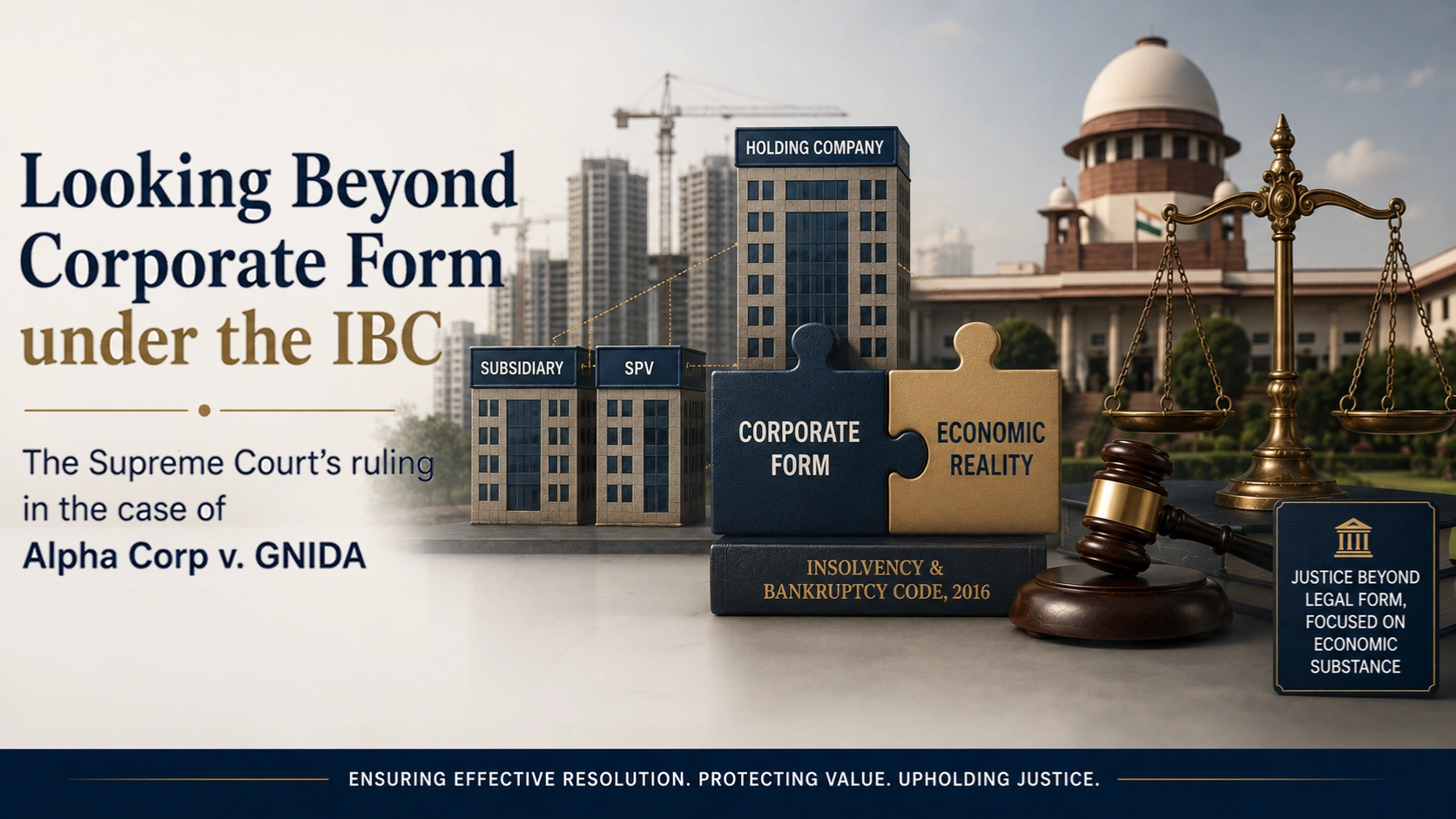
By – Nikhil Anand and Amisha Rathaur
Table of Contents
Introduction
Corporate groups rarely operate in neat legal compartments. In many cases, business decisions, financing, assets and operations are spread across several group entities, while the commercial enterprise functions as one integrated unit. This creates a familiar difficulty in insolvency proceedings: should the insolvency process follow the strict legal form of each company, or should it account for the economic reality of the group?
The Supreme Court’s decision in Alpha Corp Development Private Limited v. Greater Noida Industrial Development Authority1 brings this question into sharp focus. The judgment is significant because it recognises that, in appropriate cases, courts may look beyond the separate legal identity of group companies and examine the real economic substance of the arrangement.
The Issue:
The dispute arose in the context of the corporate insolvency resolution process of Earth Infrastructures Limited. Several real-estate projects were being developed by Earth Infrastructures Limited, but the underlying leased lands were held by its subsidiaries or special purpose vehicles.
Greater Noida Industrial Development Authority argued that since the leasehold rights were not held by the corporate debtor itself, but by separate subsidiary entities, those lands and development rights could not be dealt with in the CIRP of the holding company.
This was, at one level, a classic separate legal personality argument. The subsidiaries were separate companies and the lease rights with respect to the land parcels were executed in their respective names. Therefore, according to GNIDA, the resolution plans could not travel beyond the assets of the corporate debtor.
The NCLAT accepted this approach and set aside the orders approving the resolution plans. The Supreme Court, however, took a more commercially realistic view.
Substance-based approach of the Supreme Court
The Supreme Court did not reject the principle of separate corporate personality. It reaffirmed that holding and subsidiary companies are ordinarily distinct legal entities. However, the Court also recognised that this principle is not absolute.
The Court examined the factual structure of the projects. It noted that Earth Infrastructures Limited was the dominant entity behind the development of the projects. The subsidiaries and special purpose vehicles were not functioning as independent commercial entities in any meaningful sense. They primarily held the leased lands, while Earth Infrastructures Limited was the entity actually developing the projects, exercising control and making payments.
Infact, Earth Towne Infrastructures Private Limited was incorporated as a special purpose company pursuant to GNIDA’s own requirements. Earth Infrastructures Limited held a dominant shareholding and remained the real force behind the project. In the other projects also, the relevant entities were closely connected with Earth Infrastructures Limited.
The Court also took note of the fact that GNIDA was aware of the role played by Earth Infrastructures Limited in the development of the projects. It could not later rely only on formal corporate separateness to deny the commercial reality of the arrangement.
On these facts, the Supreme Court held that this was an appropriate case for lifting the corporate veil. It found that the subsidiaries were, in substance, fronts, and that the group had to be viewed as one economic entity for the purpose of giving effect to the resolution process.
Why the decision matters?
The judgment is important because it moves the discussion from corporate form to economic substance. It recognises that insolvency resolution cannot always be effective if courts look only at the name on which an asset is formally held, without examining who actually controlled, developed, financed and benefited from the underlying commercial enterprise.
This is particularly relevant in real-estate insolvency. Real-estate projects are often structured through subsidiaries, special purpose vehicles, development agreements and leasehold arrangements. If each entity is treated in complete isolation, resolution may become fragmented and stalled projects may remain incomplete, to the prejudice of homebuyers and other stakeholders.
The decision also supports the idea of project-specific resolution in real-estate insolvency. Instead of treating the corporate debtor’s entire business as one undifferentiated pool, the Court recognised the need to preserve and complete specific projects where resolution plans had already been approved. This approach helps protect homebuyers and preserves value in projects that can still be revived.
The Limits of the Doctrine
At the same time, the judgement rendered in the case of Alpha Corp should not be read too broadly, for it does not say that the assets of every subsidiary can automatically be treated as assets of the holding company. Nor does it dilute separate corporate personality as a general rule.
The Court’s conclusion was based on a specific factual matrix: dominant control by the corporate debtor, commonality of management and ownership, the subsidiaries existing primarily to hold project lands, the corporate debtor being the actual developer, and the public interest involved in completing stalled real-estate projects.
This is where the Single Economic Entity Doctrine must be carefully understood. It is not a shortcut to ignore corporate separateness. It is a principle that allows courts to examine whether, in substance, related entities are so closely integrated that treating them as entirely separate would defeat the purpose of insolvency resolution.
The distinction is important. Mere common shareholding or group affiliation is not enough. There must be clear evidence of economic integration, operational control and functional unity.
GNIDA’s conduct and equitable balancing
Another important aspect of the judgment is the Court’s treatment of GNIDA’s conduct. The Court found that GNIDA had failed to adequately monitor the projects, failed to take timely steps to recover its dues, and did not effectively participate in the CIRP despite being aware of the relevant facts.
As a result, while the Court protected GNIDA’s right to recover its principal dues, it denied GNIDA penal interest, penal charges and time-extension penalties. The successful resolution applicants were directed to pay the recalculated dues without passing the burden on to homebuyers.
This part of the judgment reflects the Court’s attempt to balance competing interests. The public authority was not deprived of its principal dues. The resolution applicants were allowed to proceed with the approved plans. Most importantly, homebuyers were protected from being further prejudiced by delays and disputes between the authority and the developer group.
Key takeaways
The decision in Alpha Corp is a significant development in Indian insolvency law for three reasons. First, it confirms that courts may look beyond corporate form where the factual reality shows that group entities function as one economic enterprise. Second, it clarifies that veil lifting in insolvency remains exceptional and fact-specific. Separate legal personality continues to be the rule; departure from it requires strong factual justification. Third, it strengthens the practical relevance of project-specific CIRP in real-estate insolvency, especially where such an approach enables completion of stalled projects and protects homebuyers.
Conclusion
The Supreme Court’s decision in Alpha Corp v. GNIDA is an important step in aligning insolvency law with commercial reality. It recognises that corporate structures cannot be viewed in isolation where the facts show that multiple entities were merely vehicles for one integrated enterprise.
At the same time, the judgment is carefully balanced. It does not create a general rule that all group companies must be treated as one. Instead, it reinforces a fact-specific approach, where courts examine control, ownership, management, operational integration, stakeholder impact and the purpose of the insolvency process.
For group insolvency and real-estate resolution, the judgment is likely to have lasting relevance. It shows that the IBC is not confined to rigid corporate formalism. Where justice, value maximisation and stakeholder protection require it, courts may look at the economic reality behind the corporate structure.
FAQs
-
What is the Corporate Insolvency Resolution Process (CIRP) under the IBC?
CIRP is a time-bound insolvency resolution process under the IBC initiated against a corporate debtor upon default, with the objective of resolving its insolvency through an approved resolution plan or, failing that, liquidation.
-
What does lifting the corporate veil mean in insolvency proceedings?
Lifting the corporate veil refers to disregarding the separate legal personality of a company to identify the real persons or entities controlling it, where strict adherence to corporate form would defeat justice, public interest, or the objectives of insolvency resolution.
-
What is the role of a resolution plan under the IBC?
A resolution plan is a proposal submitted by a resolution applicant for the revival and resolution of the corporate debtor, addressing payment of debts, management of affairs, and maximisation of the value of its assets.
-
Who is considered a corporate debtor under the IBC?
Under Section 3(8) of the IBC, a corporate debtor is a corporate person who owes a debt to any person and against whom a corporate insolvency resolution process has been initiated.
-
Why is the Supreme Court’s judgment in Alpha Corp v. GNIDA significant?
The judgment is significant because it confirms that courts may look beyond corporate form where group entities function as a single economic enterprise, clarifies that veil lifting in insolvency remains exceptional and fact-specific, and reinforces the concept of project-specific CIRP in real-estate insolvency to facilitate the completion of stalled projects and protect homebuyers.
 You wish to know more about Neeti Niyaman (the “Firm”) for your own information and use.