Beyond Conjecture: The importance of Reliable Sources in Judicial decision making
By – Arsh Khan and Sanya Miglani
Table of Contents
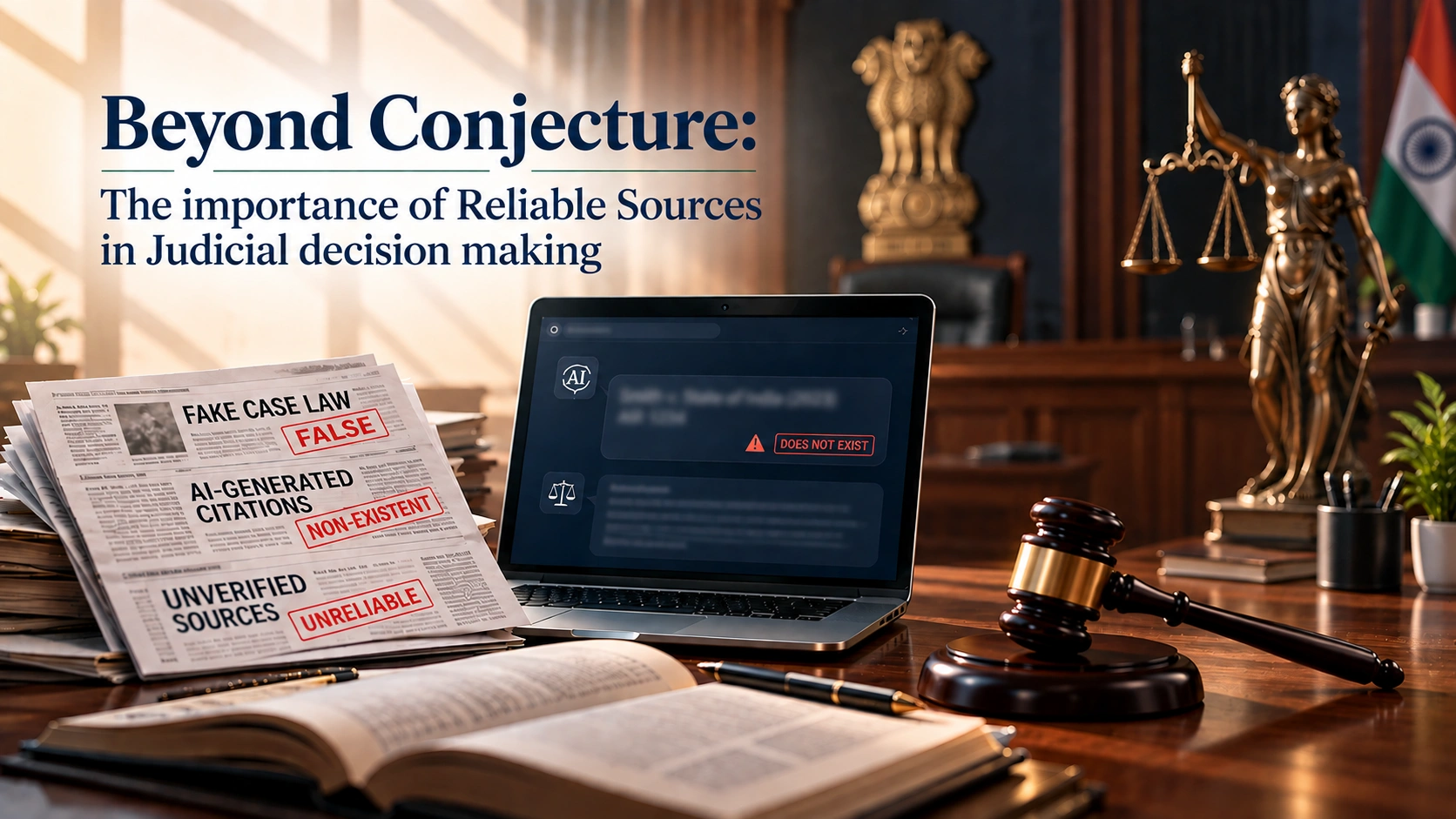
In 2024, the National Company Law Tribunal while hearing an insolvency petition passed a judgement based on fake and non-existent judicial precedents generated through artificial intelligence. The Appellate Tribunal relying on the same precedents affirmed the Tribunal’s decision. The Supreme Court while recognizing the gravity of the error, not only set aside the orders but also observed that a decision rendered by a court or adjudicating authority on the basis of fake or hallucinated material could not be regarded as a decision in the eyes of law and amounted to a subversion of the rule of law. Similarly, in cases of public interest litigations including the latest decision of the Supreme Court in Dr. K.A Paul vs. Union of India and Ors., courts have consistently held that public interest litigations proceedings must be founded on credible, cogent, and research-based material and must not amount to speculative litigation which undermines the discipline required in constitutional adjudication. These are but few instances in a long line of judgements which uphold the sanctity of reliable sources and evidence in the judicial process.
Courts and judicial institutions are often regarded as the citizen’s last recourse against government excesses and arbitrary exercise of public power, while also serving as impartial arbiters of public disputes. Courts have been accorded with significant authority to resolve questions of statutory and legislative interpretations. Thus, the legitimacy of this adjudicatory function is heavily dependent on being founded upon verified facts, legally admissible evidence, reliable sources and application of correct and relevant judicial precedents, rather than being based on untested assertions, conjectures and misinformation. Pertinently, in recent times, the judicial process has come under increasing strain from pervasive media influence, the pressures of public opinion and unprecedented technological advancements including that of artificial intelligence. These developments have blurred the distinction between verified evidence and untested assertions.
The process of judicial determination rests on the fundamental principle that evidence overrides conjecture. The Courts do not determine whether an assertion is popular or widely accepted, rather they are required to examine whether the claim can be established by the rule of law. This scrutiny requires claims to be assessed against the thresholds set by the evidentiary and procedural codes. The Hon’ble Supreme Court on various occasions has held that mere suspicion should not be allowed to take the place of proof.
Statutory Framework pertaining to reliability of Evidence
The Constitution of India provides the fundamental safeguards in the judicial process against unverified claims. Article 14 of the Constitution prohibits arbitrary state action while Article 21 requires a fair, just and reasonable procedure where life and personal liberty is affected. These basic principles flow into the various procedural and evidentiary laws.
The Bharatiya Sakshya Adhiniyam, 2023 (“BSA”), which replaced the Indian Evidence Act, governs admissibility, proof and standards of evidence in judicial proceedings. It generally requires the oral evidence to be direct and the documents to be proved through primary evidence, while permitting for secondary evidence in limited number of cases. Electronic records being tendered needs to be supported by a certificate to establish the manner in which they have been generated. The BSA also places the burden of proving a fact upon the party who asks the court to believe it. Accordingly, every evidence and claim is to be assessed in relation to their relevance, proper chain of custody and authorship of the evidence so tendered and authenticity of the same.
Similarly, civil proceedings are governed by the Code of Civil Procedure, 1908 (“CPC”). CPC requires all pleadings to be on an affidavit and verified by a person acquainted with the facts. The evidence tendered by a witness is also then subjected to cross-examination. Apart from the above, the courts at any time can require any particular fact to be proved by an affidavit. These provisions are in place to discourage litigants from placing sweeping allegations before courts without identifying whether the statements arise from personal knowledge, records or information believed to be true. It also helps to weed out hearsay evidence.
The Changing Landscape of Evidence and the Legal System
The legal system has undergone a significant transformation with the rapid advancement of technology, growing complexity of disputes and changes in the manner courts engage with disputes and the litigants. The movement towards greater transparency and procedural ease, has expanded access to information and justice, while also making reliance on rapidly evolving technologies increasingly necessary. The transformation has also significantly altered the nature and volume of material that may come before courts, with electronic records, digital communications, social media content, online databases and AI-generated material increasingly forming part of the evidentiary and legal landscape. This has brought questions of authenticity, provenance, integrity and reliability to the forefront of judicial scrutiny.
These developments have been accompanied by the growing public interest in, the functioning of the courts. Although, the same has led to an increase in accountability, but it may also have left the judicial process susceptible to risk of influence by unrelated considerations. The parallel proceedings of pending disputes through media trials can shape public opinion, prematurely prejudice rights of parties and place undue pressure on the judicial process. The rapid dissemination of information through digital and social media has further heightened this concern, as allegations, incomplete accounts and unverified material can acquire the appearance of established facts before they are subjected to judicial scrutiny. This assumes particular significance where courts are called upon to distinguish between assertion and evidence, and between information that is merely available and material that is legally relevant, admissible and sufficiently reliable to form the basis of a judicial finding.
Courts, now more than ever, must therefore remain vigilant that their findings remain based solely on legally admissible and reliable evidence.
Artificial Intelligence and the Judicial Process
Courts in India, and across the world, have recognized the growing role of Artificial Intelligence (“AI”) in the administration of judicial functions. AI has the potential of improving judicial efficiency, accessibility and case management. The courts have thus grown open to the idea of adopting AI in assistance in the administration of justice process. However, blind reliance of AI can lead to results as was seen in the Pooja Ramesh Singh case, where judicial orders were passed relying on fabricated and non-existent authorities.
AI outputs require careful human verification because they may fabricate authorities, invent nonexistent citations, merge distinct cases, misread/ misapply judicial findings or omit a necessary qualification. Recognizing both the potential and pitfall of such technology, the Supreme Court had introduced the draft Regulations for the Use of Artificial Intelligence in Courts, 2026 (“Draft AI Regulations”). The Draft AI Regulations identified several permissible areas where AI system could be used in the judicial process including in case management, cause list preparation, automated transcription, translation, legal research, precedent retrieval, etc. At the same time, it prohibited reliance on AI or algorithmic decision-making alone to determine judicial outcome or perform adjudicatory or sentencing functions.
The Draft AI Regulations also propose safeguards governing the use of AI by courts. They clarify that AI must remain subject to human judgment and may be used only as an assistive tool. AI systems should meet appropriate standards of transparency and explainability, while responsibility for their use must remain with the judicial officer concerned. Any personal data processed through such systems must also be handled in accordance with applicable data-protection laws and privacy standards.
The risks associated with AI extend beyond fabricated authorities and inaccurate legal propositions. AI systems may reproduce biases present in their training data. It can also generate seemingly authoritative conclusions without disclosing their sources. Their use also raises concerns relating to confidentiality, data protection and cybersecurity as is evident from the safeguards in the Draft AI Regulations. At the same time, AI can significantly assist the already overburdened Indian judicial system in administrative and supportive role, as long as the same is reliably vetted. AI must thus remain an aid to judicial function, and not its substitute so that technological efficiency does not come at the cost of accuracy, fairness or public confidence in the administration of justice.
Judicial Scrutiny of claims raised outside recognized evidentiary channels
Courts are often confronted with claims derived from sources which fall outside the conventional evidentiary channels, including newspaper reports, third party reports and crowdsourced repositories. Although such material may be source that initiates investigation, they are not in themselves proof of the allegation.
The courts place higher standards of scrutiny of claims raised through such unverified sources prior to taking cognizance. The Supreme Court in Laxmi Raj Shetty vs. State of Tamil Nadu held that facts stated in a newspaper are hearsay and secondary evidence and cannot be judicially noticed as proof of their truth unless established through admissible evidence. Publishing of a fact or discussion on the same by media houses is not deemed to be proof of the allegation/ claim. The same would need to be proved against relevant evidence acceptable to courts.
Courts have adopted a similar approach towards reports prepared by third parties. Such reports may prompt an inquiry or assist a regulator in identifying matters requiring examination, but they cannot by themselves establish the truth of the allegations made. In Vishal Tiwari vs. Union of India, which arose from the Hindenburg report, the Supreme Court declined to treat the report and related newspaper articles as conclusive evidence. It however observed that such material may serve as an input for the regulator but cannot, without supporting evidence, establish that the regulatory investigation was inadequate. Courts and public authorities have likewise been cautioned against relying on crowdsourced and user-editable platforms such as Wikipedia in place of authoritative sources.
The judicial response to unverified claims should be neither unsuspecting nor dismissive. Indian law recognises that newspapers, private reports, online compilations and confidential inputs may draw attention to matters deserving inquiry. Thus, in relation to unverified claims coming through sources beyond the recognized legal channels, courts may consider them as leads, rather than substitutes of evidence.
Conclusion
The legitimacy of the judicial process ultimately depends not only upon the correctness of the substantive law applied, but also upon the reliability of the material on which judicial reasoning was founded. Courts exercise authority over individual rights, public power and commercial relationships, and their decisions frequently carry consequences extending beyond the immediate parties. Judicial determinations must therefore rest upon verified facts, authentic sources and applicable legal precedents rather than suspicion and unverified assertions.
These changes have made the task of courts more difficult. Newspaper and third-party reports, AI-generated material, media trials and greater public scrutiny may bring relevant issues to light, but that alone does not make such material reliable evidence or claims verified. Courts must examine whether the material is authentic, verifiable and admissible before relying upon it. While information received through unconventional sources should not be disregarded altogether, it cannot form the basis of a final finding unless supported by legally acceptable evidence. This careful approach is necessary to ensure fairness and maintain public confidence in the judicial process.
FAQs
-
How does artificial intelligence impact the judicial decision-making process?
The use of artificial intelligence has significantly increased, with courts and legal practitioners relying on it for legal drafting, legal research, case preparation and management, transcription and translation. However, the AI generated outputs remain subject to careful scrutiny, as Artificial Intelligence has been seen to fabricate authorities, misread or misapply law and precedents, and generate unsupported research and conclusions.
-
Can AI-generated information be used as evidence in Indian courts?
AI and AI generated information has the potential of improving judicial efficiency, accessibility and case management. However, like any other source of information, it would need to stand the evidentiary test laid down under the Bharatiya Sakshya Adhiniyam, 2023. The Bharatiya Sakshya Adhiniyam, 2023 recognises electronic records under Section 61, with admissibility of electronic record governed under Sections 62 and 63. The same must remain an aid to the judicial function, and not a substitute for it. The Supreme Court, also recognizing the potential as well as pitfalls of the AI system, has introduced the draft Regulations for the Use of Artificial Intelligence in Courts, 2026 which have identified several permissible areas where AI systems could be used in the judicial process, as well as areas where it cannot be used.
-
What role does the Bharatiya Sakshya Adhiniyam 2023 play in evaluating evidence?
The Bharatiya Sakshya Adhiniyam, 2023 provides the evidentiary framework for assessing the admissibility, proof and reliability of evidence, including electronic records. It requires evidence to be assessed for its relevance, proper chain of custody, authorship and authenticity, thereby ensuring that judicial findings rest on reliable and legally acceptable material.
-
How do courts treat newspaper reports and third-party reports in judicial proceedings?
The Bharatiya Sakshya Adhiniyam, 2023 classifies evidence according to its admissibility and mode of proof. Courts treat newspaper reports and third-party reports as hearsay or secondary evidence, admissibility of which is required to be proved independently before Courts.
-
How do courts differentiate between verified evidence and unverified claims?
Courts differentiate between verified evidence and unverified claims by examining the source and evidentiary foundation of the material. As held by the Supreme Court in Laxmi Raj Shetty vs. State of Tamil Nadu 1988 3 SCC 319, hearsay and secondary evidence such as newspaper reports cannot be judicially noticed as proof of their truth unless established through admissible evidence.
References –
- Pooja Ramesh Singh vs. Jammu and Kashmir Bank, (2026) SCC Online SC 1258
- Dr. K.A Paul vs. Union of India and Ors., [Writ Petition (C) No (S). 274 / 2026
- State of Maharashtra vs. Rajendra Jawnmal Gandhi, (1997) 8 SCC 386
- Union of India vs. HC Goel, AIR 1964 SC 364
- Section 54 and 55, BSA
- Section 59 and 60, BSA
- Section 63, BSA
- Section 104, BSA
- Order VI Rule 15, CPC
- Order XVIII Rule 4, CPC
- Order XIX Rule 1, CPC
- Data, Power and Bias in Artificial Intelligence, Harvard Center for Research on Computation & Society (2020)
- Laxmi Raj Shetty vs. State of Tamil Nadu, [(1988) 3 SCC 319]
- (2024) 4 SCC 115
- Hewlett Packard vs. Commissioner of Customs, [(2023) 7 SCC 799]
 You wish to know more about Neeti Niyaman (the “Firm”) for your own information and use.