From fraud to framing of charge: How financial scams are tested in India’s criminal courts
By – Asmita Narula and Tannishtha Chatterjee
Table of Contents
Introduction
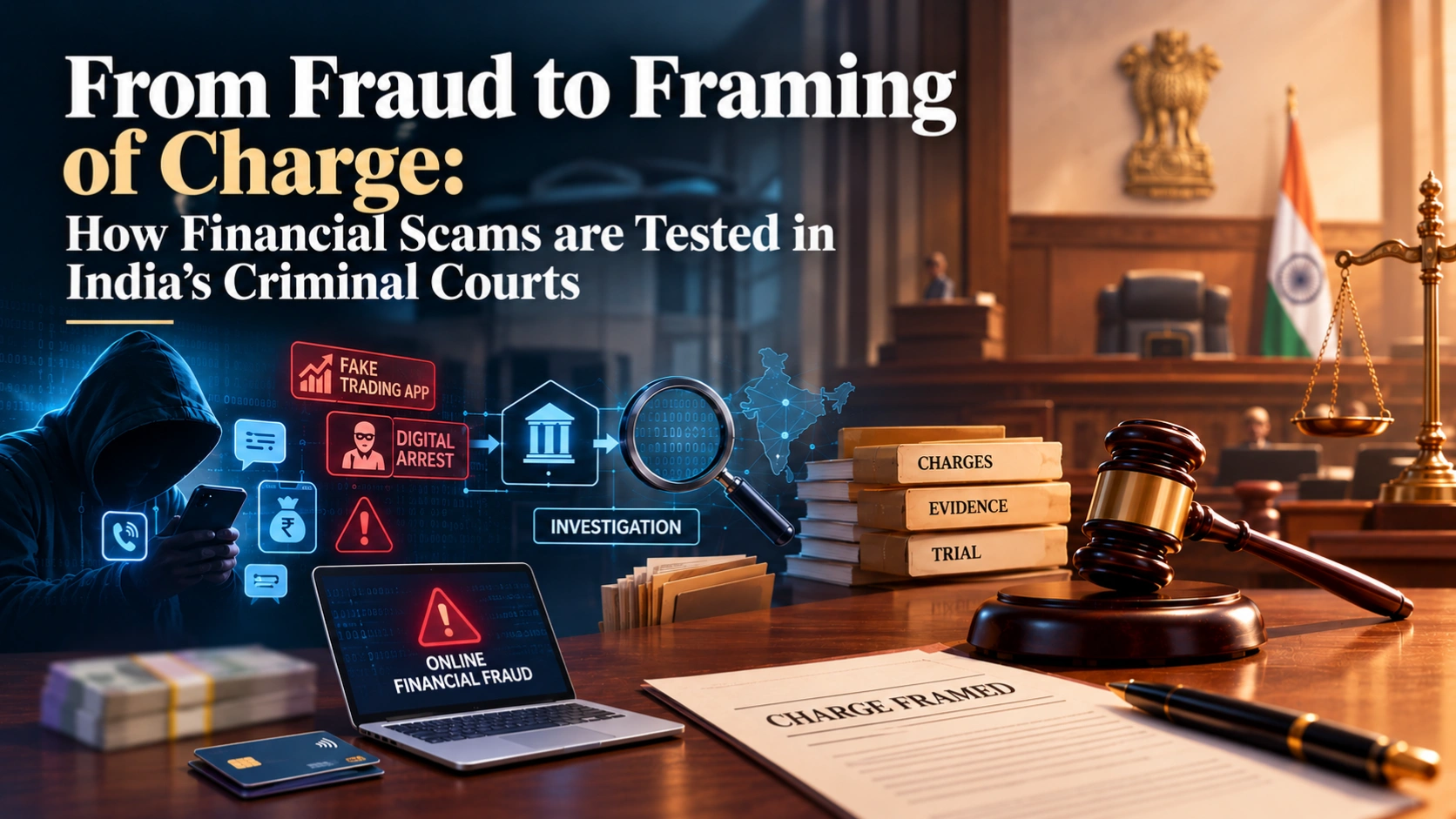
Financial scams in India operate on two parallel tracks – one comprises a relatively small number of high-value frauds, including banking and investment frauds, corporate misappropriation, securities manipulation, and money laundering through layered transactions, and the other consists of a relentless stream of small-ticket digital scams, ranging from fake trading applications and malicious links to so-called ‘digital arrests’, a concept that finds no recognition under Indian law. What is common in all these scams is the use of deception, abuse of entrusted authority or concealment of transactions to obtain an unlawful financial advantage. Both tracks end up in the same criminal courts and both expose the same weakness: the law is broad, but investigation and prosecution are slow.
Not every financial loss is a crime. A commercial failure, contractual breach or unpaid debt does not automatically constitute a criminal offence. Criminal culpability depends entirely on the ingredients of the offence which need to be established beyond reasonable doubt on the strength of the available evidence. The scam may have to be investigated at different levels where it passes through multiple companies, intermediary accounts, payment platforms and jurisdictions.
This article examines how financial-scam allegations move from complaint to trial under the new criminal framework. It focuses on the framing of charges, the first point at which a court sifts the prosecution material and separates a triable criminal case from a civil dispute in criminal form. It also covers the rise of digital-arrest frauds and the practical problems of fragmented jurisdiction, electronic evidence and asset recovery.
The statutory framework
The Bharatiya Nyaya Sanhita, 2023 (“BNS”), Bharatiya Nagarik Suraksha Sanhita, 2023 (“BNSS”), and Bharatiya Sakshya Adhiniyam, 2023 (“BSA”) came into force on 01.07.2024.
- The BNS establishes the framework for the offences, including cheating, criminal breach of trust, forgery and criminal conspiracy.
- The BNSS regulates the procedure, including investigation, arrest, framing of charges, remand, search and seizure, police reports, trial and bail etc.
- The BSA governs the admissibility and proof of evidence, including electronic records.
Several special statutes may also become applicable depending on the facts and circumstances surrounding the financial scam, like the Prevention of Corruption Act, 1988 where the financial scam involves public servants, the Companies Act, 2013 which provides for a specialised investigative mechanism for serious corporate fraud, the Securities and Exchange Board of India Act, 1992 where there is securities-related misconduct, and the Prevention of Money Laundering Act, 2002 (“PMLA”) where the proceeds of crime are transferred, concealed or channelled through multiple transactions to disguise their origin.
The BNS, like the Indian Penal Code (now repealed), has no standalone offence of “fraud”. A financial scam is prosecuted by stacking the offences which fit the facts of the case like cheating, cheating by personation, criminal breach of trust, forgery, falsification of accounts, criminal conspiracy etc. Under the BNS, the offence of organised crime has also been included which covers economic offences and cyber-crimes. When these offences are committed as a continuing unlawful activity by a syndicate, these become organized crime.
Criminal proceedings: From complaint to trial
Registration and investigation
A criminal proceeding is set in motion with information being given to an investigating agency about the commission of an offence. In case of financial scams in India, it can be given by the victim, a bank, a regulator, an auditor or an enforcement agency. The police must register a First Information Report (“FIR”) where a cognisable offence is disclosed and where the police refuses to register a FIR, the complainant can approach the Superintendent of Police and then the Magistrate. This general principle governing registration of FIR was laid down by the Supreme Court in Lalita Kumari v. Government of Uttar Pradesh in respect of Section 154 of the Code of Criminal Procedure, 1973 (“CrPC”), which pari materia applies to the new framework. However, it must be read with the provision which permits a preliminary inquiry in cases involving offences punishable with imprisonment of three years or more but less than seven years. For cyber fraud, victims are steered first to the 1930 helpline or the National Cyber Crime Reporting Portal so that funds can be frozen before they are diverted.
In cases involving financial scams in India, the investigation goes beyond identifying the initial loss. It has to establish the end to end chain -how the funds were obtained, transferred and ultimately used. The investigator has to reconstruct the transaction trail after examining bank statements and records, loan applications, corporate documents and records, electronic communication, emails, contracts, etc. and discover the nature and extent of the offence committed.
Arrest, remand and bail
FIR registration does not, by itself, justify arrest. The police can arrest without a warrant where a cognizable offence has been committed, subject to satisfying the statutory conditions, however, in other cases, a warrant of arrest from the Magistrate is required. An arrested person must be produced before the nearest Magistrate within 24 hours and any further detention must be authorised by a competent Magistrate in accordance with the law. The same safeguards apply in cases involving financial scams and financial frauds in India, regardless of the amount involved or the complexity of the transactions under investigation.
Bail requires a balance to be struck between the needs of the investigation and the rights of the accused. A plea for bail is generally opposed on the ground of possible tampering of evidence, influencing of witnesses, transferring of assets or obstructing the investigation. Bail must however be assessed on the applicable legal principles and the facts of the individual case and the seriousness of the allegations cannot justify treating accusation as conviction. The court must also have regard to statutory restrictions, wherever applicable. Pre-trial detention however must not serve as a substitute for punishment. The continued detention of an accused where trial is unduly delayed raises concerns under Article 21 of the Constitution of India, which guarantees the right to life and personal liberty.
Commencement of trial
Upon completion of the investigation, the police report / chargesheet has to be submitted to the competent Magistrate. Criminal proceedings under special statutes may follow a different route. It is at this stage, after submission of the police report / chargesheet, that the court proceeds to frame the charges against the accused persons, which is discussed in detail in the following section of this article, subsequent to which the witnesses are examined and cross-examined. Ultimately, the prosecution must prove the essential ingredients of the alleged offence(s) beyond reasonable doubt, subject to specific statutory provisions governing the burden of proof.
Framing of charge: The backbone of any criminal proceeding
For framing of charge, the BNSS largely re-enacts the CrPC while adding certain time limits. Under the new framework, charge must be framed within 60 days from the first hearing on charge and the discharge application must be filed within 60 days from the committal where the offence is being tried by the Sessions Court and 60 days from the supply of documents under Section 230 where the offence is being tried by the Magistrate.
In Dr. Anand Rai v. State of Madhya Pradesh and Another, the Supreme Court confirmed that the change is procedural, not substantive. The position is one of continuity rather than change and that the power remains the same, only the manner of its exercise has been more tightly structured. Thus, the CrPC-era case law on discharge and charge continues to govern the field.
Prima facie case and grave suspicion
At the stage of framing charge, the court has to ascertain whether there is sufficient ground for proceeding against the accused. The guilt is irrelevant. A strong suspicion founded on material, which leads the court to presume that the accused committed the offence, is enough to frame a charge and the court need not be satisfied that the evidence will lead to conviction.
In Union of India v. Prafulla Kumar Samal and Another, the Supreme Court has set out the working principles. The court has the undoubted power to sift and weigh the evidence for the limited purpose of finding out whether a prima facie case exists. Where two views are equally possible and the evidence raises only suspicion, not grave suspicion, the court may discharge the accused. The same principles have been reiterated in Sajjan Kumar v. Central Bureau of Investigation.
At this stage, only the material of the prosecution is considered and the accused does not have a right to produce any material, except where the court may itself call for material of sterling quality that may have been withheld by the investigating agency in the interest of justice. The Court must assume that the prosecution’s material is true and examine whether it discloses the ingredients of the offence. The court must apply its mind and not act as a ‘mere post office’. The Court is not bound by provisions which have been invoked by the police in the chargesheet and the court must frame a charge for offences that the material actually discloses.
The general tests are the same for every offence, including for financial scams and online financial frauds in India. However, there are certain factors which are considered in financial scams:
- Cheating vs. criminal breach of trust – Complainants often allege both these offences in the same set of facts, followed by routine and mechanical registration of FIR for both offences, whereas these offences are independent and distinct and cannot co-exist simultaneously in the same facts. Cheating requires a dishonest intention from the very inception however, criminal breach of trust needs lawful entrustment of property followed by dishonest misappropriation.
- Dishonest intention from the inception – The offence of cheating requires a dishonest or fraudulent inducement, where the intention to deceive must exist from the inception. A subsequent failure to keep a promise does not, by itself, show that the accused intended to cheat.
- Civil dispute given a criminal colour – There has been an increase in cases where mere civil disputes have been sought to be converted into criminal proceedings out of vendetta or as a pressurizing tactic. The availability of a civil remedy does not bar criminal prosecution where the necessary ingredients are present but mere breach of contract or non-payment or non-performance cannot give rise to a criminal prosecution for cheating.
- Role of each accused – Financial scams and corporate frauds often name every director, officer and signatory. Position alone is not enough. The court must find material against each accused individually – role in the transaction or knowledge or participation.
The new playbook of digital fraud and digital arrests
In the past few years, the cases of digital fraud have skyrocketed, with Indians having lost several crores. The most frightening and concerning feature of these new-era digital frauds is ‘digital arrest’ – a concept which is alien to the law in India, yet has cost the people thousands of crores. With the leak of personal data, the present-day fraudsters have access to Aadhaar numbers, bank details, family names etc., which they misuse to target the victims. Some of the ways in which these fraudsters are now targeting people include:
- Fake investment and trading groups – Targets are added to WhatsApp or Telegram groups showing guaranteed stock or IPO tips, then moved onto a fake trading app that displays rising profits. Withdrawals are blocked until more fees is paid.
- Part-Time Job Scams – Targets are attracted with small free tasks, like watching YouTube videos, posting positive reviews, etc. Subsequently, the targets are persuaded to pay large sums of money under the pretext of ‘premium tasks’.
- Courier and parcel threats – A caller, posing as an agent of a reputed courier service, claims that a parcel in the target’s name which holds drugs or fake passports has been stopped at customs in another State and persuades the target to immediately file a police complaint in that State. The target is made to believe that they are being connected to the police virtually for convenience. Fake uniforms, police-station backdrops, forged warrants and notifications, forged ID cards and even forged court orders are used to create fear in order to extort huge sums of money. This often leads to something known as ‘digital arrests’.
- Malicious links and APK files – Fake e-challan, KYC update, electricity disconnection or wedding-invite messages carry an app that, once installed, reads OTPs.
- AI voice clones – A cloned voice of a child or relative calls in distress asking for urgent money.
There is no such thing as a digital arrest under Indian law. No statute, rule or court order lets any investigating agency or any court hold a person in custody over a video call in any form whatsoever. There have been several cases where the targets have been kept on such calls for multiple days at a time at their home, threatened to not contact anyone or answer the doorbell etc. and repeatedly asked to transfer money. There have been instances where people have even been threatened to shift to a hotel where they are made to believe that they are under digital arrest.
The persons who are involved in such digital frauds are committing multiple offences such as cheating by personation, extortion, personating a public servant, forgery, identity theft, cheating by personation using a computer resource, etc.
In October 2025, the Supreme Court has taken suo motu cognizance of the increasing cases of digital arrest based on forged documents after a senior-citizen couple from Ambala lost above Rs. 1 crore in a fraud where a forged order of the Supreme Court itself was used. The Supreme Court was of the view that a stern action on a Pan-India basis is required to unearth the full extent of this criminal enterprise. The Court directed the Central Bureau of Investigation (“CBI”) to investigate cases reporting digital arrest scams. A free hand has been given to CBI to investigate the role of bankers under the provisions of the Prevention of Corruption Act, 1988, wherever they are found to be involved in the opening of mule bank accounts, which are used in cybercrime cases. The Court has passed several directions to aid the investigation to be conducted by CBI and is consistently passing interim directions to secure a coordinated response to the menace of digital arrest scams. The Court has also been informed that banks are using their own AI/ML tools for Fraud Risk Management and several banks have adopted Mule Hunter AI, with the RBI and Indian Cybercrime Coordination Centre finalising an MoU for sharing suspect registry data to enrich mule account detection tools.
Challenges in investigation and prosecution of financial scams
The law gives investigators wide powers, but cases still collapse or are stalled. The gap between registrations and convictions is the clearest sign.
Polisetti Satyadevi’s Online Financial Fraud in India: A Legal and Criminological Study identifies fragmented institutional responses, delayed reporting, difficulties in tracing intermediary accounts and weaknesses in digital evidence as important obstacles to effective enforcement.
Fragmented jurisdiction and institutional coordination
Financial scams often involve transactions spread across several States, with funds routed through multiple bank accounts, shell companies, intermediaries and, in some cases, foreign jurisdictions, which creates difficulties in determining which agency should investigate particular aspects of the alleged offence and how evidence collected by different agencies should be coordinated. Each agency operates under a distinct statutory framework and investigates different aspects of the same set of transactions. These investigations may involve overlapping documents and witnesses, but the evidence required to establish each offence is not necessarily the same.
Speed of money vs. speed of process
Financial scam proceeds are layered through mule accounts within minutes. Tracing the movement of funds is an important part of investigating financial scams however, the funds are diverted at a faster speed, often making the tracking futile. Money obtained through an alleged fraud may be transferred through several bank accounts, converted into real estate or securities, or channelled through shell companies and intermediaries to conceal its origin. Recovery remains a major concern for victims of financial scams.
Mule accounts and insider complicity
Financial scams, particularly digital frauds, rely on bank accounts opened with weak KYC, rented or bought from account holders, or opened with the help of bank staff.
Electronic and documentary evidence
Financial scams, particularly digital frauds, often generate substantial volumes of electronic evidence, including bank transaction, device data, emails, text messages, account statements and records maintained by payment intermediaries. Such material can help investigators trace the movement of funds, identify persons involved and establish links between seemingly unrelated transactions. However, the mere availability of electronic records does not guarantee their evidentiary value. Investigators must establish their authenticity and integrity, determine their source and ensure that the methods used to collect and preserve them can withstand judicial scrutiny. The admissibility of electronic and digital records will be dealt with in detail in a subsequent article. Defects in the chain of custody or certification are common grounds for challenge.
Volume, capacity and delay
With the increasing scams and fraud, there is a need for trained cyber and financial investigators however, only few police stations have such investigators, due to which most complaints never become a properly investigated FIR. In complex cases, voluminous documents, large number of witnesses and long gaps between hearings push trials past the point where courts begin granting bails on account of the delays.
Conclusion
Financial scams test the criminal justice system from both ends. Large frauds demand patient reconstruction of complex money trails across agencies and jurisdictions. Digital scams demand speed, because stolen money moves faster than any investigation. Across both, the framing of charges remains the decisive filter. There the court must find material raising grave suspicion against each accused, for an offence the facts actually disclose, rather than for a civil dispute dressed in criminal form. The digital-arrest phenomenon adds a further lesson – the most effective protection is public awareness that no agency arrests, questions or collects money over a video call. Effective enforcement will ultimately depend on better coordination between agencies, rigorous handling of electronic evidence and early preservation of assets for victims. It will equally depend on the constitutional safeguards that protect every accused from facing trial without a case.
FAQs
-
What is the legal procedure for financial fraud cases in India?
Since 01.07.2024, financial scam and fraud cases have been governed by three laws – the Bharatiya Nyaya Sanhita, 2023 (BNS), the Bharatiya Nagarik Suraksha Sanhita, 2023 (BNSS) and the Bharatiya Sakshya Adhiniyam, 2023 (BSA). Depending on the facts, special laws may also apply. The BNS has no standalone offence of “fraud”. A case is built by combining the offences that fit the facts, such as cheating, criminal breach of trust, forgery, falsification of accounts, criminal conspiracy and, where a syndicate is involved, organised crime. The legal procedure involves giving of information to the investigating authority, registration of FIR, investigation, arrest, filing of chargesheet, framing of charges, and examination and cross-examination of witnesses. The prosecution must prove the offence beyond reasonable doubt.
-
What is the process of framing of charges in criminal cases under BNSS?
After the chargesheet is filed, the Court applies its mind to the material placed on record by the prosecution to determine whether there are sufficient grounds to proceed against the accused. A strong suspicion founded on material is enough to frame a charge. Mere suspicion, as opposed to grave suspicion, is not, and where two views are equally possible the accused may be discharged. The prosecution and accused are given an opportunity of being heard before charges are framed by the Court. The accused however cannot produce material, unless the court itself calls for material of sterling quality that was withheld.
-
What is the difference between cheating and criminal breach of trust under BNS?
They are independent and distinct offences, and they cannot co-exist on the same set of facts. Cheating under Section 318 BNS requires dishonest or fraudulent inducement, with the intention to deceive present from the very beginning. A later failure to keep a promise does not, by itself, prove that intention. Criminal breach of trust under Section 316 BNS requires lawful entrustment of property, followed by dishonest misappropriation.
-
Can a civil dispute be treated as a criminal fraud case in India?
A civil dispute cannot be treated as a criminal fraud case on its own. A commercial failure, a breach of contract or an unpaid debt does not automatically amount to a criminal offence. A mere breach of contract, non-payment or non-performance cannot support a prosecution for cheating. However, the existence of a civil remedy does not bar a criminal case where the ingredients of the offence are present. At the stage of framing charges, the court must weed out such civil disputes dressed up as criminal cases.
-
How are digital arrest scams and online financial frauds investigated in India?
Digital arrest scams and online financial frauds in India are investigated in the same manner as any other offence however, the investigation goes beyond identifying the initial loss. It must establish how the funds were obtained, transferred and ultimately used. The investigator must reconstruct the transaction trail after examining bank statements and records, loan applications, corporate documents and records, electronic communication, emails, contracts, etc. and discover the nature and extent of the offence committed.
References –
- Repealed the Indian Penal Code, 1860
- Repealed the Code of Criminal Procedure, 1973
- Repealed the Indian Evidence Act, 1872
- Section 318 of BNS
- Section 319 of BNS
- Section 316 of BNS
- Section 336 of BNS
- Section 344 of BNS
- Section 61 of BNS
- Section 111 of BNS
- Section 173 of BNSS
- (2014) 2 SCC 1
- Section 173(3) of BNSS
- Article 22(2) of the Constitution of India
- Section 187 of the BNSS
- P. Chidambaram v. Directorate of Enforcement, (2020) 13 SCC 791
- Section 193 of the BNSS
- Section 251(1)(b) and Section 263(1) of the BNSS
- Section 250 and 262 of the BNSS
- (2026) 7 SCC 461
- State of Bihar v. Ramesh Singh, (1977) 4 SCC 39
- (1979) 3 SCC 4
- (2010) 9 SCC 368
- State of Orissa v. Debendra Nath Padhi, (2005) 1 SCC 568
- Nitya Dharmananda and Another v. Gopal Sheelum Reddy and Another, (2018) 2 SCC 93
- State of Gujarat v. Dilipsinh Kishorsinh Rao, (2023) 17 SCC 688
- Ghulam Hassan Beigh v. Mohammad Maqbool Magrey and Others, (2022) 12 SCC 657
- Delhi Race Club (1940) Limited and Others v. State of Uttar Pradesh and Another, (2024) 10 SCC 690
- Hridaya Ranjan Prasad Verma and Others v. State of Bihar and Another, (2000) 4 SCC 168
- Indian Oil Corpn. v. NEPC India Ltd. and Others, (2006) 6 SCC 736; Delhi Race Club (1940) Ltd. (supra)
- Delhi Race Club (1940) Limited (supra)
- Order dated 17.10.2025 passed in In Re: Victims of Digital Arrest Related to Forged Documents, Suo Moto Writ Petition (Criminal) No. 3/2025
- Order dated 01.12.2025 passed in In Re: Victims of Digital Arrest Related to Forged Documents, Suo Moto Writ Petition (Criminal) No. 3/2025
- Order dated 09.02.2026 passed in In Re: Victims of Digital Arrest Related to Forged Documents, Suo Moto Writ Petition (Criminal) No. 3/2025
- Polisetti Satyadevi, “Online Financial Fraud in India: A Legal and Criminological Study,” International Journal of Law Management & Humanities, Vol. 9, Issue V (2026), pp. 487-504, DOI: 10.63108/IJLMH.12868
 You wish to know more about Neeti Niyaman (the “Firm”) for your own information and use.