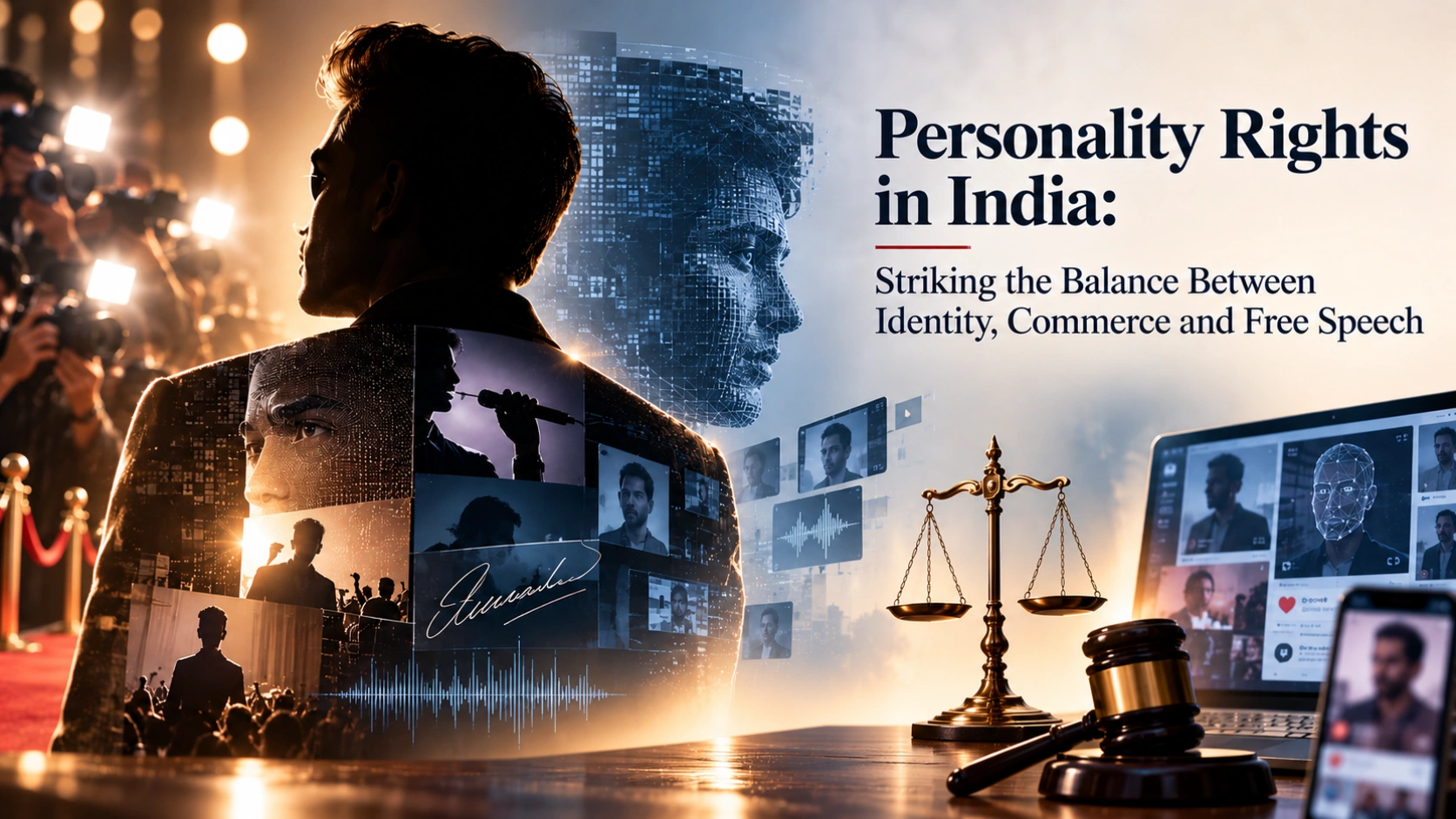
Personality Rights in India: Striking the Balance Between Identity, Commerce and Free Speech
By – Jane Kapai and Monalika Chaudhary
Table of Contents
Introduction
A celebrity’s name, face, voice, mannerisms or even a catchphrase can carry substantial commercial value. In an increasingly digital economy, this value can be exploited through merchandise, advertisements, social media, artificial intelligence (“AI”), deepfakes and voice-cloning technologies—often without the individual’s consent.
Indian courts have responded to these developments by extending protection to what are commonly described as “personality rights” or “publicity rights”. However, unlike copyright, trademark or patent rights, India does not have a dedicated statutory framework defining personality rights, their scope, duration or permissible limitations. The doctrine has instead developed incrementally through constitutional principles, common-law remedies and judicially crafted protections.
This judicial evolution raises an important question: how far should the law protect a person’s identity, particularly where that identity has acquired commercial value, without converting personality rights into a monopoly over public discourse?
Understanding Personality and Publicity Rights
Personality rights broadly concern the protection of the attributes that constitute an individual’s identity. These may include a person’s name, image, likeness, voice, signature, gestures, mannerisms or other distinctive characteristics. The academic literature generally identifies two overlapping dimensions: privacy and publicity. Privacy protects an individual’s personal sphere from unwanted intrusion, whereas publicity protects the commercial value associated with the individual’s identity.
The distinction is important. The unauthorised publication of a person’s private photograph may implicate privacy and dignity, even where there is no commercial exploitation. Conversely, using a celebrity’s photograph in an advertisement to suggest an endorsement primarily raises the question of commercial appropriation.
Indian jurisprudence has, however, frequently addressed these two dimensions together, contributing to some uncertainty regarding the precise legal nature of personality rights. While Indian courts have accepted publicity rights within the broader intellectual-property framework, their development as an independent facet of the constitutional right to privacy has historically remained less settled.
From Privacy to Publicity: The Constitutional Foundation
The constitutional foundation of the doctrine can be traced to R. Rajagopal v. State of Tamil Nadu, commonly known as the Auto Shankar case. The case arose when the Tamil magazine Nakkheeran proposed to publish the autobiography of Gauri Shankar, a death-row prisoner convicted of multiple murders. Prison authorities sought to prevent publication, arguing that it contained information about prison officials. The Supreme Court held that the press could publish information drawn from public records without the subject’s consent, while publication of private matters beyond the public record could attract liability if it unjustifiably invaded privacy. The decision thus helped establish both the protection of privacy and an important boundary for publication about public figures
The Supreme Court recognised privacy as part of Article 21 and held that an individual has a right to protect matters concerning his or her private life from unauthorised publication, subject to recognised exceptions including matters forming part of the public record. The judgment consequently became an important foundation for subsequent judicial discussion concerning control over one’s identity and personal information.
The constitutional position was subsequently placed on firmer ground by the Supreme Court’s nine-Judge Bench judgment in Justice K.S. Puttaswamy (Retd.) v. Union of India, which recognised privacy as a fundamental right under Article 21. Privacy was understood to protect the autonomy and dignity of the individual against intrusion by both State and non-State actors.
However, a constitutional right to privacy does not automatically establish an unrestricted proprietary right over one’s identity. This distinction becomes particularly important when personality rights are asserted against expression that is not commercial in nature.
The emergence of the Commercial Right of Publicity
The Delhi High Court’s decision in ICC Development (International) Ltd. v. Arvee Enterprises, is generally regarded as an early and important articulation of the commercial right of publicity in India.
The Court explained that the right of publicity derives from the right of privacy and vests in the individual rather than in an event organiser or corporate entity. The judgment recognised that an individual’s name, personality traits, signature or voice may acquire commercial value and that such value cannot simply be appropriated by another entity.
The Delhi High Court subsequently developed this principle in D.M. Entertainment Pvt. Ltd. v. Baby Gift House, wherein, the defendants imported and sold small singing/dancing dolls that mimicked the physical likeness, style, and signature moves of Daler Mehndi, and played his musical compositions without authorization, whereas he had assigned his publicity and commercial rights exclusively to D.M. Entertainment.. The Court recognised protection against unauthorised commercial exploitation of a celebrity’s persona, while simultaneously cautioning against allowing publicity rights to become so expansive that they suppress legitimate public expression.
This tension between commercial appropriation and free expression remains central to personality-rights jurisprudence.
Titan Industries and the Commercial Exploitation of Identity
In Titan Industries Ltd. v. Ramkumar Jewellers, the Delhi High Court considered the unauthorised use of Amitabh Bachchan and Jaya Bachchan’s likeness in jewellery advertisements.
The Court recognised the commercial value of celebrity identity and held that unauthorised commercial use of a celebrity’s image could infringe the celebrity’s publicity rights. The decision has subsequently become an important reference point for the proposition that a person’s recognisable identity can possess an independent commercial value capable of legal protection.
Similarly, in Shivaji Rao Gaikwad v. Varsha Productions, the Madras High Court granted protection in relation to actor Rajinikanth’s name and persona, demonstrating that the development of personality-rights jurisprudence was not confined to the Delhi High Court.
Personality Rights in the Digital and AI Era
The rapid development of social media and generative AI has substantially expanded both the value of personality and the means by which it can be appropriated.
The Delhi High Court’s decision in Anil Kapoor v. Simply Life India, is particularly significant. The Court’s protection extended beyond the actor’s name and likeness to aspects such as his voice, gestures, mannerisms and the expression “Jhakaas”. The decision demonstrated that personality rights are capable of protecting a combination of distinctive attributes through which an individual is identifiable.
The AI era has subsequently produced disputes concerning deepfakes and synthetic voices. In Arijit Singh v. Codible Ventures LLP, the Bombay High Court considered unauthorised use of the singer’s personality traits, including his name, image and voice, alongside AI technologies capable of replicating a person’s distinctive vocal identity.
More recent litigation has similarly involved AI-generated content and unauthorised digital representations of public figures, demonstrating that traditional concepts of “image” and “likeness” may no longer adequately describe the ways in which an individual’s identity can be reproduced.
The emergence of AI therefore presents a fundamental challenge: if technology can recreate a person’s voice, appearance or mannerisms without using an exact photograph or recording, should the law protect the resulting digital persona in the same manner as the original?
Recent judicial decisions suggest an increasing willingness to do so, but the absence of statutory standards leaves the boundaries of such protection uncertain.
John Doe Orders: A Judicial Response to Digital Infringement
The difficulty of identifying online infringers has also led courts to increasingly employ John Doe orders.
In Amitabh Bachchan v. Rajat Nagi, the Delhi High Court granted broad protection against unauthorised commercial exploitation of Amitabh Bachchan’s name, image, voice and other personality attributes. Such orders are particularly useful in the digital environment because infringing content can be generated and disseminated by unidentified actors at a speed that makes conventional litigation ineffective.
This procedural innovation allows courts to provide immediate relief against unidentified infringers and platforms hosting infringing material. It has since been followed in a number of personality-rights and AI-related disputes.
However, the convenience of broad ex parte injunctions must be balanced against the possibility of restraining legitimate expression without the benefit of hearing the affected parties.
The Limits: Personality Rights cannot become a Right to control Public Discourse
The most important limitation on personality rights is the constitutional guarantee of freedom of speech and expression under Article 19(1)(a). Since the orders passed in the case of Mr. Amitabh Bacchan, many actors have followed suit and filed similar petitions seeking protection of their personality rights, including but not limited to Anil Kapoor, Jackie Shroff and Arijit Singh—have also approached courts to restrain unauthorised commercial use of their names, images, voices or other identifiable attributes. These cases illustrate the growing importance of effective remedies, particularly against online impersonation and AI-generated replicas; they also make it necessary to distinguish misleading commercial exploitation from legitimate public discussion.
In D.M. Entertainment, the Delhi High Court expressly cautioned that excessive emphasis on publicity rights could chill legitimate expression. The Court recognised that an individual’s fame cannot result in the public losing an entire category of expression merely because it refers to a famous person.
This principle was further developed in Digital Collectibles Pte. Ltd. v. Galactus Funware Technology Pvt. Ltd., in which professional cricketers and entities, challenged the use of players’ names, images and other attributes on “Striker”, an online fantasy-sports platform that offered digital player cards, including NFT-enabled cards. They sought interim injunctive relief against the unauthorised use of these attributes. On 26.04.2023, the Delhi High Court declined to grant the interim injunction and emphasised that publicity rights are not absolute, and the use of publicly available information and personality attributes must be assessed alongside freedom of speech and expression. The Delhi High Court declined to treat publicity rights as an absolute and unrestricted right. The Court recognised that uses of celebrity names or images for purposes such as satire, parody, art, scholarship, music, academics and news may be protected by Article 19(1)(a).
The distinction between commercial appropriation and legitimate expression is therefore critical.
A celebrity cannot necessarily prevent a newspaper from reporting on them, an author from writing about their life, an artist from creating a parody, or a member of the public from commenting upon their work merely because their name or likeness is used.
The challenge lies in determining when such expression crosses the line into commercial exploitation, false endorsement, misrepresentation or unlawful appropriation.
The Posthumous Dimension
Another unresolved aspect is whether personality rights survive death.
The Delhi High Court considered this question in Krishna Kishore Singh v. Sarla A. Saraogi, concerning a proposed film based on the life of actor Sushant Singh Rajput. The plaintiff sought protection against use of his deceased son’s name, likeness and lifestyle without the permission of his legal heirs. The Court explicitly observed that the right to privacy, publicity, and personality belong strictly to the individual during their lifetime. Because these rights are personal and not property-based, they extinguish with the death of the individual, meaning a legal heir or father cannot sue to enforce them posthumously, and restraining the broadcast of the film would unjustifiably infringe upon the filmmakers’ fundamental right to freedom of expression under Article 19(1)(a) of the Indian Constitution
The litigation illustrates a fundamental difficulty: while privacy is inherently connected to an individual, the commercial value of a celebrity’s persona may continue after death. Whether such commercial value can be inherited, licensed or controlled by heirs cannot simply be answered by treating personality rights as identical to ordinary property rights.
The issue therefore remains one of the areas requiring greater legislative clarity.
Does India need a codified Personality-Rights regime?
The absence of a dedicated statute has allowed Indian courts to respond flexibly to new forms of exploitation. This judicial adaptability has been particularly valuable in addressing deepfakes, AI-generated content and online impersonation, where legislation may not evolve at the same pace as technology.
However, judicial development also creates uncertainty. There is presently no comprehensive statutory definition of personality rights, no uniform test for determining infringement, no clearly prescribed duration of the right, and limited clarity regarding its transmissibility after death. The existing framework instead draws upon a combination of constitutional privacy, passing off, trademark principles, copyright law and equitable remedies.
A codified framework could establish clearer standards for:
- identifying protectable attributes of personality;
- distinguishing privacy from publicity rights;
- determining commercial exploitation;
- protecting legitimate news, commentary, parody and artistic expression;
- determining whether rights survive death;
- addressing AI-generated replicas and synthetic voices; and
- prescribing appropriate remedies against online intermediaries and unidentified infringers.
At the same time, legislation must avoid transforming personality rights into an overly broad proprietary monopoly over a person’s identity.
Conclusion
Indian personality-rights jurisprudence has travelled a considerable distance—from the privacy principles of R. Rajagopal, through the commercial publicity cases such as ICC Development, D.M. Entertainment and Titan Industries, to the AI and deepfake disputes of the present day.
The judicial response has been pragmatic. Courts have recognised that identity can possess both dignitary value and commercial value, and that technological developments can make unauthorised exploitation substantially more intrusive than traditional forms of image misuse.
Yet protection of personality cannot exist in isolation. A democratic society must preserve space for journalism, criticism, parody, artistic expression, scholarship and public discussion. Digital Collectibles serves as an important reminder that publicity rights are not absolute and must operate within the constitutional framework of free expression.
The next stage of India’s personality-rights jurisprudence therefore requires a careful balance. The objective should not simply be to give celebrities greater control over everything associated with their identity, but to identify when the law should intervene and why.
As AI increasingly blurs the distinction between authentic identity and synthetic representation, the need for clarity becomes more pressing. A carefully designed statutory framework could provide that clarity while preserving the constitutional principle that fame may create commercial value, but it cannot by itself extinguish the public’s right to speak, create, report and comment.
FAQs
-
What are personality rights in India?
Personality rights protect the attributes that constitute an individual’s identity, including their name, image, likeness, voice, signature, gestures and distinctive mannerisms. They encompass two related dimensions: the right to privacy, which protects an individual’s personal sphere from unauthorised intrusion, and the right of publicity, which protects the commercial value associated with their identity. In India, these rights have developed primarily through judicial decisions, constitutional principles and existing legal remedies, rather than through a dedicated statute.
-
How do Indian courts balance personality rights and freedom of speech?
Indian courts seek to protect individuals against unauthorised commercial exploitation of their identity without unduly restricting freedom of speech and expression under Article 19(1)(a) of the Constitution. While courts have restrained the unauthorised use of identities in advertisements and other commercial contexts, they have also recognised that personality rights cannot become an absolute right to control public discourse. News reporting, criticism, satire, parody, artistic expression and academic discussion may receive constitutional protection, depending on the circumstances. The key consideration is whether the use constitutes legitimate expression or crosses the line into unlawful commercial appropriation, false endorsement or misrepresentation.
-
Can celebrities in India take legal action against AI-generated deepfakes?
Yes. Celebrities can seek legal remedies against unauthorised AI-generated deepfakes, synthetic voices and digital replicas that exploit their identity or misrepresent their endorsement. Indian courts have increasingly recognised that personality rights may extend beyond a person’s name and photograph to distinctive attributes such as their voice, gestures and mannerisms. Decisions such as Anil Kapoor v. Simply Life India and Arijit Singh v. Codible Ventures LLP illustrate the judicial response to unauthorised exploitation of celebrity identities, including through emerging technologies.
-
Do personality rights continue after a person’s death in India?
The survival of personality rights after death remains an unsettled area of Indian law. Although an individual’s identity may continue to possess commercial value after their death, it is unclear whether, and to what extent, such rights can be inherited, licensed or enforced by legal heirs. In Krishna Kishore Singh v. Sarla A. Saraogi, concerning a proposed film based on the life of actor Sushant Singh Rajput, the Delhi High Court considered issues relating to the use of a deceased person’s identity. The position highlights the need for greater clarity on the duration, transmissibility and posthumous protection of personality rights.
-
Does India need a separate law to protect personality rights?
A dedicated statutory framework could provide greater certainty regarding the scope, duration and enforcement of personality rights in India. At present, protection is derived from a combination of constitutional privacy principles, passing off, trademark and copyright law, and judicial remedies. A separate law could clarify which attributes of identity are protectable, establish standards for determining infringement, address AI-generated replicas and synthetic voices, and define whether rights survive death. However, such legislation must also safeguard legitimate journalism, criticism, parody, artistic expression and public discussion. The objective should be to prevent unauthorised exploitation of identity without creating an unrestricted monopoly over a person’s name, image or persona.
References –
- (1994) 6 SCC 632
- (2017) 10 SCC 1
- 2003 SCC OnLine Del 2
- 2010 SCC OnLine Del 4790
- 2012 SCC OnLine Del 2382
- 2015 SCC OnLine Mad 158
- 2023 SCC OnLine Del 6914
- 2024 SCC OnLine Bom 2445
- (2022) 6 HCC (Del) 641
- Supra
- 2023 SCC OnLine Del 2306
- 2023 SCC OnLine Del 3997
 You wish to know more about Neeti Niyaman (the “Firm”) for your own information and use.