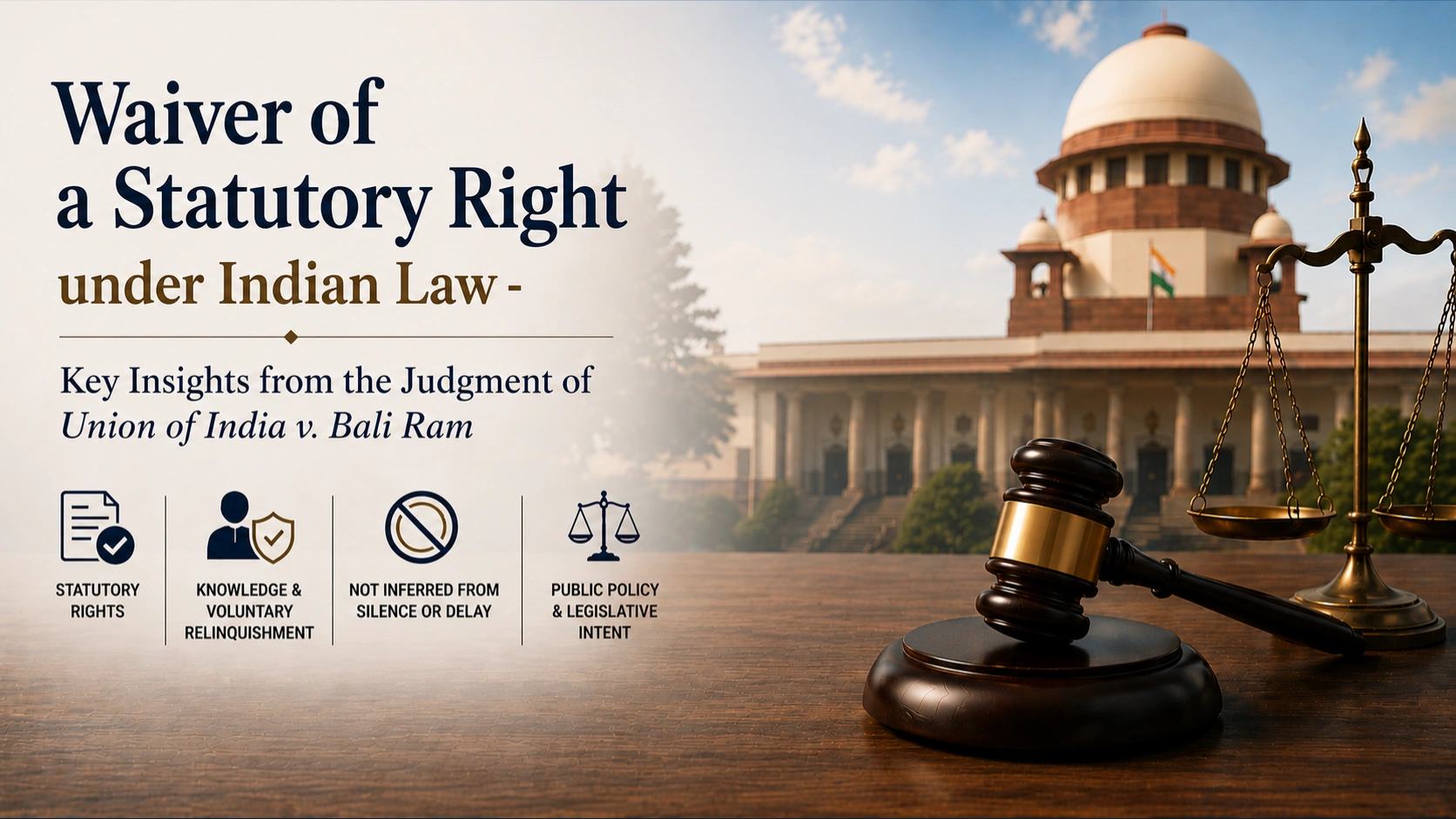
Waiver of a Statutory Right under Indian Law – Key Insights from the Judgment of Union of India v. Bali Ram
By – Kaushiki and Amisha Rathaur
Table of Contents
Introduction
The doctrine of waiver occupies an important place in Indian jurisprudence as it governs the circumstances in which a person may voluntarily relinquish a legal right. While founded upon the principles of individual autonomy and legal certainty, the doctrine assumes greater significance where the right sought to be waived is statutory in nature. Unlike contractual rights, statutory rights are created by the legislature to achieve specific legal and public objectives. Consequently, the question whether such rights may be waived depends not merely upon the intention of the individual but also upon the purpose for which the legislature enacted the statutory protection.
Indian courts have consistently recognised that not every statutory right is capable of waiver. Rights enacted solely for the benefit of an individual may ordinarily be relinquished by the beneficiary. However, where a statutory provision serves a public purpose or embodies public policy, its waiver is generally impermissible since private consent cannot be allowed to defeat legislative intent. The doctrine therefore strikes a careful balance between individual autonomy and the preservation of statutory objectives.
The Supreme Court has played a pivotal role in shaping this doctrine through judicial interpretation. While Krishan Lal v. State of J & K laid the foundational principles governing the waiver of statutory rights, the recent decision in Union of India v. Bali Ram reaffirmed those principles and clarified the essential requirements for establishing a valid plea of waiver. Read together, these decisions provide a coherent framework governing the application of the doctrine under Indian law. This article examines the legal principles governing waiver of statutory rights and analyses the significance of the Supreme Court’s decision in Bali Ram (Supra).
Concept of Waiver of Statutory Rights
Waiver is generally understood as the intentional and voluntary relinquishment of a known legal right. The doctrine proceeds on the principle that a person entitled to a legal benefit may elect not to enforce it, provided such relinquishment is conscious, informed and unequivocal. Since waiver results in the abandonment of a valuable legal right, courts do not readily infer its existence from silence, delay or inaction. Rather, there must be clear evidence demonstrating that the person had knowledge of the right and intentionally chose to relinquish it.
The doctrine assumes particular significance where the right originates from a statute. Unlike contractual rights, statutory rights derive their existence from legislation enacted to achieve specific objectives. Consequently, the enquiry extends beyond the conduct of the individual to the purpose underlying the statutory provision.
Indian jurisprudence has consistently recognised that statutory rights enacted exclusively for the benefit of an individual may ordinarily be waived. Conversely, statutory rights enacted in furtherance of public interest or legislative policy are generally incapable of waiver, as permitting their relinquishment would undermine the object of the statute. Whether a statutory right is capable of waiver therefore depends upon the purpose of the enactment, the nature of the right conferred and the consequences of permitting its waiver.
Judicial Development of the Doctrine
The judicial contours of the doctrine of waiver have been considerably refined through the decisions of the Supreme Court in Krishan Lal v. State of J & K and Union of India v. Bali Ram. While Krishan Lal (Supra) laid the doctrinal foundation governing the waiver of statutory rights, Bali Ram (Supra) reaffirmed those principles and clarified the essential requirements that must exist before a court can conclude that a legal right has been waived. Read together, these decisions provide a coherent framework governing the application of the doctrine under Indian law.
The Principle Laid Down in Krishan Lal v. State of J & K
A significant contribution of Krishan Lal (Supra) lies in establishing that the permissibility of waiving a statutory right depends upon the purpose for which the right has been enacted rather than its mandatory character. The Supreme Court held that statutory rights created solely for the benefit of an individual may ordinarily be waived, whereas rights enacted in furtherance of public interest or public policy ordinarily cannot, as permitting their waiver would defeat the legislative object. In reaching this conclusion, the Court relied upon established principles of statutory interpretation recognising that a person may renounce a legal benefit introduced exclusively for his own advantage, but not where such waiver would undermine a statutory scheme enacted in the public interest.
Applying this principle, the Court examined Section 17(5) of the Jammu and Kashmir (Government Servants) Prevention of Corruption Act, 1962, which required that a copy of the inquiry proceedings be furnished to the delinquent employee before the proposed penalty was imposed. The Court held that the provision was intended to enable the employee to effectively represent his case and was therefore enacted for his benefit. Although the provision was mandatory, it was legally capable of being waived.
However, on the facts, the Court found that the employee had consistently insisted upon receiving the inquiry proceedings and had never abandoned the statutory protection available to him. There was neither an express nor an implied relinquishment of the right. Accordingly, the Court held that no waiver could be inferred.
Reaffirmation in Union of India v. Bali Ram
The Supreme Court revisited the doctrine in Union of India v. Bali Ram and reaffirmed the principles laid down in Krishan Lal (Supra). The judgment clarified the essential requirements that must be satisfied before a plea of waiver can succeed.
The Court described waiver as the intentional relinquishment of a known right, advantage, benefit, claim or privilege. It held that three essential conditions must coexist before waiver can be inferred. First, the person against whom waiver is alleged must possess an existing legal right. Secondly, such person must have clear knowledge of that right. Thirdly, despite possessing such knowledge, the person must consciously and voluntarily relinquish it. The absence of any one of these elements is sufficient to defeat a plea of waiver.
Equally significant is the Court’s clarification that waiver cannot be inferred merely from silence, inaction or delay. Passive conduct, by itself, does not necessarily indicate an intention to abandon a legal right. There must be clear and unequivocal conduct demonstrating that the person, with full knowledge of the right available, consciously elected not to enforce it. By insisting upon this standard, the Court ensured that valuable legal rights are not defeated on the basis of assumptions or speculative inferences.
The judgment also highlights the procedural dimension of the doctrine. The Court observed that whether a party has waived a right is essentially a question of fact arising from the conduct of the parties. Consequently, a plea of waiver ordinarily requires specific pleadings. In the absence of such pleadings, the issue need not be adjudicated. The burden therefore rests upon the party asserting waiver to establish the factual foundation necessary to sustain the plea.
Applying these principles, the Supreme Court rejected the appellants’ contention that the respondent had waived the statutory protection available under Section 47 of the Persons with Disabilities (Equal Opportunities, Protection of Rights and Full Participation) Act, 1995, by accepting disability pension. The Court found that there was no material to establish that the respondent had knowledge of the statutory right sought to be enforced. Equally absent was any evidence to show that he had consciously elected to relinquish that right. Since the essential requirements of knowledge and voluntary relinquishment were not established, the plea of waiver necessarily failed.
The Court further reiterated that waiver of a statutory right is generally disfavoured where the statute has been enacted as a welfare measure or where permitting waiver would be contrary to public policy. In doing so, it reaffirmed the principle recognised in Krishan Lal (Supra) that statutory protections enacted to advance broader legislative objectives cannot readily be defeated through lightly inferred waivers.
The Contemporary Legal Position
The decisions in Krishan Lal (Supra) and Bali Ram (Supra) collectively provide a coherent framework governing the waiver of statutory rights under Indian law. Krishan Lal (Supra) establishes the governing principle that the permissibility of waiver depends upon the purpose of the statutory right rather than the mandatory nature of the provision. Building upon that foundation, Bali Ram (Supra) identifies the essential ingredients of waiver and clarifies the evidentiary burden resting upon the party asserting it.
The significance of Bali Ram (Supra) lies not in altering the settled legal position but in reaffirming that waiver cannot be inferred from equivocal conduct, silence or mere inaction. A plea of waiver must be supported by clear evidence demonstrating that a person, having full knowledge of an existing legal right, consciously and voluntarily chose to relinquish it. Equally important, the judgment reiterates that the burden of proving waiver rests upon the party asserting it and that such a plea ordinarily requires specific pleadings supported by cogent evidence.
These judgments reinforce that the doctrine of waiver strikes a balance between individual autonomy and legislative intent. While an individual may relinquish rights enacted solely for his or her benefit, statutory protections enacted in furtherance of public welfare or public policy cannot readily be defeated through lightly inferred waivers. The contemporary judicial approach therefore preserves both the voluntary nature of waiver and the integrity of the statutory framework.
Conclusion
The doctrine of waiver occupies a significant position in Indian jurisprudence by balancing an individual’s freedom to relinquish a legal right with the need to preserve statutory provisions enacted in the public interest. While statutory rights created solely for the benefit of an individual may, in appropriate circumstances, be waived, the same principle does not ordinarily extend to rights enacted to advance public policy or broader legislative objectives. The decisive consideration, as consistently recognised by the Supreme Court, is the purpose underlying the statutory provision.
The recent decision in Union of India v. Bali Ram assumes particular significance because it reaffirms and clarifies the settled principles governing waiver of statutory rights. By emphasising that waiver requires an existing legal right, knowledge of that right and its conscious and voluntary relinquishment, the Court has reaffirmed that waiver cannot be inferred from silence, delay or equivocal conduct. The judgment further clarifies that the burden of proving waiver rests upon the party asserting it and that such a plea ordinarily requires a proper factual foundation supported by specific pleadings.
When read alongside Krishan Lal (Supra), Bali Ram (Supra) provides a clear and authoritative exposition of the doctrine of waiver of statutory rights under Indian law. Together, these decisions reaffirm that the question of waiver ultimately depends upon the object of the statute and the legislative purpose sought to be achieved. As statutory and regulatory litigation continues to evolve, the principles reaffirmed in Bali Ram (Supra) will continue to guide courts in ensuring that the doctrine of waiver promotes legal certainty without compromising legislative intent or public policy.
FAQs
-
What is the doctrine of waiver under Indian law?
The doctrine of waiver is the voluntary and intentional relinquishment of a known legal right. A valid waiver must be conscious, informed, and unequivocal, and cannot be presumed from mere silence or inaction.
-
Can statutory rights be waived under Indian law?
Yes, but only where the statutory right is enacted for the benefit of an individual. Statutory rights enacted in public interest or to further legislative policy generally cannot be waived.
-
Can Fundamental Rights be waived under the Indian Constitution?
No, the Supreme Court in Basheshar Nath v. Commissioner of Income Tax held that Fundamental Rights cannot be waived, as they are constitutional guarantees intended to protect individuals against arbitrary State action and uphold the rule of law.
-
What is the difference between waiver and estoppel?
Waiver is the voluntary relinquishment of a known legal right, whereas estoppel prevents a person from going back on a representation that another has relied upon. Waiver is based on intentional abandonment, while estoppel is based on representation and reliance.
-
What are the essential requirements for a valid waiver under Indian law?
A valid waiver requires an existing legal right, full knowledge of that right, and a conscious, voluntary, and unequivocal intention to relinquish it. The burden of proving waiver lies on the party asserting it.
-
Can waiver be inferred from silence or delay?
No, mere silence, delay, or passive inaction does not amount to waiver. Courts require clear evidence of an intentional and voluntary abandonment of a known legal right.
References –
- (1994) 4 SCC 422
- 2026 LiveLaw (SC) 668
- (1994) 4 SCC 422
- 2026 LiveLaw (SC) 668
- (1994) 4 SCC 422
- 2026 LiveLaw (SC) 668
- 2026 LiveLaw (SC) 668
- 2026 LiveLaw (SC) 668
 You wish to know more about Neeti Niyaman (the “Firm”) for your own information and use.