The Citizenship Conundrum: Is your Indian Passport a proof of citizenship? MEA says no!
By – Sangeeth Narayanan
Table of Contents
Introduction
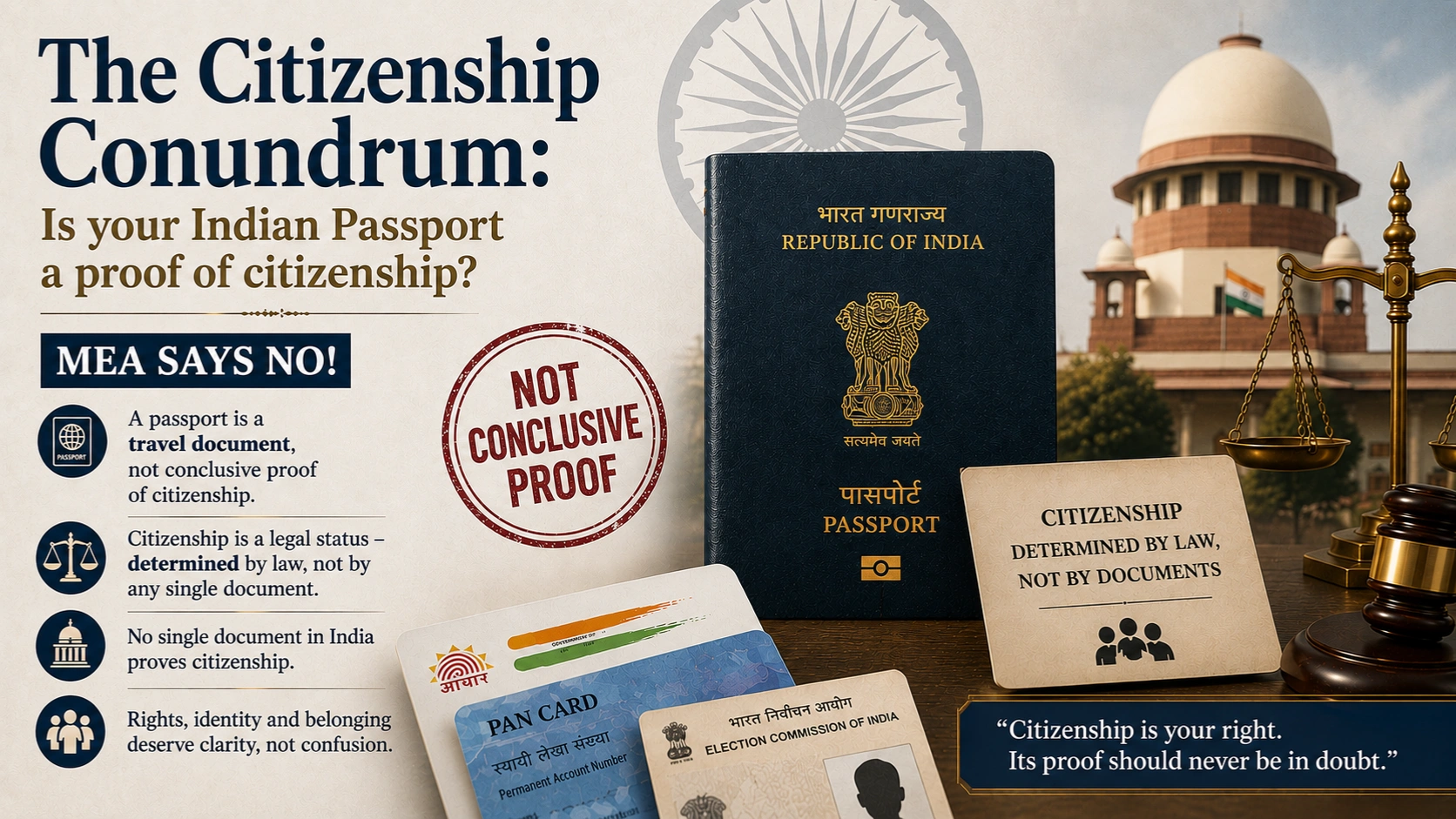
Recently, the Ministry of External Affairs (MEA) clarified that the Indian passport is primarily a “travel document” meant to facilitate internation transit and is not a conclusive proof of citizenship. It was clarified that while passports are issued to Indian citizens, the primary purpose of the passport is to enable international travel and establish identity abroad. This statement by the MEA has resulted in widespread confusion and legal insecurity and has raised concerns policy of redefining citizenship from a permanent identity to an uncertain birthright. Further, the clarification which has come in the wake of ongoing electoral roll controversy has made critics argue that the clarification aims to dilute the fundamental rights and weaken the global credibility of the Indian passport.
What is Citizenship and how is it obtained under Indian law?
Articles 5 to 11 under Part II of The Constitution of India deals with the provisions pertaining to citizenship. Article 5 of the Constitution provides for citizenship at the time of the commencement of the Constitution. It states about three scenarios under which citizenship is accorded at the time of commencement of the constitution. Under Article 5 of the Constitution, every person is deemed to be a citizen of India who, at the time of the commencement of the constitution, had his domicile in the territory of India and who was born in the territory of India or either whose parents were born in the territory of India or who has been ordinarily resident in the territory of India for not less than five years immediately preceding commencement of the constitution.
Further, the Citizenship Act, 1955 (Citizenship Act)1 is the principal statute passed by the Central Government for matters pertaining to acquisition and determination of Indian citizenship. Section 3 of the Citizenship Act states that every person born in India on or after 26th day of January 1950 but before 1st day of July 1987, on or after the first day of July 1987 but before the commencement of the Citizenship (Amendment) Act, 2003 and either of whose parents is a citizen of India at the time of his birth, on or after the commencement of the Citizenship (Amendment) Act, 2003 wherein both the parents are citizens of India or one of whose parents is a citizen of India and the other is not an illegal migrant at the time of his birth shall be considered a citizen of India by birth. Sections 4 and 5 of the Citizenship Act provide for citizenship by descent and citizenship by registration respectively. An important factor to note is that neither the Constitution of India nor the Citizenship Act categorically defines the term ‘citizen’ and does not provide for a single conclusive document for proving citizenship. Therefore, under the Citizenship Act, there are four ways to obtain citizenship – citizenship by birth, citizenship by descent, citizenship by registration and citizenship by naturalisation. Citizenship is treated as a legal status arising from facts such as birth, parentage, domicile or naturalisation.
Relevance of passport as a document as proof of citizenship:
Many Indians believe that the passport is a conclusive document which proves citizenship. Many experts in the legal community even hold the same opinion. However, with the recent clarification by the MEA has raised considerable ambiguity and concern around the validity of passport as a proof of citizenship. The Passports Act, 1967 (Passports Act)2 is the principal statue which governs the issuance of passports and travel documents. It is important to note that while the MEA has stated that the passport is primarily a travel document, the Passports Act categorically differentiate between a “passport” and a “travel document”. The Passports Act defines the term “passport” as a passport issued or deemed to have been issued under the Passports Act. The term “travel document” is defined as a travel document issued or deemed to have been issued under the Passports Act. Sub-section (2) of Section 6 of the Passports Act provides for various scenarios when the passport authority shall refuse to issue a passport or a travel document. The very first reason as stated under the said provisions for refusal to issue a passport or a travel document is that the applicant is not a citizen of India. Therefore, on one hand the Passports Act categorically holds citizenship as a necessary condition for issuance of a passport, on the other hand, the MEA states that the passport is not a conclusive proof of citizenship. Section 12 of the Passports Act deals with offences and penalties. Sub-section (1A) of Section 12 inter alia states that whoever, not being a citizen of India, makes an application for passport or obtains a passport by suppressing information about nationality shall be liable for the punishment mentioned therein. Therefore, even Section 12 of the Passports Act lays significance on citizenship as a necessary condition for application for a passport.
The Compendium of instructions / guidelines relating to issue of passports in India / abroad (Passport Manual)3 contains the guidelines for passport issuing authorities framed under the Passports Act and the rules made thereunder. Clause 7 under Chapter I deals with Passport Seva Project. It categorically states that the Passport Seva Project was launched by the MEA in May 2010 inter alia to augment and improve the delivery of passport services to Indian citizens. Under Clause 1 of Chapter II of the Passport Manual it is specifically stated that all persons who depart and intend to depart from India are required to be in possession of a valid passport or travel document and the word ‘person’ includes Indian citizens. Further clause 6.1 under Chapter II of the Passport Manual states that a passport is largely an identity and travel document issued to the State’s own nationals. A passport provides evidence of the holder’s nationality, but this is placed in the same category as any other evidence of the citizenship status of an individual.
Is there any single document issued by the Government which proves citizenship?
The Government issues various documents such as Aadhaar Card, PAN Card, Voter ID Card, Passport etc. which are used as supporting documents in various formal procedures. However, none of these documents are considered as a conclusive document proving citizenship of the holder of such documents. The Judgement of the Hon’ble Supreme Court in K.S. Puttaswamy (Retd.) v. Union of India4 held that an Aadhaar cannot be considered as proof of citizenship. The PAN card issued by the Income Tax Department is considered purely as a financial and tax identification card and does not confer citizenship. The Voter ID card which empowers a person to vote in an election also does not prove citizenship. Therefore, India does not have a single universal citizenship document. Citizenship is determined strictly under the Citizenship Act and is proven through contextual documents establishing birth, parentage and nationality.
The position held by the Hon’ble Supreme Court with respect to validity of passport vis-à-vis proof of citizenship:
The Hon’ble Supreme Court has observed that there is no standalone document which proves citizenship. No document including passport, aadhaar card, voter id etc. conclusively prove the citizenship of its holder. However, there are certain landmark judgements of the Hon’ble Supreme Court which points towards strong evidentiary value of passport as a document evidencing citizenship and protection to individuals from being stripped off their citizenship in an arbitrary and unlawful manner.
The Hon’ble Supreme Court in Satwant Singh Sawhney vs. D. Ramarathnam, Asstt. Passport Officer5 had specifically observed that a passport is at least prima facie evidence of one’s nationality. The Hon’ble Supreme Court in Association for Democratic Reforms & Ors. v Election Commission of India6 while upholding the constitutional validity of the Election Commission of India SIR of electoral rolls drew a strict line between electoral eligibility and citizenship screening, holding that voter list deletion does not strip a person of citizenship, as the ECI determines voting rights rather than formal nationality.
Documents evidencing citizenship in foreign jurisdictions:
In foreign jurisdictions such as the United States, the United Kingdom etc. a passport amongst other documents are considered as valid documentary evidence demonstrating citizenship. In the United States of America, a full validity US passport, US birth certificate, Consular Report of birth abroad, certificate of naturalization and certificate of citizenship are all valid documents for demonstrating citizenship7. Similarly, in the UK, a British passport and other documents such as British birth certificate, certificate of naturalisation and British Citizenship ceremony registration certificate are valid documents evidencing British Citizenship8.
Conclusion:
The recent clarification of the MEA on the validity of a passport as proof of citizenship has raised critical confusion and concern on the validity of the passport. A passport may primarily enable foreign travel, but while it is not required for citizenship, citizenship remains a prerequisite for its issuance, at least in case of ordinary passports. Citizenship is the foundational legal bond between an individual and a state, granting fundamental rights, legal protections, and a voice in governance. The absence of a single document proving citizenship creates an unprecedented legal vacuum within the country. Certain fundamental rights granted under the Constitution are available only to the citizens and reducing the validity of a passport to merely a travel document increases the risks of arbitrary revocation of citizenship. In view of the prevailing ambiguity, it is incumbent upon the Government to clarify which document would serve as a proof of Citizenship beyond any doubt.
FAQs
-
Is an Indian passport valid proof of citizenship?
As per the recent clarification given by the Ministry of External Affairs, the Indian passport is primarily a “travel document” meant to facilitate internation transit and is not a conclusive proof of citizenship.
-
What is considered proof of Indian citizenship?
At present there is no single document which conclusively proves citizenship in India and citizenship is treated as a legal status arising from facts such as birth, parentage, domicile or naturalisation.
-
What does the Citizenship Act, 1955 say about Indian citizenship?
The Citizenship Act provides for acquisition and determination of citizenship and explains the manner in which citizenship can be acquired by birth, descent, registration and naturalisation.
-
Does the Passports Act, 1967 treat citizenship as a requirement for issuing a passport?
Under Sub-section (2) of Section 6 of the Passports Act, 1967, one of the primary reasons for refusal to issue a passport is that of an applicant not being a citizen of India. Therefore, the Passports Act, 1967 treats citizenship as a requirement for issuing a passport.
-
Is there a single government-issued document that conclusively proves Indian citizenship?
At present, India does not have a single universal citizenship document. Citizenship is determined strictly under the Citizenship Act and is proven through contextual documents establishing birth, parentage and nationality.
References –
- https://www.indiacode.nic.in/bitstream/123456789/6793/1/the_citizenship_act_1955.pdf
- https://passportindia.gov.in/AppOnlineProject/pdf/passports_act.pdf
- https://www.passportindia.gov.in/AppOnlineProject/pdf/Latest_Passport_Manual_for_disclosure_under_RTI_Act.pdf
- (2017) 10 SCC 1
- (1967) 3 SCR 525
- Writ Petition (Civil) No. 640 of 2025
- https://in.usembassy.gov/proof-of-u-s-citizenship/
- https://faq.nhsbsa.nhs.uk/knowledgebase/article/KA-03337/en-us
 You wish to know more about Neeti Niyaman (the “Firm”) for your own information and use.