NEW COMPENSATION HEAD FOR HOMEMAKERS UNDER THE MOTOR VEHICLES ACT
By – Sanya Miglani and Tannishtha Chatterjee
Table of Contents
Introduction
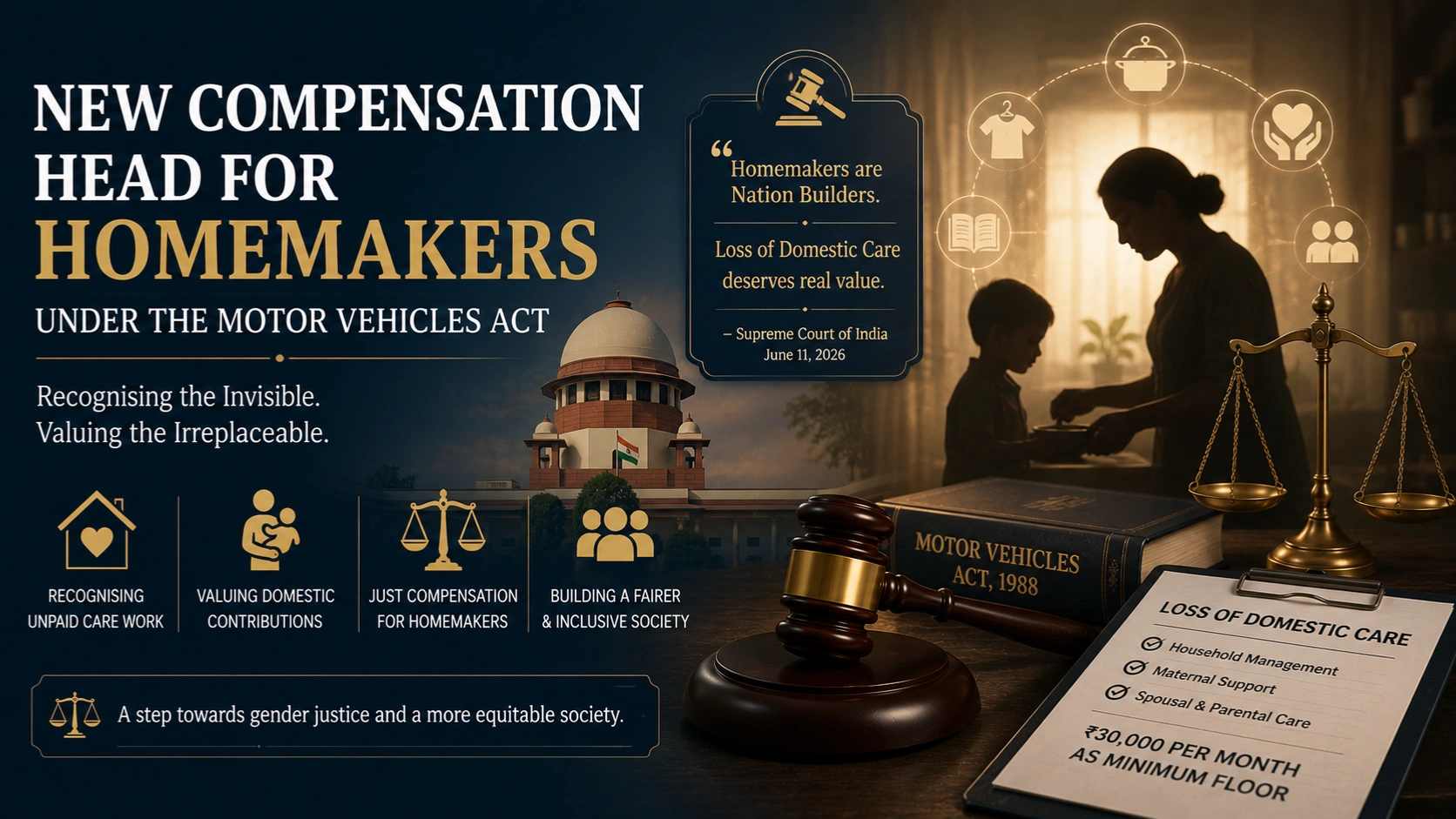
For decades, Indian courts have grappled with a persistent and structurally embedded inequity: when a homemaker dies in a motor accident, what is her economic worth in the eyes of the law? The answer has historically been meagre, a notional income benchmarked against minimum wages for skilled daily labourers, an issue that captured virtually none of the actual value of domestic care work. On June 11, 2026, the Supreme Court of India fundamentally altered this position. The Division Bench of the Hon’ble Supreme Court in the matter of Shishu Pal v. Surjeet1, introduced a new compensatory head titled “Loss of Domestic Care” and enhanced a Motor Accidents Claims Tribunal (“MACT”) award from Rs. 8,43,400 to Rs. 62,77,900, recognising homemakers as “Nation Builders” and fixing Rs. 30,000 per month as the minimum floor for valuing their contribution. The judgment is not merely a revision of quantum; it is a structural correction to a long-standing legal blind spot.
CHRONOLOGY OF LEGAL FRAMEWOK
The Motor Vehicles Act and the Compensatory framework
Compensation in motor accident fatality claims in India is governed by the Motor Vehicles Act, 1988. The Act mandates “just compensation” and empowers Motor Accident Claims Tribunals to adjudicate claims arising from road accidents. The methodology for computing compensation, particularly in fatal accident cases, has been substantially shaped by Supreme Court judgments rather than the statute itself.
The foundational framework towards compensation heads was settled by the Constitution Bench in National Insurance Co. Ltd. v. Pranay Sethi2, which recognised heads including loss of dependency (calculated on the basis of income with a multiplier), loss of consortium, loss of estate, and funeral expenses, with a direction for 10% enhancement every three years on conventional heads. Before Pranay Sethi (2017), there was no uniform or constitutionally settled framework for compensation under the Motor Vehicles Act. The law developed through a series of Supreme Court decisions.
The Homemaker Problem: Invisible Labour, Inadequate Awards
Where the deceased was a homemaker, that is, a person not drawing a market salary, Courts consistently applied a notional income approach. In Lata Wadhwa v. State of Bihar3, the Court assessed compensation for deceased housewives aged between 34 and 59 years at Rs. 3,000 per month. This figure, though well-intentioned, was never updated to reflect inflation or economic reality. In Arun Kumar Agrawal v. National Insurance Co. Ltd.4, the Court observed that the services rendered by a wife and mother could never be equated with those of a paid servant, and that their contribution was unique, irreplaceable and incapable of precise monetary assessment. Despite this recognition, the courts continued to award compensation on notional income benchmarks that were grossly disconnected from the actual economic contribution of domestic work.
In January 2021, in a motor vehicle compensation case, the Supreme Court in the case of Kirti v. Oriental Insurance Company Ltd.5, had observed that the conception that homemakers do not “work” or that they do not add economic value to the household is a problematic idea that had persisted for many years and must be overcome. However, that articulation, though progressive, did not result in a new standalone compensatory head or a fixed minimum benchmark, while the painstaking and time-consuming labour performed by homemakers was given due recognition.
Later in the case of Arvind Kumar Pandey v. Girish Pandey6, the Court held that the contribution of a homemaker is of a very high order and virtually impossible to assess fully in monetary terms.
Judicial recognition of the homemaker’s value grew steadily, yet the compensation framework remained anchored to notional income calculations that failed to capture it. The recent judgement in the case of Shishu Pal v. Surjeet resolved this gap after a long battle of litigation.
The Judgment in Shishu Pal v. Surjeet, 2026 INSC 634
The deceased died in a motor vehicle accident while travelling from Sirsa to Fatehabad, caused by the rash and negligent driving. The legal heirs of the deceased filed a compensation claim before the Motor Accident Claims Tribunal, Sirsa. By award dated December 18, 2003, the MACT granted only Rs. 2,42,000/-. The claimants appealed before the Punjab and Haryana High Court. The appeal remained pending for nearly 20 years and was decided on December 11, 2024, with the High Court enhancing compensation to Rs. 8,43,400 with interest at 7.5% per annum. Dissatisfied, the claimants approached the Supreme Court.
The Supreme Court noted that the prolonged pendency itself warranted examination and called for the records of the courts below. The Court identified two issues of considerable significance: first, the extraordinary delay of two-and-a-half decades in adjudicating a compensation claim under beneficial legislation; and second, the proper method of valuing and compensating the contribution of a homemaker whose labour and services are ordinarily invisible in monetary calculations.
The Court observed that describing a homemaker as “dependent” on earning family members is fundamentally ironic, because the functioning of the household depends substantially on the homemaker herself. Despite this reality, society has failed to adequately acknowledge such contribution. The Court referred to the observation of economist Sir Cecil Pigou in The Economics of Welfare that if a man marries his housekeeper or cook, the national dividend diminishes, because previously remunerated labour becomes unpaid household labour.
The Court noted that women’s unpaid caregiving work is estimated to contribute 15–17% of India’s GDP, yet it remains unpaid and unrecognised. It recognised that homemakers contribute through household management, child-rearing, caregiving, emotional support, and creation of social capital, labour that enables other family members to participate productively in economic activity.
The Court described homemakers as the “potters” who shape households and families, laying the foundation stones for national development, and characterised them as “Nation Builders”.
The Court identified three major dimensions of loss caused by the death of a homemaker. First, loss of household management: a homemaker ensures smooth functioning through domestic labour, planning, supervision, caregiving, and management. Second, loss of maternal support: children lose not merely affection and companionship but guidance, life skills, emotional support, and nurturing. Third, loss of spousal support: the husband loses a life partner upon whom he depends for family management, childcare, social obligations, and emotional stability. The Court further noted that the loss is also experienced by the homemaker’s parents and in-laws who often depend upon her companionship, care, and support.
The Court found that compensation calculated solely through conventional notions of notional income inevitably undervalues homemakers. Accordingly, it created a new compensatory head called “Loss of Domestic Care”, covering the homemaker’s contribution towards smooth functioning of the household, the loss of maternal support for children, and the loss of spousal support or parental care for the parents of the deceased.
The specific directions issued by the Court with respect to this head are:
- A composite amount of Rs. 30,000 per month shall be treated as compensation under the head “Loss of Domestic Care.” The amount shall operate as a stand-in minimum monthly income where the homemaker has no proven monetary earnings.
- The amount shall be revised upward by 10% cumulatively every three years.
- Where the homemaker also has independent earnings, compensation under this head shall be in addition to prove income. The Court further clarified that consortium primarily compensates emotional loss, whereas “Loss of Domestic Care” recognises the homemaker’s economic and managerial contribution within the household.
In the present case, the Court found that the asserted income of Rs. 3,000 per month from knitting and stitching lacked evidentiary support and accordingly treated the case as one involving a homemaker without proven monetary income, applying the newly created head as the monthly income benchmark. The compensation was recalculated as follows: loss of dependency was computed at Rs. 60,48,000/- (based on Rs. 30,000 per month, with 40% future prospects addition, a multiplier of 16, and deduction of one-fourth for personal expenses); loss of consortium at Rs. 1,93,600; loss of estate at Rs. 18,150/-; and funeral expenses at Rs. 18,150/-, bringing total compensation to Rs. 62,77,900/-, together with the same interest regime prescribed by the High Court.
Beyond the substantive question of compensation, the Court also addressed systemic delay. The Bench referred to more than 100 motor accident compensation appeals decided by benches across the Country, noting that the data painted an “unhappy picture” revealing alarming delay across jurisdictions, with numerous appeals remaining pending for periods ranging from 5 to 18 years before High Courts, and nearly 50% of cases reflecting pendency beyond 4 years.
The Court directed Chief Justices of all High Courts to ensure that MACT appeals pending for more than 4 years are listed according to age, with the oldest matters receiving priority, and to consider whether the number of Benches dealing with MACT matters requires enhancement. Tribunals were directed to seriously consider adopting the summary procedure contemplated by Section 169 of the Motor Vehicles Act, 1988, and to record reasons where such procedure is not adopted.
CONCLUSION AND CRITICAL ANALYSIS
The decision in the case of Shishu Pal v. Surjeet represents a significant step in the evolution of compensatory jurisprudence by acknowledging the substantial economic and social value of unpaid domestic and caregiving work. The introduction of the “Loss of Domestic Care” head addresses a longstanding gap in the law and reflects a growing judicial recognition that the contributions of homemakers extend far beyond conventional notions of income. At the same time, the judgment from a feminist lens, invites a reflection of how society traditionally perceives domestic labour, valuing the homemaker primarily through the services she provides to others and the loss occasioned by her absence, rather than through an independent recognition of the opportunities, economic potential, and personal aspirations lost in undertaking unpaid domestic labour.
FAQs
-
What is “Loss of Domestic Care” in motor accident compensation?
“Loss of Domestic Care” is a compensatory head introduced by the Supreme Court in Shishu Pal v. Surjeet to recognise the economic value of a homemaker’s unpaid domestic and caregiving work. It compensates the family for the loss of household management, childcare, caregiving, maternal support, and spousal support that the homemaker provided, independent of any emotional loss covered under consortium.
-
How is homemaker compensation calculated under the Motor Vehicles Act?
Under the Motor Vehicles Act, compensation for a deceased homemaker is calculated by assessing the value of her domestic and caregiving services factoring age and dependency and adding conventional heads such as consortium, loss of estate, and funeral expenses.
-
Can a homemaker’s family claim compensation after her death in a road accident?
A homemaker’s family can claim compensation by filing a petition before the Motor Accident Claims Tribunal under Section 166 of the Motor Vehicles Act, 1988. The homemaker’s domestic services are valued as income through judicial principles and calculated using the multiplier method even if she had no formal earnings.
-
Is “Loss of Domestic Care” different from loss of consortium?
Yes. “Loss of Domestic Care” is a pecuniary head of compensation that values the economic contribution of a homemaker’s unpaid domestic and caregiving services. In contrast, loss of consortium is a non-pecuniary head that compensates for the emotional loss of companionship, affection, guidance, and marital/familial relationship suffered by close relatives due to the death of the victim.
-
What did the Supreme Court hold in Shishu Pal v. Surjeet (2026)?
The Supreme Court in Shishu Pal v. Surjeet Judgment, fundamentally revised motor accident compensation for homemakers by introducing a new compensatory head called “Loss of Domestic Care”. The Court fixed a minimum notional value of INR 30,000 per month for Loss of Domestic Care alongside conventional heads like consortium and funeral expenses.
References –
- 2026 INSC 634
- (2017) 16 SCC 680
- (2001) 8 SCC 197
- (2010) 9 SCC 218
- 2021 SCC OnLine SC 3
- (2025) 2 SCC 145
 You wish to know more about Neeti Niyaman (the “Firm”) for your own information and use.