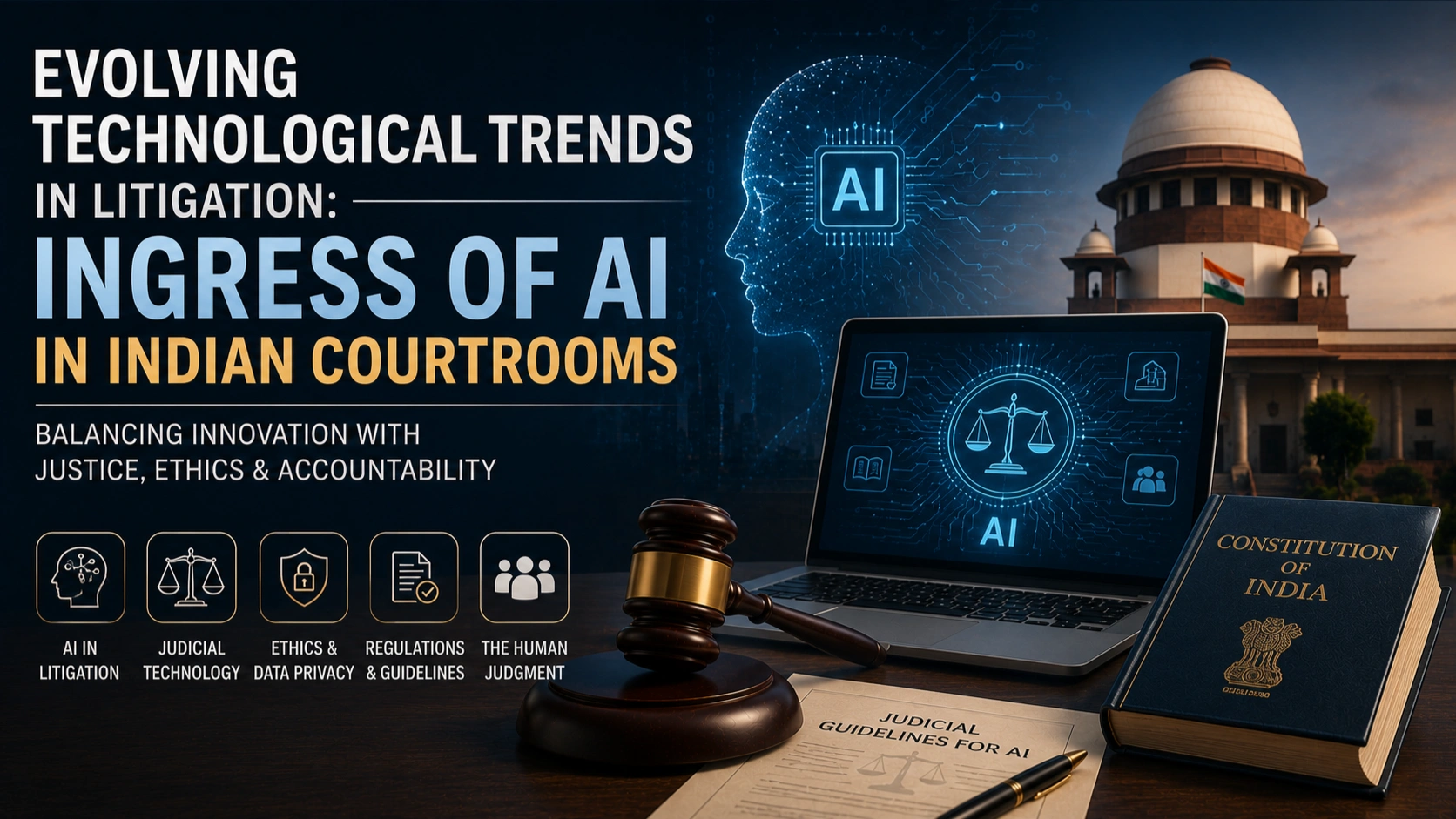
Evolving Technological trends In Litigation : Ingress of AI in Indian Court Rooms
By – Sangeeth Narayanan and Debasmita Goswami
Table of Contents
Introduction- Evolving technological trends (COVID 19 pandemic, CJI Virtual Court Rooms)
The field of litigation is witnessing continuous and expansive technological developments, which are transforming the entire landscape of litigation. Newer and advanced technologies are being developed and adopted in court practice which have tremendously impacted litigation.. For instance, the Supreme Court’s E-filing 2.0 portal which was promoted extensively during former Chief Justice of India D.Y. Chandrachud’s tenure enabled litigants to file cases and documents electronically 24/7. Digital filing of cases has resulted in drastic reduction in usage of paper and have contributed in reduction in overall litigation costs. The adoption of virtual hearing across various Courts, Tribunals and Statutory Commissions which had turned out to be a boon during the Covid-19 pandemic has enabled lawyers to attend hearings across multiple jurisdictions simultaneously.
Artificial Intelligence (AI) is the present groundbreaking technology that is reshaping many industries. Today, AI is fast becoming an integral part of various industries like e-commerce, banking and finance, entertainment etc. The field of law is also undergoing vast changes by emergence of AI. Nowadays AI is being used extensively in several key tasks such as document review, due diligence, legal research, drafting assistance etc. AI has also empowered clients as well as an ordinary citizen by making legal information easily available on fingertips. While the adoption of AI in law and especially in the field of litigation has numerous advantages, it has brought along with it newer challenges as well.
Drawbacks of AI usage in litigation
The primary concern about the deployment of AI in the field of litigation is regarding the accuracy of the AI generated results especially in case of judicial citations. There have been numerous cases where AI has generated non-existent case law citations and the same being referred by the lawyers in the courts of law. In a recent such case in the United State of America, a Federal Judge in Mississippi cancelled a civil trial and disqualified the attorneys for both the litigants after discovering that both the legal teams relied on AI generated results which included fake legal citations. Such instances are not limited to foreign jurisdictions and have occurred in India as well. Reliance on such AI hallucinations strikes at the root of judicial proceedings and would have serious consequences on dispensation of justice.
In addition to the above, there are also concerns regarding privacy and confidentiality. The private and confidential data supplied by the users of AI are prone to becoming publicly available. Further, AI results might include information which are copyrighted and use of such information albeit unknowingly without necessary permission might result in violation of copyright laws.
The need for implementation of formal Regulations for using AI in Courts
Despite the challenges faced due to reliance on AI in litigation, it is next to impossible to entirely root out the usage of AI in litigation. Being in the nascent stage of development, AI technology might not be in such a position wherein it can be relied upon blindly. Similarly, the benefits derived by all the stakeholders in the field of law by making use of AI is sufficiently established. It is only a matter of time until the technology of AI is considerably improved and the same would be put to use to a large extent by lawyers and law firms in the services rendered to their clients. Therefore, in such a case it would only be prudent to establish a set of guidelines / regulations governing the use of AI in law which could promote the benefits of regulated and controlled use of AI while avoiding the various drawbacks that are being encountered while using AI. Many jurisdictions across the world have already laid down guidelines / regulations on permitted use of AI in law / legal proceedings.
Along those lines, on 03.06.2026, the Hon’ble Supreme Court of India has issued ‘draft Regulations for use of Artificial Intelligence (AI) in Courts, 2026’ “Draft Regulations” which has been prepared under the aegis of the Artificial Intelligence Committee, Supreme Court of India. The draft Regulations aim to govern the use of Artificial Intelligence in Courts, grounded in the principles of human primacy, transparency, accountability, data protection and judicial independence, while establishing an institutional framework for responsible AI adoption across India’s judicial system. The Draft Regulations shall apply to the use, deployment, or integration of Artificial Intelligence in any judicial, adjudicatory or administrative function of the Supreme Court of India, High Courts and all Courts including the Tribunals and statutory Commissions performing adjudicatory functions, within the territory of India.
Overview of important provisions under the Draft Regulations
- Regulation 4 of the Draft Regulations provide for human primacy and judicial independence i.e. use of AI in Court process shall at all times remain strictly subservient to human judgement and judicial authority. AI system shall function only in assistive capacity and the ultimate authority to determine the matters of law, facts and justice shall vest exclusively in the judicial officers of the competent jurisdiction.
- Regulation 5 of the Draft Regulations provide that the adoption and use of AI Systems in Courts shall be consistent with the provisions of the Constitution, the principles of natural justice and shall not be used in any manner that could undermine due process, the right to a fair trial, equality before law, or access to justice
- Regulation 6 of the Draft Regulations provide for training of the AI systems used in Courts in such a manner that promotes fairness and avoids bias and discrimination. It further provides that special care shall be taken to protect the interests of the vulnerable groups such as women, children etc.
- Another important provision which is covered under Regulation 9 is auditability and continuous monitoring throughout their lifecycle and establishing adequate mechanism to detect, document and address errors, malfunctions and biases.
- Protection of data and privacy has been given due importance. Regulation 10 provides that processing of personal data through AI Systems shall be governed by the principles of purpose limitation, data minimisation and data privacy by design in accordance with the provisions of the Digital Personal Data Protection Act, 2023.
- The aspect of cyber security has been taken into consideration under Regulation 15 which provides for protection of Court data, processed through or stored in AI Systems by robust, layered and continuously updated technical and organisational security measures, commensurate with the sensitivity of the data and the nature of the Court process.
- Further, Regulations 18 and 19 provide for permissible and prohibited uses of AI. It provides that AI can be used for case management, cause list preparation, hearing scheduling and docket prioritisation. Translation of judgements, orders, pleadings and other documents, legal research, precedent retrieval, citation verification and document verification are some of the purposes for which AI Systems can be used. Further, among the prohibited uses, it is provided that no personal data of any person shall be used to train, test, or refine any AI System without the prior approval of the Appropriate Authority. It further provides that no undisclosed, opaque, or unexplainable AI System shall be used in any Court process that may materially affect the lawful rights or personal liberty of any party and no AI System shall be used to predict, profile, or infer the future conduct or behaviour of parties, accused persons, witnesses, or legal representatives in any Court process. It further provides that no AI-generated output shall be submitted to a Court as an independent source of evidence without full and transparent disclosure of its AI-generated character no AI System shall be used in any manner that may compromise the confidentiality of judicial deliberations or the independence of the judicial decision-making process.
- Another important provision under the Draft Regulations is review of the AI Systems already in use. It further provides that the Appropriate Authority shall determine the appropriate course of action in respect of any system found to be non-compliant.
- The Draft Regulations requires every High Court, Tribunal and Commission to submit an Annual Transparency Report on AI adoption within its jurisdiction, summarising the AI Systems in use, outcomes of audits, AI Incidents recorded and measures taken for compliance with and improvement of these regulations, to the Apex Body.
- All AI Systems deployed in Court processes shall be in compliance with the provisions of the Digital Personal Data Protection Act, 2023, the Information Technology Act, 2000 and any other law governing the protection of personal data and judicial information for the time being in force.
- The Draft Regulations provide for regular, structured training on the technical, legal and ethical dimensions of AI to the Judges, advocates and Court staff, who are required to use or interact with AI Systems in the course of their duties. Such training programmes shall be developed by the AI Secretariat in consultation with relevant domain experts and judicial training institutions.
Guidelines/Regulations for use of AI in judicial system : Foreign Jurisdictions
European Ethical Charter on the Use of Artificial Intelligence in Judicial Systems and their environment also acknowledges the increasing importance of artificial intelligence in modern society. The Charter entails the five principles on the use of artificial intelligence which are as follows:
- Principle of respect for fundamental rights: This is to ensure that the design and implementation of artificial intelligence tools and services are compatible with fundamental rights. Which means that when artificial intelligence tools are used to resolve a dispute or as a tool to assist in judicial decision -making or to give guidance to the public, it is essential to ensure that they do not undermine the guarantees of the right of access to the judge and the right to a fair trial.
- Principle of non-discrimination: The principle specifically prevents the development or intensification of any discrimination between individuals or groups of individuals. Given the ability of the processing methods to reveal existing discrimination, through grouping or classifying data relating to individuals or groups of individuals, public and private stakeholders must ensure that the methods do not reproduce or aggravate such discrimination and that they do not lead to deterministic analyses or uses.
- Principle of quality and security: With regards to the processing of judicial decisions and data, use of certified sources and intangible data with models elaborated should be in a multi -disciplinary manner, in a secure technological environment. The principle further entails that the designers of machine learning models should be able to draw widely on the expertise of the relevant justice system professionals (judges, prosecutors, lawyers etc.). It also proposes to form mixed project teams in short design cycles in order to produce functional models which is one of the organisational methods making it possible to capitalise on the multidisciplinary approach.
- Principle of transparency, impartiality and fairness: The principle ensures making data processing methods accessible and understandable and authorise external audits. A balance must be struck between the intellectual property of certain processing methods and the need for transparency, impartiality, fairness and intellectual integrity when tools are used that may have legal consequences or may significantly affect people’s lives.
- Principle “under user control” : Preclude a prescriptive approach and ensure that users are informed actors and in control of the choices made. The principle entails that user autonomy must be increased and not restricted through the use of artificial intelligence tools and services. Professionals in the justice system should, at any moment, be able to review judicial decisions and the data used to produce a result and continue not to be necessarily bound by it in the light of the specific features of that particular case.
Further, Federal Court of Australia’s practice note on ‘Use of Generative Artificial Intelligence Practice Note’ has also played a pivotal role in shaping the role of AI in the judicial system. The Practice Note applies to all persons who appear before or file documents with the Court. That includes litigants, whether they have legal representation or not. It also includes witnesses and other third parties. As per the practice note Generative Artificial Intelligence (“Generative AI or Gen AI”) refers to systems that create content as text, images, music, audio and videos based on a user’s “prompts.” The Court does recognize that generative AI has the potential to facilitate the just resolution of disputes by increasing efficiency in the conduct of litigation, reducing the legal costs, enhancing access to justice and the quality of the administration of justice. The Court’s expectations concerning the use of Generative AI in connection with proceedings are as follows:
- Any person who uses Generative AI will have a basic understanding of its capabilities, and its limitations and risks.
- If the Court requires it, a person must disclose to the Court if (and how) Generative AI has been used in a proceeding.
- Witnesses, parties and their lawyers must be conscious of their obligations when employing any form of Generative AI to assist in preparing documents intended to represent evidence or opinion evidence.
- Users of Generative AI should know that the technology may create results that are not accurate, entirely fictitious or plainly wrong.
- The use of Generative AI must be disclosed where Generative AI tools were used:
- to summarise or analyse information upon which a witness relies to make a statement of fact or express an opinion;
- to create images, video recordings, sound recordings or other multimedia that are presented to the Court, which should be clearly identified as having been produced using Generative AI.
- If Generative AI tools have been used in the preparation of documents, the Court expects that the responsible person will have confirmed that:
- facts stated in pleadings are based on what the party reasonably considers can be proved and claims for relief are based on proper legal principles;
- legal authorities cited in submissions exist and support the proposition stated;
- evidence cited in submissions exists, is or will be in the materials before the Court and is reasonably likely to be admissible;
- statements about what the evidence proves are findings reasonably open for the Court to make;
- chronologies are accurate.
Conclusion
In a nutshell it can be concluded that the use of AI in the judicial system domain is inevitable. Even though the AI usage has lot of advantages, the drawbacks include spread of misinformation, usage of wrong citations etc. Integration of newer technologies should not be resisted due to the disadvantages / drawbacks it poses. Improving the technology and laying down comprehensive statutory guidelines / regulations for preventing the misuse of technology could definitely be a way forward in integrating AI in courtrooms. Using AI in the judicial field does come with lot of responsibilities, and various Bars across the globe have worked out the guidelines to be followed while using AI for Court work and have also urged the litigants to stringently follow the same in order to ensure fair and speedy justice. The forming of these Draft Regulations by the Supreme Court is a positive step in that direction.
FAQs
-
What are the Draft Regulations for use of AI in Courts, 2026?
The Draft Regulations for use of AI in Courts, 2026 are issued by the Hon’ble Supreme Court of India with an aim to govern the use of Artificial Intelligence in Courts, grounded in the principles of human primacy, transparency, accountability, data protection and judicial independence, while establishing an institutional framework for responsible AI adoption across India’s judicial system.
-
Is AI allowed in Indian courts?
At present AI is not allowed in Indian Courts. The Draft Regulations for use of AI in Courts, 2026 issued by the Hon’ble Supreme Court of India propose to allow the use, deployment, or integration of Artificial Intelligence in any judicial, adjudicatory or administrative function of the Supreme Court of India, High Courts and all Courts including the Tribunals and statutory Commissions performing adjudicatory functions, within the territory of India.
-
What are the main risks of using AI in litigation?
The primary concern about the deployment of AI in the field of litigation is regarding the accuracy of the AI generated results especially in case of judicial citations. There have been numerous cases where AI has generated non-existent case law citations and the same being referred by the lawyers in the courts of law. There are also concerns regarding privacy and confidentiality. The private and confidential data supplied by the users of AI are prone to becoming publicly available.
-
Can AI replace judges in India?
No, the Draft Regulations for use of AI in Courts, 2026 have strict provisions to prevent use of AI systems in any manner that may compromise the confidentiality of judicial deliberations or the independence of the judicial decision-making process.
-
How do other countries regulate AI in courts?
Foreign jurisdictions such as Europe and Australia have introduced various Charter and guidelines for effective use of AI in the judicial systems. European Ethical Charter on the Use of Artificial Intelligence in Judicial Systems in Europe and Federal Court of Australia’s practice note on ‘Use of Generative Artificial Intelligence Practice Note’ have played a pivotal role in this regard.
References –
- Please see, US Judge Kicks Off Lawyers From Both Sides For Using AI, Cancels Trial.
- Please see, Draft ‘Regulations for Use of Artificial Intelligence (AI) in Courts, 2026’.
- Ibid.
- Please see, European Ethical Charter on the use of Artificial Intelligence in judicial systems and their environment.
- Ibid.
- Ibid.
- Ibid.
- Ibid.
- Ibid.
- Please see, Use of Generative Artificial Intelligence Practice Note (GPN-AI)
- Ibid.
- Ibid.
 You wish to know more about Neeti Niyaman (the “Firm”) for your own information and use.