THE BATTLE BEHIND THE SEARCH BAR: TRADEMARKS AND KEYWORD ADVERTISING
By Astha Sehgal and Jane Kapai
Table of Contents
Introduction
Why do certain brands appear before others when a consumer conducts an online search? Is visibility merely a consequence of relevance, or is it something that can be strategically acquired? As search engines have become the primary gateway to information and commerce, the battle for online visibility has evolved into a critical aspect of modern business strategy, reshaping the way brands compete for consumer attention. As businesses seek to position themselves before consumers at the precise moment of purchase intent, the interaction between trademark rights and online advertising has emerged as a significant legal battleground.
KEYWORD ADVERTISING: CONCEPT, OPERATION, AND LEGAL ISSUES
What is a keyword:
Behind every online search lies a powerful digital trigger: the keyword. At its most basic level, a keyword is the word or phrase entered by a user into a search engine. Yet, in the digital economy, keywords are far more than simple search terms, they are valuable gateways to consumer attention. They influence the information and advertisements presented to users, often shaping what consumers see at the very moment they begin looking for a product, service, or brand. It is this ability to capture attention at a critical point in the consumer journey that has made keywords one of the most sought-after assets in the online advertising ecosystem.
Understanding Keyword Advertising:
Keyword advertising is one of the cornerstones of the modern digital marketplace. Through Google Ads (formerly AdWords), advertisers can bid on specific search terms, known as keywords, to ensure that their advertisements appear when users search for those terms on Google’s search engine. While users see the resulting sponsored advertisements, the keyword itself remains invisible, operating in the background as the trigger for displaying the ad. This system enables businesses to reach consumers at the precise moment they express interest in a product, service, or brand. Google monetizes this process through a pay-per-click model, generating revenue each time a user clicks on a sponsored advertisement.
Legal issues surrounding Keyword Advertising:
While keyword advertising has become an integral component of digital marketing strategies, its operation has also given rise to significant legal concerns. The legal controversy arises when advertisers purchase a competitor’s trademark as a keyword. The consequence is that a consumer searching for a particular brand may be presented with sponsored advertisements for rival products or services before reaching the trademark proprietor’s website. In such cases, the goodwill and consumer recognition associated with a trademark are leveraged in a manner that can divert traffic not only to the proprietor’s business but also to competing enterprise.
It is this invisible yet commercially consequential use that brings trademark law into question. Unlike traditional infringement, the mark is neither displayed nor altered, yet its economic value is still actively exploited within the advertising ecosystem. On one hand, keyword advertising may be viewed as a legitimate form of comparative and competitive marketing that enhances consumer choice, on the other, it can be characterised as an attempt to capitalise on the reputation and advertising value painstakingly built by another trader over a period of time. The central legal question, therefore, is whether the purchase and use of a trademark as an invisible keyword amounts to “use” of the mark under trademark law and, if so, whether such use constitutes infringement.
This tension has not gone unanswered. Courts in different jurisdictions have, over time, developed a nuanced body of jurisprudence addressing the legality of keyword advertising and its implications for trademark protection in the digital economy.
JURISPRUDENCE ON THE USE OF TRADEMARKS AS KEYWORDS
The Indian courts have, over the past decade, grappled with the question of keyword advertising and trademark infringement, gradually developing a body of jurisprudence in this area. The prevailing judicial approach has been one of caution and restraint. Courts have generally been reluctant to treat the mere use of a trademark as a keyword as per se infringement, instead examining whether such use leads to consumer confusion or results in an unfair advantage, particularly in cases involving descriptive or non-distinctive marks. This approach reflects a broader concern to balance the protection of trademark rights with the need to preserve legitimate competition in online advertising markets.
In Google LLC v. DRS Logistics and Ors. and Google LLC v. MakeMyTrip (India) Pvt. Ltd., keyword bidding was not treated as trademark infringement per se. Instead, courts focused on whether such use created a likelihood of confusion or conferred an unfair advantage, especially in cases involving descriptive or commonly used trade terms. The Court clarified that infringement must be assessed by examining whether the keyword usage causes confusion, unfairly exploits the trademark’s reputation, dilutes its distinctive character, or otherwise affects its origin-indicating function.
The common thread running through these decisions is a consistent reluctance to treat keyword advertising as infringement per se. Courts have been mindful that trademark law should not be used as a tool to stifle legitimate competition in digital advertising markets. Even where marks are registered, particularly descriptive or generic ones, courts have been cautious in preventing over-extension of monopoly rights over ordinary search terms. The governing approach therefore remains centered on demonstrable consumer confusion or unfair advantage, with search engines and advertising platforms generally viewed as neutral intermediaries.
Taken together, these decisions reflect the settled judicial approach to keyword advertising, which provides the backdrop for the decision in Hindware v Grohe, (“Hindware Ruling”)
The Delhi High Court, in Hindware Ruling, appears to have adopted a more nuanced approach. While not departing entirely from the existing framework, the Court places greater emphasis on the nature of the mark and the role of the platform facilitating the advertising process, including the extent to which it participates in and benefits from such keyword use.
THE HINDWARE RULING: A DOCTRINAL SHIFT
Brief Facts of the Case:
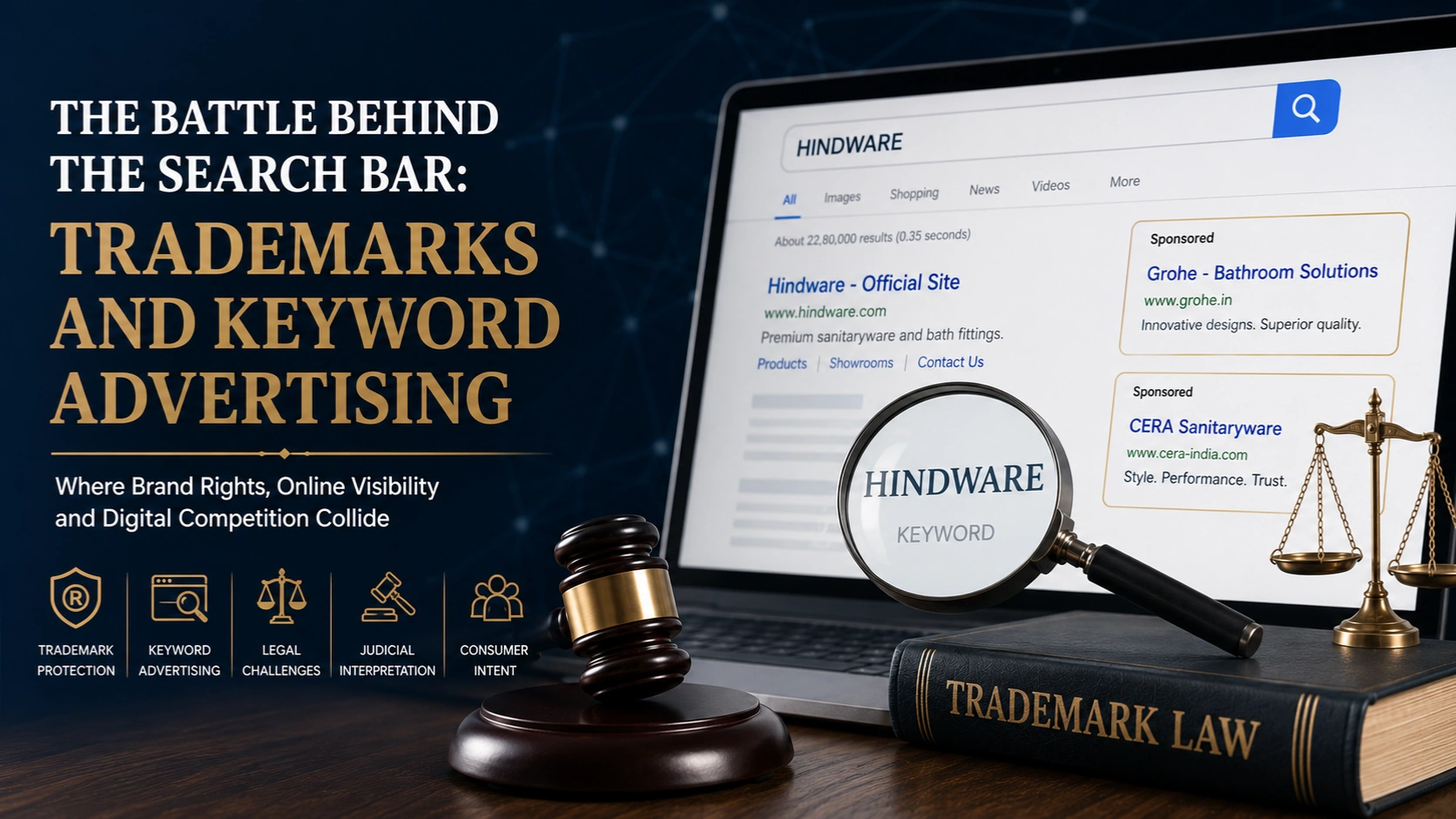
The dispute arose when Hindware Limited, proprietor of the well-known and registered trademark “HINDWARE”, discovered that its competitors, Grohe India Pvt. Ltd. and CERA Sanitaryware Limited, were purchasing the mark as a keyword through Google’s advertising programme. As a result, internet users searching specifically for “HINDWARE” were shown sponsored advertisements for competing sanitaryware products. Hindware alleged that such conduct enabled competitors to capitalise on the goodwill associated with its trademark and diverted consumers who were intentionally seeking its products.
The suit was instituted against both the competing advertisers and Google. During the course of the proceedings, Hindware entered into settlements with the advertiser-defendants. The controversy nevertheless survived insofar as Google was concerned. The central question before the Delhi High Court was whether Google’s role in permitting, facilitating, and monetising the use of the Plaintiff’s trademark as a keyword gave rise to an independent cause of action notwithstanding the settlement with the advertisers. The Court answered this question in the affirmative, holding that Google’s liability, if any, flowed from its own conduct in operating and profiting from the keyword advertising system.
Expanding the Meaning of Trademark “Use”
One of the most significant aspects of the judgment lies in its treatment of the concept of “use” under the Trademarks Act, 1999 (“the Act”). Earlier Indian decisions had dealt with whether a trademark employed invisibly within an advertising algorithm could be said to be “used” for the purposes of infringement. Google argued that a keyword functions merely as a backend trigger and is not ordinarily visible to consumers, distinguishing it from conventional trademark use in advertisements or on goods.
Rejecting this contention, the Court held that the statutory definition of “use” of a mark under Section 2(2)(c) of the Act is sufficiently broad to encompass the deployment of a trademark as a keyword. The Court observed that the Plaintiff’s mark was not being employed incidentally or for a descriptive purpose, rather, it was deliberately incorporated into a commercial advertising system to trigger the display of competing advertisements whenever consumers searched for the plaintiff’s brand. Such use enabled both Google and the advertisers to commercially benefit from the goodwill and consumer recognition associated with the mark and therefore constituted use “in other relation whatsoever” to the relevant goods and services.
Referring to the Madras High Court judgment in Consim Info Pvt. Ltd. v. Google India Pvt. Ltd ., it was observed by the Court that a practice would be regarded as being an honest practice, if it is fair with respect to the legitimate interests of the trademark proprietor and must be treated as being honest in industrial or commercial matters. Google’s actions of selling or trading off the Plaintiff’s trademark to its direct rivals or competitors without permission or sharing any profits therefrom with the trademark proprietor, was evidently considered to be dishonest use and against the principles of commercial morality as it misappropriated the advertising value of the plaintiff’s trademark and free rides on its goodwill.
The Court further held that “use in advertising” under Section 29(6) of the Act cannot be confined to visible representations of a mark. In a digital advertising ecosystem, trademark exploitation frequently occurs through algorithmic processes operating behind the user interface. Consequently, backend keyword insertion, advertisement triggering, and the use of trademarks within search advertising systems were all considered capable of constituting actionable use under the Act.
The Coined and Distinct Mark
The judgment’s most consequential doctrinal contribution is its distinction between descriptive or composite marks and inherently distinctive coined marks in the context of keyword advertising. The Court carefully differentiated the case before it from earlier decisions where the marks under consideration were either descriptive, composite, or derived from ordinary dictionary words. In those cases, courts had been reluctant to prohibit keyword bidding because doing so risked granting monopolies over terms that competitors might legitimately require for descriptive or comparative purposes.
“HINDWARE”, however, was viewed differently. The Court noted that the mark was an invented and inherently distinctive expression with no dictionary meaning and no descriptive connection to sanitaryware products. It had acquired substantial reputation and source-identifying significance through extensive commercial use. According to the Court, a consumer searching for “HINDWARE” is ordinarily seeking the Plaintiff’s products specifically and not merely conducting a generic search for sanitaryware. On this basis, the Court held that the use of such a coined and reputed mark as a keyword by competitors amounted to an appropriation of the mark’s advertising value and commercial magnetism. The judgment emphasises that a well-known coined mark performs not merely a source-identifying function but also an advertising and investment function. By auctioning that mark to competitors, the platform enabled those competitors to benefit from the trademark owner’s investment in building consumer recognition and goodwill.
The Court also rejected Google’s analogy that keyword advertising merely replicates ordinary marketplace behaviour, such as a retailer recommending an alternative brand when a customer asks for a particular product. According to the Court, the analogy fails where the search term itself is a distinctive and reputed trademark because the consumer’s query reflects a specific intention to locate a particular commercial source rather than a general category of products.
Significantly, relying upon principles reflected in Section 29(4) and earlier authorities concerning dilution and unfair advantage, the Court observed that exploitation of a reputed and distinctive mark may be actionable even in the absence of direct evidence of consumer confusion. The unauthorised commercial appropriation of the mark’s reputation and attraction was itself capable of constituting detriment to the trademark owner’s rights.
Google as an Active Participant, not a Passive Intermediary
The second major contribution of the judgment concerns intermediary liability. Google contended that it merely provided a technological platform through which advertisers independently selected keywords and therefore enjoyed protection under Section 79 of the Information Technology Act, 2000, however the Court declined to accept this characterisation. Examining the operational structure of Google’s advertising ecosystem, the Court concluded that Google’s involvement extended well beyond passive hosting. The Court noted that Google designed and controlled the keyword advertising infrastructure, suggested keywords to advertisers, operated the auction mechanism, determined advertisement placement, and derived revenue from every successful click generated through the system.
In the Court’s view, Google was therefore not a neutral intermediary merely transmitting third-party content. Rather, it actively facilitated and monetised the use of trademarked terms within its advertising architecture. Such participation placed Google outside the traditional rationale underlying intermediary safe-harbour protection.
Accordingly, the Court held that Google could not evade scrutiny solely by characterising keyword selection as an advertiser-driven process. Where a platform designs, operates, and profits from a system that enables the commercial exploitation of another’s trademark, its conduct becomes independently relevant for the purposes of trademark infringement analysis.
HINDWARE RULING: IMPLICATIONS AND UNANSWERED QUESTIONS
The immediate consequence of Hindware Ruling is a strengthening of protection for proprietors of highly distinctive and reputed trademarks. Brand owners may now find greater support for challenging the use of their marks as advertising keywords, particularly where competitors are operating in the same commercial field and the platform itself plays an active role in facilitating the bidding process.
The judgment is equally significant for digital platforms. By focusing on Google’s keyword suggestion tools, auction mechanisms, quality-score systems, and revenue model, the Court signalled that intermediary status cannot be assessed solely through formal characterisations of a platform’s role. The more a platform participates in designing, recommending, optimising, and monetising trademark-based advertising, the more difficult it becomes to portray that platform as a passive conduit of third-party content. At the same time, several questions remain unresolved.
First, the judgment is expressly grounded in the characteristics of a coined and well-known mark. It remains unclear whether the same reasoning would apply to marks that are merely distinctive, have acquired secondary meaning, or contain descriptive elements; Secondly, the relationship between trademark protection and competition law remains unsettled. Earlier cases viewed keyword advertising as a mechanism that promoted consumer choice and market competition. Hindware Ruling places greater emphasis on protecting accumulated goodwill from commercial appropriation. Future courts will likely be required to balance these competing considerations more explicitly. Lastly, the decision raises broader questions about the responsibilities of search engines and digital intermediaries. If keyword auctions involving coined marks are actionable because of the platform’s active participation, the same logic may invite scrutiny of recommendation systems, sponsored search rankings, and other algorithmic tools that monetise trademark value.
CONCLUSION
The significance of the Hindware Ruling lies not in declaring all keyword advertising unlawful, but in redefining the circumstances in which it may attract liability. The Delhi High Court does not reject the principles laid down in DRS Logistics or MakeMyTrip; rather, it refines their application by drawing a clearer distinction between descriptive or composite marks and coined, source-identifying trademarks. In doing so, the Court advances a broader understanding of trademark protection in the digital economy.
A trademark is thus viewed not merely as an indicator of source, but also as a repository of advertising value, consumer attention, and commercial goodwill. Where that value is deliberately monetized through keyword auctions involving direct competitors, the Court appears willing to recognize infringement, even in the absence of traditional visible use of the mark.
Whether this approach will ultimately be affirmed by appellate courts remains to be seen. Nevertheless, Hindware marks an important moment in the evolution of Indian trademark law. It signals a shift away from a narrow focus on consumer confusion towards a more expansive inquiry into the commercial exploitation of trademark value in algorithmically driven markets.
In many ways, it reflects a simple truth of the digital age: sometimes, what you cannot see in a search result may matter as much as what you can.
FAQs
-
What is keyword advertising and how does it create trademark issues?
Keyword advertising allows advertisers to bid on specific search terms through platforms such as Google Ads, so that their advertisements appear when users search for those terms. Trademark issues arise when an advertiser purchases a competitor’s trademark as a keyword, causing advertisements for competing products or services to appear when consumers search for the trademark owner’s brand. This raises concerns about the unauthorised exploitation of the trademark’s goodwill and advertising value.
-
Can the use of a trademark as a Google Ads keyword amount to infringement?
Yes. While Indian courts have traditionally held that the use of a trademark as a keyword is not per se infringing, such use may amount to infringement where it causes consumer confusion, takes unfair advantage of the trademark’s reputation, dilutes its distinctive character, or exploits the goodwill associated with the mark. The legal assessment depends on factors such as the nature of the trademark, the manner of use, and whether the advertiser is seeking to benefit from the trademark owner’s established market recognition.
-
What did the Delhi High Court hold in the Hindware v Grohe case?
The Delhi High Court held that the use of “HINDWARE”, a coined and well-known trademark, as a Google Ads keyword by competitors could constitute trademark infringement. The Court further ruled that the use of a trademark as an invisible backend keyword amounts to “use” of the mark under the Trade Marks Act, 1999, as it is deployed to trigger competing advertisements and derive commercial benefit from the trademark’s goodwill.
-
How did the Hindware ruling change the legal position on keyword advertising in India?
The Hindware ruling marked a shift from focusing solely on consumer confusion to recognising the unauthorised exploitation of a trademark’s goodwill and advertising value as a basis for infringement. The High Court also clarified that Google may not be allowed to seek protecttion as a mere intermediary, where it actively facilitates, operates, and profits from such keyword advertising.
-
Can Google be held liable for trademark infringement through keyword advertising?
In accordance to the judgment of the Delhi High Court, yes. The Court held that Google was not merely a passive intermediary as it designed, operated, suggested keywords for, and profited from the keyword advertising system. Consequently, where a platform actively facilitates and monetises the use of another’s trademark as a keyword, its conduct may be independently scrutinised for trademark infringement.
 You wish to know more about Neeti Niyaman (the “Firm”) for your own information and use.