EVOLVING LANDSCAPE OF INTERMEDIARY AND DIGITAL MEDIA LIABILITY: INSIGHTS ON THE DRAFT IT (INTERMEDIARY GUIDELINES AND DIGITAL MEDIA ETHICS CODE) SECOND AMENDMENT RULES, 2026
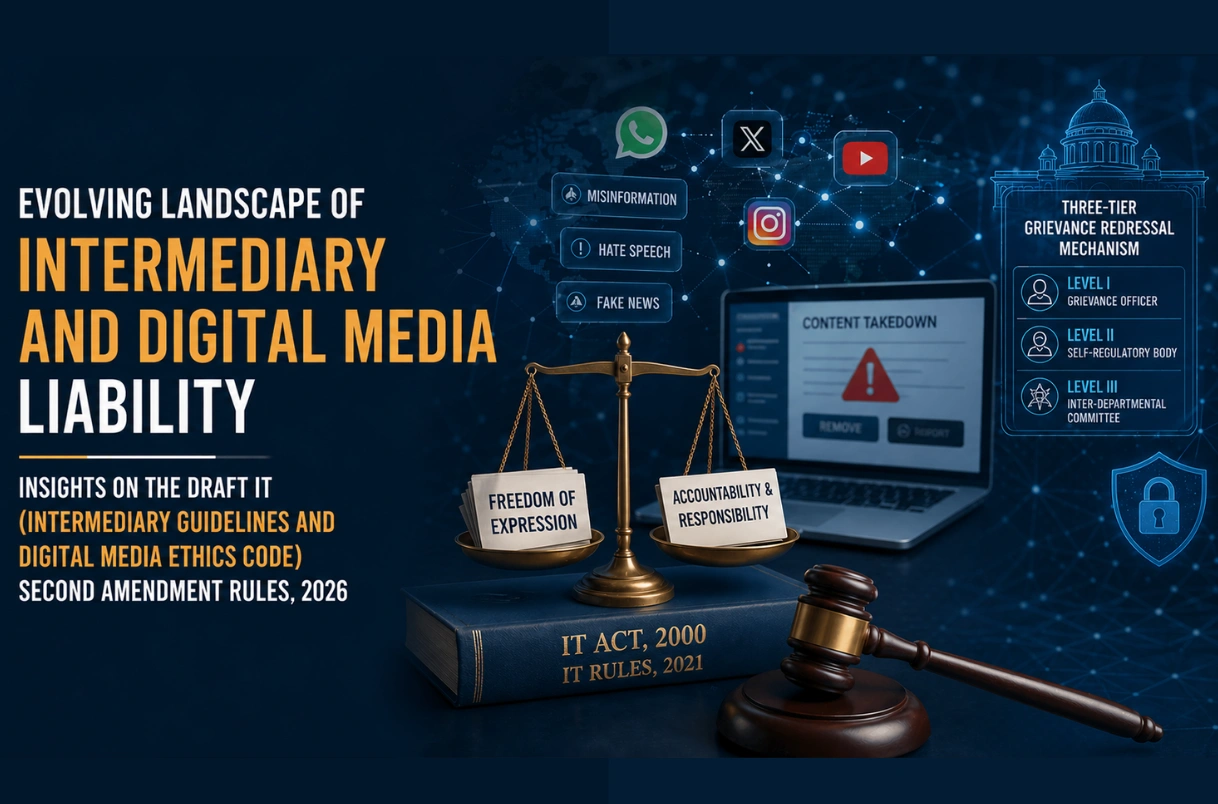
By – Shreya Dubey and Sanya Miglani
Table of Contents
Introduction
The evolution of digital media and pattern of content presentation as well as consumption have uncovered in a remarkable manner, keeping every age and kind hooked to the screens. Today, every tap or scroll opens a wave of ‘breaking’ developments, often reaching users before traditional verification process even begins. During the COVID-19 pandemic, misleading claims about cures and vaccines circulated widely on platforms like WhatsApp, often outpacing official health advisories. During the ongoing geopolitical conflicts, unverified war footage and recycled videos have gone viral on platforms like Instagram and YouTube, shaping public perception before fact-checks emerge. “Breaking News” has become the new misnomer to grab attention and messages such as false alerts about bank shutdowns or government policy changes trigger confusion and, at times, panic among users. These examples underline a key reality – users are no longer passive recipients of information but active participants in its creation and amplification.
While these platforms have emerged as powerful facilitators of free expression and democratic participation, they have also intensified concerns regarding misinformation. Owing to this evolving tension between safeguarding free speech and ensuring accountability that the Government felt the need to step in and frame the Information Technology (Intermediary Guidelines and Digital Media Ethics Code) Rules, 2021 (2021 Rules). The evolving dynamics of freedom of speech has now compelled the introduction of critical amendments to the 2021 Rules, which have been discussed ahead.
EVOLUTION OF INTERMEDIARY AND DIGITAL MEDIA LIABILITY IN INDIA
The enactment of the Information Technology Act, 2000 (“IT Act”)marked the foundational step aimed at regulating digital space. Section 2(1)(w) of the Information Technology Act, 2000 recognised intermediaries as entities that offers a platform to receive, store or transmit information on behalf of its users. It is essentially a channel that facilitates movement of information by service providers such as telecom service providers, network service providers, internet service providers, search engines, online payment sites, online marketplaces and cyber cafes. Simultaneously, the Information Technology Act, 2000 was amended to respond to the exponential rise and impact of digital platforms as well as intermediary liability. The amended Section 79 of the IT Act was designed to cater as a ‘safe harbour’ for intermediary liability, protecting them from liability against any third-party content hosted on their platform. However, the protection is not absolute and subject to compliances and due diligences laid down under the provision.
In response to the need to distinctly delineate the intermediary liability and digital media platforms while dealing with unlawful content, the Information Technology (Intermediaries Guidelines) Rules, 2011 (“2011 Rules”) were notified under the IT Act. The 2011 Rules sought to operationalise the due diligence requirements under Section 79 by laying down standards for regulation and takedown of content. However, with the emerging regulatory concerns, the 2011 Rules were subsequently replaced by the Information Technology (Intermediary Guidelines and Digital Media Ethics Code) Rules, 2021 (“2021 Rules”), aimed at providing a more comprehensive and enforceable framework to address intermediary accountability.
The Information Technology (Intermediary Guidelines and Digital Media Ethics Code) Rules: A New Digital Rulebook
If the Information Technology Act, 2000 was India’s first attempt to understand the internet, the Information Technology (Intermediary Guidelines and Digital Media Ethics Code) Rules, 2021 was its response to what the internet had become. By 2021, the digital world was no longer just about emails and websites. It was loud, fast, and deeply influential. Platforms were no longer passive hosts, as they had become powerful gatekeepers of information. Public accounts, influencers, and over-the-top (OTT) platforms emerged as key actors in shaping, curating, and amplifying digital narratives.
Recognising this shift, the IT Rules 2021 Amendment introduced an entirely new vocabulary comprising of definitions such as “digital media,” “publisher of online curated content,” “news and current affairs content,” and the distinction between an ordinary Social Media Intermediary and a Significant Social Media Intermediary (SSMI), with more than 50 lakh users was introduced.
Who Really Controls What We See?
The structure of the 2021 Rules divided the digital universe into two broad worlds. Part II governs intermediaries, platforms such as WhatsApp, Instagram that provide a venue for the movement of information for users whereas, Part III regulates digital media platforms including publishers of news and current affairs or publishers of online curated content such as Netflix etc. The Rules define the regulated entities as follows.
- News Aggregator: entities that are aggregators, curators and present news and current affairs content [Rule 2(o)]
- Publisher of news and current affairs content: “an online paper, news portal, news aggregator, news agency and such other entity called by whatever name, which is functionally similar to publishers of news and current affairs content but shall not include newspapers, replica e-papers of the newspaper and any individual or user who is not transmitting content in the course of systematic business, professional or commercial activity;” [Rule 2(t)]
- Publisher of online curated content: publisher that determining online curated content being made available, makes available to users a computer resource that enables such users to access online curated content over the internet or computer networks, and such other entity called by whatever name, which is functionally similar to publishers of online curated content but does not include any individual or user who is not transmitting online curated content in the course of systematic business, professional or commercial activity [Rule 2(u)]
- Social media intermediary with less than 50 lakh registered Indian users. [Rule 2(w)]
- Significant social media intermediary (SSMI) with more than 50 lakh registered Indian users. [Rule 2(v)]
This classification is not merely technical. It actively determines how content is regulated at every stage of its digital journey. A single piece of information may originate from a news publisher, pass through an aggregator, and eventually go viral. However, each stage attracts a distinct layer of regulatory obligation. Publishers of news and curated content are bound by the Code of Ethics and the three-tier grievance redressal mechanism, ensuring accountability for the substance and presentation of content. Intermediary liability, on the other hand, are governed primarily by due diligence obligations under Rule 3.
Due Diligence Obligations under Rule 3
Rule 3 of the existing 2021 Rules define the onus of due diligence on intermediaries, requiring them to act against unlawful content once they obtain “actual knowledge” of its existence. The standard for determining ‘actual knowledge’ and intermediary liability was clarified by the Supreme Court in Shreya Singhal v. Union of India (2015) 5 SCC 1 whereby the Court while striking down Section 66A of the Information Technology Act, 2000 for violating free speech, also interpreted intermediary liability under Section 79 of the IT Act. The Court held that “actual knowledge” does not arise merely from user complaints or private notices, but only when an intermediary receives an order from the court or notification from a competent government authority, directing removal of specific content. In view of the same, Rule 3 imposes the due diligence obligations on intermediaries in the following manner –
- Content Takedown: The due diligence compliance requires platforms to take reasonable effort to prevent hosting of unlawful and misguided information such as information that is false, fake, threatening, infringed content, offensive, promoting enmity etc. [Rule 3(1)(d)]
- Knowledge of unlawful content: Platforms are required to promptly remove or disable access to unlawful content upon receiving actual knowledge either by itself, from a court or authorized government notice and preserve records for investigation.
- Grievance Redressal Mechanism: Platforms are also required to maintain a grievance redressal mechanism, respond to complaints within defined timelines, and respect fundamental rights, including equality, free speech, and personal liberty. [Rule 3(2)(a)]
Code of Ethics and the Three-Tier Mechanism
One of the most striking features of the IT Rules 2021 Amendment was the introduction of the independent three-tier regulatory mechanism for media entities that are publishers of news and current affairs content including online papers, news portal, news aggregators and agencies as well as publishers of online curated content. These entities have to follow the Code of Ethics through a three-tier mechanism, thereby extending the scope of regulation beyond traditional intermediaries.
- At Level I, publisher is required to appoint a grievance officer responsible for addressing complaints. [Rule 11]
- If the grievance remains unresolved within a period of 15 days, it is escalated to Level II, which comprises a self-regulatory body formed by one or more publishers or their associations. [Rule 12]
- At Level III, the Rules provide for the constitution of Inter-Departmental Committee, which examines grievances arising from the decision at the self-regulating level as well as other complaints concerning violations of the Code. [Rule 13]
The tier-based mechanism warrants proactiveness from platforms in ensuring timely takedown and regulation of unlawful content. For instance, if a controversial web series on an OTT sparks public outrage, the complaint does not go straight to the government. It begins with the platform itself and escalates upward if unresolved.
Key Proposed Amendments under the Draft IT Rules (Second Amendment), 2026
The Ministry of Electronics and Information on 30 March 2026 has issued the draft Second Amendment to the Information Technology (Intermediary Guidelines and Digital Media Ethics Code) Rules, 2021 (Proposed Amendment) and opened the floor for stakeholders to share comments and feedback. The Ministry while notifying the IT Rules 2026, conveyed the objective of the Government to strengthen compliance and effectiveness of content regulation mechanisms on digital platforms covered by the IT Rules, 2021 signalling a shift towards closer regulation of news and current affairs content shared on digital platforms.
- Expansion of Part III to Intermediaries and User-Generated Content: The three-tier grievance redressal mechanism operates in relation to platforms engaged in publishing of the content, whereas intermediaries are governed primarily under Part II. The proposed amendment extends the applicability of Rules 14, 15, and 16 to intermediaries as well as news and current affairs content shared by users who are not publishers.
The amendment significantly widens the regulatory net by bringing intermediaries and user-shared news content within the three-tier grievance redressal framework, meaning that everyday content circulating on platforms like WhatsApp, X, or YouTube can now be subject to government oversight. In practice, this allows authorities to step in more directly, whether by directing the takedown of a viral false “breaking news” or urgently blocking harmful misinformation during crises. It also means that the regulation of such platforms falls under the regulatory oversight of the Ministry/Government.
- Enhanced Role of the Inter-Departmental Committee: The amendment proposes the Inter-Departmental Committee to be set up under Rule 14 to hear matters and make recommendations to the Ministry on matter listed under the Rule including matters referred to it by Ministry. Such amendment expands the scope of Inter-Departmental Committee to matters referred directly by the Ministry, thereby widening the supervisory role over regulation of digital content.
- Insertion of Rule 3(4): Compliance with Ministry Directions: The Proposed Amendment also suggests insertion of a new sub clause 4 to Rule 3 defining the Due Diligence compliances laid down for intermediaries. The insertion of Rule 3(4) formalises the obligation on intermediaries to comply with a range of instruments issued by the Ministry, including clarifications, advisories, orders, directions, standard operating procedures, codes of practice, and guidelines.
- Expanded Data Retention Obligations: The proposed amendment also suggests amending Rules 3(1)g and 3(1)(h), laying the mandate for retaining information by intermediaries by introducing the phrase “without prejudice to any requirement relating to the preservation or retention of information applicable to intermediaries under the Act or any other law for the time being in force”.
Such insertion both clarifies as well as widens the scope of data retention obligations. It suggests that data retention obligations under the IT Rules, 2021 are not exhaustive and operate alongside obligations imposed under other applicable laws. As a result, intermediaries are required to account for multiple sources of legal obligation when determining retention timelines.
Who Controls the Digital Narrative? The Core Dilemma of Regulation against Restriction
The question of who ultimately shapes the digital narrative sits at the intersection of regulatory necessity versus constitutional freedom. Publishers of the legal news portal, LiveLaw had challenged the vires of the 2021 Rules before the Kerela High court for being violative of Articles 14, 19(1)(g) and 21 of the Constitution, in as much as the Rules introduced a Code of Ethics and government led oversight mechanism for digital news platforms. The Kerela High Court on 13 Maach 2021 stayed the 2021 Rules and directed the Union not to take any coercive action against non-compliance with the IT Rules. Subsequently, several other petitions challenging the IT Rules were filed before various High Courts across the country. Owing to the multiplicity of the Petitions, the Union approached the Supreme Court for transfer of the Petitions before one court. The Supreme Court has since transferred the petitions to be heard together by the Delhi High Court. The challenge to the 2021 Rules before the Delhi High Court (W.P.(C) 3125/2021 and connected matters) is presently pending adjudication.
The Proposed Amendment acknowledges the role played by digital platforms in the dissemination of information. In this context, the inclusion of such platforms within the ambit of the oversight mechanism under Rules 14 to 16 may be seen as an attempt to introduce a layer of required regulatory scrutiny over the spread of misinformation, lack of accountability, and the amplification effects of algorithmic distribution. The proposed amendment, therefore, operationally recognises that effective regulation of digital media cannot remain confined to traditional publishers alone.
However, at the same time, the extension of government oversight to this expanded category of content introduces a set of institutional and constitutional considerations. Given that the oversight mechanism is anchored by the government, its application to a broader spectrum of content, especially that generated by users, raises questions regarding the scope, consistency, and neutrality of its exercise. In practice, distinguishing between legitimate regulatory intervention and actions that may be aligned with political or ideological considerations can prove complex, particularly in the context of news and current affairs, which are inherently intertwined with public discourse and democratic debate. This creates a delicate regulatory environment where the exercise of oversight must navigate the fine balance between ensuring accountability in information dissemination and preserving the autonomy of digital speech.
FAQs
-
What are the Draft IT (Intermediary Guidelines and Digital Media Ethics Code) Second Amendment Rules, 2026?
The Draft Information Technology (Intermediary Guidelines and Digital Media Ethics Code) Second Amendment Rules, 2026 are a proposed set of amendments issued by the Ministry of Electronics and Information Technology (MeitY) to further modify the existing IT (Intermediary Guidelines and Digital Media Ethics Code) Rules, 2021, primarily aimed at regulating news and current affairs circulated on social media platforms.
-
Why has the Government proposed amendments to the IT Rules, 2021?
The proposed amendment aims to impose stricter compliance obligations for intermediaries with government-issued directions and widen the scope of regulatory oversight over online content, including news and current affairs.
-
How do the Draft IT Rules 2026 expand intermediary liability in India?
The Draft Amendment proposes to extend the application of Part III of the 2021 Rules, particularly Rules 14, 15, and 16 to intermediaries, thereby subjecting social media platforms to enhanced government oversight and takedown powers over circulation of information.
-
What is the role of the Inter-Departmental Committee under the proposed amendments?
The amendment enhances the role of the Inter-Departmental Committee under Rule 14 by empowering it to hear matters not only on complaints under the 2021 Rules, but also on issues directly referred by the Ministry.
-
How will Rule 3(4) impact intermediaries under the Draft IT Rules 2026?
The proposed insertion of Rule 3(4) formalises the obligation on intermediaries to comply with a range of instruments issued by the Ministry, including clarifications, advisories, orders, directions, standard operating procedures, codes of practice, and guidelines.
 You wish to know more about Neeti Niyaman (the “Firm”) for your own information and use.