Amendment to Rule 3 of the Electricity Rules, 2005: A significant reset of India’s Captive Generating Plant framework
By – Devank Maheshwari
Table of Contents
Introduction
In India, the captive generation regime is governed in detail by Rule 3 of the Electricity Rules, 2005. The Electricity (Amendment) Rules, 2026 (“2026 Amendment”) notified by the Ministry of Power (“MOP”) substitute Rule 3 in its entirety.
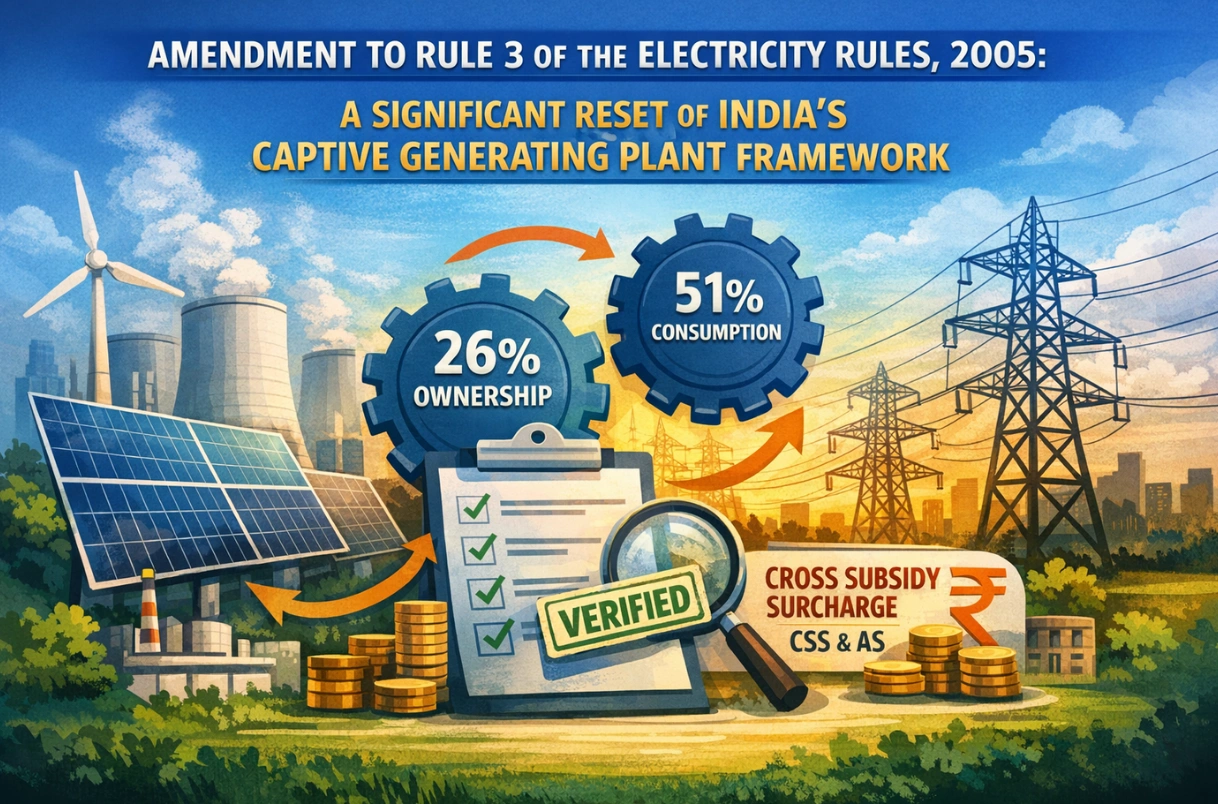
The 2026 Amendment keeps the two statutory pillars of captive status i.e., minimum 26% ownership and minimum 51% consumption, but revises how these tests work for group captive projects (especially those structured as associations of persons (“AoP”) and special purpose vehicles (“SPVs”). The key change is that the plant level captive qualification is judged collectively, while individual captive consumption is capped (unless an individual holds ≥26% ownership), with any excess treated as non-captive and exposed to cross-subsidy surcharge (“CSS”) and additional surcharge (“AS”).
The amendment also introduces a verification and appeals mechanism (state nodal agency for intra-State, and National Load Despatch Centre for inter-State).
Taken together, the 2026 Amendment is best understood as a shift from a disputes prone unitary qualifying ratio / strict proportionality approach that could jeopardize captive status for entire projects, toward a segmented compliance model with plant-level captive status.
Statutory foundation
Captive generation is anchored in Section 9 of the Electricity Act, 2003 (“Electricity Act”), which recognizes captive generation and links it to an open access right for carrying electricity from the captive plant to the destination of use. The surcharge framework relevant in practice is contained in Section 42, which is the statutory backdrop for why captive classification materially affects cost in so far as the surcharge is not applicable thereon.
The baseline text of Rule 3 (before the recent amendment of the electricity rules 2005) included a 26% ownership test and 51% annual consumption test, special handling for AoP and SPV with proportionality requirements.
The Supreme Court in Dakshin Gujarat Vij Company Limited v. Gayatri Shakti Paper and Board Limited (Civil Appeal Nos. 8527–8529 of 2009) addressed a key ambiguity under Rule 3 by affirming that an SPV qualifies as an AOP. As a result, the requirement of proportional consumption was held to apply equally to SPV based structures.
The Court also introduced what came to be known as the unitary qualifying ratio (“UQR”), under which each captive user is required to consume, on an annual basis, at least 1.96% (with a permissible variation of ±10%) of the total electricity generated for every 1% equity held. In practical terms, this meant that each user had to individually meet a minimum consumption threshold aligned with its shareholding. Non-compliance by one user could lead to exclusion of its consumption from the aggregate calculation, potentially jeopardising the captive status of the entire project and exposing all users to cross subsidy surcharge (CSS) and additional surcharge (AS).
What changed in Rule 3
Captive user and corporate-group aggregation
- The 2026 Amendment expands the meaning of a “captive user” to expressly include not only the entity itself but also its subsidiary, holding company, and other subsidiaries of such holding company. In the same vein, “ownership” is now defined to cover equity or proprietary interest held either directly or indirectly through these related entities.
- A key clarification introduced by the amendment is the recognition of fellow subsidiaries within the ownership structure. This ensures that group companies holding equity across different entities within the same corporate group are duly considered for determining captive status.
- Further, the amendment allows group entities to internally decide how the eligible captive consumption is to be distributed among themselves, as long as the overall eligibility conditions are satisfied at a collective level.
Recalibration of proportionality requirement
- Under the 2026 Amendment, compliance with the 26% ownership and 51% consumption requirements is assessed based on the total consumption of all captive users taken together. This means that even if a particular user does not consume electricity strictly in proportion to its shareholding, its actual consumption will still be counted for meeting the overall thresholds.
- This marks a shift from the earlier UQR approach, where non-compliance by one user could adversely affect others and expose the entire arrangement to cross subsidy surcharge and additional surcharge. The new framework therefore reduces inter-se risk among participants in group captive structures.
- At the same time, a limit has been introduced whereby each user’s consumption can qualify as captive only up to 100% of its proportionate entitlement based on its ownership share. Any consumption beyond this limit will be treated as non-captive and will attract CSS and AS.
- An important exception is provided for users holding 26% or more ownership in the project as such users are not subject to the proportionate consumption cap. This creates a clear advantage for anchor investors in group captive projects.
- The 2026 amendment took effect on 13.03.2026. However, provisions relating to proportionate consumption limits for individual users in association of persons structures, as well as the new verification framework, became applicable from 01.04.2026, allowing a brief transition period for stakeholders to adjust to the revised regime.
Verification framework redesign
- Under the old approach, inter-state captive status verification was assigned to CEA and no single nationally standardized intra state verification mechanism existed. However, under the new approach, the 2026 Amendment introduces a clear, two-tier mechanism for verifying captive status based on the location of the plant and its users:
- Where the generating plant and captive users are located within the same state, verification will be carried out by a nodal agency designated by the respective State Government, in accordance with procedures specified by that agency.
- In cases where the plant and captive users are situated across different states, the verification responsibility will lie with the National Load Despatch Centre (NLDC), following a procedure approved by the Central Government.
No CSS/AS pending verification
- Under Rule 3(4)(c), CSS and AS are not levied pending verification, subject to declarations under the issued procedure. However, if the plant fails verification for the financial year, CSS and AS (as determined by the State Commission) become payable along with carrying cost computed at the base rate under the Late Payment Surcharge rules.
Stakeholders impacted:
Captive users: These users benefit from clearer corporate group aggregation and more workable group captive compliance, but must implement stronger governance for ownership tracking, consumption accounting, and declarations required under verification procedures.
Project SPVs and developers: The explicit SPV-as-AoP treatment, plus the collective compliance approach, reduces disputes between the members of a captive structure.
NLDC: NLDC’s new role (inter-State verification) signals a move to operator backed verification, potentially integrating better with metering, scheduling, and grid settlement practices.
How the 2026 amendment is likely impact electricity sector
Reduced all-or-nothing risk for group captive
The earlier proportionality disputes created a high-stakes compliance environment where deviations by participants could threaten the entire captive characterization. The new rule’s “collective plant test + individual cap” should lower such risk for the project and redirect disputes into narrower questions: which portion of an individual user’s consumption is captive vs non-captive.
Better fit with modern corporate group structures
The new deeming fiction for group entities addresses a recurring gap that ownership and consumption within corporate groups often do not align cleanly with single-company definitions, and earlier rules relied on admissibility provisos that still left interpretive space. The 2026 Amendment has provided much needed clarity on group level compliance.
Verification institutionalization
Moving verification more decisively into nodal agencies and NLDC, coupled with a standardized appeal route, signals the intent to make captive status determinations more standardized and less ad hoc.
FAQs
-
What is Rule 3 of the Electricity Rules, 2005 and why is it important for captive generating plants in India?
Rule 3 lays down the conditions for a power plant to qualify as a captive generating plant. It is important because only captive plants are exempt from cross subsidy surcharge (CSS) and additional surcharge (AS), which significantly reduces power costs for industrial consumers.
-
What are the key changes introduced under the Electricity (Amendment) Rules, 2026 for captive generating plants?
The amendment clarifies group structures by including holding companies, subsidiaries and fellow subsidiaries as captive users. It shifts the focus to collective consumption instead of strict individual proportionality, introduces a cap on excess consumption, recognises use through energy storage, and creates a formal verification framework.
-
What are the ownership and consumption requirements to qualify as a captive generating plant under the amended Rule 3?
Captive users must collectively hold at least 26% ownership in the plant and must collectively consume at least 51% of the electricity generated in a financial year.
-
How does the 2026 amendment change the proportional consumption requirement for group captive projects?
Earlier, each user had to strictly consume in proportion to its shareholding. Now, compliance is checked at a group level. Individual users can deviate, but their consumption counts towards the total. However, consumption beyond their proportionate share is treated as non-captive and attracts charges. Users with 26% or more ownership are exempt from this limit.
-
Who is responsible for verifying captive status under the amended Rule 3 framework?
If the plant and users are in the same state, the state-designated nodal agency verifies captive status. If they are in different states, the National Load Despatch Centre (NLDC) carries out the verification.
 You wish to know more about Neeti Niyaman (the “Firm”) for your own information and use.