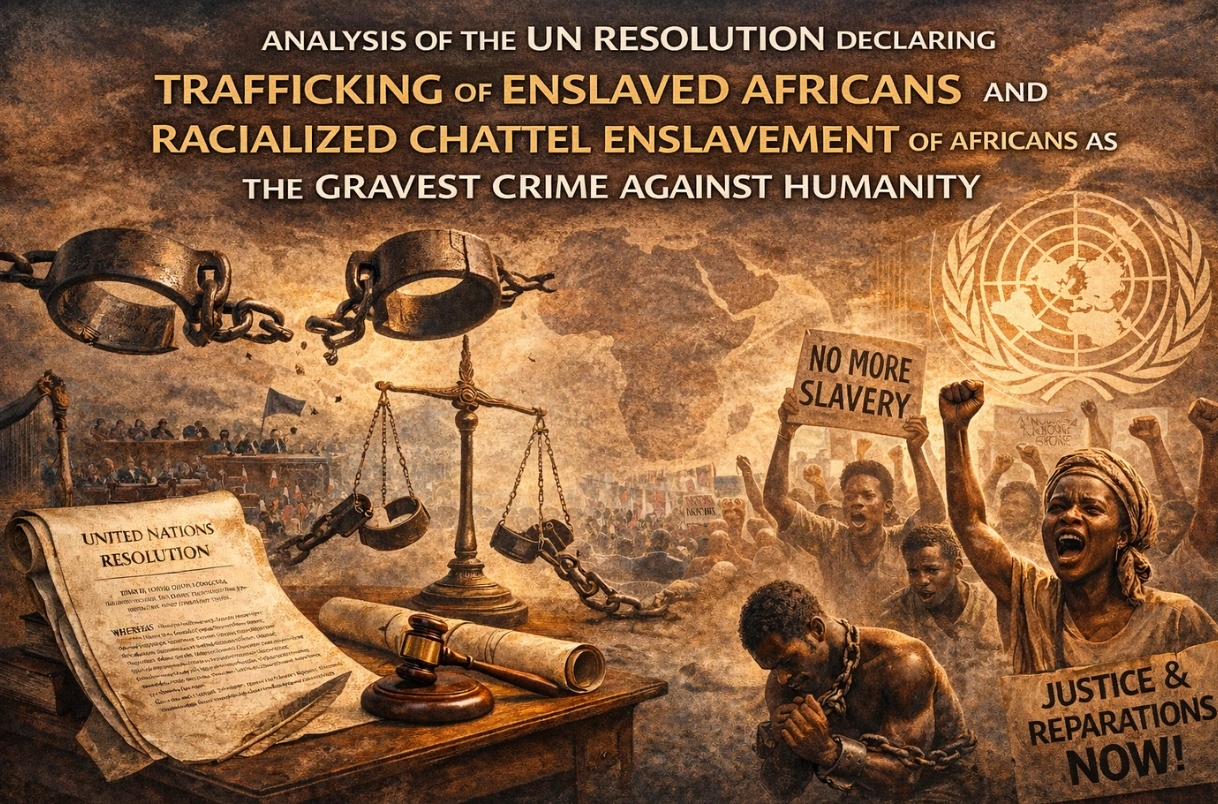
Analysis of the UN Resolution declaring Trafficking of Enslaved Africans and Racialized Chattel Enslavement of Africans as the Gravest Crime Against Humanity
By – Debasmita Goswami and Jane Kapai
Table of Contents
Introduction
United Nations General Assembly vide its 80th resolution has declared that trafficking of enslaved Africans and racialized chattel enslavement of Africans as the gravest crime against the humanity (“Resolution”). The Resolution’s call for reparations extends far beyond financial compensation. It highlights the need for recognition of the immense scale and brutality of slavery , reconciliation rooted in truth-telling and historical accountability, and transformational change addressing the persistent global inequalities that remain tied to the legacy of enslavement.1 It also observes that the legacies of slavery and the transatlantic slave trade persist today in the form of structural racism, racial inequalities, underdevelopment, marginalization and the existing socioeconomic disparities. It also reaffirms its collective recognition of the profound and lasting impacts of the abhorrent regimes of slavery and colonialism and the persistence of racial discrimination and neo-colonialism on Africans and people of African descent and how this continues to cause immense suffering, cultural disruption, economic exploitation, emotional trauma and unending discrimination endured by Africans and people of African descent throughout history.
Africans and people of African descent have continuously resisted, contested and litigated the crimes of slavery and the slave trade from their inception, including through more than six-century Africana abolitionist tradition, early acts of resistance and testimony, State diplomacy, armed struggles and the strategic use of courts and petitions to assert human rights, dignity, autonomy over their bodies and territorial sovereignty.2 The Resolution recalls the large – scale trafficking of enslaved Africans marked a profound rupture in human history whose consequences have extended across centuries and continents and the fifteenth century marked the critical beginning of the exceptional and the dark history of the capture, forced transportation and racialized chattel enslavement of the people of Africa. President of Ghana, H.E. John Dramani Mahama has therefore reiterated the significance of this landmark decision, stating: “This resolution is a pathway to healing and reparative justice. This resolution is a safeguard against forgetting.”3
The road towards UN Resolution
As per the United Nations Human Rights Commission slavery is the ultimate denial of human dignity. It reduces a person to the status of property or commodity, something to control, to exploit and discard. The consequences involve psychological trauma, chronic depression, sexual abuse, post-traumatic stress disorder which not only affects the victims but may also extend to their family members. It leaves the scars not only on the individual but on the entire social fabric.4 The definition of slavery for the first time appeared in an international agreement in the League of Nations Slavery Convention of 25th September, 1926. It defined slavery as “the status or condition of a person over whom any or all of the powers attaching to the right of ownership are exercised.”5
The forms of slavery includes serfdom which is equivalent of “predial slavery” which meant the use of slaves on the plantations for agricultural production. The Temporary Slavery Commission in the year 1924 also reported that numerous people were found in “agricultural debt bondage” which combined elements of both debt bondage and serfdom. Apart from serfdom, there are certain techniques of exploitation akin to slavery which affect the migrant workers. For instance the employer confiscating the worker’s passport and in case of the domestic workers keeping them in captivity. Even the women migrant workers are vulnerable to slave like exploitation. There have also been instances where the employers of the migrant workers acquire a significant degree of control over their employees by not paying the wages on time or not paying adequate wages leaving the migrant worker vulnerable and leaving the migrant worker at the mercy of the employer. The migrant workers are therefore subjected to discrimination which undermines human dignity.6
There have also been instances of sexual slavery which is closely related to that of forced prostitution but is a distinct form of sexual exploitation. It is not necessary that there has to be financial gain in sexual slavery, it is merely the imposition of absolute control or power of one person over another. The use of sexual slavery in any form during the times of armed conflict in the form of rape, or other form of sexual abuse constitutes a grave breach of international humanitarian law. The main characteristics of the slavery therefore includes the degree of restriction of the individual’s inherent right to freedom of movement; the degree of control, of the individual’s personal belongings and the existence of informed consent and a full understanding of the nature of the relationship between the parties.7
In the aim of curbing this social menace United Nations has passed the Resolution commemorating the abolition of slavery and the transatlantic slave trade.
What does the UN Resolution entail?
The Resolution recognizes that for 400 years the trafficking of enslaved Africans and racialized chattel enslavement of Africans forcibly captured, commodified and transported millions of African men, women and children, constituting the largest forced migration in history and one of the longest running systems of organized mass human exploitation in recorded history. It acknowledges the Kouroukan Fouga (Manden Charter) 12358, which established through Article 5 that everybody has a right to life and to the preservation of physical integrity and established the sovereignty of life over property. It further recognizes the call of the African Union’s Agenda 2063 (“African Agenda”) for the restoration of Africa’s place in history and the healing of its wounds, including those inflicted by slavery and colonialism.9 African agenda focuses on the vision of “an integrated, prosperous and peaceful Africa, driven by its own citizens and representing a dynamic force in the international arena.” Its aspirations include a prosperous Africa, based on inclusive growth and sustainable development; a continent being politically united and having respect for human rights, justice and rule of law; a peaceful and secure Africa; a continent with strong cultural identity, common heritage values and ethics; whose development is people driven, relying on the potential of African people especially its women and youth and caring for children and building Africa as a strong, united, resilient and influential global player and partner.10 It also upholds the spirit of the International Covenant on Civil and Political Rights11 and the International Covenant on Economic, Social and Cultural Rights12 reaffirming that recognition of the inherent dignity and of the equal and inalienable rights of all members of the human family is the foundation of freedom, justice and peace in the world. It also affirms the importance of addressing historical wrongs affecting Africans and people of African descent in a manner that promotes justice, human rights, dignity and healing and emphasizes that claims for reparations represent a concrete step towards remedying historical wrongs against Africans and people of African descent. It also calls for the prompt and unhindered restitution of cultural properties, monuments, museum pieces, artefacts, manuscripts and documents and national archives that are of spiritual, historical and cultural or other value to countries of origin without charge. It encourages the Member States to promote comprehensive educational programmes, memorialization initiatives and scholarly research on slavery.
Structural Limits of Reparatory Justice
The General Assembly’s resolution, while historically significant in recognising the transatlantic slave trade as a crime against humanity, operates within a structural framework in which normative recognition exceeds institutional enforceability. Unlike Security Council decisions adopted under Chapter VII, General Assembly resolutions do not create binding legal obligations on member states; their status remains recommendatory rather than mandatory. The primary limitation, therefore, lies in the resolution’s non-binding character: while it articulates a right to reparatory justice, its realisation is contingent upon political will and domestic implementation rather than legal compulsion. The result is an enforceability deficit, where reparatory justice is normatively affirmed but operationally uncertain.
Beyond its formal status, the resolution reflects deeper conceptual constraints inherent in reparatory justice frameworks, which are traditionally grounded in models of state responsibility and corrective justice.13 There is a persistent difficulty in addressing structural and historical harm and the question of attribution i.e. who is responsible for centuries-old harms and to whom obligations are owed.
State responses to the resolution underscore these tensions. The United States, in voting against it, rejected the existence of a legal right to reparations for acts that were not unlawful under international law at the time they occurred. Similarly, the European Union, while acknowledging the slave trade as an unparalleled historical tragedy, abstained on the grounds that the resolution implied a retroactive application of legal norms and advanced reparations claims inconsistent with established principles of international law.14
At a more fundamental level, reparatory justice may be limited by the nature of the remedy it seeks to provide. Article 34 of the ILC Articles on the Responsibility of States for Internationally Wrongful Acts provides full reparations in the form of restitution, compensation and satisfaction. The classical principle of restitutio in integrum, articulated in the Chorzów Factory case, holds that reparations must, as far as possible, restore the injured party to the position they would have occupied but for the wrongdoing15, however in the context of slavery, a system marked by mass dispossession, cultural destruction, and intergenerational harm such restoration may be conceptually and practically unattainable.
Further, while monetary compensation is undoubtedly integral to addressing injustice, the sums awarded rarely approximate the full extent of loss accumulated over time. More significantly, compensation is inherently incapable of restoring the social, cultural, and historical trajectories that have been irreversibly altered over generations. A structurally comparable example is found in the displacement of Adivasi communities in India, where land acquisition in the name of development has been justified through monetary compensation and projected economic benefits.16 Such rehabilitation and resettlement policies, however, addressed only the quantifiable residue of loss, while the loss of social and cultural continuity as consequences of dispossession, remain unrestored. As a result, the stated goals of social justice within these development frameworks frequently remain unfulfilled.
Reparations for mass historical injustices such as the transatlantic slave trade in this context are therefore necessarily approximations not equivalents of the harm suffered but gestures toward it: partial, symbolically freighted, and functioning to acknowledge wrongdoing, restore dignity, and reaffirm moral responsibility. The term ‘symbolic’ clearly indicates that it involves a greater intangible element. It can range from disclosing the truth about the past traumas and events affecting the victims, restoring the good name of the victims, offering official apologies, creation of parks dedicating to the memory of the victims or changing the names of the public spaces. Symbolic reparations cater to the need for respect, dignity and creating a safe future.17
Normative Significance of the resolution
Albeit the resolution’s characteristic as a non-enforceable instrument and the limits of substantive reparations, its normative significance should not be dismissed on such grounds. Reparations are, as a matter of principle, never fully restorative. What reparations can do, and what this resolution begins to do, is reframe the moral and political record. By formally declaring the slave trade the greatest crime against humanity, the Resolution requires states to reckon with this inheritance. It distinguishes the present international order from its predecessor, affirming that the values underpinning contemporary international law are incompatible with what was done, and that the dignity and equality of those who were denied it are now internationally recognised. This is not, in itself, a remedy, but it is a necessary precondition for one.
The UN Resolution operatively calls upon member states to engage in dialogue on reparatory justice, in not only measures of restitution but also including full and formal apology, compensation, rehabilitation, satisfaction, guarantees of non-repetition and changes to laws, programmes and services to address racism and systemic discrimination.18 The resolution also calls for prompt and unhindered restitution of cultural properties, and documents that are of historical and cultural value, recognising that it leads to the promotion of national culture and the enjoyment of cultural rights by present and future generations.19
The resolution also expressly reaffirms that crimes related to the trafficking and enslavement of Africans “are not subject to statutory limitations”, invoking the African jurisprudential principle that ‘a crime does not rot’. More fundamentally, the resolution’s invocation of jus cogens peremptory norms of international law from which no derogation is permitted rests on the argument that slavery’s prohibition a principle so fundamental to human dignity that it transcends temporal codification.
Amidst these competing arguments, it is important to be precise that this resolution does not establish a mechanism for reparations, define its beneficiaries or compel any state to provide redress. Its significance lies instead in the institutional and normative pathways it opens. By mandating the Secretary-General to report to the General Assembly on implementation, it introduces a modest but formal layer of accountability. More broadly, it provides a platform upon which future negotiations, institutional mechanisms, and potential legal developments on reparations may be built.
In this sense, the resolution does not resolve the question of reparations, but it meaningfully repositions it within the architecture of international law and politics, transforming it from a contested claim into an increasingly unavoidable one.
Conclusion
International reparatory justice for descendants of enslaved Africans, however morally urgent, may be an idea whose legal time has not yet come. The obstacles of international principle such as non-retroactivity, are structural, not merely political, cannot be overcome by declaratory instruments alone. The legacies of slavery persist in structural racism, intergenerational inequality, and enduring global disparities that continue to reflect the historical extraction of labour and wealth. Reparations, even where not fully realisable in legal terms, remain essential as a means of acknowledging and confronting these continuing harms. At this juncture, emphasis should also be given on the symbolic reparations.
The significance of the UN resolution lies precisely in this space. It does not impose binding obligations or establish a reparatory mechanism, but it reshapes the normative environment within which international law evolves. By consolidating global recognition of the scale and enduring consequences of the slave trade, it strengthens the legal and moral foundations upon which future claims may be built.
Whether this normative shift ultimately crystallises into binding frameworks or enforceable mechanisms will depend on sustained political will and continued advocacy by affected communities. The resolution, therefore, stands as both an achievement and an unfinished commitment, in that it affirms that the transatlantic slave trade constitutes the gravest crime against humanity, while leaving open and indeed necessitating the ongoing task of determining what meaningful justice in response must entail.
FAQs
-
What does the UN resolution declaring slavery a crime against humanity mean?
UN Resolution has declared slavery a crime against humanity. It serves as a historic, political recognition aimed at addressing the lasting legacies of racism, calling for reparatory justice, and ensuring the historical wrongs are formally acknowledged.1
-
What is meant by trafficking of enslaved Africans?
The transatlantic trade in enslaved Africans, which operated between the fifteenth and late nineteenth centuries, involved the horrific trafficking of millions of women, men and children, mostly from West Africa to the Americas. This forced displacement enriched imperial and other powers. It also gave rise to false narratives of white supremacy and racial inferiority.2
-
What historical impact did the transatlantic slave trade have on Africans and their descendants?
For 400 years the trafficking of enslaved Africans and racialized chattel enslavement of Africans forcibly captured, commodified and transported millions of African men, women and children, constituting the largest forced migration in history and one of the longest running systems of organized mass human exploitation in recorded history. It led to long-term impoverishment, caused psychological trauma to the survivors and also led to acute economic crisis.
-
What role does international law play in addressing slavery and the slave trade?
International law has a huge role to play in addressing slavery and the slave trade. It mandates that states criminalize, prevent, and suppress all forms of forced labour, trafficking, and human ownership.
-
How does the UN resolution address historical injustices linked to slavery?
The Resolution acknowledges the Kouroukan Fouga (Manden Charter) 12353 which established through Article 5 that everybody has a right to life and to the preservation of physical integrity and established the sovereignty of life over property. It further recognizes the call of the African Union’s Agenda 2063 (“African Agenda”) for the restoration of Africa’s place in history and the healing of its wounds, including those inflicted by slavery and colonialism4. It also upholds the spirit of the International Covenant on Civil and Political Rights5 and the International Covenant on Economic, Social and Cultural Rights6 reaffirming that recognition of the inherent dignity and of the equal and inalienable rights of all members of the human family is the foundation of freedom, justice and peace in the world.
References –
- Available at, Ghana Leads Historic UN Vote Declaring Slave Trade the Gravest Crime Against Humanity | United Nations in Ghana, please also see Eightieth session, Agenda item 119, Commemoration of the abolition of slavery and the transatlantic slave trade, United Nations General Assembly
- Available at, Eightieth session, Agenda item 119, Commemoration of the abolition of slavery and the transatlantic slave trade, United Nations General Assembly
- Available at, Please see, Ghana Leads Historic UN Vote Declaring Slave Trade the Gravest Crime Against Humanity | United Nations in Ghana
- Available at, “Forms of slavery keep changing, but the harm remains the same.” | OHCHR
- Available at, Abolishing Slavery and its Contemporary Forms, David Weissbrodt and Anti- Slavery International 0244536.fm; please also see Slavery Convention | OHCHR.
- Ibid.
- Ibid.
- Available at, https://ich.unesco.org/en/RL/manden-charter-proclaimed-in-kurukan-fuga-00290
- Available at, 33126-doc-framework_document_book.pdf
- Ibid.
- Available at, https://www.ohchr.org/en/instruments-mechanisms/instruments/international-covenant-civil-and-political-rights
- Available at, Please see, https://www.ohchr.org/en/instruments-mechanisms/instruments/international-covenant-economic-social-and-cultural-rights
- Available at, Felix Lambrecht, 2025 Reparative Justice for Historical Injustice https://compass.onlinelibrary.wiley.com/doi/10.1111/phc3.70065
- Available at, EU Explanation of Vote – UN General Assembly: Action on A/80/L.48 – Declaration of the Trafficking of Enslaved Africans and Racialized Chattel Enslavement of Africans as the Gravest Crime Against Humanity | EEAS
- Germany v Poland, The Factory at Chorzow (Claim for Indemnity) (The Merits), Permanent Court of International Justice, File E. c. XIII, Docket XIV:I Judgment No. 13, 13 September 1928
- Available at, Gaurav Sikka, Moving Beyond Economic Analysis: Assessing The Socio-Cultural Impacts Of Displacement And Resettlement By Sardar Sarovar Project, India, 2020, https://ges.rgo.ru/jour/article/view/1320?locale=en_US
- Available at, Frédéric Mégret, ‘The International Criminal Court and the failure to mention symbolic reparations’, in Social Science Research Network, 2008, p. 3, available at: http://papers.ssrn.com/sol3/papers.cfm? abstract_id=1275087 and IRC1200008 1..26
- Resolution 8, UN General Assembly, Declaration of the Trafficking of Enslaved Africans and Racialized Chattel Enslavement of Africans as the Gravest Crime against Humanity
- ibid.
 You wish to know more about Neeti Niyaman (the “Firm”) for your own information and use.