CIIRP UNDER THE IBC: REGULATORY EXPERIMENTATION WITHOUT STRUCTURAL REPAIR
By – Nikhil Anand
Table of Contents
Introduction: Time Delays and the Push for Reform
The Insolvency and Bankruptcy Code (IBC) has been instrumental in reshaping India’s insolvency landscape by strengthening creditor confidence and significantly improving credit realization rates. The Report of the Colloquium on functioning and strengthening of the IBC ecosystem (November 2022) noted that, since the enactment of the Code, resolution plans have yielded Rs. 2.43 lakh crore for creditors, amounting to nearly 178% of the liquidation value. Notwithstanding the overall effectiveness of the Code, its efficiency continues to be substantially undermined by the prevalence of protracted timelines and litigation-driven delays. The average time for completing the CIRP process is approximately 603 days, far exceeding the statutory limit of 330 days. Against this backdrop, a key objective of the proposed IBC amendment is to reinforce the time-bound character of the insolvency resolution process.
The Emergence of CIIRP: From Adjudication to Hybrid Resolution
The IBC Amendment Bill, 2025 introduces the Creditor-Initiated Insolvency Resolution Process (CIIRP), marking a shift from a predominantly adjudication-driven process to a hybrid out of court mechanism. A key concern identified by the 2022 committee was the excessive time consumed in adjudication, largely attributable to repeated adjournments and extended opportunities granted to Corporate Debtors (CDs) to file replies. In response, the Committee recommended an out of court arrangement which may be termed as ‘Creditor-led Resolution Approach’(CLRP) and was considered in detail by the Expert Committee Report on CLRP. The CIIRP, as proposed under the amendment bill, adopts a hybrid framework that incorporates an out-of-court resolution mechanism while retaining safety valves that permit recourse to the judicial process.
Structure and Procedure of the CIIRP Framework
The CIIRP can be initiated by a notified classes of financial creditors against eligible CDs upon securing prior approval of creditors holding at least 51 per cent in value of the debt and after affording the CD an opportunity to make representations. Upon completion of these procedural safeguards, a Resolution Professional is appointed, who triggers the commencement of CIIRP through a public announcement, which is deemed to be the commencement date and simultaneously communicated to the Adjudicating Authority and the IBBI. While the management of the CD continues with the existing board, the Resolution Professional exercises supervisory oversight, participates in board meetings, prepares the information memorandum, verifies claims, and ensures compliance of any resolution plan with statutory requirements.
Mandatory Conversion to CIRP: Built-In Failure Mechanism
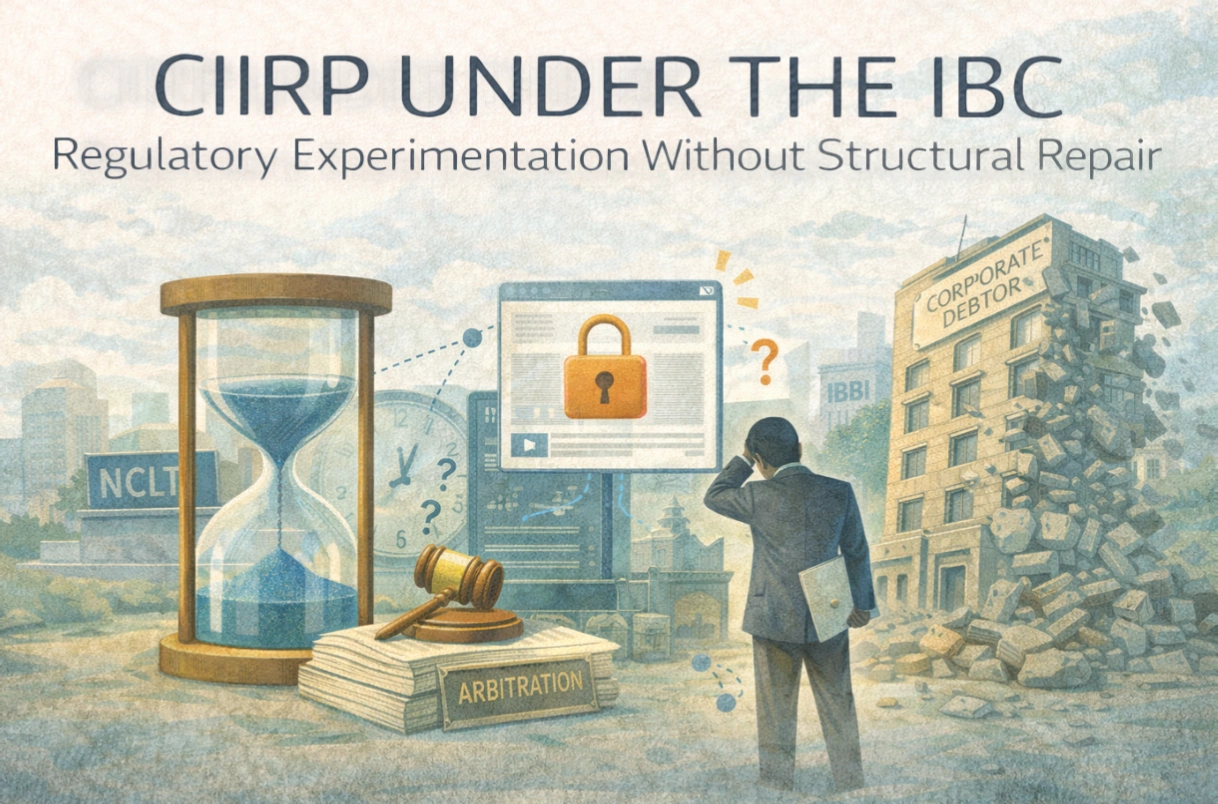
There is a provision for mandatory conversion of a CIIRP into a regular CIRP upon the occurrence of specified contingencies. The NCLT is required to order such conversion where no resolution plan is approved within the prescribed CIIRP timeline or where the committee of creditors resolves to shift the process to a CIRP, where the management or personnel of the CD fail to assist or cooperate with the resolution professional, or where the adjudicating authority rejects the resolution plan submitted under the CIIRP framework. There is a real possibility that an uncooperative and incumbent management of the CD may strategically participate in CIIRP only to prolong the resolution process, withholding information or obstructing progress, thereby triggering conversion to CIRP after valuable time has already been lost.
Persistent Non-Cooperation by Corporate Debtors: An Unresolved Structural Defect
There is a high possibility of the RP facing un-cooperation from the CD, which was noted by the Committee of 2022 where it stated that “IPs face great difficulty in obtaining records from the promoters of the CD and there are disputes raised by both parties about what information has been submitted and what is still pending to be submitted.” Section 58E imposes on the CD’s management a duty to cooperate with the RP and states that “the CD’s management shall cooperate with the RP” and provide books, records and information. In case of non-cooperation, the RP can take recourse to Section 19 which again pushes it to litigation. A research by the Indian Institute of Corporate Affairs highlighted that 80% of the CDs lack documentation model for statutory and non-statutory records. In this context, the 2022 Committee recommended the creation of a single, centralized digital platform for submission of all relevant information, accessible to all authorized stakeholders. However, to date, no such centralized platform has been established to give effect to this recommendation.
Regulatory Experimentation Without Structural Reform: A Premature Step?
The article does not oppose the introduction of experimental mechanisms per se, as such experimentation is often essential in the domain of economic legislation, a principle expressly recognised by the Supreme Court in Swiss Ribbons. Rather, the critique is directed at the introduction of new processes without first addressing the structural deficiencies that continue to undermine the effective functioning of the insolvency framework. One such structural deficiency, as discussed above, is the persistent non-cooperation by CDs, which is likely to undermine CIIRP as well, given that its effective functioning is heavily dependent on timely and bona fide cooperation from the corporate debtor. Therefore, it is imperative that the existing structural deficiencies are addressed and remedied before embarking on further regulatory experimentation.
FAQs
-
What is CIIRP under the Insolvency and Bankruptcy Code?
The Creditor-Initiated Insolvency Resolution Process (CIIRP) is a streamlined, largely out-of-court settlement mechanism designed to resolve corporate distress faster than the conventional Corporate Insolvency Resolution Process (CIRP). Under this model, the existing management continues to remain in control of the company’s day-to-day operations instead of being displaced by an insolvency professional. The Resolution Professional (RP) is entitled to attend meetings of the company and has been vested with the power to veto resolutions passed by the company. The role of the National Company Law Tribunal (NCLT) is kept to a minimum and is primarily limited to granting a formal moratorium to protect the corporate debtor’s assets and providing final approval to the agreed resolution plan. This structure is intended to avoid the prolonged delays typically associated with court-driven insolvency proceedings.
-
Who can initiate the Creditor-Initiated Insolvency Resolution Process?
The Creditor-Initiated Insolvency Resolution Process (CIIRP) can be initiated only by such classes of financial creditors as may be notified by the Central Government. To trigger the process, a creditor or a group of creditors must collectively hold at least 51% of the total financial debt by value and must issue a 30-day prior notice to the corporate debtor, calling upon it to either settle the outstanding dues or submit a representation opposing the initiation. If the debtor fails to resolve the default within this notice period, the financial creditors may proceed with the appointment of a Resolution Professional and the issuance of a public announcement commencing the CIIRP.
-
How is CIIRP different from the regular CIRP process?
The Creditor-Initiated Insolvency Resolution Process (CIIRP) substantially reduces the burden on the National Company Law Tribunal (NCLT) by shifting the initiation of insolvency from a judicial process to a predominantly out-of-court mechanism. The CIIRP commences upon the public announcement made by a Resolution Professional, subject to the consent of 51% of financial creditors and the lapse of the mandatory 30-day notice period issued to the debtor. This structure eliminates the delays commonly encountered at the admission stage of CIRP, which often arise due to repeated adjournments, replies, and rejoinders. Under CIIRP, the NCLT’s role is largely supervisory and confined to granting a moratorium, if sought, and approving the final resolution plan. The process operates on a compressed timeline of 150 days, extendable by a further 45 days, thereby replacing value-eroding litigation with a creditor-led, time-bound resolution framework.
-
What are the key challenges in implementing CIIRP?
The implementation of the Creditor-Initiated Insolvency Resolution Process (CIIRP), once enacted, is likely to face significant challenges, particularly due to its reliance on a “debtor-in-possession” model that allows the existing management to retain operational control. The success of this framework is heavily dependent on the bona fide cooperation of the corporate debtor’s management, which is often absent in distressed situations. Since the process is largely conducted outside the court system, an uncooperative management may frustrate the resolution by withholding critical financial information or by using the 150-day timeline as a delaying strategy before the matter is eventually converted into a regular CIRP. Additionally, as the moratorium is not automatic and must be separately sought from the NCLT, there exists a risk of value erosion if adverse actions are taken against the corporate debtor before judicial protection is secured. These structural concerns indicate that, in the absence of stronger enforcement mechanisms, penalties for non-cooperation, or a centralized digital information-sharing platform, the CIIRP may face practical difficulties in achieving its objective of a swift resolution.
-
Does management of the corporate debtor continue during CIIRP?
Upon the commencement of the Creditor-Initiated Insolvency Resolution Process (CIIRP), the management of the Corporate Debtor continues under a “debtor-in-possession” model. Unlike the regular CIRP, where the management is suspended and vested in an insolvency professional, the CIIRP permits the existing board and management to remain in place. The Resolution Professional exercises supervisory oversight and is empowered to attend board meetings, prepare the information memorandum, and verify claims, while the day-to-day operations of the company continue to be managed by the incumbent management.
References –
- Insolvency and Bankruptcy Board of India, Report of the Colloquium on the Functioning and Strengthening of the IBC Ecosystem (Nov. 28–29, 2022)
- Amresh Kumar Sood, A Critical Analysis of the Insolvency and Bankruptcy (Amendment) Bill, 2025: A Legislative Response to Evolving Jurisprudence, THE RESOLUTION PROFESSIONAL (Jan. 2026)
- The Insolvency and Bankruptcy Code (Amendment) Bill, 2025, introduced in Lok Sabha (Aug. 12, 2025) (as published by Insolvency and Bankruptcy Board of India)
- Report of the Colloquium, supra.
- Insolvency and Bankruptcy Board of India, [Framework Report on Creditor Led Resolution Approach in Fast-track Corporate Insolvency Resolution Process under the Insolvency and Bankruptcy Code, 2016] (May, 2023)
- IBC (Amendment) Bill, 2025, § 58B
- IBC (Amendment) Bill, 2025, § 58B, supra.
- IBC (Amendment) Bill, 2025, § 58F.
- IBC (Amendment) Bill, 2025, § 58H.
- Report of the Colloquium, supra.
- IBC (Amendment) Bill, 2025, § 58E.
- Insolvency and Bankruptcy Code, 2016, § 19 (India).
- Indian Institute of Corporate Affairs, Strengthening the Insolvency and Bankruptcy Code: Policy and Implementation Issues (2024)
- Report of the Colloquium, supra.
- Swiss Ribbons (P) Ltd. v. Union of India, (2019) 4 SCC 17 (India).
 You wish to know more about Neeti Niyaman (the “Firm”) for your own information and use.