Gati Vidhi – February 2026
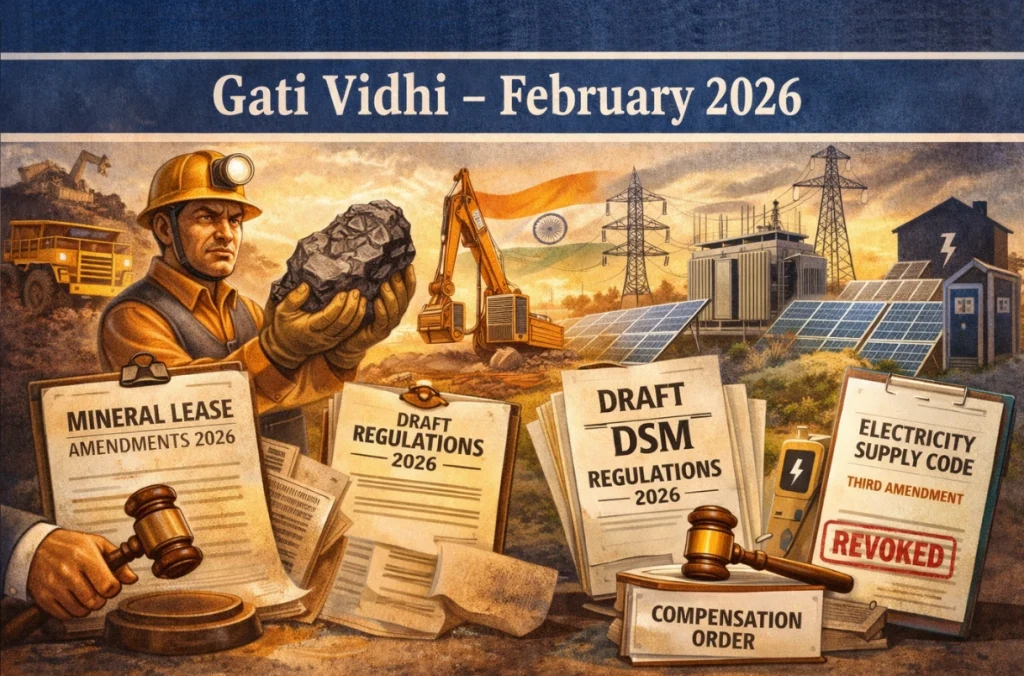
MoC issues notification for inclusion of Coking Coal as a Critical & Strategic Mineral under the MMDR Act
MoC has, vide notification dated 27.01.2026, made the following amendments to the First Schedule of the MMDR Act:
i. Part A, Item 1 – For the word “Coal”, the words “Coal, including Coking Coal” has been substituted.
ii. Part D, insertion of Item 3A – Coking Coal.
MoC has exercised its powers under Section 11C of the MMDR Act.
The amendment can be accessed here.
MoC issues the draft amendment to the Mineral Concession Rules, 1960
The Ministry of Coal (“MoC”), vide Notice bearing File No. PS1/1/2026-PS1 (FTS:65152) dated 22.01.2026, has issued the draft amendment to the Mineral Concession Rules, 1960 (“MCR 1960”). The amendment has been proposed in view of the insertion of Section 15B (5) in the Mines and Minerals (Development and Regulation) Act, 1957 (“MMDR Act”) in the year 2025.
Section 15B (5) provides that the inclusion of any mineral other than minor mineral in a lease granted in respect of a minor mineral shall be made in accordance with the conditions as may be prescribed for this purposed by the Central Government.
The following amendments have been proposed:
- Substitution of Rule 27(1)(a) – The discovery of any mineral in the lease area, which is not specified in the lease, shall be reported by the lessee to the State Government within a period of 6 months from the notification of the amendment or 60 days from the date of such discovery, whichever is later. The lessee shall not win and dispose of such discovered mineral until such mineral is included in the mining lease.
- Substitution of Rule 27(1)(b) – A mining lease holder may apply to the State Government for inclusion of any other mineral (including a minor mineral) in the mining lease. The Government shall permit inclusion within 60 days from the date of receipt of the application by issuance of an order. Thereafter, the new mineral shall be deemed to be included in the mining lease.
- First proviso to Rule 27(1)(b) – Where a mineral specified under Part A of the First Schedule of the Act is included in the mining lease of mineral other than mineral specified under Part A or where mineral other than mineral specified under Part A is included in the mining lease granted for mineral specified under Part A, the holder has to report the inclusion to the Central Government within 30 days from the date of inclusion.
- Second proviso to Rule 27(1)(b) – Provides for the conditions to be satisfied by the State Government for inclusion of mineral specified under Part A in a mining lease granted in respect of a mineral other than mineral specified under Part A.
- Third proviso to Rule 27(1)(b) – For inclusion of mineral not specified under Part A in a mining lease granted in respect of a mineral specified under Part A, the rules applicable upon such mineral to be included shall also apply, unless otherwise expressly provided.
- Insertion of Rule 66-B – Provides for the inclusion of mineral specified under Part A in mining lease granted in respect of a minor mineral. The Rule provides for the steps to be taken by the holder of a mining lease for minor mineral regarding reporting of the discovery of the mineral, application to the State Government for inclusion of such mineral in the mining lease and the factors to be satisfied by the State Government before granting of such area.
MoC has invited comments/suggestions from the general public, mining industry stakeholders etc. on the draft amendment within 15 days from the publication of this notice.
The draft amendment can be accessed here.
APTEL directs M.P. DISCOM to compensate for Unjust Enrichment for power supplied in the absence of LTOA
The Appellate Tribunal for Electricity (“APTEL”), vide its judgement dated 19.01.2026 in Appeal No. 375 of 2019 (JK Minerals v. Madhya Pradesh Electricity Regulatory Commission & Ors.) held the denial of Long-Term Open Access (“LTOA”) by the State Transmission and Distribution entities to JK Minerals as erroneous and further allowed compensation for unjust enrichment.
JK Minerals had preferred an appeal against the order dated 16.08.2019, passed by the Madhya Pradesh Electricity Regulatory Commission (“MPERC”) in Petition No. 22 of 2017 (“Impugned Order”), by which MPERC had allowed grant of LTOA, however rejected compensation for the losses suffered on account of the denial by the state transmission and distribution entities to JK Minerals. Before APTEL, JK Minerals sought for direction for the M.P. Paschim Kshyetra Vidyut Vitran Company Limited (“MPPKSVCL”), the Distribution Company to adjust units of power generated and injected by it into the grid from 22.08.2016 to 10.05.2018, the period during which the generator was injecting power despite rejection of its application seeking LTOA.
JK Minerals had entered into a power purchase agreement with Indore Treasure Islands Private Limited (“Treasure Islands”) for 100% third party sale of energy. The generator subsequently applied for LTOA, which was rejected by both, the M.P. Power Transmission Company Limited (“MPPTCL”), the State Transmission Utility and MPPKSVCL, in view of technical feasibility and network congestion. In the meantime, the generator commissioned its solar power plant and started injecting power into the grid.
The State Transmission and Distribution entities contended that permission to inject power was granted based on an undertaking by JK Minerals, by which it admitted injecting power free of cost, until Open Access was granted.
After examining the record, the Tribunal held that the injection of free power into the grid till grant of Open Access was a case of legitimate expectation, that LTOA would be granted in a stipulated time. The Tribunal held that the Distribution Company unduly benefitted from accepting the power injected, without desisting the supply in cognizance of the absence of approval, amounting to unjust enrichment. The Tribunal laid emphasis on Section 70 of the Indian Contract Act, 1872, holding that the distribution licensee accepted free supply against an undertaking that total power be drawn within the existing Contract Demand, which negated any objections raised by the Respondent for denial of the generator’s application, and yet accepting free supply.
Accordingly, the Tribunal allowed compensation for loss accrued to JK Minerals due to denial of LTOA, from the date MPERC granted the generator LTOA with another company until the date of the Impugned Order i.e., 15.09.2017 to 10.05.2018. The Tribunal further differentiated payment of “interest” or “carrying cost” from “penalty” or “fine” and held that where there is an order for restitution, the direction to pay interest must follow, allowing payment of interest to JK Minerals.
CERC holds that NTPC cannot withhold Change in Law compensation pending APDISCOMs’ reconciliation
CERC, vide its order dated 27.01.2026 in Petition No. 517/MP/2024, has observed that NTPC Limited is obligated to pay Change in Law compensation to Solairepro Urja Private Limited and cannot delay payment on the ground of pending reconciliation or non-receipt of funds from the Andhra Pradesh DISCOMs. The Commission noted that Solairepro’s entitlement to compensation on account of Safeguard Duty on imported solar modules had already been recognised in an earlier order. However, despite submission of all requisite documents, reconciliation and payment were not undertaken due to differences between NTPC and the DISCOMs.
The Commission rejected the objection raised by the DISCOMs relating to the AC/DC ratio, observing that installation of higher DC capacity to achieve the contracted AC output is a standard industry practice and is in line with MNRE guidelines and approvals of the local electrical authorities. CERC directed all parties to complete reconciliation within 30 days and ordered NTPC to release the reconciled amount along with late payment surcharge through supplementary invoices within 45 days. The Commission further held that in case of non-compliance, Solairepro would be at liberty to seek action under Section 142 of the Electricity Act, reinforcing the principle of timely compliance with regulatory orders and protection of developers’ rights under Change in Law provisions.
CERC holds that prolonged and wilful payment defaults justify revocation of trading licensee
The Central Electricity Regulatory Commission (“CERC”), vide order dated 21.01.2026 in Review Petition No. 9/RP/2025 in Petition No. 306/MP/2022, held that prolonged and wilful payment defaults by an electricity trader warrant regulatory action, including revocation of its inter-State trading licence. The Commission dismissed the review petition filed by Kreate Energy (India) Pvt. Ltd., refusing to interfere with its earlier decision initiating licence revocation proceedings. CERC rejected the trader’s claim that the show-cause notice issued in May 2025 suffered from errors of fact or law and clarified that pending disputes or recoverable dues from third parties do not excuse non-payment of admitted liabilities.
The Commission noted that Kreate Energy failed to clear dues payable to Uttarakhand Power Corporation Ltd. despite receiving full settlement from the Indian Energy Exchange (IEX). Post-dated cheques issued by the trader were dishonoured, and repeated opportunities to pay dues in instalments were not availed. CERC emphasized that electricity trading is a regulated activity requiring strict financial discipline, and that defaults undermine market confidence. While declining to grant relief, the Commission allowed Kreate Energy an additional 10 days to respond to the original show-cause notice, keeping the revocation proceedings alive and signalling a firm regulatory stance against payment indiscipline in the power trading sector.
RERC notifies the RERC (Electricity Supply Code and Connected Matters) (Third Amendment) Regulations, 2026
The Rajasthan Electricity Regulatory Commission (“RERC”) vide its order dated 21.01.2026 in Suo-motu petition No. 2374/2025 has notified the RERC (Electricity Supply Code and Connected Matters) (Third Amendment) Regulations, 2026, introducing a framework for dual source electricity supply to HT/EHT consumers, including data centres, PHED and other essential service providers.
The amendment originates from petitions filed by Rajasthan Discoms seeking approval to allow HT/EHT consumers to draw power from two independent sources, either simultaneously or with one source as standby, in order to enhance reliability and continuity of supply. During the proceedings, the Commission clarified that issues relating to tariff (including charging of fixed costs) would be dealt with separately, and the present amendment is confined strictly to changes in the Supply Code.
By way of the amendment, new Regulation 6.14 has been inserted in the Supply Code, 2021. The provision permits HT/EHT consumers to obtain electricity supply from two sources, subject to technical feasibility and compliance with safety regulations. Consumers are allowed flexibility to draw power from either source from zero up to their contracted demand. However, the entire cost towards extension of electric lines and installation of electric plant for both sources is to be borne by the consumer.
In addition, Schedule-I (Schedule of Charges) has been amended to provide that where a consumer opts for dual source supply whether for simultaneous use or as a standby arrangement double the plant cost shall be charged, reflecting the additional infrastructure required.
The Commission noted that similar dual source arrangements have been successfully implemented at large data centres such as NTT Data Centre, Mumbai and STT Global Data Centre, Noida, demonstrating technical feasibility and operational benefits. RERC observed that the amendment would significantly improve supply reliability for critical and essential services.
RERC (Electricity Supply Code and Connected Matters) (Third Amendment) Regulations, 2026 can be accessed here.
RERC issues draft RERC (Demand Flexibility (DF)/Demand Side Management (DSM) Regulations, 2026.
RERC issues draft RERC (Demand Flexibility (“DF”)/Demand Side Management (“DSM”) Regulations, 2026 (“Draft Regulations”). The Draft Regulations recognize that modern DSM must work on two complementary levels to be effective. The first fold focuses on load shifting and demand flexibility, which aims to defer or shift demand from high-cost peak periods to low-cost, low-demand periods, specifically the solar-rich hours. This active management would help the grid absorb excess renewable energy that might otherwise be wasted. The second fold remains rooted in energy efficiency, which focuses on reducing overall demand by increasing the efficiency of end-use appliances and industrial processes. Together, this two-fold approach would directly reduce the power procurement costs of discoms by minimizing the need for expensive peaking power.
The Draft Regulations provide for the role of distribution licensees such as to allocate funds to the DF/DSM cell, developing a robust DF/DSM portfolio structure on a rolling basis for the MYT/ARR period for the purpose of planning, conduct consumer outreach and awareness to inform consumers of DF/DSM programmes and encourage their participation etc. It also provides for the timelines for submission of DF/DSM portfolio and approvals. It further mentions that discom shall plan, design, and implement demand response programmes with the objective of reducing peak demand. Discom shall define participation criteria, baseline methodologies, event triggers, and incentive or penalty mechanisms, and ensure transparent measurement, verification, and settlement of demand response performance.
RERC in this regard has invited comments from the stakeholders and the last date for the submission of comments is 27.02.2026.
RERC Demand Side Management Regulations, 2026 can be accessed here.
TGERC has notified the TGERC (Terms and Conditions of Open Access) (First Amendment) Regulation, 2026
The Telangana Electricity Regulatory Commission (“TGERC”) has notified the TGERC (Terms and Conditions of Open Access) (First Amendment) Regulation, 2026 on 24.01.2026, whereby it has amended the TGERC (Terms and Conditions of Open Access) Regulation, 2024 (“2024 Regulation”). The amendment will come into force upon publication in the Telangana Gazette.
The amendment has been issued pursuant to a clarification issued by the National Load Despatch Centre (NLDC) and in alignment with the CERC Procedure for Implementation of the REC Mechanism, 2024, to address the treatment of unutilised banked energy under the Green Energy Open Access (“GEOA”) framework.
The revised provision clarifies that Renewable Energy Generating Stations shall be entitled to Renewable Energy Certificates (“REC”) corresponding to the unutilised banked quantum of energy, correcting the earlier position which linked REC issuance only to GEOA consumers. Further, Clause 14.11 of the 2024 Regulation has been modified to provide that any energy injected into the licensee’s network between the date of grant of GEOA and the date of submission of the wheeling agreement shall be treated as inadvertent power, with no entitlement to energy charges for such injection.
The Regulations can be accessed here.
TGERC has notified the TGERC (Licensee’s Duty for Supply of Electricity on Request) (Second Amendment) Regulation, 2026
The TGERC has notified the TGERC (Licensee’s Duty for Supply of Electricity on Request) (Second Amendment) Regulation, 2026 on 17.01.2026 further amending the APERC (Licensee’s Duty for Supply of Electricity on Request) Regulation, 2013 (“2013 Regulation”), which was adopted by TGERC. The First Amendment was notified on 20.01.2015. The amendment will come into force upon publication in the Telangana Gazette.
The Second Amendment has introduced a uniform and load-based Service Line Charges framework for new Low Tension (“LT”) connections and Additional Load under LT categories within a 1 km radius of the existing electrified network, in place of a case-by-case estimation. The charges are specified category-wise for LT consumers i.e., Domestic (LT-I), Commercial (LT-II), Industries (LT-III), Cottage Industries (LT-IV), Agriculture (LT-V), Street Lights and PWS Schemes (LT-VI), General (LT-VII) and Electric Vehicle Charging Stations (LT-IX), with slab-based rates linked to the contracted load. For apartments, commercial complexes, and multi-storied buildings, the combined contracted load will be considered for levy of charges.
The Second Amendment further provides that the Distribution Licensee shall supply, erect and maintain the Distribution Transformer for LT connections covered under the new provision, without charging its cost. It also revises the treatment of Dedicated Transformers for larger LT loads in apartments and commercial complexes, clarifying when Development Charges may or may not be levied.
The Regulations can be accessed here.
 You wish to know more about Neeti Niyaman (the “Firm”) for your own information and use.