When TV Studios become Courtrooms: Judicial response to Media Trials in India
By – Devank Maheshwari and Kaushiki
Table of Contents
Introduction: Media’s Democratic Role and Its Drift Toward Sensationalism
In a constitutional democracy like India, the media is often hailed as the fourth pillar of democracy and an indispensable watchdog that informs the public, exposes wrongdoing, and ensures accountability. However, in recent years, the Indian media landscape has witnessed a dramatic transformation. What was once a pursuit of truth and fairness has, in many instances, been replaced by sensationalism, speculation, and instant verdicts.
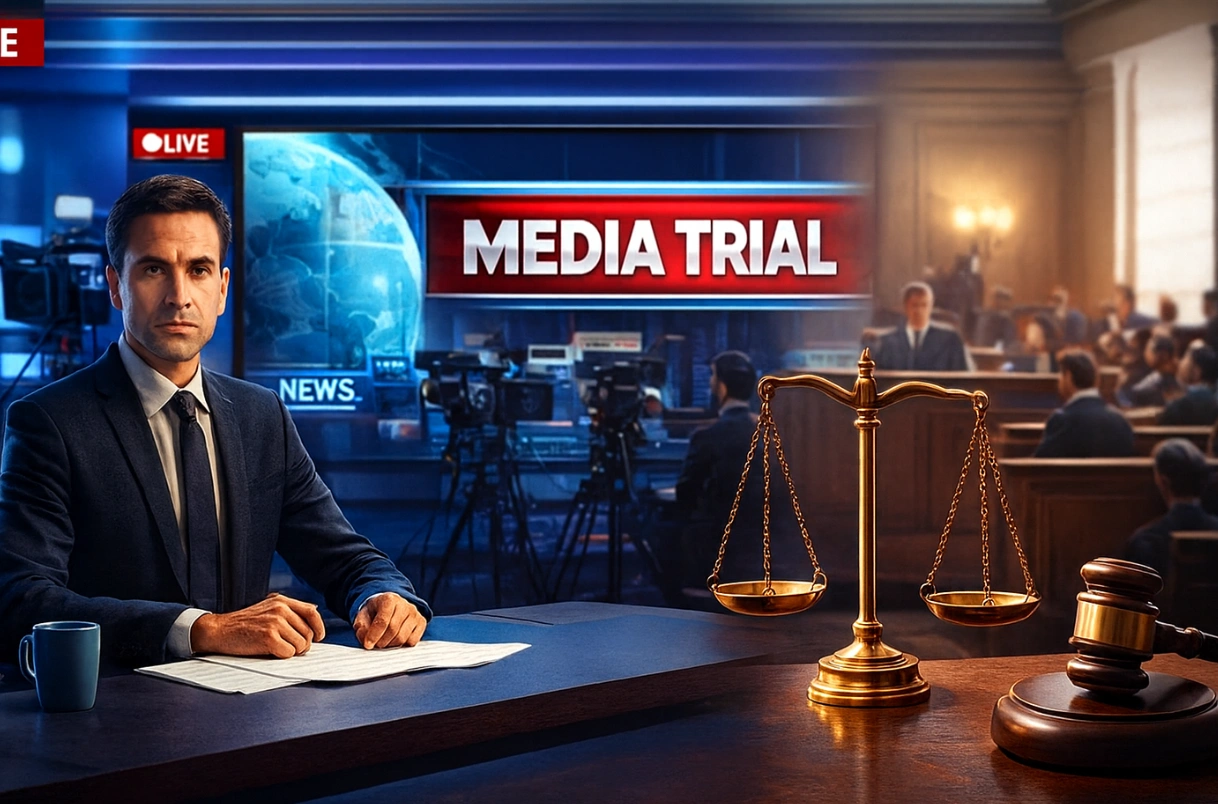
Television studios today often resemble courtrooms, where prime – time anchors assume the roles of prosecutor, judge, and sometimes even executioner. Public opinion is shaped, and verdicts are pronounced, long before a court of law has had its say. This phenomenon, commonly referred to as a ‘media trial’ arises when news coverage extends beyond factual reporting to influence perceptions of guilt or innocence effectively prejudging ongoing cases and undermining the judicial process.
The Constitutional Dilemma: Free Speech vs Fair Trial
Together, these cases of Media Trials in India expose a deeper fundamental constitutional dilemma: how to balance the freedom of speech and expression guaranteed under Article 19(1)(a) with the right to a fair trial enshrined under Article 21. A free press is vital for ensuring transparency and accountability, yet unrestrained commentary on sub judice matters threatens to erode judicial impartiality and infringe upon the accused’s right to due process. The challenge, therefore, is not to restrict media freedom but to ensure that it operates within the bounds of fairness, responsibility, and respect for the judicial process preserving both the vibrancy of free expression and the sanctity of justice.
Landmark Indian Cases Shaped by Media Trials
There have been a number of famous cases of media trial in India. One of the earliest examples is the K.M. Nanavati case (1959), where extensive newspaper coverage influenced the jury trial, prompting the Bombay High Court to intervene. In the Jessica Lal murder case (1999) and the Priyadarshini Mattoo case (1996), media outrage after initial acquittals helped reignite public and legal scrutiny, eventually leading to convictions. However, the Aarushi Talwar double murder case (2008) exposed the darker side of media sensationalism, as the parents of the victim were vilified without conclusive evidence, a position later overturned by the Allahabad High Court. Similarly, the Sushant Singh Rajput case (2020) saw rampant speculation, leaked information, and vilification of individuals, prompting judicial censure and discussions on regulatory reform. These cases reveal how media trials can both spotlight injustice and compromise due process, raising urgent concerns about press responsibility in a democracy.
Constitutional Framework Governing Media Conduct
The phenomenon of media trials in India exists at the intersection of two fundamental and often competing constitutional principles: the freedom of speech and expression and the right to a fair trial. The former, guaranteed under Article 19(1)(a) of the Constitution, is one of the cornerstones of Indian democracy, ensuring that the press can operate independently, scrutinize power, and inform citizens without undue interference. A free and vibrant media serves as the fourth pillar of democracy, playing a crucial role in holding the government, law enforcement agencies, and public institutions accountable.
Legal and Constitutional dimensions
However, this freedom is not without limits. Article 19(2) provides for reasonable restrictions on speech in the interests of sovereignty, public order, decency, morality, and, importantly, the administration of justice. Equally essential is Article 21, which guarantees the right to life and personal liberty. Over the years, the judiciary has interpreted this provision expansively to include the right to a fair trial and protection of dignity. In the context of media trials, Article 21 also becomes relevant as unrestrained reporting can irreversibly harm an individual’s personal and professional life, even before a court has examined the evidence.
To protect these principles, Indian law provides various mechanisms to check the overreach of the media. It is pertinent to note that India does not have any specific law dealing with media trial. Instead, a patchwork of constitutional provisions, contempt laws, guidelines, and self-regulatory bodies address the issue.
Contempt of Court: The First Line of Control
The Contempt of Courts Act, 1971 empowers courts to take action against publications that scandalize or lower the authority of the court or that prejudice or interfere with judicial proceedings. Under Section 2(c), any publication that risks obstructing the administration of justice or influences judicial outcomes may constitute criminal contempt. However, Section 3(2) provides that publications are immune from contempt if no proceeding is actively pending, i.e., before a chargesheet is filed or cognizance is taken. The implication is that media commentary before a case formally reaches court, such as during initial police investigation, is largely exempt from contempt.
Further, the introduction of the Bharatiya Nyaya Sanhita (“BNS”), new legal perspectives have developed regarding media accountability. Provisions such as Section 356 (defamation) and Section 77 (obstruction of justice) can be invoked to address instances where media reporting harms an individual’s reputation or interferes with ongoing legal proceedings.
Self-Regulation: PCI Norms and Their Limitations
Furthermore, the Press Council of India (“PCI”) has issued Norms of Journalistic Conduct, 2022 which include guidelines to avoid sensational or one-sided reporting of criminal cases. For example, the norms urge newspapers to exercise restraint in publishing details that could jeopardize a fair trial and to refrain from running parallel trials or presuming guilt. It is important to note that PCI can entertain complaints and censure or warn a newspaper if it finds ethical violations. However, the PCI’s powers are limited as it cannot impose fines or stop publication, and its reprimands have only moral force. Moreover, PCI’s remit is only over the print media, and it has no jurisdiction over television or digital news.
Regulation of Television Media Under the Cable TV Act
Apart from the above, the television news falls under the Cable Television Networks (Regulation) Act, 1995 and the accompanying Cable Television Network Rules, 1994. Rule 6 of the Cable Television Network Rules lays down content standards that TV broadcasts must adhere to. Notably, it prohibits airing content that “contains anything obscene, defamatory, deliberate, false and suggestive innuendos” or “anything amounting to contempt of court” or that “criticises, maligns or slanders any individual”, etc.
Judicial Intervention and Postponement Orders
In practice, maintaining the equilibrium between media freedom and judicial integrity remains a constant challenge. Courts have frequently had to intervene to restrict prejudicial reporting in high – profile cases, issuing postponement orders or restraining media coverage that could influence ongoing trials. Such measures highlight the judiciary’s role as the ultimate guardian of fairness, ensuring that freedom of expression does not become a weapon that tips the scales of justice. The constitutional and legal dimensions of media trials, therefore, underscore an essential truth: a democracy cannot function properly if public opinion, shaped by sensational reporting, eclipses the impartial processes of the law.
Judicial Precedents on Balancing Press Freedom and Fair Trial
Freedom of Press Jurisprudence: Express Newspapers Line of Cases
The issue of media trial gets vexed right at the intersection of right to speech and right to fair trial. The position of the Supreme Court vis-à-vis press freedom is well documented. In Express Newspapers (Private) Ltd. & Anr. v. The Union of India & Ors. [1959 S.C.R. 12], the Supreme Court, while referring to its earlier decisions in Romesh Thappar v. State of Madras [AIR 1950 SC 124] and Brij Bhushan v. State of Delhi [AIR 1950 SC 129] held that freedom of speech and expression includes within its scope the freedom of the press. It was further held that the freedom of speech and expression includes freedom of propagation of ideas which freedom is ensured by the freedom of circulation and that the liberty of the press is an essential part of the right to freedom of speech and expression and that the liberty of the press consists in allowing no previous restraint upon publication.
It is, however, to be noted that free speech and by implication, the freedom of press, is not absolute. In Express Newspapers Pvt. Ltd. & Ors v. Union Of India [AIR 1986 SC 872], the Supreme Court emphasized that though the freedom of press is an inalienable right, but the same is not absolute and is subject to the restrictions contained in Art. 19(2). That must be so because unrestricted freedom of speech and expression which includes the freedom of the press and is wholly free from restraints, amounts to uncontrolled licence which would lead to disorder and anarchy, and it would be hazardous to ignore the vital importance of our social and national interest in public order and security of the State.
Trial by Media: R.K. Anand v. Registrar (2009)
Over the years, the Indian judiciary has repeatedly confronted the phenomenon of media trials, articulating a clear and consistent stance: while the press enjoys constitutional protection, its freedom is not absolute and must not compromise the fairness of judicial proceedings.
The Supreme Court acknowledged this tension in R.K. Anand v. Registrar, Delhi High Court [(2009) 8 SCC 106]. It noted that a concurrent media trial has no legal standing in our system because it creates a conflict between Article 19(1)(a) and Article 21, i.e., between free speech and the right to a fair trial. Pertinently, it addressed the issue of ‘what is media trial’ and observed it to mean “the impact of television and newspaper coverage on a person’s reputation by creating a widespread perception of guilt regardless of any verdict in a court of law. During high publicity court cases, the media are often accused of provoking an atmosphere of public hysteria akin to a lynch mob which not only makes a fair trial nearly impossible but means that, regardless of the result of the trial, in public perception the accused is already held guilty and would not be able to live the rest of their life without intense public scrutiny”.
However, in the said judgment, the Supreme Court significantly upheld journalistic efforts to expose truth (as long as they do not prejudice the trial), while reiterating that trial by media has no place when a matter is sub judice.
Postponement Orders: Sahara India (2012)
One of the most important judgments is Sahara India Real Estate Corporation Limited and Others v. Securities and Exchange Board of India & Another [(2012) 10 SCC 603] (“Sahara”) wherein the Supreme Court has laid down principles governing the passing of the prior restraint order against the publication in some exceptional cases and discussed in detailed the exceptions involved. Another significant judgment is the case of Reliance Petrochemicals Ltd v. Proprietors Of Indian Express, [(1988) 4 SCC 592] wherein the Supreme Court had laid down the test governing the grant of the prohibitory orders against the publication in the context of interference with the administration of justice wherein there is a real and imminent danger of the same.
Pertinently, in the case of Sahara, the Supreme Court introduced the concept of postponement orders as a tool to balance Article 19(1)(a) and Article 21. A postponement order means that a court can temporarily defer media reporting on certain aspects of a case (e.g. evidence, witness testimony etc.) until a later stage, to prevent prejudice to the accused’s fair trial rights. The Court reasoned that such deferred publication orders are a neutralizing device in the form of a narrowly tailored restriction that delays reporting rather than completely prohibiting it.
It is to be noted that the above mechanism devised by the Supreme Court in Sahara can be seen as less drastic than blanket prior restraint and preferable to punishing the media after the fact. The Sahara judgment made it clear that media freedom is vital, but it must not prejudice ongoing legal proceedings. More importantly, Sahara solidified the legal position that courts have inherent power to regulate media coverage in extreme cases to protect the right to a fair trial. It also underscored that this power should be used sparingly and only when necessary to prevent serious prejudice.
Protection Against Investigative Leaks: Rajendran Chingaravelu
Another significant judgment in this context is Rajendran Chingaravelu v. RK Mishra [Civil Appeal No. 7914 of 2009] that deals with the complicity of public officials in leaking sensitive information to the media. In the said case, the Supreme Court came down heavily on the growing tendency among investigating officers (either police or other departments) to inform the media, even before the completion of investigation, that they have caught a criminal or an offender. It was observed that such crude attempts to claim credit for imaginary investigational breakthroughs should be curbed. It was observed that premature disclosures or `leakage’ to the media in a pending investigation will not only jeopardise and impede further investigation, but many a time, allow the real culprit to escape from law.
Therefore, the above judgment deals with the idea that media trials are not always initiated by news outlets alone and sometimes authorities contribute by selectively leaking information. The Supreme Court’s remarks condemned this practice, as it manipulates public discourse and jeopardizes the accused’s right to an impartial investigation and trial. In effect, the Supreme Court extended the media trial critique to the pre-trial stage to state that investigators must not conduct trials through media.
Guidelines from High Courts: Ethical Boundaries for Media Reporting
Apart from the above, the Bombay High Court has issued normative guidelines on the conduct of media in such circumstances. The Bombay High Court in Nilesh Navlakha v. Onion of India [2021 SCC OnLine Bom 56] noted that that the press/media ought to avoid/ regulate certain reports /discussions /debates/ interviews in respect of and/or touching upon any on-going inquiry/investigation into a criminal offence and that only those items are presented for reading/viewing and otherwise perceiving through the senses which are merely informative but in public interest instead of what, according to the media, the public is interested in. No report/discussion/debate/interview should be presented by the press/media which could harm the interests of the accused being investigated or a witness in the case or any such person who may be relevant for any investigation, with a view to satiate the thirst of stealing a march over competitors in the field of reporting. Accordingly, the High Court issued the following indicative directions:
- Presumption of innocence: media must not portray an accused as guilty before conviction.
- No publication of confessions: alleged confessions to police should not be broadcast or printed.
- No crime scene reconstructions: re-enactments or dramatizations of alleged crimes are impermissible.
- No interviews of witnesses: media should not interview or coerce witnesses in sub judice matters.
- No bias in reporting: avoid one-sided narratives or campaigns that advocate for conviction/acquittal.
- Avoid infringement of privacy: especially in cases involving celebrities or sensitive matters.
- Cable TV Code enforcement: The Programme Code under the Cable TV Act must be strictly followed.
- The I&B Ministry must take prompt action against channels violating these norms.
Conclusion: Toward a Balanced Framework for Media Freedom and Judicial Fairness
The evolution of media trials in India reflects the growing tension between a robust free press and the sanctity of due process within the wider debate on the impacts of media on society. While the media plays a pivotal role in bringing transparency and ensuring that justice is not derailed by systemic failures, its overreach, particularly in criminal cases, can distort the presumption of innocence, derail investigations, and influence judicial outcomes. As courts have repeatedly emphasized, the line between responsible journalism and judicial interference must be drawn carefully to preserve both democratic accountability and legal fairness. Moving forward, striking a balance between Article 19(1)(a) and Article 21 is essential. This demands a collaborative framework involving the judiciary, the legislature, media regulators, and civil society. Legal mechanisms such as postponement orders, clearer contempt provisions, and strict enforcement of ethical codes must be combined with internal reforms within the media industry.
FAQs
-
What is a “media trial,” and how is it different from regular news reporting?
A media trial arises when news coverage shifts from factual reporting to shaping public perception about an accused person’s guilt or innocence. Instead of confining itself to verified information, the media begins presenting speculative narratives, leaked details, opinion-driven debates, and dramatic portrayals that function like an informal courtroom. Unlike conventional journalism, which respects due process, a media trial often prejudges a case, influencing public sentiment before courts have examined the evidence.
-
What are the effects of media trials on public opinion in India?
Media trials can heavily influence public opinion, especially in high-profile cases. Sensational coverage can create an impression of guilt irrespective of legal findings, leading to serious reputational and personal consequences for individuals involved. This environment may place undue pressure on investigators and courts, distort public understanding of the legal process, and erode confidence in judicial neutrality. While media scrutiny can expose systemic failures, unchecked commentary risks undermining the right to a fair trial.
-
What has the Indian judiciary said about media trials?
The judiciary has consistently warned against the dangers posed by media trials. Courts have held that while press freedom under Article 19(1)(a) is vital, it cannot override the right to a fair trial under Article 21. In cases such as R.K. Anand v. Registrar, Delhi High Court and Sahara India Real Estate Corporation Ltd. v. SEBI, the Supreme Court highlighted that prejudicial reporting can interfere with the administration of justice. The Court has also recognized its authority to regulate or postpone media reporting to safeguard judicial proceedings.
-
Can courts restrict media reporting during high-profile cases?
Yes. Courts can impose narrowly tailored restrictions to prevent media coverage that risks prejudicing an ongoing case. The Supreme Court in Sahara upheld the use of postponement orders, which temporarily defer the publication of sensitive information to protect fair trial rights. Such restrictions fall within the scope of reasonable limits under Article 19(2) and are used sparingly, only when essential to preserve the integrity of judicial proceedings.
-
How do Indian news channels influence public opinion in high-profile legal cases?
Indian news channels often adopt formats that amplify drama, including panel debates, reenactments, leaked investigation details, and emotionally charged commentary. This style of reporting can shape public opinion long before courts assess the evidence. In several cases, courts have observed that such coverage fosters a climate of prejudice and can create an environment that resembles a parallel trial, potentially affecting the fairness of ongoing investigations and judicial decision-making.


 You wish to know more about Neeti Niyaman (the “Firm”) for your own information and use.